
News
Lanka can’t afford fossil fuels but can’t afford to get off them either

(climatechangenews)
Sri Lanka is in turmoil, with fuel and food shortages provoking citizens to storm the presidential palace and send Gotobaya Rajapaksa packing.Reliance on fossil fuel imports is a big factor in the economic crisis. Fuel prices spiking while tourism stayed in the doldrums led to the country running out of foreign currency, not helped by chronic fiscal mismanagement.
That same economic crisis is now making it harder than ever for Sri Lanka to develop a renewable industry, energy experts and business owners say.On 31 March, protesters marched on president Gotabaya Rajapaksa’s private residence. Things escalated until on 9 July, they stormed the presidential palace, prompting Rajapaksa to resign and flee to Singapore. He appointed an ally, Ranil Wickremesinghe, as his successor and this week a Sri Lankan official said Rajapaksa himself would return to the country, dampening hopes of substantive political change.
Sri Lanka’s economic crisis stems from consistently importing more than it exports. As the country pays in foreign currency (largely US dollars) for imports and sells in foreign currency for exports, its central bank’s foreign currency reserves have been depleting.The government didn’t have enough Sri Lankan rupees to pay for imports so prices of products, including essentials like food and fuel, shot up.
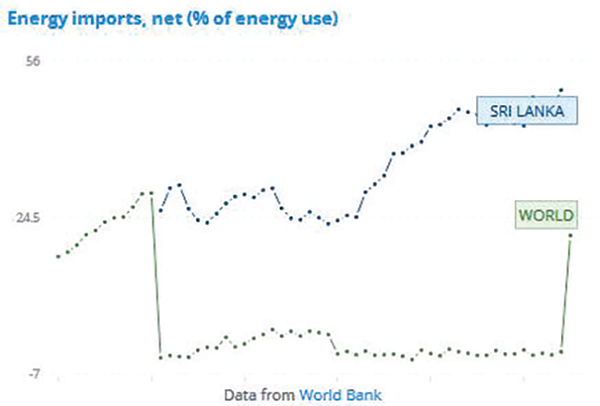
Between 1990 and 2000, Sri Lanka’s net energy imports as a percentage of total energy use doubled from 20% to 40% and has stayed around the same ever since. In 2021, the country spent $3.7bn on imports of oil and coal. Sri Lanka has no significant fossil fuel reserves. It does, according to the World Bank, have good potential for solar and wind power. Yet it has failed to develop either technology. It gets around a third of its electricity from imported oil, a third from imported coal and a third from domestic hydropower.
Lankan journalist Rathindra Kuruwita said this failure to develop renewables was largely the fault of the island’s state-owned monopoly utility provider, the Ceylon Electricity Board.
“Most of the engineers are in cahoots with the power plant mafia,” he said. This “mafia” is not an organised crime mob, but a network of people with a vested interest in fossil fuels: power plant operators, diesel distributors and coal importers.
The Sri Lanka Sustainable Energy Authority has also been slow in approving licenses for renewable projects, he said. If those projects had been approved, Kuruwita added, “we wouldn’t be in this mess”.
When an electrical engineer named Champika Ranawaka became energy minister in 2015, he tried to reform the CEB, Kuruwita said. He lasted eight months in the role.Now the country has run out of foreign currency to import the amount of fossil fuels its infrastructure needs. There are shortages of electricity, of cooking gas and of fuel for vehicles and for the diesel generators used as back-up power.
Before terrorist attacks in 2019 and the coronavirus pandemic, tourism provided 6% of Sri Lanka’s GDP. There were hopes it would rebound this year and bring in much needed foreign currency.But Nimesh, who works in the Atha resort in central Sri Lanka, told Climate Home that tourists are finding it hard to find vehicles to transport them as drivers are having to queue for days to get fuel.On top of that, small hotels and restaurants are suffering from power cuts. Larger hotels have generators but are finding it difficult to find fuel for them.
“These power cuts and fuel shortages are really affecting the tourism industry,” he said.
Lien Wysmans runs a backpackers’ hostel on Arugam Bay beach in the island’s east. She told Climate Home: “There are power cuts as well of about four or five hours a day… I’m freaking out”.
Although Wysmans says her guests don’t mind the power cuts, others are less tolerant. A March 2022 review for a beachfront Airbnb gives one star, citing “power cut- not their fault but created problem for us” among the reasons.A Financial Times reporter who visited the country recently said: “Anyone considering a trip to Sri Lanka this year or next also faces a difficult choice. Avoid the country entirely and the risk of a severely impacted and unexpectedly expensive trip, or support a vulnerable economy unduly impacted by the pandemic and poor management.”
Electric vehicles (with enough electricity) and rooftop solar panels would solve many of the tourist industry’s problems. But rolling them out requires money which most Sri Lankan citizens and their government don’t have.
Wysmans said solar panels “would be definitely a very good solution”. She can’t install them as she is renting the property but, even if she owned it, she said that the return on investment is 25 years. “It’s economically not beneficial for anybody because it’s just too expensive,” she said. “Also, the government is not really supporting.”
Nimesh said: “Solar panels are a great solution but the problem is government can’t afford to give financial support to invest in these projects due to the critical financial crisis that our country is facing”.
There are international schemes to help, like a Asian Development Bank funded scheme to provide low-interest loans for rooftop solar power. But these are on a small scale.
Speaking from her native Belgium, Wysmans said: “Sri Lanka has a really great opportunity for being a self-sustainable renewable energy island but the corruption is stopping all of it.”
“They’ve got the sun, they’ve got the water, they’ve got the wind, they just need to do it,” she added, “but if you have a corrupt government who wants to bring oil in where they can put half the money in their own pocket, it’s never going to happen.”
The Sustainable Energy Authority did not reply to a request for comment.


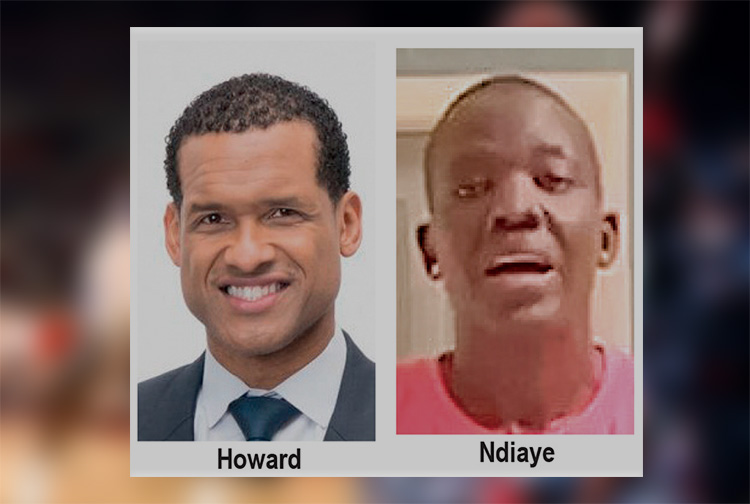
The U.S. Embassy in Colombo welcomed the U.S. Sports Envoys to Sri Lanka, former National Basketball Association (NBA) and Women’s National Basketball Association (WNBA) players Stephen Howard and Astou Ndiaye, from June 8 through 14.
The Public Diplomacy section of the U.S. Embassy said that it would launch a weeklong basketball program intended to harness the unifying power of sports, made possible through collaboration with Foundation of Goodness and IImpact Hoop Lab.
While in Sri Lanka, Howard and Ndiaye, both retired professional basketball players, will conduct a weeklong program, Hoops for Hope: Bridging Borders through Basketball. The Sports Envoys will lead basketball clinics and exhibition matches and engage in leadership sessions in Colombo and Southern Province for youth aged 14-18 from Northern, Uva, Eastern and Western Provinces, offering skills and leadership training both on and off the court. The U.S. Envoys will also share their expertise with the Sri Lanka Basketball Federation, national coaches, and players, furthering the development of basketball in the country. Beyond the clinics, they will collaborate with Sri Lankan schoolchildren to take part in a community service project in the Colombo area.
“We are so proud to welcome Stephen and Astou as our Sports Envoys to Sri Lanka, to build on the strong people-to-people connections between the United States and Sri Lanka,” said U.S. Ambassador Julie Chung. “The lessons that will be shared by our Sports Envoys – communication, teamwork, resilience, inclusion, and conflict resolution – are essential for leadership development, community building, equality, and peace. The U.S. Sports Envoy program is a testament to our belief that sports can be a powerful tool in promoting peace and unity.”
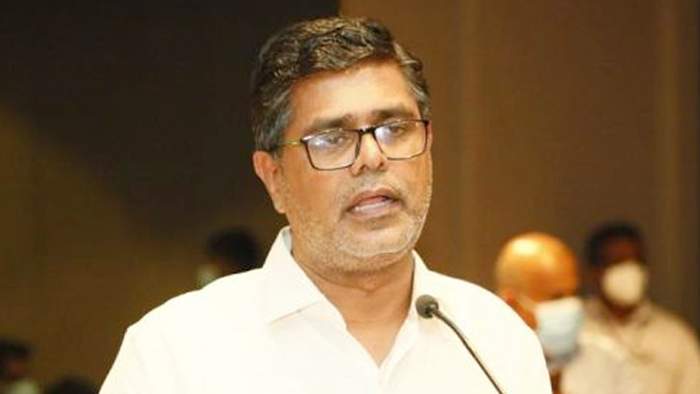
SJB Colombo District MP Mujibur Rahuman in parliament demanded to know from the government the reasons for CEB suspending the leave of all its employees until further notice from Thursday.
MP Rahuman said that the CEB has got an acting General Manager anew and the latter yesterday morning issued a circular suspending leave of all CEB employees with immediate effect until further notice.
“We demand that Minister Kanchana Wijesekera should explain this to the House. This circular was issued while this debate on the new Electricity Amendment Bill was pending. There are many who oppose this Bill. The Minister must tell parliament the reason for the urge to cancel the leave of CEB employees,” the MP said.However, Speaker Mahinda Yapa Abeywardena prevented Minister Wijesekera responding to the query and said that the matter raised by MP Rahuman was not relevant.
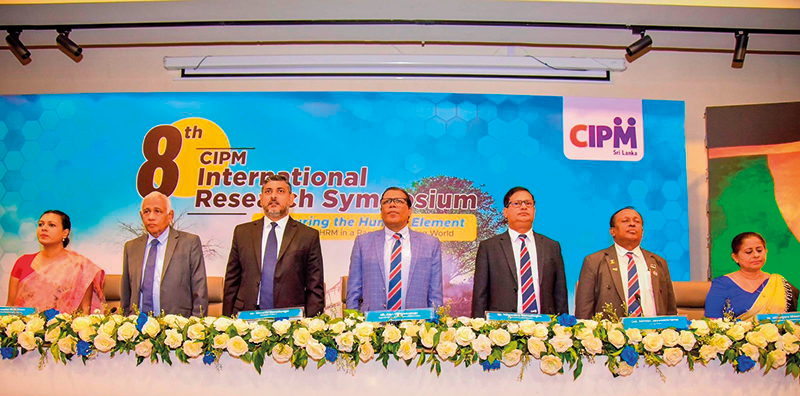
The Chartered Institute of Personnel Management (CIPM) successfully concluded the 8th Annual CIPM Symposium, which took place on 31st May 2024. Themed “Nurturing the Human Element—Redefining HRM in a Rapidly Changing World,” the symposium underscored the pivotal role of human resource management (HRM) in today’s dynamic global landscape. Since its inception in 1959, CIPM has been dedicated to advancing the HR profession through education, professional development, and advocacy, solidifying its position as Sri Lanka’s leading professional body for HRM.
Ken Vijayakumar, the President of the CIPM, graced the occasion as the chief guest. The symposium commenced with the welcome address by the Chairperson, Prof. Arosha Adikaram, followed by the Web Launch of the Symposium Proceedings and Abstract Book by the CIPM President. The event featured distinguished addresses, including a speech by Chief Guest Ken Vijayakumar, President of CIPM, and an address by Guest of Honor Shakthi Ranatunga, Chief Operating Officer of MAS Holdings Pvt. Ltd., Sri Lanka.
The symposium also featured an inspiring keynote address by Prof. Mario Fernando, Professor of Management and Director of the Centre for Cross Cultural Management (CCCM) at the University of Wollongong, Australia.
Vote of Thanks of the inauguration session was delivered by Dr. Dillanjani Weeratunga, Symposium Co-chair.
The symposium served as a comprehensive platform for researchers to present their findings across a wide range of critical topics in HRM. These included Cultural Diversity and Inclusion, Talent Development and Retention, Ethical Leadership and Corporate Social Responsibility, Adapting to Technological Advancements, Mental Health and Well-being at Work, Global Workforce Challenges, Employee Empowerment, and Reskilling and Upskilling.
The plenary session was led by Prof. Wasantha Rajapakse. Certificates were awarded to the best paper presenters during the valedictory session, followed by a vote of thanks delivered by Kamani Perera, Manager of Research and Development.
The annual symposium of CIPM was a truly inclusive event, attracting a diverse audience that spanned undergraduates, graduates, working professionals, research scholars and lecturers. This widespread interest highlights the symposium’s significance in the field of HRM, offering a unique opportunity for everyone to network and learn from scholarly brains.The CIPM International Research Symposium was sponsored by Hambantota International Port, Sri Lanka Institute of Information Technology (SLIIT), E B Creasy & Co. PLC, and Print Xcel Company.



US sports envoys to Lanka to champion youth development

Rahuman questions sudden cancellation of leave of CEB employees


