Features
Kohomba Kankariya, the sociology of a Kandyan ritual

Kohomba kankariya, the sociology of a Kandyan ritual,
by Sarath Amunugama
(Yapa Publications, Colombo, 2021).
Reviewed by Usvatte-aratchi
‘What we have described in this book are the halcyon days of Kandyan dancing….. ’ Amunugama.
Sarath Amunugama has put out a new book and it is on the Kohomba Kankariya. This is the first book on the subject that I read, although there are three others in Sinhala in my collection. Two of them are collections of kavi and other statements in the ritual. None of them describes the performance of a kankariya in detail, as Amunugama does.
Of them, the book that comes close to Amunugama’s concerns is that by Mudiyanse Dissanayaka, an accomplished artist and teacher (one time professor at the University of the Visual Arts in Colombo) of dancing. Dissanayake in the last chapter of his book deals with some concerns relevant to Amunugama’s subject matter: the sociology of the ritual. Amunugama’s Kohomba Kankariya is the first full length treatment of the subject. That is in contrast to the extensive attention paid to healing rituals in the southern coastal belt, by scholars, both local and foreign.
I am personally familiar with actual performances of sooniyama, sanni yakuma and rata yakuma, having seen them when I was a child and never forgot. I have never seen a kohomba kankariya live or on record. Amunugama writes a fine account of a kankariya which was performed in Rangamuwa, in 2015 in a village near his parents’ home. He himself was the prime mover organizing it. He also noted the distinction that other forms of dancing (panther, udakki, raban) in and around Kandy and were undertaken by high caste persons. After all he is ‘Kandy Man’. That itself makes reviewing this book difficult. It is partly personal and mostly professional. I shall try, nevertheless.

The reader would enjoy the systematic presentation of the kankariya. Here, I will offer a few comments on the sociology of it, well aware that I, no sociologist, dare to comment on the writings of a most brilliant student of the subject in the country. Amunugama has an ambitious plan in this essay: ‘ …. what I am attempting here is to prepare a schematic ‘frame’ into which all or most rituals can be incorporated. …….all local healing rituals have the same basic format…’. While the schemata that Amunugama presents is mostly complete, he misses a very substantial part of the of suniyama.
For several hours in the early hours of the following morning, yakdessa conduct various acts to remove all evil influences afflicting the aturaya. These include puhul kapima (cutting a cucumber), cutting tholabo (a kind of yam), dehi (lime) kapima, valalu kapima (the patient is put in a sort of cage made of cane and the cane is cut to set him/her free), symbolically removing all that afflicts him. Sirasa pada kavi comes in here. Finally, the whole atamagale, made of banana tree skins and gokkola (young coconut fronds’) in which the aturaya sat all night, is cut down. All this is furious activity with several yaddessa wielding knives is entirely exciting. It may be useful to consider that. Amunugama successfully analyses the kankariya in terms of this schemata.
I found the second essay the most engaging. Its subtitle is ‘from cosmic drama to street and stage spectacle’ announces to us the processes he analyses. The personages who facilitated that transfer of whom Amunugama writes are of equal interest, because those personages and dancers belonged in different worlds. But yesterday, ves natum was in kohomba kankariya in villages in kande uda rata. Today, corona permitting, we sit in the comfort of the balcony of the Queen’s Hotel and watch ves netum and sit in the Lionel Wendt and watch Chitrasena’s ‘karadiya’ or Ravi Bandhu lead a drum ensemble. Ves dancers play before potentates in Colombo or conduct a bride and bridegroom to the poruva in Guruva pattu far distant from Harispattu. How did that shift take place? What social forces enabled that change? Who were the agents who activated the process? Those are questions to which Amunugama provides answers, probably never final.
The kankariya and ves netum were performed by men of the berava caste, low in esteem in the hierarchy. Like almost all ritual healers among the Sinhala, these ritualists tilled some land from which they derived a meager income, which they supplemented from performing rituals. To dance before Europeans, to dance before royalty (Edward, the Prince of Wales) and before the Governor were some sort of manumission. When they travelled to Europe and US in late 19th century, and early 20th century as performers in circuses they not only earned some money but also stood in altered relations to their foreign employers.
For the Europeans, these dancers were exotic people from strange lands. From the beginning of the 16th century, when the Portuguese ventured south along the eastern coast of Africa, never far beyond to lose sight of land and went inland along Sierra Leone rivers they came across people quite unlike themselves and with manners and customs utterly foreign to them. The sailors came home and spoke of those wonders and exaggerated the unusual features so much so that there were stories of men from whose head trees grew. Gulliver’s Travels is an outcome from these fanciful stories.
Kings kept zoos of animals from tropical lands and humans who were different from themselves. Vimala Dharma Suriya I, when he became king in maha nuvara repeated this experience which he had witnessed in Lisbon. In 1917, P.B. Nugawela, a high caste potentate brought ves natum to the dalada perahera. Writes Amunugama, ‘…..the yakdessas…. had to be brought in as Sinhala society began to emerge from its feudal straitjacket’. The Ceylon National Congress, a political organization looking for identifying itself with national culture began to espouse Kandyan dancing.
In the 1930s, Western educated aesthetes in Colombo, the 43 Group led by George Keyt, ‘discovered’ these dancers and dances. Their photographs were published in Europe. The dancers appeared in exhibitions in Europe. The dancers ‘….(moved) away from the Kankariya to enter the global stage as dance performers and drummers’. ‘Nittawela Gunaya, the finest exponent of the Kandyan dance on stage…. was not interested in the Kankariya ritual’. The same could be said of Sri Jayana. Those processes need further analysis.
A high official in the department of education in the late 1930s, S.L.B Sapukotana, was enthusiastic about teaching Kandyan dancing in all schools. Such change would have given a new social status to members of the berava caste and of course raised their incomes. In 1947 or so, Mr. Punchi Banda arrived in the then remote little town Hikkaduva, where I was a student, to teach Kandyan dancing. And we learnt the first steps ‘thei, thei’ and a few days later ‘thei kita, kita thei ‘. We first danced the musaladi (Tamil for a hare) vannama. That process has gone on and now many children in most schools learn Kandyan dancing.
The clothing of ritualists in the coastal belt have changed, influenced by the costumes of Kandyan dancers. The all white cloth from the waist to the ankles that ritualists in the south wore now has red and blue lines at the ankles. Drummers who sometimes tied a white piece of cloth round their heads now wear an elaborate headdress copying dancers in the Kandyan tradition. Many cultural practices from the hills have been adopted by those in the plains, e.g. wedding suits have changed from European to thuppotti. Brides now mostly commonly adorn themselves with Kandyan sari and matching jewellery. These phenomena, someone needs to inquire into.
The most striking transfer of rituals to the proscenium theatre was brought about by Ediriweera Sarachchandra, when he wrote and directed Maname nadagama. The story was from the jataka potha. It was a village ritual, more entertainment, that was played over seven evenings on a village heath. Sarachchandra brought it on stage as a sophisticated play that lasted a mere two hours. He went to the same well, the jataka pota, for fresh themes and we had kada valalu (in which Amunugama acted), pemato jayato soko, loma hansa while hasti kanta mantare was from the dhammapadattha kata. This well seems to have been beyond the depths of those that came after Sarachchandra. These are subjects for broader and deeper inquiry.
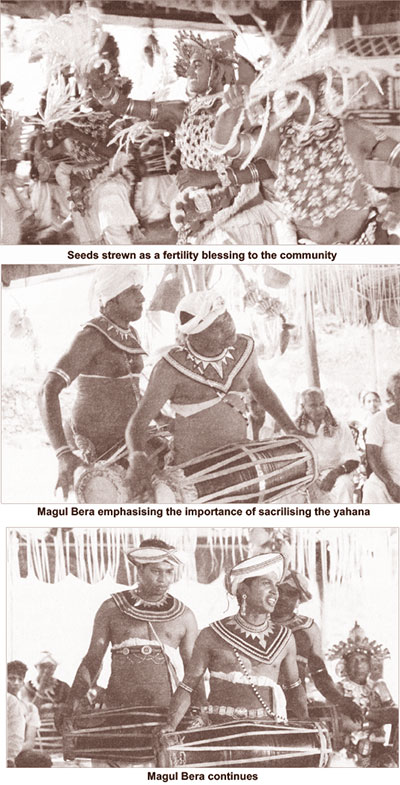
In the last essay Amunugama presents a series of ‘….photographs of the kankariya and its associated personnel’. Here and elsewhere in the book, there are photographs of dancers like Gunaya, Suramba, his two sons Sumanaweera and Samaraweera and Chitrasena. There are also pictures of Lionel Wendt and George Keyt.
I conclude.
Diversion to Pali grammar.
On page 18, Amunugama presents a stanza which he says, ‘identifies the hopes and prayers of Sinhala Buddhists’. In homes of many people in this country, this stanza is heard, often several times a day.
devo vassatu kaalena- sassa sampatti hetu ca
pito bhavatu loko ca- raja bhavatu dhammiko.
He translated it as follows: ‘may Gods bring rain in due season- cause our livelihoods to prosper/may the populace be happy and may the ruler be righteous’. I have seen the same stanza, as presented here, in a number of places. As I found its grammar intriguing, I inquired where it was copied from. I learnt that it came from H.W.Codrington’s, A short History of Ceylon, published in 1926.
There are several problems with both copying the stanza and its translation. All the verbs are in the benedictive mood, singular number: vassatu (pl.vassantu), hotu (pl.hontu) and bhavatu (pl.bhavantu) The verb in the second line is hotu not hetu. The benedictive verb in Pali has this ‘tu’ ending. Then, devo vassatu kalena is singular and the subject cannot be in the plural: Gods. The fact is that devo, is rain or water (devo vassati is the Pali equivalent of ‘It rains’. Rhys Davids, Pali Dictionary). Then devo vassatu kaalena says ‘may it rain in season’. In the second line, the words hetu ca was copied for Codrington, wrong. There is a word hetu as in ‘ye dhamma hetuppabhava’, attributed to Sariputta. ‘hetu’ here means cause (noun). In contrast, hotu means ‘may there be’, the benedictive form of hoti (plural: honti, to be). So all three verbs are in the benedictive mood: vassatu, hotu and bhavatu. tu ending also occurs in another usage. ‘aham gaccatu kamo.’ (I like to go); or ‘bilalo musike khadatu kamo (a cat likes to eat mice’). Ca is a common conjunction equivalent to ‘and’. The translation of the line is, ‘may crops (literally, cereals) be plentiful’. There are no problems with the last two lines, except perhaps to note that raja is singular, (plural rajano, an irregular declension.) Now even bhikkhu (bhikkhu is the plural as well) have no intelligent reading of Pali, as we hear day in day out on television. To lose a language is to suffer a tremendous loss.