Features
Kandyan kingdom: From the fringe to the centre

By Uditha Devapriya
The rise of Kandy, as a political subunit in the country, can generally be attributed to three factors: the shift from Kurunegala to Gampola as the capital city, the onslaughts made on udarata by the Aryachakravartis from Jaffna, and the rise to power of nobles and chief ministers at the time of the Gampola and Kotte kings.
Literary evidence tells us that the shift to a new capital occurred due to internal squabbles. The emergence of two, sometimes three centres of power, was inevitable: it was a necessary antidote to a harsh reality. By moving further southwest, however, the country moved away from a stable order. The new centres essentially forewent on the old stability.
At the time of the Gampola kings, udarata was known as Malayarata, and it was considered an effective barricade against foreign invasions.
In the 15th Century the capital city was, perhaps due to this, moved to Senkadagala Nuwara or Kandy. When the first Gampola era ruler, Bhuvanekabahu IV, administered the country from the new capital, his brother Parakramabahu V was ruling from Dedigama at the Four Korales.
Whether or not such a system was amenable to either ruler we do not know, but what we do know is that the Gampola kingdom regarded udarata as a link between rajarata to the north and ruhuna to the south. Hence it was in the interests of both ruler and co-ruler, not to mention their ministers, to secure it from the north.
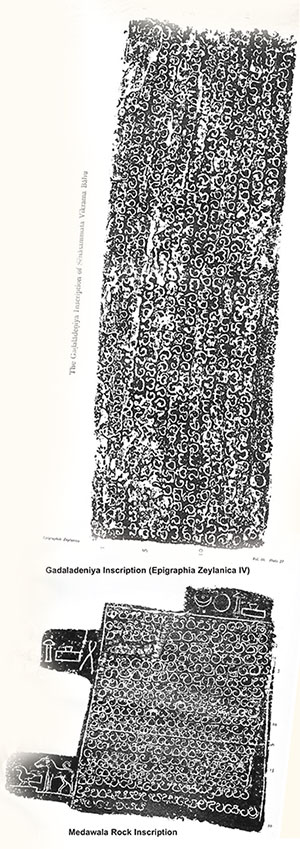
Inscriptions at Kotagala and Lahugama tell us that the Aryachakravarti rulers frequently challenged the legitimacy of the Sinhala kings by invading this region. The first attempt is said to have failed, but by 1359, according to an inscription at Medawala in Harispattuwa, the leader of the campaign, Ariyan of Singai Nagar or Mathandan Perumal, was collecting taxes from five villages in Gampola through Brahmins on behalf of Jaffna; according to the Rajavaliya, the Aryachakravartis “cause[d] tribute to be brought from the hill country.” To stop this, a powerful unifying figure had to emerge.

Senadhilankara would be succeeded by the Alagakkonara dynasty. Alakeshwara, a scion of the Alagakkonaras, proved himself to his rulers by defying the Aryachakravartis, building a fort at Jayawardenapura Kotte, and destroying a fleet of ships at Panadura when they had been despatched to quell the presumptuous minister.
The position he enjoyed in the court can be gleaned from the fact that, when news of the despatch came, Bhuvanekabahu V fled the court. Not surprisingly, the Rajavaliya describes this as a cowardly act.
However, Sri Lanka was a monarchy, not a country of chief ministers. The claims of the latter had to be put down, and they were: In the face of the leadership vacuum following the Zheng He episode, a conflict over succession ensued between Alakeshwara and Parakramabahu VI. The latter prevailed in this contest, after which he went on to rule from Raigama and later Gampola, subsequently establishing a new kingdom in Kotte.
Despite the quelling of Alakeshwara, though, the aspirations of other sub-rulers could not be stemmed forever, and though Parakramabahu VI unified the entire country (going as far as to send a nephew to Jaffna to bring the kingdom under him) the threat of certain regions, especially Malayarata, seceding from the capital continued to linger.
According to the Rajavaliya the first such threat came in the king’s 52nd year from a sub-ruler or situ raja named Sojata (Joti Sitana), who “neglected payment of his yearly tribute, and rebelled,” from udarata. Parakramabahu quelled the rebellion by raising an army and committing it to a relative of his, Ambulugala kumaraya, who is then said to have proceeded to conquer the hill country. The Medawala inscription gives us the full name of the rebel as Divanawatte Lanka Adhikarin.
Whatever hopes one may have had of a unified polity soon dissipated upon the death of Parakramabahu VI. This had much to do with the leadership struggles that ensued after his death: His successor, Jayabahu II, was after the space of four years ousted and murdered by Sapumal kumaraya, who ascended the throne as Bhuvanekabahu VI and soon faced a similar attempt on him by two disgruntled noblemen (Siriwardena Patiraja and Kuragala Himi). The ambitious prince quelled this uprising by turning to Ambulugala kumaraya. Paranavitana observed that this uprising represented “an upsurge of national sentiment” against a ruler of Malayali blood, though R.A.L.H. Gunawardena disagreed.
In any case, the cycle of accession and deposal recurred upon Bhuvanekabahu’s death, and ironically this time it was the prince of Ambulugala’s turn to act as ‘ouster’: Literary sources inform us that Bhuvanekabahu was succeeded by Pandita Parakramabahu, and the aspiring kumaraya, perhaps angered at the fact that the successor had been brought up by the same people he had defeated on behalf of the previous king, collected a large force from the Four Korales, encamped in Siyana Korale, shifted to Kelaniya, fought with and killed Patiraja and Kuragala, proceeded to Kotte, killed Parakramabahu, and the next day “ascended the throne as Vira Parakramabahu.” History often can be stranger than fiction.
Given the tenuous relationship between successors and aspirants in Kotte it comes to no surprise that sub-rulers in Kandy would take advantage of the turmoil and try to establish an independent kingdom. To ensure the loyalty of the Kandyan regions and the stability of the union, both Parakramabahu VI and Bhuvanekabahu IV married princesses from the region. This practice continued for a long time. They also extracted rajakariya from the inhabitants. If those inhabitants failed to deliver on such services, the rulers would issue threats ranging from mild punishment to political and military intervention.
These were artful, if not shrewd, means of guaranteeing continuity and order, and they were successful for some time. Yet they could not stem the hopes and wishes of the inhabitants of declaring independence.


The continuation of the Mahavamsa puts down a different date for his ascension, at 1542 or 1543. We can agree that this is erroneous and is not supported by other evidence. However, the Mahavamsa tell us of his lineage, which is supposed to have begun with a princess Mayuravati who was “born of a peahen’s egg” and from whom originated the Mehenavara-vamsa. Vikramabahu was apparently the grandson of Jayamahalena Savulu Parakramabahu, a descendant of this princess.
According to popular lore from then, “Senkhanda nam Siriwardenapura” is said to have been Vikramabahu’s “birthright” (jamma-praveni), and he proceeded there after conquering his enemies. He is also said to have constructed several religious shrines, among them the Poya Maluva at the Malvatte Viharaya. To consolidate his legitimacy he went on pilgrimages to Adam’s Peak, supported attempts of the Maha Nayaka Dharmakirti to purify the sangha, and made several offerings to the Tooth Relic of the Buddha.
In fact, the honorific ‘Senasammata’ points at the importance he attached to gaining the trust of his cohorts: He was indebted to the army for having supported him in his endeavour to secede from Kotte, and to this end, as the Gadaladeniya inscription tells us, he made a promise that no loss of life would be inflicted by his chiefs on the army.
The chiefs, unsurprisingly, happened to be his stooges: The Siduruvana Kaidam-Pota informs us that he “suppressed the troubles” fermented by the headmen of the region, known as Bandaras, deprived them of their power, and gave them the lesser title of Mudliyars, before declaring Senkandha the new capital of the country. In other words, the history of Kandy commences, ironically enough, with the suppression of the Bandaras.