
Features
JRJ in action and events leading to the July 1983 disaster

Excerpted from volume two of Sarath Amunugama’s autobiography
Another innovation of the JRJ regime was the introduction of lotteries to supplement national budgetary allocations. The pioneer of this scheme was Wickreme Weerasooria who was the Secretary of the Ministry of Planning. I got associated with this project because printing was a subject assigned to the Ministry of State of which I was the Secretary.
The idea of a lottery was first mooted by Ingrid McAlpine nee Wijeratne, who lived in UK for a long time and returned after the UNP victory to be inducted as a close friend of the President and a member of Madam Elina’s inner circle. She was the niece of Philip Gunawardena, her mother being Philip’s elder sister. But the Wijeratnes were UNP supporters and had been strong backers of JRJ when he contested the Kelaniya electorate.
As President, JRJ went out of his way to help those families whose parents and grandparents had backed him when he was a young, and perhaps lesser known, candidate. Among them were the Gunasekere and Wijeratne families whose progeny were promoted in the Mahara, Gampaha and Kelaniya areas. Ingrid’s project proposal was accepted by JRJ and Wickreme with his usual gusto launched the National lottery which was at that time the only lottery permitted.
The funds so collected were available to the President as discretionary funds which were not permitted earlier under the National Budget. Other senior ministers in his cabinet quickly saw the advantages of these discretionary funds, as well as printing contracts and began to lobby the President to set up their own lotteries. Predictably the first to lobby the President and set up the Sevana Fund and lottery was the Prime Minister.
He did not use the good offices of Ingrid but chose his favourite Ajantha Wijesena, who used his marketing skills to develop the Sevana Fund for subsidizing his minister’s housing development program. Lalith followed with his request for a Mahapola lottery to be managed by Ingrid. By this time the Finance Ministry was getting alarmed at the proliferation of discretionary funds of individual ministers and the setting up of extra-budgetary mechanisms which diluted Treasury control of state finances.
Wickreme also pointed out the wasteful duplication of publicity and marketing agencies and even more urgently the decline of income of the National Lottery which was under the charge of the President. Other Ministers were also lining up after being promoted by printers and advertising agencies who saw a golden opportunity. Finally the President had to put his foot down and refuse new requests.
However he directed that a substantial portion of the income from the National Lottery be diverted to Mahapola. Lalith was satisfied but it created a bad precedent because successive trade ministers started playing politics with those funds. They saw a god given opportunity to divert funds to their electorates outside the country’s budget.
Lalith won the hearts of the undergraduates of his time with his initiative. I can testify to the fact that many of the Mahapola recipients flocked to pay homage at his funeral and lined the roads as a tribute to a man with a vision who made their lives better. The role of Lalith, Gamini and Ronnie clearly showed the value of literate and dynamic ministers. Unfortunately that tendency was nipped in the bud by political leaders who had to pay their dues to loyalist party hacks and financiers who had helped them in times of adversity.
Chambers of Commerce
Lalith was the ideal choice for establishing commercial links with our partner countries as the Minister of Trade. With his wide range of contacts, superlative knowledge of the law and the English language and his well-known habit of hard work and diligent preparation he made ministerial missions abroad most fruitful for the country. He also had excellent contacts with our private sector which at that time happened to be dominated by old Royalists.
Among them were Ken Balendra, Ratna Sivaratnam, Chari de Silva, Wijemanne, Ranjan Gooneratne and several others. The plantation sector was dominated by old Royalists and Old Trinitians. They were all close to the young minister and could interact with him on a friendly basis. Many successive Presidents tended to appoint second raters as ministers who could not reach out to the important capitalists in the country. They had to depend on cronies as intermediaries who were usually corrupt and were rent seekers. This parasitic class came to the fore with Chandrika and especially Mahinda Rajapakse.
I was directed by the President to join Lalith’s pathbreaking mission to set up the first Japan-Sri Lanka Trade chamber in JRJ in action and events leading to the July 1983 disasterTokyo. This high level delegation
included Chandi Chanmugam from the Treasury, Paul Perera of BOI, Raju Coomaraswamy, Chari de Silva, Wettasinghe, Cornel Perera, H.R. Fernando and a few others. I represented the tourism sector. The Japanese side included Yasoao Fukuda who was later to be Prime Minister of Japan and all the leaders of the ‘Daibatsu’ or the major business houses of the country.
It included Mitsui, Mitsubishi, C. Itoh, Sumitomo and many other companies who wanted to do business under the JRJ dispensation. This meeting contributed to making Japan one of our major economic partners and a long term friend. Over 40 years later when on an official visit to Japan I was able to participate in another meeting of the chamber. I referred to the fact that the Chamber had met continuously from that inaugural meeting and Mr. Fukuda and I were probably the only living survivors of the original meeting held in the Imperial Hotel in Tokyo under the leadership of Lalith.
Lalith’s expertise was also sought in Geneva by Gamini Corea for UNCTAD and Lakshman Kadirgamar for negotiations on `intellectual property’. These invitations led to a milestone in Lalith’s life when he began to date Srimani de Saram who was working in the secretariat of UNCTAD, on the staff of Gamini Corea its Secretary-General. He married her in Geneva and she became his standard bearer after his death. Tragically Srimani herself was afflicted with a cancer and died not long after her husband.
Ethnic Conflict
If there was one issue which spelt the eventual doom of the UNP it was JRJ’s inept handling of the ethnic issue. Like Hitler’s ‘Thousand year Reich’ the euphoric UNP hoped to remain in power for a long period of time. JRJ’s models of Singapore and Malaysia were, in effect, one party states. Unlike in the UNP, in those nations leaders who obtained freedom remained to guide their destinies with near dictatorial powers.
JRJ too wanted to ‘roll up the electoral map’. This was a euphemism for the untrammeled perpetuation of UNP rule. The JRJ constitution, with its new electoral system, was tailormade to accommodate the UNP which was the largest party in the country. There was no hope for the SLFP except through coalition politics. With no prospect of regaining office, the usually indisciplined SLFP leaders, who had earlier paid homage to the Bandaranaike ‘family show’, now began to cut loose, criticize their leader and even enter into a dialogue with JRJ. But all these plans went awry due to the prolonged ethnic conflict.
The President was beleaguered, abandoned by his erstwhile comrades, and had to literally fight for his life. Walls in Colombo were plastered with JVP slogans calling for “Death to the Old Man”. How did this happen? What were the series of blunders that bedeviled JRJ’s second term of office? The main factor was his inability to contain the ethnic conflict. This led to his alienation from India which at that time, opportunistically or otherwise, espoused the Tamil cause.
Later when he attempted to compromise with India he was reviled by the majority of the Sinhalese who followed the virulent anti-Indian line of the JVP, supported by the SLFP. By making Cyril Mathew and some of his backbenchers to join that bandwagon he further alienated India and Sri Lanka was put on a slippery slope to disaster.
At the beginning of his tenure JRJ had an opportunity of solving the Tamil question. Though his rival Kobbekaduwa did well in the North and East at the 1982 Presidential election, largely because the SLFP closed the door to foreign agricultural products which Jaffna farmers grew in abundance, many Tamils believed that JRJ will remove restrictive communal provisions like the language laws, University quotas and offer better opportunities to them for trade.
In addition the Tamil elite in Colombo were mostly supporters of the UNP. It is ironical that the most pro-devolution politician in the State Council days was Bandaranaike. When he entered politics as a young man Bandaranaike was an advocate of federalism. In contrast JRJ was from the beginning a supporter of a strong unitary nation based on his historical readings about Sinhala kings.
The Senanayakes and following them JRJ, had a streak of Sinhala nationalism. In my personal experience when talking to JRJ about the ethnic question he usually referred to the Tamils as ‘Damilas’; a terminology used in ancient Sinhala inscriptions. The problem was that instead of addressing the real concerns of the Tamils, the youth in particular, he spent time in attempting to ‘strike a deal’ with the Tamil leadership.
Though this seemed a viable option at the start, the entry of militant Tamil youth swung the pendulum towards the confrontation. The communal riots that followed the UNP victory reduced JRJs options because he did not want to antagonize the Sinhala extremists at the very beginning of his regime. In allying himself firmly with the US he did not watch his flank which was Indira Gandhi’s India.
Under normal conditions, for instance with Nehru, Shastri or Morarji Desai, JRJ would have had room to maneuver. But at this stage Indira was taking India on a different path which asserted India’s primacy in foreign relations in the subcontinent. She wanted India to be a regional super power as demonstrated in her invasion of East Pakistan and the creation of a pro-India new nation called Bangladesh.
In this scenario both JRJ and his policies appeared to be irritants to Indira’s left leaning advisors who were jubilant that their military interventions against their main enemy Pakistan was successful. At this juncture with the Indian Congress being challenged electorally for the first time, Indira was also persuaded that the Tamil ‘card’ would benefit her in the forthcoming elections. In the face of her defeat in the Nehru stronghold of Rae Bareilly, she had moved to the Chikmagalur seat in South India signaling the growing strength of the ‘southern cow belt’.
During the SLFP coalition regime of 1970-1977, Tamil disquiet was rapidly increasing. The educational policies of Minister Badiuddin Mahmud, which was dominated by two nationalist extremists – Udugama and Sumathipala as its top bureaucrats brought in policies designed to build up education in Sinhala rural areas which had been badly neglected by successive governments. This attempt at re-balancing education was at the expense of Tamils who had earlier benefited from widespread education.
During the Colonial period Christian Missionaries, particularly from the US, had introduced a system of education which was not bettered anywhere else in the island. Education had been the lifeline of the Tamils; their passport to employment and relief from the harsh, dry climate and water shortage which marked the peninsula.
The worst of these Udugama-Sumathipala fiats, as far as Tamil youth were concerned, was the introduction of ‘standardization of marks’ in determining entry to higher education provided by the state. Since due to socialist policies the state had a monopoly of education this decision appeared to be discriminatory of the minorities and the urban poor.
As Director of Combined Services during this time I sat on several committees to examine the effects of these policy shifts on the public service. At these meetings Parliamentarians representing urban electorates like Pieter Keuneman and Bernard Soysa opposed district wise quotas for higher education saying that urban poor children were no better off than the rural poor child and were unfairly discriminated against by the new educational laws.
But the rural based SLFP was in favour of ‘positive discrimination’. They argued not very convincingly that this policy would help rural Tamil students as well. But the stakes were too high to win over the Jaffna based students. They were now anyway skirmishing with the police who were mostly disaffected Sinhala lower orders sent on punishment transfer far away from their homes. The situation in Jaffna was a tinder box about to explode and the Tamil Parliamentarians were too scared to reach out to Sinhala leaders for a solution now that seniors like Chelvanayagam and Ponnambalam were no more.
The progressive alienation and radicalization of Tamil youth led to a stiffening of the attitudes of the Tamil Parliamentarians. This led to the landmark Vadukkodai declaration of the Tamil United Liberation Front of 1975. This declaration emphasized the concept of the North and East as the ‘homelands’ of the ‘Tamil speaking people’. Merging the North and East for the first time to make it a viable geographical entity necessitated the inclusion of the Muslims as part of the ‘Tamil speaking entity’ since the Muslims were in a majority in the East and together with the Sinhalese in the Eastern province formed a clear numerical majority over the Tamils.
It was the Vadukoddai ideology which was gaining ground when JRJ entered the scene. The stinging defeat of the SLFP in reality complicated the situation. If the SLFP had a greater number of MPs in Parliament after the 1977 election they would have constituted the main opposition. But with their abysmal defeat the Tamil United Liberation Front had a bigger member of MPs and JRJ, with great delight, helped in making the TULF leader Amirthalingam the leader of the Opposition.
But this fateful decision had many long term consequences. -Amirthalingam was known as a firebrand orator and an extremist. With the weight of office as the Leader of the Opposition his fire was doused. Though he tried to play the role of a national leader in his impassioned defence of Mrs. B, he naturally used his powers as Opposition leader to highlight the grievances of the Tamil people further polarizing the two main ethnic groups. Whereas, on the other hand, the SLFP deprived even of the consolation prize of Opposition leadership, had no hesitation in promoting Sinhala extremism in order to embarrass the UNP.
JRJ’s solution to this unhealthy state of affairs was worse than the disease. He unleashed Cyril Mathew as the UNP’s own Sinhala extremist. Mathew with the resources of the state behind him not only attacked Tamils he disliked but also attacked other opponents of the UNP like Madoluwawe ‘Sobhita and Ediriweera Sarathchandra which alienated a swathe of the Sinhala intelligentsia.
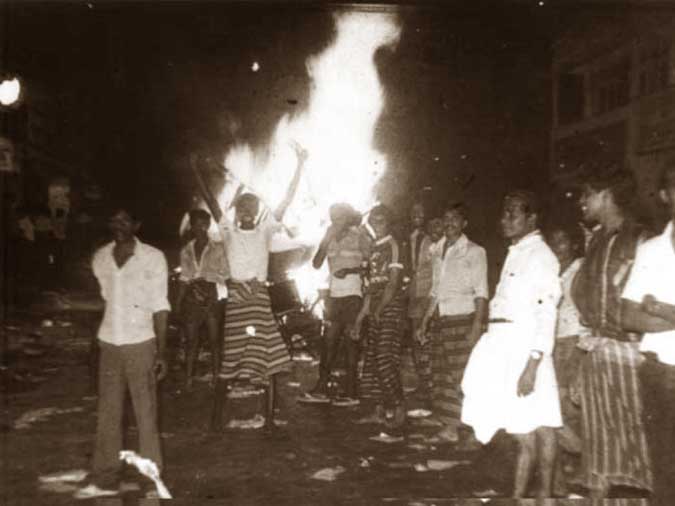
Mathew consolidated his position as a Sinhala hero by promoting goon squads drawn from Corporations under his care as the Minister of Industries. These goons were unleashed on the urban Tamils in August 1983 leading to an unprecedented communal holocaust which marked a point of no return. After 1983 JRJ downgraded Mathew but it was much too late. The UNP government was held up as being a promoter of state violence against Tamils.


by Dr Gotabhya Ranasinghe
Senior Consultant Cardiologist
National Hospital Sri Lanka
When we sought a meeting with Hon Dr. Ramesh Pathirana, Minister of Health, he graciously cleared his busy schedule to accommodate us. Renowned for his attentive listening and deep understanding, Minister Pathirana is dedicated to advancing the health sector. His openness and transparency exemplify the qualities of an exemplary politician and minister.
Dr. Palitha Mahipala, the current Health Secretary, demonstrates both commendable enthusiasm and unwavering support. This combination of attributes makes him a highly compatible colleague for the esteemed Minister of Health.
Our discussion centered on a project that has been in the works for the past 30 years, one that no other minister had managed to advance.
Minister Pathirana, however, recognized the project’s significance and its potential to revolutionize care for heart patients.
The project involves the construction of a state-of-the-art facility at the premises of the National Hospital Colombo. The project’s location within the premises of the National Hospital underscores its importance and relevance to the healthcare infrastructure of the nation.
This facility will include a cardiology building and a tertiary care center, equipped with the latest technology to handle and treat all types of heart-related conditions and surgeries.
Securing funding was a major milestone for this initiative. Minister Pathirana successfully obtained approval for a $40 billion loan from the Asian Development Bank. With the funding in place, the foundation stone is scheduled to be laid in September this year, and construction will begin in January 2025.
This project guarantees a consistent and uninterrupted supply of stents and related medications for heart patients. As a result, patients will have timely access to essential medical supplies during their treatment and recovery. By securing these critical resources, the project aims to enhance patient outcomes, minimize treatment delays, and maintain the highest standards of cardiac care.
Upon its fruition, this monumental building will serve as a beacon of hope and healing, symbolizing the unwavering dedication to improving patient outcomes and fostering a healthier society.We anticipate a future marked by significant progress and positive outcomes in Sri Lanka’s cardiovascular treatment landscape within the foreseeable timeframe.

by Fr. Emmanuel Fernando, OMI
Jesuit Fr. Aloysius Pieris (affectionately called Fr. Aloy) celebrated his 90th birthday on April 9, 2024 and I, as the editor of our Oblate Journal, THE MISSIONARY OBLATE had gone to press by that time. Immediately I decided to publish an article, appreciating the untiring selfless services he continues to offer for inter-Faith dialogue, the renewal of the Catholic Church, his concern for the poor and the suffering Sri Lankan masses and to me, the present writer.
It was in 1988, when I was appointed Director of the Oblate Scholastics at Ampitiya by the then Oblate Provincial Fr. Anselm Silva, that I came to know Fr. Aloy more closely. Knowing well his expertise in matters spiritual, theological, Indological and pastoral, and with the collaborative spirit of my companion-formators, our Oblate Scholastics were sent to Tulana, the Research and Encounter Centre, Kelaniya, of which he is the Founder-Director, for ‘exposure-programmes’ on matters spiritual, biblical, theological and pastoral. Some of these dimensions according to my view and that of my companion-formators, were not available at the National Seminary, Ampitiya.
Ever since that time, our Oblate formators/ accompaniers at the Oblate Scholasticate, Ampitiya , have continued to send our Oblate Scholastics to Tulana Centre for deepening their insights and convictions regarding matters needed to serve the people in today’s context. Fr. Aloy also had tried very enthusiastically with the Oblate team headed by Frs. Oswald Firth and Clement Waidyasekara to begin a Theologate, directed by the Religious Congregations in Sri Lanka, for the contextual formation/ accompaniment of their members. It should very well be a desired goal of the Leaders / Provincials of the Religious Congregations.
Besides being a formator/accompanier at the Oblate Scholasticate, I was entrusted also with the task of editing and publishing our Oblate journal, ‘The Missionary Oblate’. To maintain the quality of the journal I continue to depend on Fr. Aloy for his thought-provoking and stimulating articles on Biblical Spirituality, Biblical Theology and Ecclesiology. I am very grateful to him for his generous assistance. Of late, his writings on renewal of the Church, initiated by Pope St. John XX111 and continued by Pope Francis through the Synodal path, published in our Oblate journal, enable our readers to focus their attention also on the needed renewal in the Catholic Church in Sri Lanka. Fr. Aloy appreciated very much the Synodal path adopted by the Jesuit Pope Francis for the renewal of the Church, rooted very much on prayerful discernment. In my Religious and presbyteral life, Fr.Aloy continues to be my spiritual animator / guide and ongoing formator / acccompanier.
Fr. Aloysius Pieris, BA Hons (Lond), LPh (SHC, India), STL (PFT, Naples), PhD (SLU/VC), ThD (Tilburg), D.Ltt (KU), has been one of the eminent Asian theologians well recognized internationally and one who has lectured and held visiting chairs in many universities both in the West and in the East. Many members of Religious Congregations from Asian countries have benefited from his lectures and guidance in the East Asian Pastoral Institute (EAPI) in Manila, Philippines. He had been a Theologian consulted by the Federation of Asian Bishops’ Conferences for many years. During his professorship at the Gregorian University in Rome, he was called to be a member of a special group of advisers on other religions consulted by Pope Paul VI.
Fr. Aloy is the author of more than 30 books and well over 500 Research Papers. Some of his books and articles have been translated and published in several countries. Among those books, one can find the following: 1) The Genesis of an Asian Theology of Liberation (An Autobiographical Excursus on the Art of Theologising in Asia, 2) An Asian Theology of Liberation, 3) Providential Timeliness of Vatican 11 (a long-overdue halt to a scandalous millennium, 4) Give Vatican 11 a chance, 5) Leadership in the Church, 6) Relishing our faith in working for justice (Themes for study and discussion), 7) A Message meant mainly, not exclusively for Jesuits (Background information necessary for helping Francis renew the Church), 8) Lent in Lanka (Reflections and Resolutions, 9) Love meets wisdom (A Christian Experience of Buddhism, 10) Fire and Water 11) God’s Reign for God’s poor, 12) Our Unhiddden Agenda (How we Jesuits work, pray and form our men). He is also the Editor of two journals, Vagdevi, Journal of Religious Reflection and Dialogue, New Series.
Fr. Aloy has a BA in Pali and Sanskrit from the University of London and a Ph.D in Buddhist Philosophy from the University of Sri Lankan, Vidyodaya Campus. On Nov. 23, 2019, he was awarded the prestigious honorary Doctorate of Literature (D.Litt) by the Chancellor of the University of Kelaniya, the Most Venerable Welamitiyawe Dharmakirthi Sri Kusala Dhamma Thera.
Fr. Aloy continues to be a promoter of Gospel values and virtues. Justice as a constitutive dimension of love and social concern for the downtrodden masses are very much noted in his life and work. He had very much appreciated the commitment of the late Fr. Joseph (Joe) Fernando, the National Director of the Social and Economic Centre (SEDEC) for the poor.
In Sri Lanka, a few religious Congregations – the Good Shepherd Sisters, the Christian Brothers, the Marist Brothers and the Oblates – have invited him to animate their members especially during their Provincial Congresses, Chapters and International Conferences. The mainline Christian Churches also have sought his advice and followed his seminars. I, for one, regret very much, that the Sri Lankan authorities of the Catholic Church –today’s Hierarchy—- have not sought Fr.
Aloy’s expertise for the renewal of the Catholic Church in Sri Lanka and thus have not benefited from the immense store of wisdom and insight that he can offer to our local Church while the Sri Lankan bishops who governed the Catholic church in the immediate aftermath of the Second Vatican Council (Edmund Fernando OMI, Anthony de Saram, Leo Nanayakkara OSB, Frank Marcus Fernando, Paul Perera,) visited him and consulted him on many matters. Among the Tamil Bishops, Bishop Rayappu Joseph was keeping close contact with him and Bishop J. Deogupillai hosted him and his team visiting him after the horrible Black July massacre of Tamils.
Sri Lanka-Singapore Free Trade Agreement
By Gomi Senadhira
senadhiragomi@gmail.com
“You might tell fairy tales, but the progress of a country cannot be achieved through such narratives. A country cannot be developed by making false promises. The country moved backward because of the electoral promises made by political parties throughout time. We have witnessed that the ultimate result of this is the country becoming bankrupt. Unfortunately, many segments of the population have not come to realize this yet.” – President Ranil Wickremesinghe, 2024 Budget speech
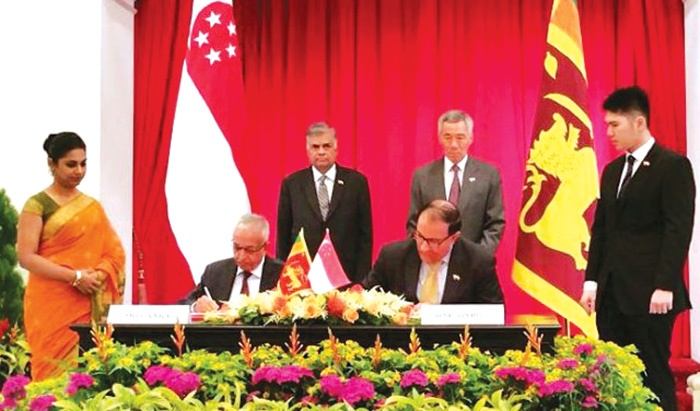
Any Sri Lankan would agree with the above words of President Wickremesinghe on the false promises our politicians and officials make and the fairy tales they narrate which bankrupted this country. So, to understand this, let’s look at one such fairy tale with lots of false promises; Ranil Wickremesinghe’s greatest achievement in the area of international trade and investment promotion during the Yahapalana period, Sri Lanka-Singapore Free Trade Agreement (SLSFTA).
It is appropriate and timely to do it now as Finance Minister Wickremesinghe has just presented to parliament a bill on the National Policy on Economic Transformation which includes the establishment of an Office for International Trade and the Sri Lanka Institute of Economics and International Trade.
Was SLSFTA a “Cleverly negotiated Free Trade Agreement” as stated by the (former) Minister of Development Strategies and International Trade Malik Samarawickrama during the Parliamentary Debate on the SLSFTA in July 2018, or a colossal blunder covered up with lies, false promises, and fairy tales? After SLSFTA was signed there were a number of fairy tales published on this agreement by the Ministry of Development Strategies and International, Institute of Policy Studies, and others.
However, for this article, I would like to limit my comments to the speech by Minister Samarawickrama during the Parliamentary Debate, and the two most important areas in the agreement which were covered up with lies, fairy tales, and false promises, namely: revenue loss for Sri Lanka and Investment from Singapore. On the other important area, “Waste products dumping” I do not want to comment here as I have written extensively on the issue.
1. The revenue loss
During the Parliamentary Debate in July 2018, Minister Samarawickrama stated “…. let me reiterate that this FTA with Singapore has been very cleverly negotiated by us…. The liberalisation programme under this FTA has been carefully designed to have the least impact on domestic industry and revenue collection. We have included all revenue sensitive items in the negative list of items which will not be subject to removal of tariff. Therefore, 97.8% revenue from Customs duty is protected. Our tariff liberalisation will take place over a period of 12-15 years! In fact, the revenue earned through tariffs on goods imported from Singapore last year was Rs. 35 billion.
The revenue loss for over the next 15 years due to the FTA is only Rs. 733 million– which when annualised, on average, is just Rs. 51 million. That is just 0.14% per year! So anyone who claims the Singapore FTA causes revenue loss to the Government cannot do basic arithmetic! Mr. Speaker, in conclusion, I call on my fellow members of this House – don’t mislead the public with baseless criticism that is not grounded in facts. Don’t look at petty politics and use these issues for your own political survival.”
I was surprised to read the minister’s speech because an article published in January 2018 in “The Straits Times“, based on information released by the Singaporean Negotiators stated, “…. With the FTA, tariff savings for Singapore exports are estimated to hit $10 million annually“.
As the annual tariff savings (that is the revenue loss for Sri Lanka) calculated by the Singaporean Negotiators, Singaporean $ 10 million (Sri Lankan rupees 1,200 million in 2018) was way above the rupees’ 733 million revenue loss for 15 years estimated by the Sri Lankan negotiators, it was clear to any observer that one of the parties to the agreement had not done the basic arithmetic!
Six years later, according to a report published by “The Morning” newspaper, speaking at the Committee on Public Finance (COPF) on 7th May 2024, Mr Samarawickrama’s chief trade negotiator K.J. Weerasinghehad had admitted “…. that forecasted revenue loss for the Government of Sri Lanka through the Singapore FTA is Rs. 450 million in 2023 and Rs. 1.3 billion in 2024.”
If these numbers are correct, as tariff liberalisation under the SLSFTA has just started, we will pass Rs 2 billion very soon. Then, the question is how Sri Lanka’s trade negotiators made such a colossal blunder. Didn’t they do their basic arithmetic? If they didn’t know how to do basic arithmetic they should have at least done their basic readings. For example, the headline of the article published in The Straits Times in January 2018 was “Singapore, Sri Lanka sign FTA, annual savings of $10m expected”.
Anyway, as Sri Lanka’s chief negotiator reiterated at the COPF meeting that “…. since 99% of the tariffs in Singapore have zero rates of duty, Sri Lanka has agreed on 80% tariff liberalisation over a period of 15 years while expecting Singapore investments to address the imbalance in trade,” let’s turn towards investment.
Investment from Singapore
In July 2018, speaking during the Parliamentary Debate on the FTA this is what Minister Malik Samarawickrama stated on investment from Singapore, “Already, thanks to this FTA, in just the past two-and-a-half months since the agreement came into effect we have received a proposal from Singapore for investment amounting to $ 14.8 billion in an oil refinery for export of petroleum products. In addition, we have proposals for a steel manufacturing plant for exports ($ 1 billion investment), flour milling plant ($ 50 million), sugar refinery ($ 200 million). This adds up to more than $ 16.05 billion in the pipeline on these projects alone.
And all of these projects will create thousands of more jobs for our people. In principle approval has already been granted by the BOI and the investors are awaiting the release of land the environmental approvals to commence the project.
I request the Opposition and those with vested interests to change their narrow-minded thinking and join us to develop our country. We must always look at what is best for the whole community, not just the few who may oppose. We owe it to our people to courageously take decisions that will change their lives for the better.”
According to the media report I quoted earlier, speaking at the Committee on Public Finance (COPF) Chief Negotiator Weerasinghe has admitted that Sri Lanka was not happy with overall Singapore investments that have come in the past few years in return for the trade liberalisation under the Singapore-Sri Lanka Free Trade Agreement. He has added that between 2021 and 2023 the total investment from Singapore had been around $162 million!
What happened to those projects worth $16 billion negotiated, thanks to the SLSFTA, in just the two-and-a-half months after the agreement came into effect and approved by the BOI? I do not know about the steel manufacturing plant for exports ($ 1 billion investment), flour milling plant ($ 50 million) and sugar refinery ($ 200 million).
However, story of the multibillion-dollar investment in the Petroleum Refinery unfolded in a manner that would qualify it as the best fairy tale with false promises presented by our politicians and the officials, prior to 2019 elections.
Though many Sri Lankans got to know, through the media which repeatedly highlighted a plethora of issues surrounding the project and the questionable credentials of the Singaporean investor, the construction work on the Mirrijiwela Oil Refinery along with the cement factory began on the24th of March 2019 with a bang and Minister Ranil Wickremesinghe and his ministers along with the foreign and local dignitaries laid the foundation stones.
That was few months before the 2019 Presidential elections. Inaugurating the construction work Prime Minister Ranil Wickremesinghe said the projects will create thousands of job opportunities in the area and surrounding districts.
The oil refinery, which was to be built over 200 acres of land, with the capacity to refine 200,000 barrels of crude oil per day, was to generate US$7 billion of exports and create 1,500 direct and 3,000 indirect jobs. The construction of the refinery was to be completed in 44 months. Four years later, in August 2023 the Cabinet of Ministers approved the proposal presented by President Ranil Wickremesinghe to cancel the agreement with the investors of the refinery as the project has not been implemented! Can they explain to the country how much money was wasted to produce that fairy tale?
It is obvious that the President, ministers, and officials had made huge blunders and had deliberately misled the public and the parliament on the revenue loss and potential investment from SLSFTA with fairy tales and false promises.
As the president himself said, a country cannot be developed by making false promises or with fairy tales and these false promises and fairy tales had bankrupted the country. “Unfortunately, many segments of the population have not come to realize this yet”.
(The writer, a specialist and an activist on trade and development issues . )



US sports envoys to Lanka to champion youth development

Rahuman questions sudden cancellation of leave of CEB employees


