
Life style
Jeans have come long way


Nowadays, fashion trends are changed. Previously, fashion trend is controlled by the
fashion magazine,
however, it is different now. No better it is good or bad,
the trend of
fashion is shaped and influenced by online celebrities.
People tend to follow the popular stars’ dressing has a long history. In the past, the loyal families always lead the fashion trend, such as Marie Antoinette, she leads the fanciest and
luxurious fashion trend, and the Kings in the past are the
fashion stars as well. Time goes by, movie stars and singers become to the fashion trend that
ordinary
people tend to follow. With the increase of the economy, people have better life quality,
therefore, they would like to pay more
attention to their
dressing, and this
stimulates the bloom of fashion industry too.
History of denim jeans – how denim trend changed over the year
“Fashion is mysterious, as a rule. Why are blue jeans a classic? You just hit on something that happens to be timeless and right.” – Diane von Furstenberg
Denim has known to revolutionize the fashion industry than any other clothing. From being tough twill trousers worn by merchant sailors to becoming wardrobe-staple denim jeans have come a long way.
Despite the range of innovative materials available, denim remains one of the most versatile, durable, and highly sought-after fabrics on the market. It has evolved with time and still remains to have the same appeal. Several studies have attempted to provide a history of denim, such as Ian Finlayson’s (1990) Denim: An American Legend, a historical iconography of denim, and Miller and Woodward’s (2011) Global Denim.
However, do you know how it all started? In this article, our author Adita Banerjee has covered the following topics that will show how denim jeans were originated and have become part of our daily wear.
How were jeans born?
Branding of Denim Jeans
Evolution of Denim Jeans
Denim Production in the modern age
How do designers get the inspiration to include denim in the clothing lines?
How does your favourite denim brand come to the front?
Denim – Day and Night
How were jeans born?
Jeans have a long history, dating back to 1567 with the introduction of the word “Genoese” or “genes” to describe the tough twill trousers worn by merchant sailors from the Italian coastal city of Genoa. Weavers in Nimes, France tried to reproduce this fabric.
This fabric was classified as a twill weave fabric using one coloured thread (basically indigo dyed) and one white thread with the weft passing under the warp threads. It had a unique feel and was a perfect fit for the working class people. Today we call it denim, the word denim comes from the French phrase “Serge de Nimes” which means serge from Nimes. The meaning of denim alluded to the working-class and only later became a fashion statement.
Branding of Denim Jeans
In 1853 Levi Strauss moved to San Francisco to open a dry good store for people involved in the ‘gold rush’. He was dealing with the imported cotton fabric, denim when Jacob W. Davis, a tailor, who made functional items such as tents, horse blankets, and wagon covers asked Strauss to partner with him to patent and sell clothing reinforced with rivets. The reason was that Levi’s fabric was integral to them and Strauss had discovered a way to make it more durable by using metal rivets.
They became partners and on May 20, 1873, the two men received U.S. Patent 139,121 from the United States Patent and Trademark Office. The minors appreciated the new look of jeans which overcame the problem of ripped pockets. Strauss and Davis initially made jeans in two types of fabric, brown duck, and blue denim until the creation of the denim 501 styles in 1890 which paved way for a modernized version.
Many improvements were made like belt loops appeared in 1922 and zippers replaced the button fly. However, by 1890 this partnership ended and manufacturers like OshKosh B’Gosh, Wrangler, and Lee Mercantile appeared in the limelight.
Evolution of Denim Jeans
In 150 years, jeans have gone through a lot of changes. In the late 1800s, the jeans were basically a “waist overall” and were commonly worn by western cowboys, miners, farmers in the US. Being cheap and sturdy it became a common feature among working men.
In the early 20th century, denim was widely used by the military during World War-I and thus became associated with militarism.
During the mid-50s, the term jeans was used to distinguish it from other fabrics. Young people started wearing denim in the 1950s as a symbol of rebellion inspired by movies like “The Wild One” played by Marlon Brando and “Rebel Without a Cause” by James Dean.
The 1960s-70s was marked by bell-bottom widely featured in magazines while in1965, Limbo, a boutique in the New York East Village, came up with the idea to wash a pair of jeans to make them look used and worn out, decorated them with patches and decals.
In 1976, Calvin Klein showed blue jeans on the runway—the first designer to do so followed by Gloria Vanderbilt. They paved way for the acid-wash jeans in the 1980s.
Baggy, ripped jeans was all over the world in the 1990s and fashion houses such as Versace, Dolce & Gabbana and Dior also entered the jean market to promote their designs among which skinny jeans became a favourite in the 2000s.
Over the decades, the types and styles of jeans became stratified among the socio-economic group making jeans a part of life. Denim jeans has inherited unique features over the years and each has been modified by designers to showcase individual taste and style.
Denim Production in the modern age
The process of denim making is vigorous and time-consuming. The manufactured denim fabric is taken to the processing department for further steps. Designers use five elements to create a design that will stimulate the potential consumer to buy like colour, silhouette, drape, texture, and tone.
Harper Magazine



Institute of Hospitality Sri Lanka
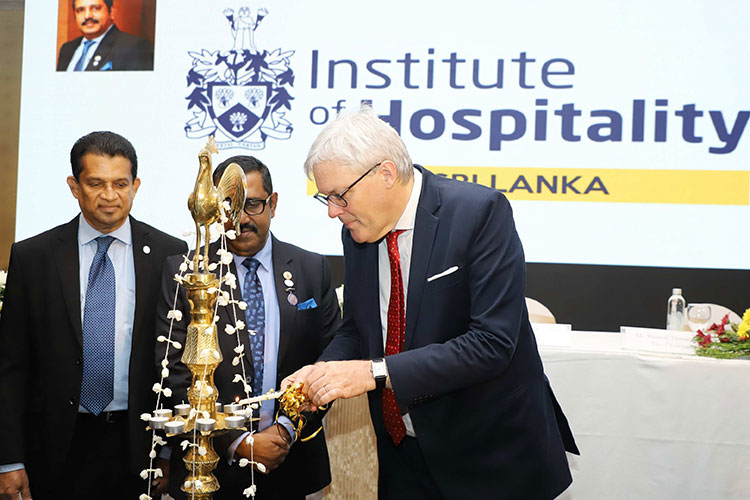
 The 32nd Annual General Meeting (AGM) of the UK-based Institute of Hospitality’s Sri Lanka Chapter was held recently at the Ramada Hotel Colombo,.The event provided an evening of camaraderie , reflection of the past and present achievements,setting new benchmarks for the future
The AGM had the presence of two distinguished guests, the Chief Guest Opposition Leader Sajith Premadasa, and the Guest of Honour British High Commissioner to Sri Lanka, Andrew Patrick. Their inspiring speeches were lauded by all hoteliers who were present at the occasion
A special thanks was extended to Robert Richardson, CEO of the Institute of Hospitality UK, along with his team, sponsors, committee members, and all attendees for making the event memorable.
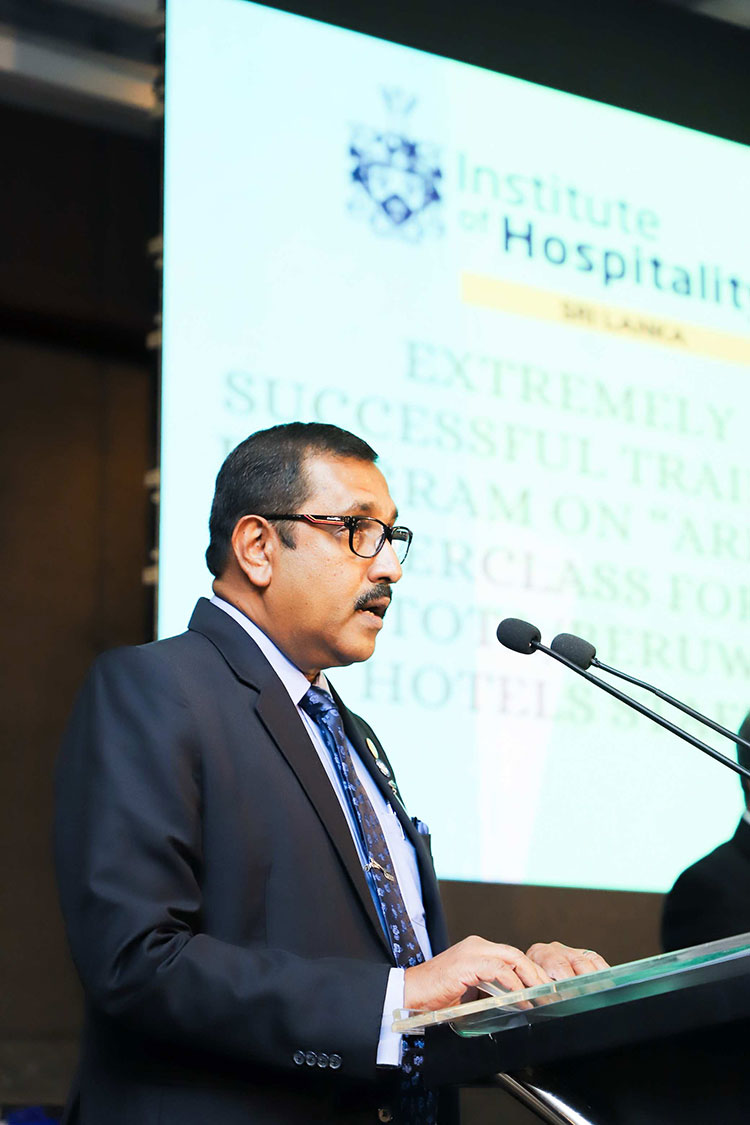
Dr. Harsha Jayasingh, Past President of the Institute of Hospitality (UK) Sri Lanka Chapter, emphasised the Institute’s longstanding history and the strength of its Sri Lankan branch. “The Institute of Hospitality (IH) UK has a history of 86 years, and we are proud to be the Sri Lanka Branch. IH Sri Lanka is much stronger now with many members from all areas of the hospitality industry,” he stated.
Dr. Jayasingh highlighted the significant role of tourism in Sri Lanka’s economy,. He said tourism it is the third-largest source of revenue for the country. “Tourism accounts for about 13.3% of total foreign exchange earnings and employs 450,000 people directly and indirectly. The hospitality industry in this island of pearl holds tremendous potential for economic growth, job creations, and cultural exchange,” he added.
He also pointed out more women should be attracted to the industry and advocated for the use of technology in hospitality sector to attract the younger generation.
The newly appointed Chairman Ramesh Dassanayake spoke about the challenges faced by the industry, including the reluctance of youth to join the sector. . Dassanayake expressed concerns over the migration of staff between hotels and the overall ‘brain drain’ in the sector. ” We must maintain high standards in the hotel We must try to attract tourists to Sri Lanka, we must have with many facilities Hence, hotel schools and other professional institutions involved in skills development mustincrease their intakes,” he pointed out.
Chief Guest Sajith Premadasa emphasised the importance of eco tourism and said “We need to have an environmental policy related to tourism in place,” . .
The 32nd AGM of the Institute of Hospitality UK, Sri Lanka Chapter, was a testament to the strength and potential of Sri Lanka’s hospitality industry. The insights and commitments shared during the event set a new benchmark for the future.(ZC)



Pix by Thushara Attapathu
Life style
He recognizes human identity beyond boundaries of gender, race, nationality and religion.

Visit of Sri Gurudev to Sri Lanka
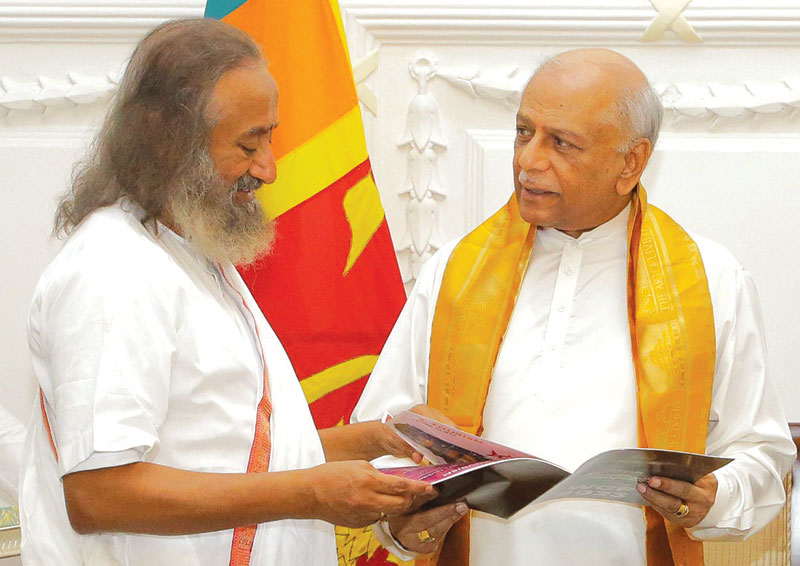
Humanitarian, spiritual leader and Global Ambassador of Peace Gurudev Sri Sri Ravi Shankar (Sri Gurudev) was in Sri Lanka on a three day tour on the invitation of the Prime Minister of Sri Lanka Dinesh Gunewardene. Gurudev who inspired a wave of volunteerism and service to moot one of the largest volunteer-based organisations in the world – The Art of Living – visited the various projects under the aegis of the foundation and launched twelve vocational and technical centers around the island. He was accompanied by thousands of followers from Sri Lanka and around the world.
Gurudev who visited Sri Lanka for the sixth time also had a first day cover launched in honour of his visit. He is a strong proponent of spreading happiness, using the unique Sudarshan Kriya, yoga, meditation and practical wisdom to unite people, empower individuals and transform communities. His programmes provide techniques and tools to live a deeper, more joyous life, while his non-profit organisations recognize the human identity beyond the boundaries of gender, race, nationality and religion.
The Art of Living which has more than 30,000 teachers and over one million volunteers across 180 countries has touched in excess of five hundred million people around the world. CNN called it “Life Changing” and The Washington Post headlined it, “Fresh air to millions”.
In Trincomalee, Gurudev met with war victims and had a heartwarming engagement with the children from the children’s homes run by the Foundation. He also visited the Koneswara Temple in Trincomalee and graced the Kumbhabhishekam at Seetha ecogPnize the human identity beyond the boundaries of gender, race, nationality and religion. Amman temple at Nuwara Eliya. He held discussions with the trustees on the progress of the foundation’s social service projects, while also holding a special event – Ekamuthuwa – attended by a large number of dignitaries and his devotees from around the world.
His time with the Prime Minister was spent discussing the prospects of unity in diversity and uniting Sri Lanka by adding happiness into the formula of living. In addition he had discussions with the Speaker of the Parliament of Sri Lanka Mahinda Yapa Abeywardena, prominent business stewards and civil society leaders.
by Zanita Careem
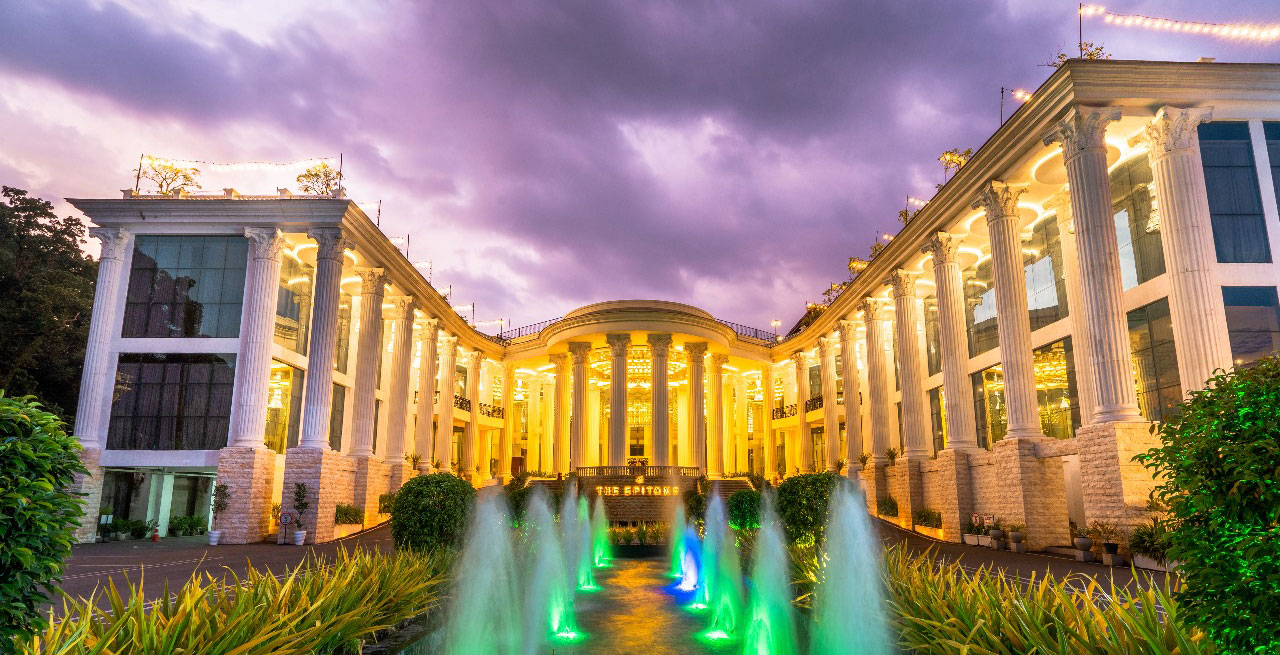
Envison your dream wedding day come to life at the Epitome Hotel, a prestigious city hotel in Kurunegala offering an unrivalled luxury rendors experience for weddings.
The venue is designed to embody opulence and luxury from all quarters for a spectacular wedding in kurunegala,Thier ballroom is the largest banquet facility in Sri Lanka It can be divided into six luxurious pillarless wedding halls on the ground floor and 25pax smaller banquet halls.
It can be easily named as a five star heaven in the heart of the city contributing to a myriad of immense experiences tailored to inspire and delight wedding experiences.
From opulent décor set up to exquisite table decor, lavish food, every detail is meticulously curated to spark your imagination and ignite creativity for a perfect wedding. The previous prestigious wedding shows season one and season two attracted large crowds
were unique events which gave the wedding vendors and potential clients had an opportunity to connect and interact with each other. Beyond being a showcase it was a chance for the wedding vendors to unite and contribute to the vibrancy of the wedding industry. The wedding show covered all area of the bridal industry providing a comprehensive variety of bridal supplies from Sri lanka and became the most popular bridal exhibitions in Kurunegala.This bridal exhibitions allowed brides and grooms to experience first hand the products and services available from suppliers in Sri Lanka
These wedding shows held at The Epitome created a benchmark and gave an opportunity for vendors to create connections to the utmost satisfaction said Harshan Lakshita Executive Director. of the magnificent Hotel
Our wedding shows featured experts and professionals in every field‘ It covered all areas of the bridal industry provided a comprehensive variety of bridal supplies from Sri lanka and became most popular bridal exhibition in this region.We are always open to everyone to join us at our wedding shows in the future. It is an opportunity to discover the incredible talent within our local wedding and bridal vendors to make meaningful relationships and plan thier special day at our breathtaking hotel The Epitome said General Manager Kavinda Caldera
The Epitome Hotel’s bridal show which will be held end of June will buzz with great ideas,advice and inspiration for all those who plan thier dream wedding
…….
The Hotel Epitome’s Wedding Season 3 will marked excellence, celebration and inspiration for those in the wedding industry. The exhibition halls will resonate with ideas on exquisite bridal wear to decor, florists , photography etc and showshowcase the rich tapestry of talent within the local wedding industry. .





US sports envoys to Lanka to champion youth development

Rahuman questions sudden cancellation of leave of CEB employees


