
Life style
Jack of many tastes

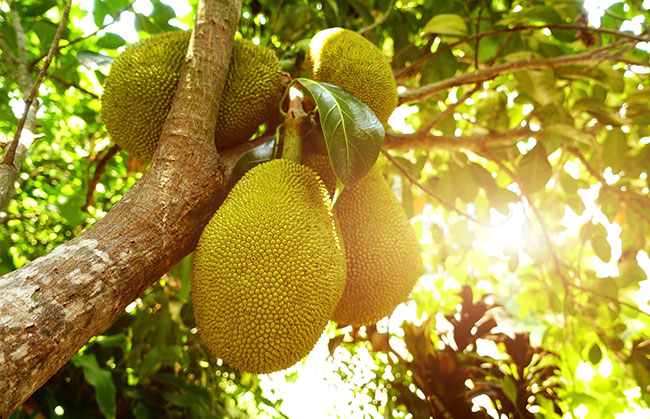
Jackfruit (sometimes written jak) or kos runs through Lankan lives, history and culture for several centuries. Rich with multiple disease-preventive properties, jackfruit is considered a ‘super food’ in many western countries. The tree which bears this largest tree-borne fruit which has fed our people in hard times is revered as buth gaha. Yet, the full potential of this wonder fruit found in abundance is still not tapped here at home.
BY RANDIMA ATTYGALLE
Jackfruit or kos preparation days of my childhood was not about cooking yet another curry for lunch or grabbing an ‘instant’ bag of pods or kos madulu from a vendor; it was a half-day undertaking, almost a ritual. In my grandparents’ sprawling garden, I would watch a domestic pluck a fruit off a jak tree and rip it open. Magilin achchci who would protect her time-tested recipes almost with her life would then take over, squatting before the giant fruit ready for the big task to follow.It would take a good hour or two for her to clean the yellow bulbs of koholle (the sticky substance inherent in the fruit) with coconut oil. An underling would join her to speed up the exercise and if a visiting old hand happened to be around, she too would join. Sipping their mid-day kahata or plain tea, gossip would abound cleaning kos madulu for the pot.
Jackfruit is a popular rice substitute in rural Sri Lanka often accompanied with traditionals like pol sambol and dried fish or karawala – an epicurean delight. The Jack tree is revered by Lankans as buth gaha translating to ‘rice tree’. The fruit has fed many Lankans during food shortages through history and the COVID pandemic is the newest on the list. Selling a bag or two of kos daily during the first two waves of the pandemic also helped feed many families here.
Botanically termed
Artocarpus heterophyllus, jackfruit. the largest of all fruit known in the world, originated in the Indo-Malayan region. From there it spread to neighbouring Sri Lanka, South China, South East Asia and also to certain parts of Africa including Kenya, Uganda, Zanzibar, Mauritius and Madagascar. It also found its way to Brazil, Jamaica and Australia. The major jackfruit growing areas in the world are Bangladesh (where it is designated as the national fruit), Brazil, Myanmar, India, Indonesia, Nepal, Malaysia, Thailand and Philippines.
Acclaimed by villagers as a kiri gaha or a tree with sap, the jackfruit tree is also associated with many superstitious and rituals with a long history of that here at home. Historical records such as Mahawansa, Amawathura and Visuddi Margaya chronicle such connections. Robert Knox in his book, An Historical Relation of the Island Ceylon too refers to the tree and its values. “Certain literary sources also document that a jackfruit orchard of 100,000 plants was grown under the royal patronage of Maha Parakramabahu. In early Sinhala literature this fruit is referred to by many terms including pana, panasa, herali and kos. Some of the names of towns and villages also reflect the close association Lankans have had with this fruit.
Kosgoda, Kosmulla, Koswatta, Kosgama, Panagoda, Panamure, Panamaldeniya and Heraliyawa are some examples,” points out the former Head of Fruits Division and Senior Research Officer from Horticultural Crops Research and Development Institute (HORDI) in Gannoruwa, Indrani Medagoda. The fruit research scientist who has extensively studied and presented papers on jackfruit also says that although it is consumed as a substitute for rice, it remains an underutilized crop in local agriculture. “Only about 30% of the total production is consumed and rest is wasted,” remarks Medagoda who calls for strategies to enhance the utilization of this wonder fruit to increase the income of growers and to enhance its contribution towards food security.
Jackfruit is considered to be an essential crop in the island given its multiple values include timber, medicinal, cultural and environmental. There are two fruiting seasons explains Medagoda. “March-June is the major season and November to January is the minor season. However, there are some off-season and year-round bearing trees as well.”
The traditional knowledge on jackfruit is used only at household level and dissemination of such knowledge among the growers and other interest groups is important remarks the scientist. “An integrated approach is needed to improve the conservation and utilization of genetic resources of the jak trees growing in Sri Lanka. This would improve productivity, quality and income from cultivation and will contribute to poverty alleviation and increased food security among the rural communities,” she adds.
Philanthropist and independence fighter Arthur V Dias, a landowner/planter, pioneered a jackfruit propagation across the island in 1918 earning himself the endearment Kos Mama. His campaign was instrumental in declaring jak a protected tree and none can be felled without a permit testifying to its importance in the country.
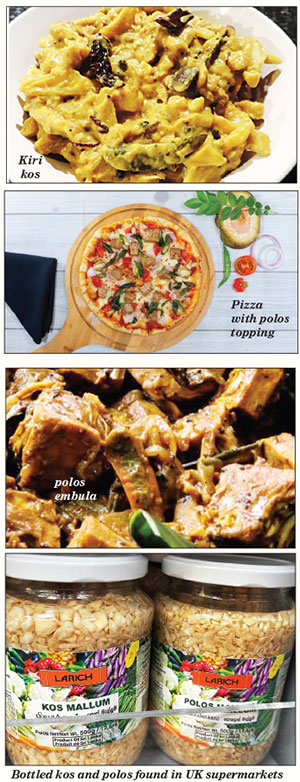
Jackfruit comes in many a form; an immature fruit which is polos is often cooked as a curry popular as polos ambula. Another is polos mallum. Polos ambula is now popular in overseas restaurants as well. “At one time polos was available only in Asian supermarkets in England, but today it is available in most supermarkets and stocks run out very quickly. It is a very popular vegetarian dish and is also a popular substitute for pulled pork dishes in restaurants,” says Padma Tennakoon from Staffordshire in the UK.
A can of jackfruit costs around
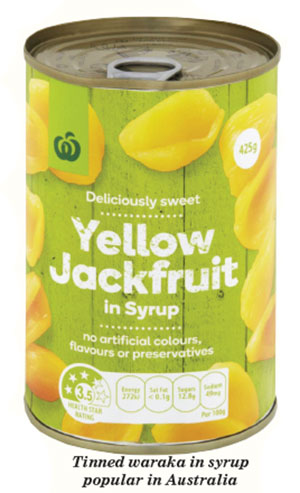
£ 3.50 in the UK and the price varies from shop to shop says Padma who had been living in England for nearly 50 years now. She loves the honey-sweet waraka (ripe jackfruit bulb) as well as jak in its other forms. “Waraka too is available canned but still found only in Asian supermarkets. Nothing can match fresh kos and waraka we used to enjoy back home in Sri Lanka but when you live abroad craving our traditional food, we are more than happy to have them even in tins or jars,” she says.
Jackfruit is popular in Australia as well. It is found canned, frozen and raw in both local and Sri Lankan supermarkets, says Lanchana Alwis who is reading for her Master’s degree in the University of Melbourne. “Raw jak is expensive compared to other fruits here. It is about $16 a kilo. A can (400g) costs about $4.50. Although I have still not seen it served as a curry in Australian restaurants, most Lankan restaurants in Melbourne serve kos curry for lunch and it is quite popular even among the locals. However, certain Australian restaurants offer BBQ jackfruit sandwiches and pulled jackfruit tacos.”
Jackfruit can be served boiled, as a kos beduma, atu kos, kos eta beduma and kalu pol maluwa. Ripe fruit could be either waraka or vela. Waraka is firmer than vela which is slimy and less preferred. Waraka sprinkled with a dash of pepper and salt is a succulent dessert and its fruity aroma is hard to hide. Some like it, others don’t.
The disease-preventive properties of jackfruit have earned it recognition as a ‘super food’ in many western countries, says Head of Nutrition at the Department of Nutrition at the Medical Research Institute (MRI) and President of the Sri Lanka Medical Nutrition Association (SLMNA), Dr. Renuka Jayatissa. “Sri Lanka has still not fully recognized the fruit’s health benefits and measures need to be in place to be more creative with its preparation and popularize it among young people,” observes Dr. Jayatissa who cites roasted jackfruit as an example. “This could be a healthy snack with less energy which would not affect weight.”
Although a few upmarket outlets and restaurants are experimenting with jackfruit dishes, the potential is still largely unoptimized says the Clinical Nutritionist. “Jackfruit can be a healthy filling for cutlets and patties and polos is a wonderful topping for pizzas. These should be made more freely available.”
Jackfruit is a rich source of potassium which is essential to maintain healthy blood pressure levels and a third of our daily potassium requirement could be met with one tea cup of jackfruit explains Dr. Jayatissa. A very rich source of fibre as well, jackfruit consumption could minimize the risk of colon and prostate cancer. Its antioxidants have cancer preventive properties, especially against breast cancer, she says.
Jackfruit is a also a good source of Vitamin A and magnesium. “A cup of jackfruit can meet 40% of the daily requirement of magnesium which helps prevent muscle cramps. Jak seeds are a good source of proteins and energy and it is always encouraged to cook jak with the seeds. Other curries made out of seeds such as kalu pol maluwa are very healthy.”
The ripe waraka has more carbohydrates than the raw fruit says Dr. Jayatissa. “The good news is that waraka is a low-carb food and even those with diabetes can safely enjoy it as it has the bonus of minimizing the absorption of carbohydrates because of the presence of fibre. It is a wonder fruit which is capable of controlling the sugar levels with the help of fibre,” says Dr. Jayatissa who encourages restaurant owners and chefs to be make optimum use of this fully organic nature’s panacea which is found in abundance countrywide.



Institute of Hospitality Sri Lanka
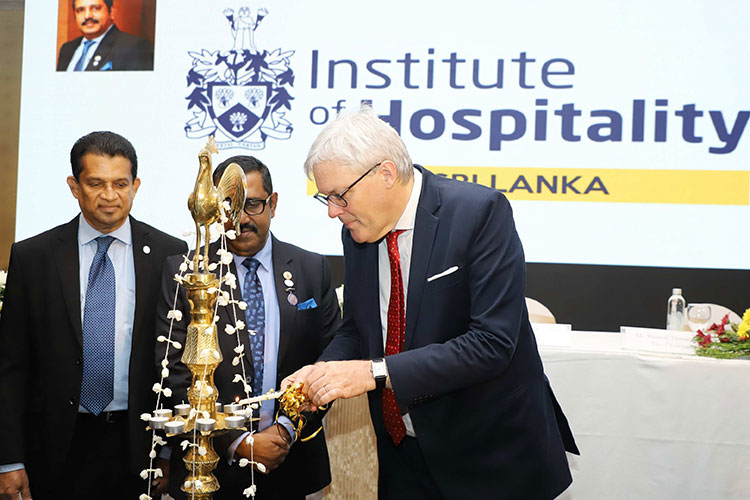
 The 32nd Annual General Meeting (AGM) of the UK-based Institute of Hospitality’s Sri Lanka Chapter was held recently at the Ramada Hotel Colombo,.The event provided an evening of camaraderie , reflection of the past and present achievements,setting new benchmarks for the future
The AGM had the presence of two distinguished guests, the Chief Guest Opposition Leader Sajith Premadasa, and the Guest of Honour British High Commissioner to Sri Lanka, Andrew Patrick. Their inspiring speeches were lauded by all hoteliers who were present at the occasion
A special thanks was extended to Robert Richardson, CEO of the Institute of Hospitality UK, along with his team, sponsors, committee members, and all attendees for making the event memorable.
Dr. Harsha Jayasingh, Past President of the Institute of Hospitality (UK) Sri Lanka Chapter, emphasised the Institute’s longstanding history and the strength of its Sri Lankan branch. “The Institute of Hospitality (IH) UK has a history of 86 years, and we are proud to be the Sri Lanka Branch. IH Sri Lanka is much stronger now with many members from all areas of the hospitality industry,” he stated.
Dr. Jayasingh highlighted the significant role of tourism in Sri Lanka’s economy,. He said tourism it is the third-largest source of revenue for the country. “Tourism accounts for about 13.3% of total foreign exchange earnings and employs 450,000 people directly and indirectly. The hospitality industry in this island of pearl holds tremendous potential for economic growth, job creations, and cultural exchange,” he added.
He also pointed out more women should be attracted to the industry and advocated for the use of technology in hospitality sector to attract the younger generation.
The newly appointed Chairman Ramesh Dassanayake spoke about the challenges faced by the industry, including the reluctance of youth to join the sector. . Dassanayake expressed concerns over the migration of staff between hotels and the overall ‘brain drain’ in the sector. ” We must maintain high standards in the hotel We must try to attract tourists to Sri Lanka, we must have with many facilities Hence, hotel schools and other professional institutions involved in skills development mustincrease their intakes,” he pointed out.
Chief Guest Sajith Premadasa emphasised the importance of eco tourism and said “We need to have an environmental policy related to tourism in place,” . .
The 32nd AGM of the Institute of Hospitality UK, Sri Lanka Chapter, was a testament to the strength and potential of Sri Lanka’s hospitality industry. The insights and commitments shared during the event set a new benchmark for the future.(ZC)


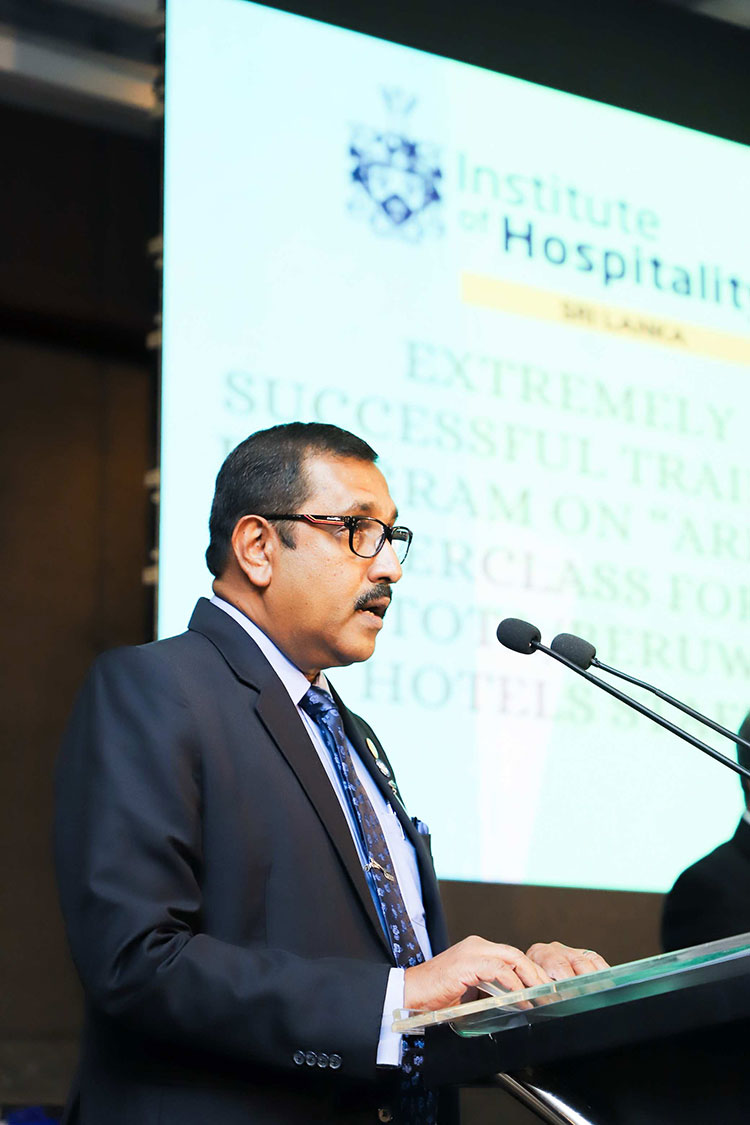

Pix by Thushara Attapathu
Life style
He recognizes human identity beyond boundaries of gender, race, nationality and religion.

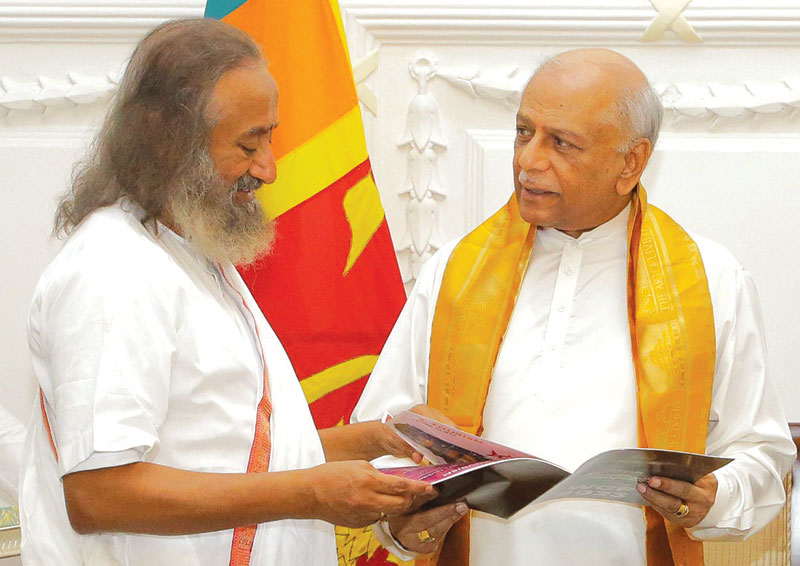
Visit of Sri Gurudev to Sri Lanka
Humanitarian, spiritual leader and Global Ambassador of Peace Gurudev Sri Sri Ravi Shankar (Sri Gurudev) was in Sri Lanka on a three day tour on the invitation of the Prime Minister of Sri Lanka Dinesh Gunewardene. Gurudev who inspired a wave of volunteerism and service to moot one of the largest volunteer-based organisations in the world – The Art of Living – visited the various projects under the aegis of the foundation and launched twelve vocational and technical centers around the island. He was accompanied by thousands of followers from Sri Lanka and around the world.
Gurudev who visited Sri Lanka for the sixth time also had a first day cover launched in honour of his visit. He is a strong proponent of spreading happiness, using the unique Sudarshan Kriya, yoga, meditation and practical wisdom to unite people, empower individuals and transform communities. His programmes provide techniques and tools to live a deeper, more joyous life, while his non-profit organisations recognize the human identity beyond the boundaries of gender, race, nationality and religion.
The Art of Living which has more than 30,000 teachers and over one million volunteers across 180 countries has touched in excess of five hundred million people around the world. CNN called it “Life Changing” and The Washington Post headlined it, “Fresh air to millions”.
In Trincomalee, Gurudev met with war victims and had a heartwarming engagement with the children from the children’s homes run by the Foundation. He also visited the Koneswara Temple in Trincomalee and graced the Kumbhabhishekam at Seetha ecogPnize the human identity beyond the boundaries of gender, race, nationality and religion. Amman temple at Nuwara Eliya. He held discussions with the trustees on the progress of the foundation’s social service projects, while also holding a special event – Ekamuthuwa – attended by a large number of dignitaries and his devotees from around the world.
His time with the Prime Minister was spent discussing the prospects of unity in diversity and uniting Sri Lanka by adding happiness into the formula of living. In addition he had discussions with the Speaker of the Parliament of Sri Lanka Mahinda Yapa Abeywardena, prominent business stewards and civil society leaders.
by Zanita Careem
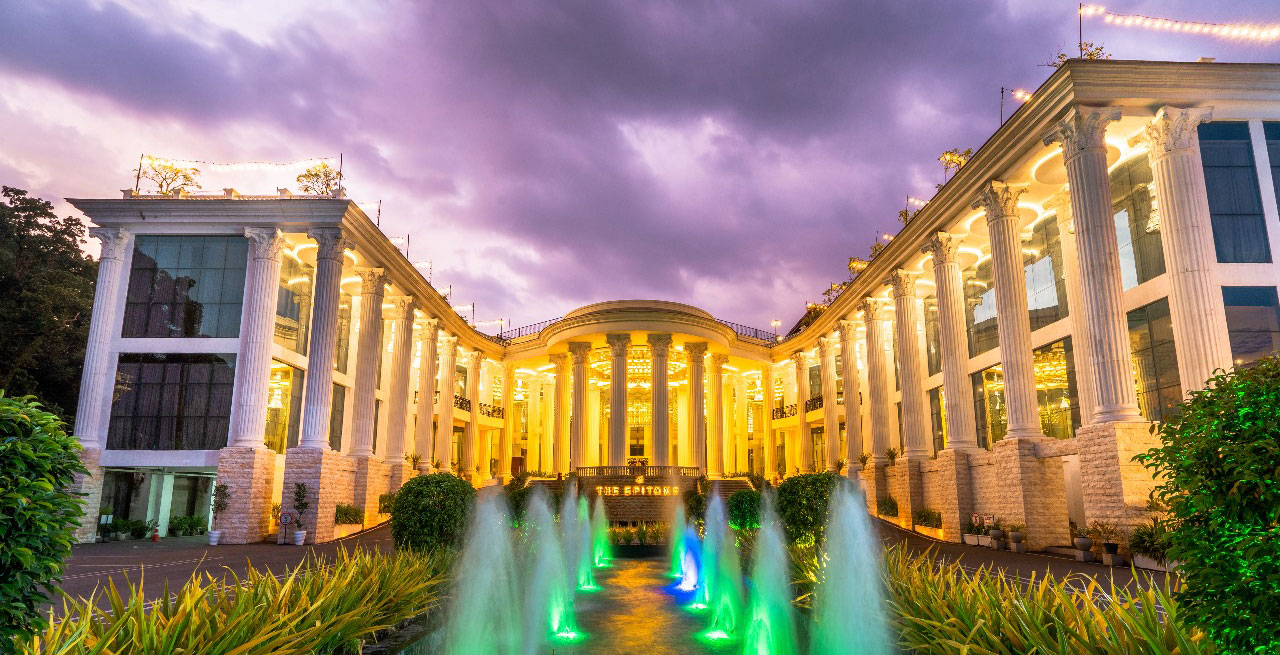
Envison your dream wedding day come to life at the Epitome Hotel, a prestigious city hotel in Kurunegala offering an unrivalled luxury rendors experience for weddings.
The venue is designed to embody opulence and luxury from all quarters for a spectacular wedding in kurunegala,Thier ballroom is the largest banquet facility in Sri Lanka It can be divided into six luxurious pillarless wedding halls on the ground floor and 25pax smaller banquet halls.
It can be easily named as a five star heaven in the heart of the city contributing to a myriad of immense experiences tailored to inspire and delight wedding experiences.
From opulent décor set up to exquisite table decor, lavish food, every detail is meticulously curated to spark your imagination and ignite creativity for a perfect wedding. The previous prestigious wedding shows season one and season two attracted large crowds
were unique events which gave the wedding vendors and potential clients had an opportunity to connect and interact with each other. Beyond being a showcase it was a chance for the wedding vendors to unite and contribute to the vibrancy of the wedding industry. The wedding show covered all area of the bridal industry providing a comprehensive variety of bridal supplies from Sri lanka and became the most popular bridal exhibitions in Kurunegala.This bridal exhibitions allowed brides and grooms to experience first hand the products and services available from suppliers in Sri Lanka
These wedding shows held at The Epitome created a benchmark and gave an opportunity for vendors to create connections to the utmost satisfaction said Harshan Lakshita Executive Director. of the magnificent Hotel
Our wedding shows featured experts and professionals in every field‘ It covered all areas of the bridal industry provided a comprehensive variety of bridal supplies from Sri lanka and became most popular bridal exhibition in this region.We are always open to everyone to join us at our wedding shows in the future. It is an opportunity to discover the incredible talent within our local wedding and bridal vendors to make meaningful relationships and plan thier special day at our breathtaking hotel The Epitome said General Manager Kavinda Caldera
The Epitome Hotel’s bridal show which will be held end of June will buzz with great ideas,advice and inspiration for all those who plan thier dream wedding
…….
The Hotel Epitome’s Wedding Season 3 will marked excellence, celebration and inspiration for those in the wedding industry. The exhibition halls will resonate with ideas on exquisite bridal wear to decor, florists , photography etc and showshowcase the rich tapestry of talent within the local wedding industry. .







US sports envoys to Lanka to champion youth development

Rahuman questions sudden cancellation of leave of CEB employees


