
Features
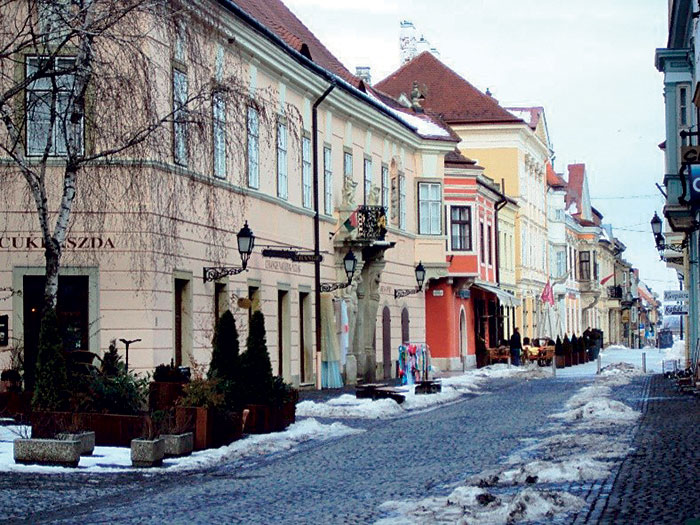
HUNGARY-CZECHOSLOVAKIA-LIECHTENSTEIN-SWITZERLAND

CONFESSIONS OF A GLOBAL GYPSY
By Dr. Chandana (Chandi) Jayawardena DPhil
President – Chandi J. Associates Inc. Consulting, Canada
Founder & Administrator – Global Hospitality Forum
chandij@sympatico.ca
After an enjoyable stay in Austria, we were ready to continue our six week-long winter trip to 16 countries. Vienna is a perfect hub to visit cities of countries adjoining landlocked Austria. Today, it is bordered by eight other countries – the Czech Republic and Germany to the north, Slovakia and Hungary to the east, Slovenia and Italy to the south, and Switzerland and Liechtenstein to the west. As the next step of our adventure, we planned to travel to Hungary and then Czechoslovakia, or Czecho-Slovakia
HUNGARY
Having arranged to travel to Hungary with a travel agency in Vienna, we woke up early morning to meet the Austrian driver/tour guide who came in a small van to pick us up. He was friendly and so were the other passengers, four British teachers working in Saudi Arabia. After an hour of travel from Vienna, we reached the Austria-Hungary border. There was a small challenge there. Hungarian visa officers required our photographs, but their photo machines were out of order. We were allowed to rush back to the Austrian side of the border to take photographs for Hungarian entry visas. After that, the trip was without any further setbacks.
Hungary is another landlocked country in Central Europe. The territory of present-day Hungary has for centuries been a crossroads for various peoples, including Celts, Romans, Germanic tribes, Huns, West Slavs and the Avars. The foundation of the Hungarian state was established in the late 9th century. By the 12th century, Hungary became a regional power, reaching its cultural and political height in the 15th century. After that it was partially occupied by the Ottoman Empire for over 150 years. Hungary came under Habsburg rule at the turn of the 18th century, later joining with the Austrian Empire to form Austria-Hungary, a major power into the early 20th century.
The Austro-Hungary Empire collapsed after World War I, and after World War II, Hungary became a satellite state of the Soviet Union. Following the failed 1956 revolution, Hungary became a comparatively freer, though still repressive, member of the Eastern Bloc. A few years after our visit in 1985, the removal of Hungary’s border fence with Austria accelerated the collapse of the Eastern Bloc and the Soviet Union. That was a part of a broad wave of revolutions in various communist countries of Central and Eastern Europe.
Győr
En-route to Budapest, the capital city of Hungary, we visited a small city with a population of 70,000, Győr. In spite of the small size, it is the sixth largest city in the country and it is also the main city of Northwest Hungary. As it is halfway between Vienna and Budapest, and situated on one of the important roads of Central Europe, it appeared to have some movement of tourists. In 1985, the total population of Hungary was around 10.5 million and today it has gone down below 10 million. Twenty percent of Hungarians or in 1985, over two million lived in Budapest.

Budapest
We reached Budapest by mid-morning and could not believe our eyes. Based on our first impressions and experiences in a few key cities in the Eastern Bloc countries in 1985, our expectations were not high. Budapest was clean, beautiful, grand and friendly. “No wonder that some call it the Paris of the East”, I told my wife.
The history of Budapest is the history of three cities: Óbuda (old Buda), Buda the high city found on the banks of the left bank, and Pest, found on the right bank. The history of Budapest began when an early Celtic settlement transformed into the Roman town of Aquincum. The Hungarians arrived in the territory in the late 9th century, but the area was pillaged by the Mongols in the mid-13th century. Re-established Buda became one of the centres of Renaissance humanist culture by the 15th century.
After the reconquest of Buda in late 17th century, after a 150 year long Ottoman rule, the region entered a new age of prosperity, in 1873, with the unification of Buda, Óbuda and Pest the name ‘Budapest’ given to the new capital of Hungary. Budapest also became the co-capital of the Austro-Hungarian Empire.
Bisected by the Danube River, Budapest’s cityscape is studded with architectural landmarks Buda’s medieval Castle Hill and grand neoclassical buildings along Pest’s Andrássy Avenue to the 19th-century Chain Bridge are impressive. Turkish and Roman influence on Hungarian culture explains the popularity of mineral spas, including at thermal Lake Hévíz.
We visited most of the key tourist attractions in Budapest and nearby areas, including Matthias Church, Buda Castle built in the 13th century, Fisherman’s Bastion, which is an architectural icon of the city, and one of Europe’s oldest and most beloved coffee-houses, Café Gerbeaud. Our lunch at a small restaurant included goulash soup which was much hotter than the versions I had tasted before, and used to prepare when I was an executive chef. I also made a short visit to the best five-star international hotel in the city, Budapest InterContinential. On our way back to Vienna, we stopped again in Győr for refreshments.
CZECOSLOVAKIA
Towards the end of our stay in Austria, I planned a quick trip to Czechoslovakia. My wife wanted to skip that trip to spend the day with her mother and our Austrian friends, doing fun things in Vienna. I went alone to Czechoslovakia early in the morning with a group of tourists travelling in a coach. Learning from a bad experience at the Bulgaria-Romania border, 10 days prior, I took the advice from the Austrian travel agency, and armed myself with an additional visa for Czechoslovakia.
Czechoslovakia was an interesting country with a population of 10 million divided among two main ethnic groups – the Czech people and the Slovak people. Ethnic Czechs were called Bohemians in English until the early 20th century, referring to the former name of their country, Bohemia. Czechoslovakia was a sovereign state created after the World War I, when it declared its independence from Austria-Hungary. In 1938, at the eve of World War II, a major territory of the country became part of Germany, while the country lost further territories to Hungary and Poland.
After World War II, the country of Czechoslovakia was re-established, with the exception of Carpathian Ruthenia, which became part of the Ukrainian SSR (a republic of the Soviet Union). From 1948, Czechoslovakia was part of the Eastern Bloc. A period of political liberalization in 1968, known as the Prague Spring, was violently ended when the Soviet Union, assisted by some other Warsaw Pact countries, invaded Czechoslovakia.
Four years after my visit, in 1989, as Marxist–Leninist governments (and communism) were ending all over Central and Eastern Europe, Czechoslovaks peacefully deposed their socialist government in the Velvet Revolution. Later, in 1993, Czechoslovakia peacefully split into the two sovereign states of the Czech Republic and Slovakia as the result of nationalist tensions among the Slovaks.
Bratislava
The tour coach reached Bratislava, by mid-morning. Bratislava in 1985, the second city of Czechoslovakia and today the capital of Slovakia, is set along the Danube River by the border with Austria and Hungary. It’s surrounded by vineyards and the Little Carpathian Mountains, criss-crossed with forested hiking and cycling trails. The pedestrian-only, 18th-century old town is known for its lively bars and cafés. When we reached the city, the coach left us and the driver asked us to meet him in the same spot in eight hours.
That was a challenging excursion as no one at information and tour desks spoke any English. My German was not good enough to find my way. Bratislava and suburbs had several universities, and as a result there were many student excursionist. I eventually became friendly with a couple of students from West Germany, who liked to practice speaking English, and a Czechoslovakian student. We created our own city itinerary for the day, with the help of her Slovak-English dictionary.
Bratislava Castle
We visited the picturesque Bratislava whose Old Town banks the Danube River. It is relatively a smaller city with a population of around 350,000. It is one of the best preserved medieval old towns in Europe. Besides the colourful medieval houses, impressive churches, bell towers and beautiful baroque palaces, the most enchanting building is definitely the Bratislava Castle. Perched atop a hill, the reconstructed Bratislava Castle overlooks old town and the Danube.
My new friends and I spent hours at the castle in the midst of heavy snowing. When snow fall eased, we walked a lot around the city. We had lunch in a Slovak cellar type restaurant. After lunch we continued our discovery tour by foot. It was wet and cold, but fun.
An Assignment in Switzerland
When I returned to Vienna, I received a call from Sri Lanka. It was my father-in-law who ran our family business – Streamline Services, a travel agency and hospitality consulting company. We also represented a few well-known hotel schools in Europe for whom our company recruited students from Sri Lanka.
My father-in-law, Captain Wick chatted over the telephone for a long time. He said, “Chandi, the HotelConsult Hotel School contract you secured for us three years ago has progressed well. When you are in Switzerland, HotelConsult has invited you to check their facilities, meet our students, have a luncheon meeting with the President of the school, and also deliver a guest lecture. Their main campus is in Brig, which is only a three-hour train ride from Zürich which you have planned to visit. Can you go there and spend a couple of days?”
I said, “Yes, Captain!” and changed my travel plans immediately. My wife and mother-in-law suggested that I go to Switzerland alone on the business trip while they went on to Munich to stay with our good Bavarian friends in West Germany. We agreed to part for three days.
After leaving Vienna, the train passed some beautiful Austrian villages as well as cities such as Linz, Salzburg, Innsbruck and Bludenz. Mr and Mrs. Schädler, an elderly couple returning to their country Liechtenstein, after a week in Vienna, became friendly with me, and were impressed with my hunger for global travels. “On your way to Zürich, why don’t you visit our country?” Mrs. Schädler asked me. When I told them that I don’t have a visa, Mr. Schädler was quick to encourage me saying “there are no border controls between Liechtenstein and Switzerland and, the Swiss visa is valid in Liechtenstein.” I was tempted.
The train reached the Swiss border city Buchs around 3:00 pm. When I realized that Liechtenstein was only five miles away, I changed my mind, and travel plans and got off the train. After leaving my bag in a station locker, I took a bus to Liechtenstein.

LIECHTENSTEIN
Liechtenstein is a German-speaking, 61-square mile wide principality between Austria and Switzerland. It’s known for its medieval castles, alpine landscapes and villages linked by a network of trails. In 1985, with a population of only 26,000 (today, 39,000 inhabitants) Liechtenstein is one of the smallest countries in the world. It is the same size as the District of Columbia, in the USA. Liechtenstein is the world’s wealthiest country. According to the World Bank, its annual per-capita income is $175,813, ranking Liechtenstein ahead of Monaco, Luxembourg, Switzerland and Bermuda in 2022.
Vaduz
Vaduz, the capital of Liechtenstein, sits on the Rhine River near the Swiss border. It is a cultural and financial centre, home to Kunstmuseum Liechtenstein, with galleries of modern and contemporary art. The Postmuseum displays Liechtenstein’s famous postage stamps. Although ideal for tourism, the largest hotel in the city had only 41 rooms! The main attraction is the Vaduz Castle.
Vaduz Castle
On a hillside overlooking the town, Vaduz Castle dates back to the 12th century and is a royal family residence. The nearby national museum houses archaeological and cultural artifacts in a medieval building. After a brief visit to Vaduz, I took a bus to return to Buchs in Switzerland. But I realized that it was now getting too late to travel to Brig according to my original plan before my spur of the moment decision to visit another country.
SWITZERLAND
Having travelled in Switzerland for studies and leisure three years ago, I was familiar with half a dozen key cities in this beautiful country. Switzerland’s political structure is fairly unique in the world. In total, there are 26 cantons (states of the Swiss Confederation) with an average population of 250,000 per canton. The primary language in 19 cantons is German, six cantons are French and one canton is Italian. In 1985 the population of Switzerland was only 6.5 million (today, nearly 10 million).
Before catching the last train from Buchs, I called HotelConsult to inform them about my slight change of travel plans. Then I called my Ceylon Hotel School batch mate and hostel mate for three years, Patrick Taylor (Patta) who was living in Zug with his Swiss wife, Judy. They met, fell in love and got married when Patta was the first Executive Chef of Triton Hotel and Judy was a Tour Leader for a Swiss tour operator in Sri Lanka. They invited me to their home, which was 30 minutes south of Zürich by train. They came to the Zug railway station to pick me up.
Zug
As I arrived in Zug, when it was very dark and cold, and did not see much. Zug is the main town and capital of the Swiss canton of Zug. The city is small and had a population of just over 20,000. Its name originates from the fishing vocabulary; in the Middle Ages it referred to the right to pull up fishing nets and hence to the right to fish. This town is well-known for its low taxes and affluence with beautiful nature. The historic town of Zug a favourite destination for those who are fond of discovering noteworthy landmarks.
I stayed in Patta and Judy’s house that night. Judy quickly prepared a traditional Swiss meal including Zürcher geschnetzeltes (meat cut Zürich-style), a simple but very tasty dish consisting of veal cooked with mushrooms, cream, onions and wine. Patta prepared rösti (a Swiss dish made with raw grated potatoes and butter).
Zürcher geschnetzeltes mit rösti
As Judy was starting a new job next day, she went to sleep early leaving Patta and I to catch up about our memorable college years. After dinner I had a long chat with Patta till early hours in the morning. We talked about how our lives have changed since we first met 14 years ago in Colombo. Judy had motivated Patta to set up a small business in Zug called, Taylor Catering Services. “Machang, I also make some income from a new hobby of mine, Patta told me.
Their apartment was beautiful and had a collection of large abstract paintings. Patta surprised me when he told me that he is the artist. Painting had been something he tried after settling in Switzerland. I never knew about my friend’s artistic talent when we were college students. Those beautiful paintings inspired me to try abstract painting myself. I did this for many years after that, with a few solo abstract art exhibitions in four countries in South Asia, South America, the Caribbean and North America. Thanks for the motivation, Patta!
Patrick Taylor and I during a CHS trip in early 1970s
Patta was fascinated with my travel record and future travel ambitions. “Machang, where else are you travelling during this trip before returning to your base in London?” he asked. I said, “just a few brief stops in Zürich, Bern, Brig, Lax, Fiesch, Lausanne, Luzern, Munich, Paris, Amiens, Boulogne-Sur-Mer and Dover.” Patta laughed loud and said, “The travel bug has certainly bitten you, Chandana!”
The last lap of the six-week long trip
To be continued next Sunday…


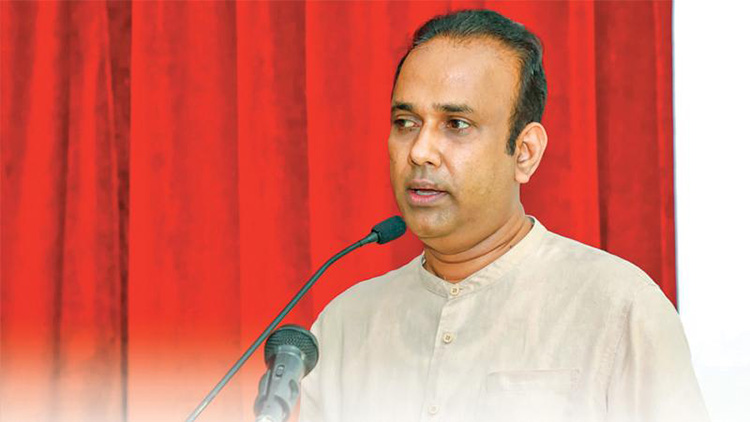
by Dr Gotabhya Ranasinghe
Senior Consultant Cardiologist
National Hospital Sri Lanka
When we sought a meeting with Hon Dr. Ramesh Pathirana, Minister of Health, he graciously cleared his busy schedule to accommodate us. Renowned for his attentive listening and deep understanding, Minister Pathirana is dedicated to advancing the health sector. His openness and transparency exemplify the qualities of an exemplary politician and minister.
Dr. Palitha Mahipala, the current Health Secretary, demonstrates both commendable enthusiasm and unwavering support. This combination of attributes makes him a highly compatible colleague for the esteemed Minister of Health.
Our discussion centered on a project that has been in the works for the past 30 years, one that no other minister had managed to advance.
Minister Pathirana, however, recognized the project’s significance and its potential to revolutionize care for heart patients.
The project involves the construction of a state-of-the-art facility at the premises of the National Hospital Colombo. The project’s location within the premises of the National Hospital underscores its importance and relevance to the healthcare infrastructure of the nation.
This facility will include a cardiology building and a tertiary care center, equipped with the latest technology to handle and treat all types of heart-related conditions and surgeries.
Securing funding was a major milestone for this initiative. Minister Pathirana successfully obtained approval for a $40 billion loan from the Asian Development Bank. With the funding in place, the foundation stone is scheduled to be laid in September this year, and construction will begin in January 2025.
This project guarantees a consistent and uninterrupted supply of stents and related medications for heart patients. As a result, patients will have timely access to essential medical supplies during their treatment and recovery. By securing these critical resources, the project aims to enhance patient outcomes, minimize treatment delays, and maintain the highest standards of cardiac care.
Upon its fruition, this monumental building will serve as a beacon of hope and healing, symbolizing the unwavering dedication to improving patient outcomes and fostering a healthier society.We anticipate a future marked by significant progress and positive outcomes in Sri Lanka’s cardiovascular treatment landscape within the foreseeable timeframe.

by Fr. Emmanuel Fernando, OMI
Jesuit Fr. Aloysius Pieris (affectionately called Fr. Aloy) celebrated his 90th birthday on April 9, 2024 and I, as the editor of our Oblate Journal, THE MISSIONARY OBLATE had gone to press by that time. Immediately I decided to publish an article, appreciating the untiring selfless services he continues to offer for inter-Faith dialogue, the renewal of the Catholic Church, his concern for the poor and the suffering Sri Lankan masses and to me, the present writer.
It was in 1988, when I was appointed Director of the Oblate Scholastics at Ampitiya by the then Oblate Provincial Fr. Anselm Silva, that I came to know Fr. Aloy more closely. Knowing well his expertise in matters spiritual, theological, Indological and pastoral, and with the collaborative spirit of my companion-formators, our Oblate Scholastics were sent to Tulana, the Research and Encounter Centre, Kelaniya, of which he is the Founder-Director, for ‘exposure-programmes’ on matters spiritual, biblical, theological and pastoral. Some of these dimensions according to my view and that of my companion-formators, were not available at the National Seminary, Ampitiya.
Ever since that time, our Oblate formators/ accompaniers at the Oblate Scholasticate, Ampitiya , have continued to send our Oblate Scholastics to Tulana Centre for deepening their insights and convictions regarding matters needed to serve the people in today’s context. Fr. Aloy also had tried very enthusiastically with the Oblate team headed by Frs. Oswald Firth and Clement Waidyasekara to begin a Theologate, directed by the Religious Congregations in Sri Lanka, for the contextual formation/ accompaniment of their members. It should very well be a desired goal of the Leaders / Provincials of the Religious Congregations.
Besides being a formator/accompanier at the Oblate Scholasticate, I was entrusted also with the task of editing and publishing our Oblate journal, ‘The Missionary Oblate’. To maintain the quality of the journal I continue to depend on Fr. Aloy for his thought-provoking and stimulating articles on Biblical Spirituality, Biblical Theology and Ecclesiology. I am very grateful to him for his generous assistance. Of late, his writings on renewal of the Church, initiated by Pope St. John XX111 and continued by Pope Francis through the Synodal path, published in our Oblate journal, enable our readers to focus their attention also on the needed renewal in the Catholic Church in Sri Lanka. Fr. Aloy appreciated very much the Synodal path adopted by the Jesuit Pope Francis for the renewal of the Church, rooted very much on prayerful discernment. In my Religious and presbyteral life, Fr.Aloy continues to be my spiritual animator / guide and ongoing formator / acccompanier.
Fr. Aloysius Pieris, BA Hons (Lond), LPh (SHC, India), STL (PFT, Naples), PhD (SLU/VC), ThD (Tilburg), D.Ltt (KU), has been one of the eminent Asian theologians well recognized internationally and one who has lectured and held visiting chairs in many universities both in the West and in the East. Many members of Religious Congregations from Asian countries have benefited from his lectures and guidance in the East Asian Pastoral Institute (EAPI) in Manila, Philippines. He had been a Theologian consulted by the Federation of Asian Bishops’ Conferences for many years. During his professorship at the Gregorian University in Rome, he was called to be a member of a special group of advisers on other religions consulted by Pope Paul VI.
Fr. Aloy is the author of more than 30 books and well over 500 Research Papers. Some of his books and articles have been translated and published in several countries. Among those books, one can find the following: 1) The Genesis of an Asian Theology of Liberation (An Autobiographical Excursus on the Art of Theologising in Asia, 2) An Asian Theology of Liberation, 3) Providential Timeliness of Vatican 11 (a long-overdue halt to a scandalous millennium, 4) Give Vatican 11 a chance, 5) Leadership in the Church, 6) Relishing our faith in working for justice (Themes for study and discussion), 7) A Message meant mainly, not exclusively for Jesuits (Background information necessary for helping Francis renew the Church), 8) Lent in Lanka (Reflections and Resolutions, 9) Love meets wisdom (A Christian Experience of Buddhism, 10) Fire and Water 11) God’s Reign for God’s poor, 12) Our Unhiddden Agenda (How we Jesuits work, pray and form our men). He is also the Editor of two journals, Vagdevi, Journal of Religious Reflection and Dialogue, New Series.
Fr. Aloy has a BA in Pali and Sanskrit from the University of London and a Ph.D in Buddhist Philosophy from the University of Sri Lankan, Vidyodaya Campus. On Nov. 23, 2019, he was awarded the prestigious honorary Doctorate of Literature (D.Litt) by the Chancellor of the University of Kelaniya, the Most Venerable Welamitiyawe Dharmakirthi Sri Kusala Dhamma Thera.
Fr. Aloy continues to be a promoter of Gospel values and virtues. Justice as a constitutive dimension of love and social concern for the downtrodden masses are very much noted in his life and work. He had very much appreciated the commitment of the late Fr. Joseph (Joe) Fernando, the National Director of the Social and Economic Centre (SEDEC) for the poor.
In Sri Lanka, a few religious Congregations – the Good Shepherd Sisters, the Christian Brothers, the Marist Brothers and the Oblates – have invited him to animate their members especially during their Provincial Congresses, Chapters and International Conferences. The mainline Christian Churches also have sought his advice and followed his seminars. I, for one, regret very much, that the Sri Lankan authorities of the Catholic Church –today’s Hierarchy—- have not sought Fr.
Aloy’s expertise for the renewal of the Catholic Church in Sri Lanka and thus have not benefited from the immense store of wisdom and insight that he can offer to our local Church while the Sri Lankan bishops who governed the Catholic church in the immediate aftermath of the Second Vatican Council (Edmund Fernando OMI, Anthony de Saram, Leo Nanayakkara OSB, Frank Marcus Fernando, Paul Perera,) visited him and consulted him on many matters. Among the Tamil Bishops, Bishop Rayappu Joseph was keeping close contact with him and Bishop J. Deogupillai hosted him and his team visiting him after the horrible Black July massacre of Tamils.
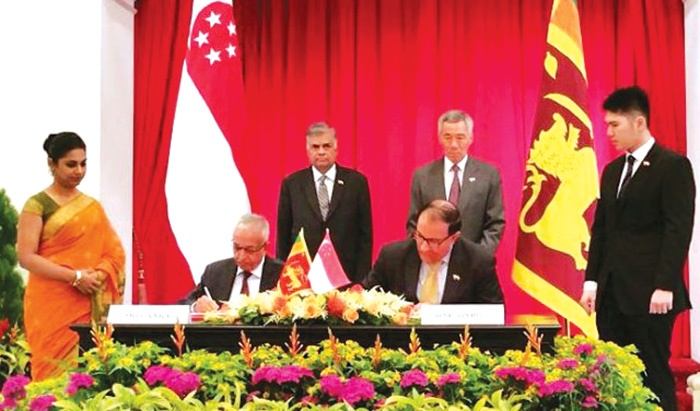
Sri Lanka-Singapore Free Trade Agreement
By Gomi Senadhira
senadhiragomi@gmail.com
“You might tell fairy tales, but the progress of a country cannot be achieved through such narratives. A country cannot be developed by making false promises. The country moved backward because of the electoral promises made by political parties throughout time. We have witnessed that the ultimate result of this is the country becoming bankrupt. Unfortunately, many segments of the population have not come to realize this yet.” – President Ranil Wickremesinghe, 2024 Budget speech
Any Sri Lankan would agree with the above words of President Wickremesinghe on the false promises our politicians and officials make and the fairy tales they narrate which bankrupted this country. So, to understand this, let’s look at one such fairy tale with lots of false promises; Ranil Wickremesinghe’s greatest achievement in the area of international trade and investment promotion during the Yahapalana period, Sri Lanka-Singapore Free Trade Agreement (SLSFTA).
It is appropriate and timely to do it now as Finance Minister Wickremesinghe has just presented to parliament a bill on the National Policy on Economic Transformation which includes the establishment of an Office for International Trade and the Sri Lanka Institute of Economics and International Trade.
Was SLSFTA a “Cleverly negotiated Free Trade Agreement” as stated by the (former) Minister of Development Strategies and International Trade Malik Samarawickrama during the Parliamentary Debate on the SLSFTA in July 2018, or a colossal blunder covered up with lies, false promises, and fairy tales? After SLSFTA was signed there were a number of fairy tales published on this agreement by the Ministry of Development Strategies and International, Institute of Policy Studies, and others.
However, for this article, I would like to limit my comments to the speech by Minister Samarawickrama during the Parliamentary Debate, and the two most important areas in the agreement which were covered up with lies, fairy tales, and false promises, namely: revenue loss for Sri Lanka and Investment from Singapore. On the other important area, “Waste products dumping” I do not want to comment here as I have written extensively on the issue.
1. The revenue loss
During the Parliamentary Debate in July 2018, Minister Samarawickrama stated “…. let me reiterate that this FTA with Singapore has been very cleverly negotiated by us…. The liberalisation programme under this FTA has been carefully designed to have the least impact on domestic industry and revenue collection. We have included all revenue sensitive items in the negative list of items which will not be subject to removal of tariff. Therefore, 97.8% revenue from Customs duty is protected. Our tariff liberalisation will take place over a period of 12-15 years! In fact, the revenue earned through tariffs on goods imported from Singapore last year was Rs. 35 billion.
The revenue loss for over the next 15 years due to the FTA is only Rs. 733 million– which when annualised, on average, is just Rs. 51 million. That is just 0.14% per year! So anyone who claims the Singapore FTA causes revenue loss to the Government cannot do basic arithmetic! Mr. Speaker, in conclusion, I call on my fellow members of this House – don’t mislead the public with baseless criticism that is not grounded in facts. Don’t look at petty politics and use these issues for your own political survival.”
I was surprised to read the minister’s speech because an article published in January 2018 in “The Straits Times“, based on information released by the Singaporean Negotiators stated, “…. With the FTA, tariff savings for Singapore exports are estimated to hit $10 million annually“.
As the annual tariff savings (that is the revenue loss for Sri Lanka) calculated by the Singaporean Negotiators, Singaporean $ 10 million (Sri Lankan rupees 1,200 million in 2018) was way above the rupees’ 733 million revenue loss for 15 years estimated by the Sri Lankan negotiators, it was clear to any observer that one of the parties to the agreement had not done the basic arithmetic!
Six years later, according to a report published by “The Morning” newspaper, speaking at the Committee on Public Finance (COPF) on 7th May 2024, Mr Samarawickrama’s chief trade negotiator K.J. Weerasinghehad had admitted “…. that forecasted revenue loss for the Government of Sri Lanka through the Singapore FTA is Rs. 450 million in 2023 and Rs. 1.3 billion in 2024.”
If these numbers are correct, as tariff liberalisation under the SLSFTA has just started, we will pass Rs 2 billion very soon. Then, the question is how Sri Lanka’s trade negotiators made such a colossal blunder. Didn’t they do their basic arithmetic? If they didn’t know how to do basic arithmetic they should have at least done their basic readings. For example, the headline of the article published in The Straits Times in January 2018 was “Singapore, Sri Lanka sign FTA, annual savings of $10m expected”.
Anyway, as Sri Lanka’s chief negotiator reiterated at the COPF meeting that “…. since 99% of the tariffs in Singapore have zero rates of duty, Sri Lanka has agreed on 80% tariff liberalisation over a period of 15 years while expecting Singapore investments to address the imbalance in trade,” let’s turn towards investment.
Investment from Singapore
In July 2018, speaking during the Parliamentary Debate on the FTA this is what Minister Malik Samarawickrama stated on investment from Singapore, “Already, thanks to this FTA, in just the past two-and-a-half months since the agreement came into effect we have received a proposal from Singapore for investment amounting to $ 14.8 billion in an oil refinery for export of petroleum products. In addition, we have proposals for a steel manufacturing plant for exports ($ 1 billion investment), flour milling plant ($ 50 million), sugar refinery ($ 200 million). This adds up to more than $ 16.05 billion in the pipeline on these projects alone.
And all of these projects will create thousands of more jobs for our people. In principle approval has already been granted by the BOI and the investors are awaiting the release of land the environmental approvals to commence the project.
I request the Opposition and those with vested interests to change their narrow-minded thinking and join us to develop our country. We must always look at what is best for the whole community, not just the few who may oppose. We owe it to our people to courageously take decisions that will change their lives for the better.”
According to the media report I quoted earlier, speaking at the Committee on Public Finance (COPF) Chief Negotiator Weerasinghe has admitted that Sri Lanka was not happy with overall Singapore investments that have come in the past few years in return for the trade liberalisation under the Singapore-Sri Lanka Free Trade Agreement. He has added that between 2021 and 2023 the total investment from Singapore had been around $162 million!
What happened to those projects worth $16 billion negotiated, thanks to the SLSFTA, in just the two-and-a-half months after the agreement came into effect and approved by the BOI? I do not know about the steel manufacturing plant for exports ($ 1 billion investment), flour milling plant ($ 50 million) and sugar refinery ($ 200 million).
However, story of the multibillion-dollar investment in the Petroleum Refinery unfolded in a manner that would qualify it as the best fairy tale with false promises presented by our politicians and the officials, prior to 2019 elections.
Though many Sri Lankans got to know, through the media which repeatedly highlighted a plethora of issues surrounding the project and the questionable credentials of the Singaporean investor, the construction work on the Mirrijiwela Oil Refinery along with the cement factory began on the24th of March 2019 with a bang and Minister Ranil Wickremesinghe and his ministers along with the foreign and local dignitaries laid the foundation stones.
That was few months before the 2019 Presidential elections. Inaugurating the construction work Prime Minister Ranil Wickremesinghe said the projects will create thousands of job opportunities in the area and surrounding districts.
The oil refinery, which was to be built over 200 acres of land, with the capacity to refine 200,000 barrels of crude oil per day, was to generate US$7 billion of exports and create 1,500 direct and 3,000 indirect jobs. The construction of the refinery was to be completed in 44 months. Four years later, in August 2023 the Cabinet of Ministers approved the proposal presented by President Ranil Wickremesinghe to cancel the agreement with the investors of the refinery as the project has not been implemented! Can they explain to the country how much money was wasted to produce that fairy tale?
It is obvious that the President, ministers, and officials had made huge blunders and had deliberately misled the public and the parliament on the revenue loss and potential investment from SLSFTA with fairy tales and false promises.
As the president himself said, a country cannot be developed by making false promises or with fairy tales and these false promises and fairy tales had bankrupted the country. “Unfortunately, many segments of the population have not come to realize this yet”.
(The writer, a specialist and an activist on trade and development issues . )



US sports envoys to Lanka to champion youth development

Rahuman questions sudden cancellation of leave of CEB employees


