Features
How can we tackle issue in tea sector?

By Prof. Kapila G Prematilake
Department of Export Agriculture Faculty of Animal Science & Export Agriculture Uva Wellassa University
Scope of this article is to give some insight into the soil fertility status of tea soils and current situation of fertiliser usage in tea sector and the potential to proceed with organic fertiliser usage in the future
. It is apparent that the current agronomic practices undertaken in tea fields are not quite sufficient to meet the total demand for organic fertilisers. Further improvement in soil organic matter status is therefore very necessary in order to achieve the future goals in tea production.
The use of organic fertilisers to tea is not of recent origin; it was recommended many years ago with the understanding of their paramount importance in maintaining the physical, chemical and biological properties of soil and therein enhancing the nutrients availability in soil enabling uptake them by plants.
A large amount of plant parts from different sources which are generally considered ‘organic matter’,such as rehabilitation grasses, shade tree loppings, mulch materials, green manure plants, weed compost, pruned litter etc. is added to soil in a tea field. These organic matters are subjected to decompose and mineralise their complex compounds such as protein, peptides, amino acids and amides by soil-dwelling macro, meso and micro fauna and flora. Hence, only a fraction of nutrients such as Nitrogen (N), Phosphorus (P2O5) and Potassium (K2O) and carbon (C) in organic matter is released by mineralization in plant available forms: NH4+ NO3– , PO4-3, HPO4-2, H2PO4– and K+ ions.


Further, soil carbon supplied from organic matter is subjected to periodical burn at 1% per annum, i.e. 10-20 m tons/ha. Hence, a high level of carbon cannot be sustained without a regular supply and proper management. As such, organic matter has to be supplied at least at the rate of 10, 15 and 20 m.tons/ha/yr for the Up country, mid country and low country, tea lands, respectively. Therefore, there are enormous benefit of increasing the organic matter fraction of soil as a fertility promoting strategy.
In tea cultivation the capacity of in situ supplying of organic matter is enormous as indicated above. Tea being a shade loving plant it needs an optimum shade level to grow, hence high and low shade trees have been established in tea fields. The low shade tree species such as Gliricidia, Dadap and Calliandra not only provide shade but also supply green manure by lopping or pruning branches periodically and adding them to the soil. High shade tree species such as Albezzia and Grevillea also provide green manure by pruning (pollarding) their branches annually. In addition, a variety of green manure crops such as Crotolaria species Artimesia vulgaris (Nochchi), Sesbania sesban (Wal Katurumurunga), Sambucas javonica (Eldebery), Tithonia diversifolia (Wild sunflower) can be planted for in situ supply of green manure to tea fields.
The total dry matter of organic matter added to mature a tea field by aforementioned various agronomic practices was estimated to be 79-130 m tons/ha/annum (Table 1). Of this amount nitrogen (N), phosphorus (P2O5), potassium (K2O) and Carbon (C) composite at the rate of 592-958 kg/ha, 135-220 kg/ha, 444-716 kg /ha and 8.4-13.8 m tons/ha, respectively. Table 1:


When fertiliser requirement as per the TRI recommendation is considered, there is about 100 kg deficit in N for VP tea when supplied by organic matter. There are at least 45-50 plucking rounds per annum at this phase, and therefore, an additional amount of organic matter has to be supplied definitely to offset the lost plant nutrients with regular plucking. However, in regard to seed tea nutrients available with organic manure is found to be at a manageable level Table 2:
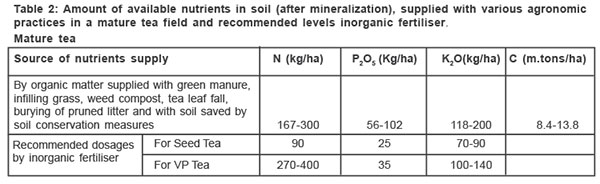


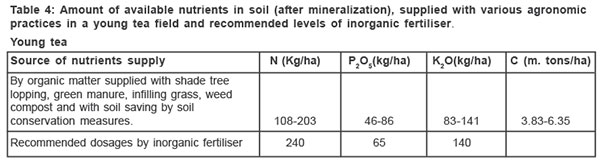
It is thus apparent that there is some short in supply of nutrients at the all mature, young and new clearing phases when treated with organic compounds. Furthermore, it should be noted that in tea soil it is required to maintain the ratio between nitrogen and potassium around 2:1. Considering the all aspects a certain amount of organic matter has to be additionally supplied to each category of field, accordingly. Table 4:

Making availability of organic matter:
It is to be noted that there are some other practices as well to increase the amount of organic matter in soil. Addition of wormy compost and compost made of refuse tea are among them. However, the biggest issue in case of compost use is application of a large volume or weight to a vast area of tea land, which is sometimes larger than 100 ha in size. It is obvious that carrying a large number of bags with compost in worker’s shoulder is a tedious job and more laborious. One practical solution is the establishment of green manure within and around the land, wherever possible as mentioned above and applying them in situ. Though we have not drawn a proper attention, there are many sources of organic matter in the vicinity our lands. Only some of them which are rich in nutrients, have been exploited or underexploited. Wild sun flower (Tithonia diversifolia), Patas (Euphatorium innuliformis), Eldeberry (Sambucus javonica), Dadap (Erythrina lithosperma) and are some of the examples. Planting of a suitable green manure crop or mixture of crops on fences and vacant patches and establishment of double hedge rows of green manure crops on sloppy lands [SALT] can be proposed. These plants can be pruned at regular intervals and litter can be utilised for compost making or directly incorporate in to soil. For instance, in one ha of small farm unit, Gliricidia like species can be planted on the fence and regularly lopped the plants and added to soil or buried them. It is able to obtain 6000 kg dry matter per annum from loppings, which contain around 180 kg N.
Poor retention of soil nutrients in soil.
Poor retention of nutrients in soil solution when any artificial or organic fertilisers are added, has become a critical issue due to the fact that tea soil has been heavily degraded resulting in a drastic reduction in soil Carbon content. In many tea lands it has come down to even <1% although it should be maintained at least above 2%. There is no any use of adding fertilisers on such infertile and degraded soil because without adding organic materials and implementing good agricultural practices (GAP) it is not possible to maximise the efficiency of chemical fertilisers and amendments. Likewise, the efficacy of use of any bio fertiliser also depends upon the degree of presence of soil organic matter.
Furthermore, the efficacy of use of any fertiliser by crop plants can be improved only by incorporation it into soil or otherwise by burying the material. A very good results have been able to achieve with burying of tea pruned litter in situ rather than just spread them on the ground. An early bud break after pruning of tea, greenish color of shoot and yield increment are some of the benefits achieved.
Therefore, soil incorporation of any fertiliser is very necessarily to be done at any cost instead of just broadcasting to soil surface. Spreading over the surface soil will only result in fast growth of weeds and evaporating some nutrients in gaseous form and washing away nutrients, causing eutrophication in rivers and reservoirs.
Hence, a massive campaign has to be launched to educate the all tea growers, emphasising the importance of use of organic matter. Motivating them for production and regular application of organic compounds in proper manner to their own tea fields is the need of the hour. Finally, there is a pressing need to follow all good agricultural practices (GAP) including soil conservation measures and cultivating many green manure crops to keep the tea land enriched with more organic matter throughout the year.