
Foreign News
Gunmen storm Ecuador television studio live on air

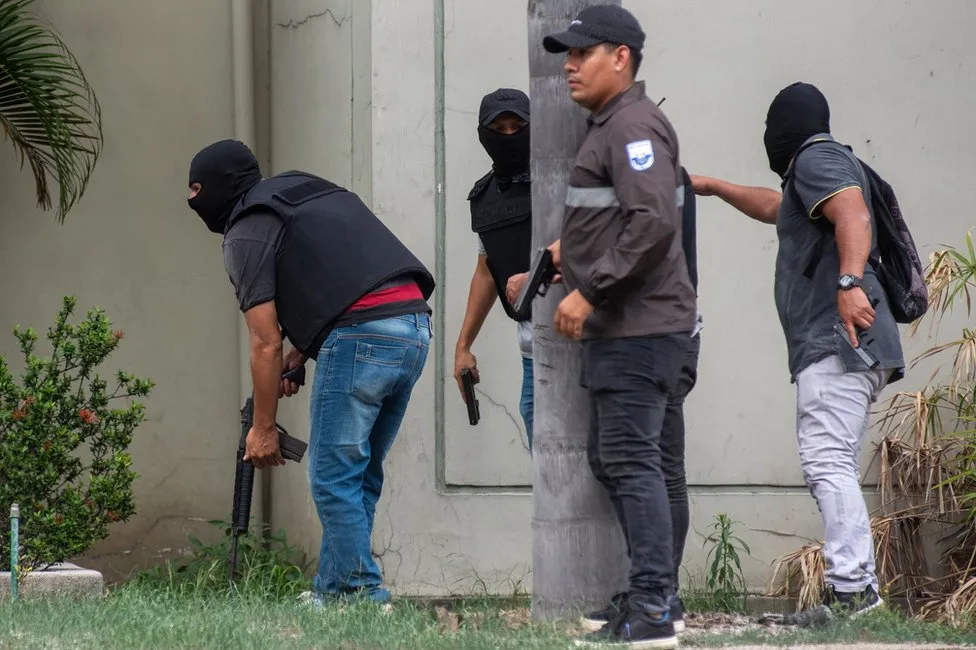
Masked gunmen have broken into a live television studio in Ecuador and threatened terrified staff.
Employees were forced on to the floor during the broadcast by the public television channel TC in the city of Guayaquil before the live feed cut out. Police say they later freed all the staff and made 13 arrests, showing off weapons recovered.
At least 10 people have been killed since a 60-day state of emergency began in Ecuador on Monday.
The emergency was declared after a notorious gangster vanished from his prison cell. It is unclear whether the incident at the TV studio in Guayaquil was related to the disappearance from a prison in the same city of the boss of the Choneros gang, Adolfo Macías Villamar, or Fito as he is better known.
In neighbouring Peru, the government ordered the immediate deployment of a police force to the border to prevent any instability crossing into the country.
The US has said it condemns the “brazen attacks” in Ecuador and is “co-ordinating closely” with President Daniel Noboa and his Ecuadorean government and stands “ready to provide assistance”.
Ecuador is one of the world’s top banana exporters, but also exports oil, coffee, cocoa, shrimps and fish products. A surge in violence in the Andean nation, inside and outside its prisons, has been linked to fighting between drug cartels, both foreign and local, over control of cocaine routes to the US and Europe.
During Tuesday’s assault at the TV station, one gunman pointed a pump-action shotgun at the head of one of the captives, who was also threatened with a revolver.
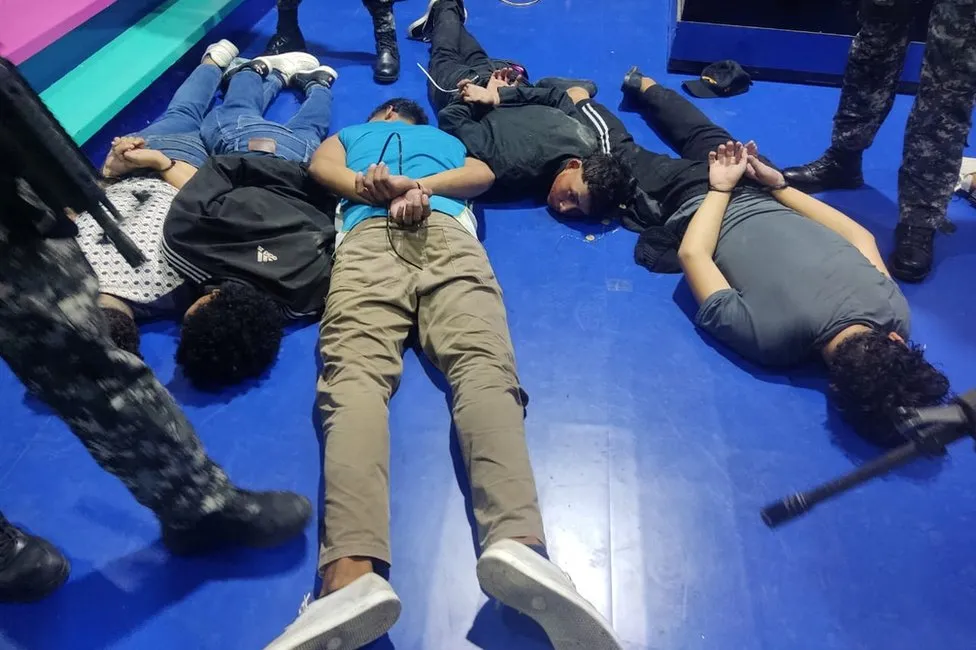
A woman could be heard pleading, “Don’t shoot, please don’t shoot,” AFP news agency reports, while a person could be heard screaming in apparent pain.
“Please, they came in to kill us,” a TC employee told AFP in a WhatsApp message. “God don’t let this happen. The criminals are on air.”
Posting video of the suspects arrested on social media, police said the perpetrators would be “punished for terrorist acts”.
President Noboa said on Tuesday that an “internal armed conflict” now existed in the country and he was mobilising the armed forces to carry out “military operations to neutralise” what he called “transnational organised crime, terrorist organisations and belligerent non-state actors”.
He was responding to a wave of recent jail riots and escapes from prisons and other acts of violence blamed by authorities on criminal gangs.
His decree listed the Choneros (named after the town of Chone in Manabi Province) as well as 21 other gangs: the Aguilas, AguilasKiller, AK-47, Caballeros Oscuros, ChoneKiller, Covicheros, Cuartel de las Feas, Cubanos, Fatales, Ganster, Kater Piler, Lagartos, Latin Kings, Lobos, Los p.27, Los Tiburones, Mafia 18, Mafia Trebol, Patrones, R7 and Tiguerones.
The order built on the state of emergency declared on Monday, which ordains a nightly curfew in an attempt to curb violence following Fito’s escape. Security forces have been trying to re-establish order in at least six jails where riots broke out on Monday.
Eight people were killed and three injured in attacks linked to criminal gangs in Guayaquil on Tuesday while two police officers were killed by “armed criminals” in the nearby town of Nobol, police said.
In the city of Riobamba, nearly 40 inmates, including another convicted drug lord, broke out of a prison.
At least seven police officers were also kidnapped and a video circulating on social media shows three of the kidnapped officers sitting on the ground with a gun pointed at them as one is forced to read a statement addressed to President Noboa, AFP reports.
“You declared war, you will get war,” the officer reads out. “You declared a state of emergency. We declare police, civilians and soldiers to be the spoils of war.”
Police have ordered the evacuation of the government compound in Quito over security concerns,
Quito residents told Reuters news agency the city was in chaos since news of the attack at the TV station in Guayaquil.
“There’s too much nervousness in the city,” said Mario Urena. “At work, people are leaving earlier. All the people are leaving, you see a lot of traffic and alarms everywhere. There’s a chaos.”
Other people in the city of Cuenca told AFP of their shock at seeing the TV station seized. “In Ecuador, we have never seen this kind of thing, where a channel has been practically hijacked and a broadcast starts with shootings, with kidnappings,” said Francisco Rosas. “So what kind of security situation are we in? And if a television station is capable of receiving this type of robbery, this type of insecurity, imagine restaurants or shops.”

In recent years, the country’s prisons have been plagued by violent feuds between jailed members of rival gangs, often resulting in multiple massacres of inmates.
The Choneros are a powerful prison gang thought to be behind many of the deadly riots and prison fights which have erupted in Ecuador’s jails over recent years.
Fito is thought to have absconded just hours before his planned transfer. Two prison guards have been detained on suspicion of helping him escape. His escape is also a blow to the government of President Noboa, who was sworn in in November after winning an election tarnished by the assassination of presidential candidate and journalist Fernando Villavicencio.
Villavicencio had reported receiving death threats from Fito just days before he was shot dead while leaving a campaign rally in Quito.

(BBC)






Apollo 8 astronaut Bill Anders, who snapped one of the most famous photographs taken in outer space, has died at the age of 90.
Officials say a small plane he was flying crashed into the water north of Seattle, Washington.
Anders’ son Greg confirmed that his father was flying the small plane, and that his body was recovered on Friday afternoon. “The family is devastated. He was a great pilot. He will be missed,” a statement from the family reads.
Anders – who was a lunar module pilot on the Apollo 8 mission – took the iconic Earthrise photograph, one of the most memorable and inspirational images of Earth from space.
Taken on Christmas Eve during the 1968 mission, the first crewed space flight to leave Earth and reach the Moon, the picture shows the planet rising above the horizon from the barren lunar surface.
Anders later described it as his most significant contribution to the space programme.
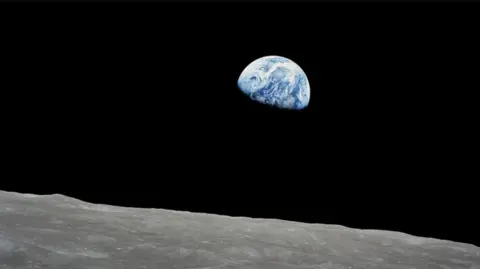
The image is widely credited with motivating the global environmental movement and leading to the creation of Earth Day, an annual event to promote activism and awareness of caring for the planet.
Speaking of the moment, Anders said: “We came all this way to explore the Moon, and the most important thing that we discovered was the Earth.”
Officials said on Friday that Anders crashed his plane around 11:40PDT (1940BST).
The US National Transportation Safety Board (NTSB) said the 90-year-old was flying a Beechcraft A A 45 – also known as a T-34. The agency said that the plane crashed about 80ft (25m) from the coast of Jones Island.
Anders also served as the backup pilot to the Apollo 11 mission, the name of the effort that led to the first Moon landing on July 24, 1969.
Following Anders’ retirement from the space programme in 1969, the former astronaut largely worked in the aerospace industry for several decades. He also served as US Ambassador to Norway for a year in the 1970s.
But he is best remembered for the Apollo 8 mission and the iconic photograph he took from space.
“In 1968, during Apollo 8, Bill Anders offered to humanity among the deepest of gifts an astronaut can give. He traveled to the threshold of the Moon and helped all of us see something else: ourselves,” Nasa Administrator Bill Nelson said in a statement.
Mark Kelly, a former astronaut who now serves as a US Senator for the state of Arizona, said in a post on X, formerly Twitter, that Anders “inspired me and generations of astronauts and explorers. My thoughts are with his family and friends”.
[BBC]

A Chinese spacecraft carrying rock and soil samples from the far side of the Moon has lifted off from the lunar surface to start its journey back to Earth, according to state media.
The achievement on Tuesday is a world first and the latest leap for Beijing’s decades-old space programme, which aims to send a crewed mission to the Moon by 2030.
The Xinhua News Agency, citing the China National Space Administration (CNSA), said that the ascender of the Chang’e-6 probe took off at 7:38am local time on Tuesday (23:38 GMT) and entered a preset orbit around the moon.
It described the move as “an unprecedented feat in human lunar exploration history”.
The Chang’e-6 probe was launched last month and its lander touched down on the far side of the Moon on Sunday. It used a drill and robotic arm to dig up soil on and below the Moon’s surface, according to Xinhua.
After successfully gathering its samples, the Chang’e-6 unfurled China’s national flag for the first time on the far side of the Moon, it said.
The agency cited the CNSA as saying that the spacecraft stowed the samples it had gathered in a container inside the ascender of the probe as planned.
[Aljazeera]

China says its uncrewed craft has successfully landed on the far side of the Moon – an unexplored place almost no-one tries to go.
The Chang’e 6 touched down in the South Pole-Aitken Basin at 06:23 Beijing time on Sunday morning (22:23 GMT Saturday), the China National Space Administration (CNSA) said.
Launched on 3 May, the mission aims to collect precious rock and soil from this region for the first time in history. The probe could extract some of the Moon’s oldest rocks from a huge crater on its South Pole.
The landing was fraught with risks, because it is very difficult to communicate with spacecraft once they reach the far side of the Moon. China is the only country to have achieved the feat before, landing its Chang’e-4 in 2019.
After launching from Wenchang Space Launch Center, the Chang’e 6 spacecraft had been orbiting the Moon waiting to land. The lander component of the mission then separated from the orbiter to touch down on the side of the Moon that faces permanently away from Earth.
During the descent, an autonomous visual obstacle avoidance system was used to automatically detect obstacles, with a visible light camera selecting a comparatively safe landing area based on the brightness and darkness of the lunar surface, the CNSA was quoted as saying by state-run Xinhua news agency.
The lander hovered about 100m (328ft) above the safe landing area, and used a laser 3D scanner before a slow vertical descent. The operation was supported by the Queqiao-2 relay satellite, the CNSA said.
Chinese state media described the successful landing as an “historic moment”. The state broadcaster said “applause erupted at the Beijing Aerospace Flight Control Center” when the Chang’e landing craft touched down on the Moon early on Sunday morning.
The lander should spend up to three days gathering materials from the surface in an operation the CNSA said would involve “many engineering innovations, high risks and great difficulty”. “Everyone is very excited that we might get a look at these rocks no-one has ever seen before,” explains Professor John Pernet-Fisher, who specialises in lunar geology at the University of Manchester.
He has analysed other lunar rock brought back on the American Apollo mission and previous Chinese missions. But he says the chance to analyse rock from a completely different area of the Moon could answer fundamental questions about how planets form.
Most of the rocks collected so far are volcanic, similar to what we might find in Iceland or Hawaii. But the material on the far side would have a different chemistry . “It would help us answer those really big questions, like how are planets formed, why do crusts form, what is the origin of water in the solar system?” the professor says.
The mission aims to collect about 2kg (4.4lb) of material using a drill and mechanical arm, according to the CNSA.
The South Pole–Aitken basin, an impact crater, is one of the largest known in the solar system.
From there, the probe could gather material that came from deep inside the lunar mantle – the inner core of the Moon – Prof Pernet-Fisher says.
The Moon’s South Pole is the next frontier in lunar missions – countries are keen to understand the region because there is a good chance it has ice.
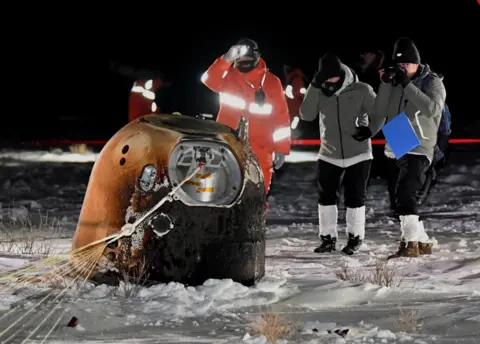
The capsule in the last Chinese moon mission, Chang’e 5, brought back soil and rocks in 2020 (BBC)
Access to water would significantly boost the chances of successfully establishing a human base on the Moon for scientific research.
If the mission succeeds, the craft will return to Earth with the precious samples on board a special return capsule.
The material will be kept in special conditions to try to keep it as pristine as possible.
Scientists in China will be given the first chance to analyse the rocks, and later researchers around the world will be able to apply for the opportunity too.
This is the second time China has launched a mission to collect samples from the Moon.
In 2020 Chang’e 5 brought back 1.7kg of material from an area called Oceanus Procellarum on the Moon’s near side.
China is planning three more uncrewed missions this decade as it looks for water on the Moon and investigates setting up a permanent base there.
Beijing’s broader strategy aims to see a Chinese astronaut walk on the moon by around 2030.
The US also aims to put astronauts back on the moon, with Nasa aiming to launch its Artemis 3 mission in 2026.
(BBC)



US sports envoys to Lanka to champion youth development

Rahuman questions sudden cancellation of leave of CEB employees


