
Features
Forty-year saga that can never be forgotten

By Rohan Abeywardena
For the 35th anniversary of The Island five years ago, when our editor Prabath Sahabandu asked me to pen a piece for that issue, I took the opportunity to write about all the hilarious things we did to keep ourselves entertained, while we worked through all types of storms as during much of that period the country was in turmoil with LTTE terror attacks taking place regularly, mainly in the form of suicide bombings that snuffed out innocent lives by the dozens, the JVP’s bloody second uprising and the then government’s counter terror campaign to crush it. We ourselves came very close to peril on more than one occasion after our founder literally vanished into thin air; his newspapers were marked by some of those in power as threats to them. We managed to withstand all that not because we were some heroes, but it was simply a case of us just doing what we had to do in the line of duty.
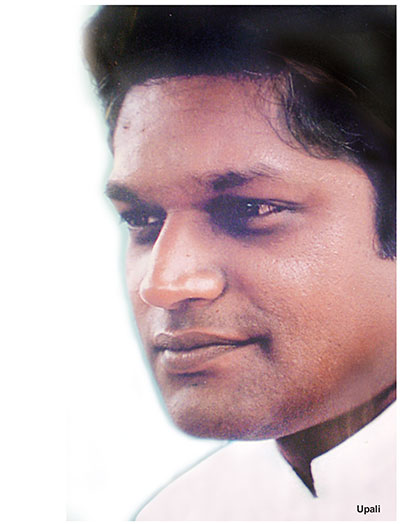
Last week, when the editor asked me to contribute a column to the 40th anniversary issue, I literally underwent a shock reawakening as to how long it has been since I was among the first few journalists to join this newspaper just about two weeks before it started and a few weeks after the Sunday Island began. In fact, if my now 65-year-old memory serves me right, my first English editorial identity card here bore the legend EE12, indicating that I was the 12th employee to join it. By the time Mr. Upali Wijewardene disappeared with few others who were accompanying him while returning to Colombo on his Learjet from Malaysia in early 1983, our editorial had a formidable team with more than 60 permanent employees, including many veterans and many provincial correspondents, freelancers and even foreign contributors. Of that original lot, I believe only myself, Zanita Careem and Norman Palihawadana still remain here, while many have been claimed by father time and others migrated or are working elsewhere. Both Zanita and Norman have been working throughout at The Island, but I left the newspaper thrice and came back each time, but yet I have put in a total of more than 24 years with the newspaper.
 At the time when I first joined The Island in the first week of November 1981, I had been working at the now defunct, staid Sun newspaper of the then powerful Independent Newspaper Group as a sub-editor with Zanita and she followed me to The Island a month or two after me as did many others thereafter. When I joined that former newspaper, I had very high hopes of contributing to combatting wrongs in the society in general, because the newspaper literally shouted from its roof top how independent it was with regular ‘exposures’ with banner headlines. But I soon realised that it was nothing but a charade and started questioning my inner-self as to whose independence that they practised.
Some of those at the helm there could have even made Joseph Goebbels blush, for most of their exposures were nothing more than recycled formula type stories as in the celluloid world. Those regularly repeated topics were ‘child labour’, ‘pornography’, illicit abortions, boy prostitution, etc. While the so-called national newspapers kept the country’s intelligentsia generally hoodwinked, the Sinhala language organ of the Communist Party Aththa edited by legendary B.A. Siriwardena (fondly known as Sira) literally went to town, daily exposing corruption and intrigues that were widespread especially among those wielding power and Sira easily wrote the best biting editorial each day among all Sinhala language newspapers. That paper often only had one broad sheet comprising four pages. Even some of those haughty Colombo 07 types who would not want to be seen dead with a Sinhala Commie newspaper, was known to at least read Sira’s blunt down-to-earth editorials, like pinstriped British Bankers reading or ogling at the racy tabloid London SUN hidden inside the broadsheet Financial Times or the Guardian. Of course, unlike the London SUN there was nothing obscene in Sira’s Aththa. It also had formidable cartoonist Jiffrey Yoonoos, who was once slashed with a knife because someone could not stomach his drawings.
The Sun that I worked in and its weekly Weekend were not all about bumming the government in power. There were naturally exceptions like when they took on the then national carrier Air Lanka and its powerful Chairman and Managing Director, the late Capt. Rakhitha Wickramanayake. It was also a treat to read the weekly political column under the pen name Migara written by present Editor of The Sunday Times Sinha Ratnatunga, at a time when the country was starved of inside authentic news.
It was a very good training school for beginners. And I am eternally grateful that I received a good foundation there, especially under the tutelage of Louis Benedict. And many top journalists of today cut their teeth at the old Sun/Weekend.
The straw that broke the camel’s back for me was how The Sun covered the way the UNP storm troopers of the JSS wielding cycle chains and what not broke up the July ’80 general strike. I clearly remember staff photographers coming with photos of battered blood-soaked strikers, who were attacked near Lake House, but the newspaper was more worried about publishing those and antagonising JRJ than reporting the dastardly act. The strikers were simply asking for a Rs 300 salary increase from that regime which came to power with a five-sixths landslide victory in 1977 after making all sorts of promises, including eight pounds of cereals per person per week on top of the existing free rice ration. But after assuming power everything was forgotten and even the existing free rice ration was scrapped. Atop that the self-proclaimed Dharmishta (righteous) regime rolled out the red carpet to capitalist Robber Barons by devaluing the rupee by as much as 43 per cent, eliminated all food subsidies, reduced workers’ rights etc. etc.
 I must however state that why I left The Sun and joined a yet to start private newspaper was not because I then had any special illusions about its founder Mr. Upali Wijewardene, except maybe I was attracted to the challenge of working for a man, who was drawing venomous fire from some among the ruling clique, who, I knew, were no angels. However, once the newspaper was started, we all realised that he was a hands-off boss, who gave a free hand to his editor with no interference whatsoever, not even from some of his close relatives. And the editor too was game for a free media culture. In that way, Wijewardene literally opened the floodgates for a truly liberal media culture in this country among national media, which clearly later paved the way for the independent and competitive TV and radio which we enjoy today along with the newspapers and an abusive social media.
When I was called for the sole interview with newpaper’s Editor Vijitha Yapa and Englishman Peter Harland, both had been handpicked by Wijewardene to launch his English newspapers; what really hooked me was the salary that was offered. The interview was not about my competency, but how quickly I could come. One question thatYapa asked me was how much I was drawing at The Sun, when I said I was getting little over Rs 1,200 per month, which was a good salary for a journalist at the time he quickly said: “We’ll give you 1800 a month”. I said I would take it, though I’m sure had I asked for 2000 they would have agreed to it.
What hurt me the most when I left The Sun was the type of departure given to me. Since I felt I was considered just a mediocre, I thought they would be glad to see the back of me, but when I went to give my letter of resignation to editor Rex de Silva, he asked me to give it to the Chairman. But when I went up to the Chairman’s office, I was asked to take a seat and wait and I waited and waited for I believe was well over an hour. Finally, in disgust when I got up to dump my resignation letter with the reception and vanish from there for good, the receptionist said “You can now see the Chairman”. And when I walked into his room and gave the letter all he said was you can go. And that was the treatment meted out to an employee who had taken hardly a day’s leave in the nearly two years he had worked there. But that must be because I must have been the first to join a new rival.
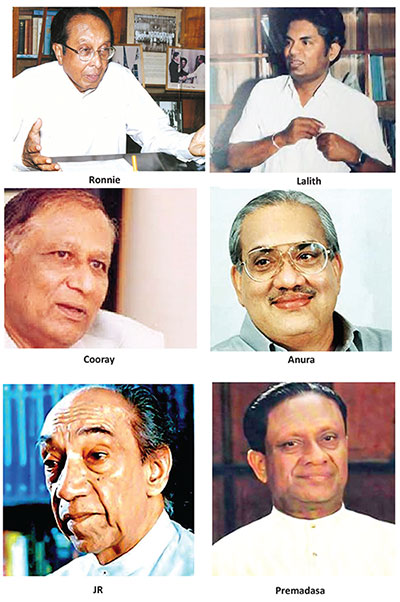
So much happened in those early years of this newspaper that someone should write a book on its history. But I will leave the reader with some interesting personal experiences that must be told. After the sudden disappearance of Wijewardene, it dawned on everyone that we could no longer go on the way it was and we had to sue for peace especially with Finance Minister Ronnie de Mel and our main nemesis, Ranasinghe Premadasa, the then Prime Minister and Minister of Local Government, Housing and Construction and designated successor of JRJ. But Premadasa was paranoid about being usurped by not only Wijewardene, but even by others like Lalith Athulathmudali, Gamini Dissanayake, and he even clashed with Ronnie de Mel. While de Mel was willing to kiss and forget as long as he got good coverage in return from us,Premadasa was not the forgiving or forgetting type.
However, once we got into a fresh scrape with de Mel. It all started with him bashing us in parliament in the worst possible way, most probably after someone provoked him. At the time the late Ajith Samaranayake, probably one of the most talented journalists this country has hitherto produced, acted as editor as Gamini (Gamma to most of us) Weerakoon was abroad. So not to be outdone, Ajith wrote one of the most devastating editorials in reply headlined ‘Barbarians at the gate’ and carried it prominently on page one from top to bottom on left side, not on the usual editorial page. The immediate result was fireworks and I will not go into details except to say banks could have throttled us at the time at the behest of the powerful FM.
Around this time, I had started doing a series of interviews with important political personalities of the day called FIRING LINE. But in order to make peace with Mr. de Mel once again I was ordered to do a weekly interview with him.
Similarly, I learned the hard way why Junius Richard Jayewardene was called the 20th Century Fox. He was a person who never gave any official interviews to any local journalist as long as he was in power. So, when in retirement I thought I could cajole him into speaking out as there was so much blood letting since the signing of the controversial Indo-Lanka Accord of July 1987, for political expediency and there seemed to be no let up with his own party divided and in tatters. Well, I finally did manage to get an appointment for an interview through his Secretary Mr. Mapitigama. At the appointed day and time, I went to his private residence at Ward Place, ‘Braemar’. After a short chat with the head of his security detail SSP Sumith de Silva and Mr. Mapitigama I was ushered into old JRJ’s office and after the initial handshake and my taking a seat opposite him, he at once asked me something like so young man what do you want to talk about? I quickly pulled out my cassette tape recorder and the list of questions.
Now, I must say the secret of my success with the Firing Line series was that I literally ambushed my subjects usually with a below the belt question at the opening bell itself as that almost always resulted in my ‘victim’ virtually eating humble pie after being stunned. With the 20th Century Fox I did not however plan any such stunts but the intention was to soften him up first by pandering to his tastes before trying hard stuff. But lo and behold what I finally got from him was the shock of my career.
The minute I moved to switch on the tape he said stop and to put it away. Then he said, “We’ll first discuss what you want to ask me”. I skipped all formalities and started asking about most of the problems facing the country caused by the UNP often changing the goal post because it wanted to control everything through the imperial presidency of his. But each time I tried to raise an issue from the past he simply shut me up by asking whether I was there and he would say, “You can’t say that because you were not there”.
Most interestingly and ironically the old man was not worried about what was happening to the country, but was repeatedly griping about how much they had suffered by being deprived of their estates by the Land Reforms of the previous United Front government of Bandaranaike. In a way, it explained why he wanted to take revenge from her soon after coming to power.
One thing on which he did make his opinion known to me during that one-sided exchange was that it was wrong of Lalith and Gamini to break away from the party to fight Premadasa. His line of thinking was that they should have worked for change from within.
And finally he said something to the effect “now you got what you came for”, but when I protested that I came there after informing the editor that I am going to interview President Jayewardene and I couldn’t go back and tell him I had no interview. Then he thought for a few seconds and asked me to leave the questions with his secretary.
A few days later, Mapitigama called me and said the President’s answers were ready. I quickly drove to ‘Braemar’, collected it without even bothering to look at what was inside the closed envelope and rushed back to the office thinking I was on top of the world with an exclusive interview with the ex-President.
But when I went through it, I found that what he had answered were not the questions I had given; they were either reworded or totally new questions to fit JRJ’s agenda. When I suggested to then editor Gamini Weerakoon we throw it away and forget about it, the boss however laughed and asked me to carry it.
Another interesting experience I had was when I went to do a Firing Line interview with the late Anura Bandaranaike at his Rosmead Place residence when he was the Leader of the Opposition during President Premadasa’s tenure. Bandaranaike being a formidable debater with the gift of the gab I had no intention of giving him any kid glove treatment even though I then literally worked for his uncle Dr. Seevali Ratwatte, who was our Chairman at the time.
Now, I had been battling Premadasa for a long time in my own way, so at the opening bell I asked Bandaranaike how he hoped to defeat Premadasa when the latter got up as early as 3:00 am and began attending to his work at 4:00 am, whereas the Leader of the Opposition usually got up long past noon after enjoying the good life into the early hours of the morning. The question blew a fuse inside him and the burly giant got up, shoving the coffee table that was there between us, at me. Luckily, I was able to jump back. But soon he realised his blunder and recovered his composure and said he didn’t have to work so hard or something to that effect. But I am sure I had the better of him in the ensuing interview.
Over the particular interview I had no problem back at UNL. In fact, the late Dr. Ratwatte was a gem of a boss when dealing with journalists like me. There was a real incident later on when I wrote a story about some local consultants hired by the World Bank to prepare feasibility studies to help start various business ventures, and took it for a ride. Having spent a couple of million dollars or more on the project, the WB found most of those feasibility studies were either frivolous or redundant. For they were about how to start a successful bakery business, a laundry, beauty salon, etc.
When the newspaper hit the market with that story one of the consultants concerned immediately phoned and demanded a correction, but point blank I refused. The result was that this highly qualified guy, being a Bandaranaike, came to teach me a lesson after telling me so by rushing to our Chairman. The minute he arrived in Dr Ratwatte’s office I got a call from the head office saying the Chairman wanted to see me. In fact, I saw this guy driving into the UNL compound in an Alfa Romeo. I immediately armed myself with something that I was able to surprise him with. So, when Dr Ratwatte asked me ‘Rohan what is all this’? I showed everyone a copy of the internal World Bank critical assessment. But before I could even open it the Chairman just said, ‘Okay, okay you can go back’.
Then there was also a Firing Line Interview that didn’t go beyond a few questions with Bulathsinhalage Sirisena Cooray, one-time strongman under Premadasa. So, some time after the latter’s assassination and after he was distanced by both the UNP and the Premadasa family I asked Cooray for an interview to tell his side of the story as he was being maligned by many. When he agreed for an interview, I got myself dropped at his then residence at Lake Drive close to McDonald’s, Rajagiriya, and asked the driver to pick me up later on his way back after dropping several others.
One of my planned line of attacks was to nail him about his dealings with the underworld characters, like Soththi Upali. So, when I came to the subject of how he came to know Soththi Upali, and no sooner had Cooray told me ‘oya lamaya’ [Soththi Upali] used to drop into see him in connection with Gam Udawa work, than he realised the trap was being laid to corner him; he immediately told me to leave. By that time, I believe Soththi Upali had already been killed by his enemies. But since there was no sign of my vehicle and though the distance from his residence to MacDonald’s Junction wouldn’t have been more than 150 metres, but it felt as if it was the longest walk I had ever undertaken and unlike today Lake Drive was then generally deserted.
My luck with ‘Firing Line’ however, was soon running out with my potential subjects/victims soon getting wise to my shock therapy and some of them even pitched into me on flimsy excuses even before I could open my mouth at an interview.
I believe one of the first to try that counter shock strategy on me was the late TULF Leader M. Sivasithamparam, who succeeded as the TULF Leader after the Tiger hit team assassinated A. Amirthalingam. So, when I went to interview him for ‘Firing Line’, I knew he was no spring chicken as he was a veteran politician and a formidable lawyer. When I got to his place, close to Thimbirigasyaya Junction, I got a shelling from the man accusing me of keeping him waiting for about two hours. That lecture of his about being punctual and not wasting other people’s time would have taken a good 15 minutes. But I was quite sure the appointment I made was for around 10:30, but he insisted it was two hours earlier, or something to that effect.



by Dr Gotabhya Ranasinghe
Senior Consultant Cardiologist
National Hospital Sri Lanka
When we sought a meeting with Hon Dr. Ramesh Pathirana, Minister of Health, he graciously cleared his busy schedule to accommodate us. Renowned for his attentive listening and deep understanding, Minister Pathirana is dedicated to advancing the health sector. His openness and transparency exemplify the qualities of an exemplary politician and minister.
Dr. Palitha Mahipala, the current Health Secretary, demonstrates both commendable enthusiasm and unwavering support. This combination of attributes makes him a highly compatible colleague for the esteemed Minister of Health.
Our discussion centered on a project that has been in the works for the past 30 years, one that no other minister had managed to advance.
Minister Pathirana, however, recognized the project’s significance and its potential to revolutionize care for heart patients.
The project involves the construction of a state-of-the-art facility at the premises of the National Hospital Colombo. The project’s location within the premises of the National Hospital underscores its importance and relevance to the healthcare infrastructure of the nation.
This facility will include a cardiology building and a tertiary care center, equipped with the latest technology to handle and treat all types of heart-related conditions and surgeries.
Securing funding was a major milestone for this initiative. Minister Pathirana successfully obtained approval for a $40 billion loan from the Asian Development Bank. With the funding in place, the foundation stone is scheduled to be laid in September this year, and construction will begin in January 2025.
This project guarantees a consistent and uninterrupted supply of stents and related medications for heart patients. As a result, patients will have timely access to essential medical supplies during their treatment and recovery. By securing these critical resources, the project aims to enhance patient outcomes, minimize treatment delays, and maintain the highest standards of cardiac care.
Upon its fruition, this monumental building will serve as a beacon of hope and healing, symbolizing the unwavering dedication to improving patient outcomes and fostering a healthier society.We anticipate a future marked by significant progress and positive outcomes in Sri Lanka’s cardiovascular treatment landscape within the foreseeable timeframe.

by Fr. Emmanuel Fernando, OMI
Jesuit Fr. Aloysius Pieris (affectionately called Fr. Aloy) celebrated his 90th birthday on April 9, 2024 and I, as the editor of our Oblate Journal, THE MISSIONARY OBLATE had gone to press by that time. Immediately I decided to publish an article, appreciating the untiring selfless services he continues to offer for inter-Faith dialogue, the renewal of the Catholic Church, his concern for the poor and the suffering Sri Lankan masses and to me, the present writer.
It was in 1988, when I was appointed Director of the Oblate Scholastics at Ampitiya by the then Oblate Provincial Fr. Anselm Silva, that I came to know Fr. Aloy more closely. Knowing well his expertise in matters spiritual, theological, Indological and pastoral, and with the collaborative spirit of my companion-formators, our Oblate Scholastics were sent to Tulana, the Research and Encounter Centre, Kelaniya, of which he is the Founder-Director, for ‘exposure-programmes’ on matters spiritual, biblical, theological and pastoral. Some of these dimensions according to my view and that of my companion-formators, were not available at the National Seminary, Ampitiya.
Ever since that time, our Oblate formators/ accompaniers at the Oblate Scholasticate, Ampitiya , have continued to send our Oblate Scholastics to Tulana Centre for deepening their insights and convictions regarding matters needed to serve the people in today’s context. Fr. Aloy also had tried very enthusiastically with the Oblate team headed by Frs. Oswald Firth and Clement Waidyasekara to begin a Theologate, directed by the Religious Congregations in Sri Lanka, for the contextual formation/ accompaniment of their members. It should very well be a desired goal of the Leaders / Provincials of the Religious Congregations.
Besides being a formator/accompanier at the Oblate Scholasticate, I was entrusted also with the task of editing and publishing our Oblate journal, ‘The Missionary Oblate’. To maintain the quality of the journal I continue to depend on Fr. Aloy for his thought-provoking and stimulating articles on Biblical Spirituality, Biblical Theology and Ecclesiology. I am very grateful to him for his generous assistance. Of late, his writings on renewal of the Church, initiated by Pope St. John XX111 and continued by Pope Francis through the Synodal path, published in our Oblate journal, enable our readers to focus their attention also on the needed renewal in the Catholic Church in Sri Lanka. Fr. Aloy appreciated very much the Synodal path adopted by the Jesuit Pope Francis for the renewal of the Church, rooted very much on prayerful discernment. In my Religious and presbyteral life, Fr.Aloy continues to be my spiritual animator / guide and ongoing formator / acccompanier.
Fr. Aloysius Pieris, BA Hons (Lond), LPh (SHC, India), STL (PFT, Naples), PhD (SLU/VC), ThD (Tilburg), D.Ltt (KU), has been one of the eminent Asian theologians well recognized internationally and one who has lectured and held visiting chairs in many universities both in the West and in the East. Many members of Religious Congregations from Asian countries have benefited from his lectures and guidance in the East Asian Pastoral Institute (EAPI) in Manila, Philippines. He had been a Theologian consulted by the Federation of Asian Bishops’ Conferences for many years. During his professorship at the Gregorian University in Rome, he was called to be a member of a special group of advisers on other religions consulted by Pope Paul VI.
Fr. Aloy is the author of more than 30 books and well over 500 Research Papers. Some of his books and articles have been translated and published in several countries. Among those books, one can find the following: 1) The Genesis of an Asian Theology of Liberation (An Autobiographical Excursus on the Art of Theologising in Asia, 2) An Asian Theology of Liberation, 3) Providential Timeliness of Vatican 11 (a long-overdue halt to a scandalous millennium, 4) Give Vatican 11 a chance, 5) Leadership in the Church, 6) Relishing our faith in working for justice (Themes for study and discussion), 7) A Message meant mainly, not exclusively for Jesuits (Background information necessary for helping Francis renew the Church), 8) Lent in Lanka (Reflections and Resolutions, 9) Love meets wisdom (A Christian Experience of Buddhism, 10) Fire and Water 11) God’s Reign for God’s poor, 12) Our Unhiddden Agenda (How we Jesuits work, pray and form our men). He is also the Editor of two journals, Vagdevi, Journal of Religious Reflection and Dialogue, New Series.
Fr. Aloy has a BA in Pali and Sanskrit from the University of London and a Ph.D in Buddhist Philosophy from the University of Sri Lankan, Vidyodaya Campus. On Nov. 23, 2019, he was awarded the prestigious honorary Doctorate of Literature (D.Litt) by the Chancellor of the University of Kelaniya, the Most Venerable Welamitiyawe Dharmakirthi Sri Kusala Dhamma Thera.
Fr. Aloy continues to be a promoter of Gospel values and virtues. Justice as a constitutive dimension of love and social concern for the downtrodden masses are very much noted in his life and work. He had very much appreciated the commitment of the late Fr. Joseph (Joe) Fernando, the National Director of the Social and Economic Centre (SEDEC) for the poor.
In Sri Lanka, a few religious Congregations – the Good Shepherd Sisters, the Christian Brothers, the Marist Brothers and the Oblates – have invited him to animate their members especially during their Provincial Congresses, Chapters and International Conferences. The mainline Christian Churches also have sought his advice and followed his seminars. I, for one, regret very much, that the Sri Lankan authorities of the Catholic Church –today’s Hierarchy—- have not sought Fr.
Aloy’s expertise for the renewal of the Catholic Church in Sri Lanka and thus have not benefited from the immense store of wisdom and insight that he can offer to our local Church while the Sri Lankan bishops who governed the Catholic church in the immediate aftermath of the Second Vatican Council (Edmund Fernando OMI, Anthony de Saram, Leo Nanayakkara OSB, Frank Marcus Fernando, Paul Perera,) visited him and consulted him on many matters. Among the Tamil Bishops, Bishop Rayappu Joseph was keeping close contact with him and Bishop J. Deogupillai hosted him and his team visiting him after the horrible Black July massacre of Tamils.
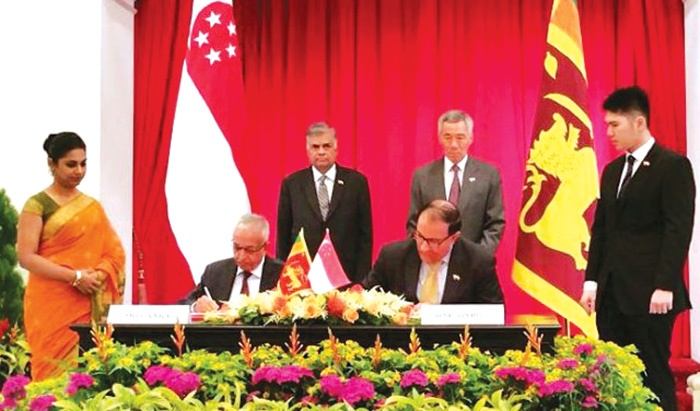
Sri Lanka-Singapore Free Trade Agreement
By Gomi Senadhira
senadhiragomi@gmail.com
“You might tell fairy tales, but the progress of a country cannot be achieved through such narratives. A country cannot be developed by making false promises. The country moved backward because of the electoral promises made by political parties throughout time. We have witnessed that the ultimate result of this is the country becoming bankrupt. Unfortunately, many segments of the population have not come to realize this yet.” – President Ranil Wickremesinghe, 2024 Budget speech
Any Sri Lankan would agree with the above words of President Wickremesinghe on the false promises our politicians and officials make and the fairy tales they narrate which bankrupted this country. So, to understand this, let’s look at one such fairy tale with lots of false promises; Ranil Wickremesinghe’s greatest achievement in the area of international trade and investment promotion during the Yahapalana period, Sri Lanka-Singapore Free Trade Agreement (SLSFTA).
It is appropriate and timely to do it now as Finance Minister Wickremesinghe has just presented to parliament a bill on the National Policy on Economic Transformation which includes the establishment of an Office for International Trade and the Sri Lanka Institute of Economics and International Trade.
Was SLSFTA a “Cleverly negotiated Free Trade Agreement” as stated by the (former) Minister of Development Strategies and International Trade Malik Samarawickrama during the Parliamentary Debate on the SLSFTA in July 2018, or a colossal blunder covered up with lies, false promises, and fairy tales? After SLSFTA was signed there were a number of fairy tales published on this agreement by the Ministry of Development Strategies and International, Institute of Policy Studies, and others.
However, for this article, I would like to limit my comments to the speech by Minister Samarawickrama during the Parliamentary Debate, and the two most important areas in the agreement which were covered up with lies, fairy tales, and false promises, namely: revenue loss for Sri Lanka and Investment from Singapore. On the other important area, “Waste products dumping” I do not want to comment here as I have written extensively on the issue.
1. The revenue loss
During the Parliamentary Debate in July 2018, Minister Samarawickrama stated “…. let me reiterate that this FTA with Singapore has been very cleverly negotiated by us…. The liberalisation programme under this FTA has been carefully designed to have the least impact on domestic industry and revenue collection. We have included all revenue sensitive items in the negative list of items which will not be subject to removal of tariff. Therefore, 97.8% revenue from Customs duty is protected. Our tariff liberalisation will take place over a period of 12-15 years! In fact, the revenue earned through tariffs on goods imported from Singapore last year was Rs. 35 billion.
The revenue loss for over the next 15 years due to the FTA is only Rs. 733 million– which when annualised, on average, is just Rs. 51 million. That is just 0.14% per year! So anyone who claims the Singapore FTA causes revenue loss to the Government cannot do basic arithmetic! Mr. Speaker, in conclusion, I call on my fellow members of this House – don’t mislead the public with baseless criticism that is not grounded in facts. Don’t look at petty politics and use these issues for your own political survival.”
I was surprised to read the minister’s speech because an article published in January 2018 in “The Straits Times“, based on information released by the Singaporean Negotiators stated, “…. With the FTA, tariff savings for Singapore exports are estimated to hit $10 million annually“.
As the annual tariff savings (that is the revenue loss for Sri Lanka) calculated by the Singaporean Negotiators, Singaporean $ 10 million (Sri Lankan rupees 1,200 million in 2018) was way above the rupees’ 733 million revenue loss for 15 years estimated by the Sri Lankan negotiators, it was clear to any observer that one of the parties to the agreement had not done the basic arithmetic!
Six years later, according to a report published by “The Morning” newspaper, speaking at the Committee on Public Finance (COPF) on 7th May 2024, Mr Samarawickrama’s chief trade negotiator K.J. Weerasinghehad had admitted “…. that forecasted revenue loss for the Government of Sri Lanka through the Singapore FTA is Rs. 450 million in 2023 and Rs. 1.3 billion in 2024.”
If these numbers are correct, as tariff liberalisation under the SLSFTA has just started, we will pass Rs 2 billion very soon. Then, the question is how Sri Lanka’s trade negotiators made such a colossal blunder. Didn’t they do their basic arithmetic? If they didn’t know how to do basic arithmetic they should have at least done their basic readings. For example, the headline of the article published in The Straits Times in January 2018 was “Singapore, Sri Lanka sign FTA, annual savings of $10m expected”.
Anyway, as Sri Lanka’s chief negotiator reiterated at the COPF meeting that “…. since 99% of the tariffs in Singapore have zero rates of duty, Sri Lanka has agreed on 80% tariff liberalisation over a period of 15 years while expecting Singapore investments to address the imbalance in trade,” let’s turn towards investment.
Investment from Singapore
In July 2018, speaking during the Parliamentary Debate on the FTA this is what Minister Malik Samarawickrama stated on investment from Singapore, “Already, thanks to this FTA, in just the past two-and-a-half months since the agreement came into effect we have received a proposal from Singapore for investment amounting to $ 14.8 billion in an oil refinery for export of petroleum products. In addition, we have proposals for a steel manufacturing plant for exports ($ 1 billion investment), flour milling plant ($ 50 million), sugar refinery ($ 200 million). This adds up to more than $ 16.05 billion in the pipeline on these projects alone.
And all of these projects will create thousands of more jobs for our people. In principle approval has already been granted by the BOI and the investors are awaiting the release of land the environmental approvals to commence the project.
I request the Opposition and those with vested interests to change their narrow-minded thinking and join us to develop our country. We must always look at what is best for the whole community, not just the few who may oppose. We owe it to our people to courageously take decisions that will change their lives for the better.”
According to the media report I quoted earlier, speaking at the Committee on Public Finance (COPF) Chief Negotiator Weerasinghe has admitted that Sri Lanka was not happy with overall Singapore investments that have come in the past few years in return for the trade liberalisation under the Singapore-Sri Lanka Free Trade Agreement. He has added that between 2021 and 2023 the total investment from Singapore had been around $162 million!
What happened to those projects worth $16 billion negotiated, thanks to the SLSFTA, in just the two-and-a-half months after the agreement came into effect and approved by the BOI? I do not know about the steel manufacturing plant for exports ($ 1 billion investment), flour milling plant ($ 50 million) and sugar refinery ($ 200 million).
However, story of the multibillion-dollar investment in the Petroleum Refinery unfolded in a manner that would qualify it as the best fairy tale with false promises presented by our politicians and the officials, prior to 2019 elections.
Though many Sri Lankans got to know, through the media which repeatedly highlighted a plethora of issues surrounding the project and the questionable credentials of the Singaporean investor, the construction work on the Mirrijiwela Oil Refinery along with the cement factory began on the24th of March 2019 with a bang and Minister Ranil Wickremesinghe and his ministers along with the foreign and local dignitaries laid the foundation stones.
That was few months before the 2019 Presidential elections. Inaugurating the construction work Prime Minister Ranil Wickremesinghe said the projects will create thousands of job opportunities in the area and surrounding districts.
The oil refinery, which was to be built over 200 acres of land, with the capacity to refine 200,000 barrels of crude oil per day, was to generate US$7 billion of exports and create 1,500 direct and 3,000 indirect jobs. The construction of the refinery was to be completed in 44 months. Four years later, in August 2023 the Cabinet of Ministers approved the proposal presented by President Ranil Wickremesinghe to cancel the agreement with the investors of the refinery as the project has not been implemented! Can they explain to the country how much money was wasted to produce that fairy tale?
It is obvious that the President, ministers, and officials had made huge blunders and had deliberately misled the public and the parliament on the revenue loss and potential investment from SLSFTA with fairy tales and false promises.
As the president himself said, a country cannot be developed by making false promises or with fairy tales and these false promises and fairy tales had bankrupted the country. “Unfortunately, many segments of the population have not come to realize this yet”.
(The writer, a specialist and an activist on trade and development issues . )



US sports envoys to Lanka to champion youth development

Rahuman questions sudden cancellation of leave of CEB employees


