Features
For the Leopard

The leopard is the most widespread of all the big cats. The typical form came from Egypt. Its present range extends from sub-Saharan Africa across the Arabian Peninsula into the Indian subcontinent, including Sri Lanka and further eastwards to China, Korea, Peninsular Malaysia and Java. It was the Swedish Botanist, Carl Linnaeus who first gave the leopard its scientific name, Panthers pardus in 1758. Given the leopard’s wide geographical distribution, a number of subspecies have been described since then.
Deraniyagala (1949) recognized the Sri Lankan leopard as a separate subspecies, Panthera pardus kotiya on the basis that it differed from the mainland form, Panthera pardus fusca by its smaller size and longer tail. Fernando (1964) found no justification for such a distinction, yet recent DNA based genetic studies by Miththapala and others. (1991,1992) have confirmed the genetic distinctness and validity of the Sri Lankan subspecies.
Sri Lankan leopards are characterized by decreased genetic variation in comparison to those in India. They are believed to have been isolated on the island for about 10,000 years. The confirmation of the Sri Lankan leopard as a distinct subspecies is important, as it makes it all the more imperative that proper measures are adopted to conserve it, and its habitat. As this is the only large, spotted felid in Sri Lanka, it cannot be confused with any other wild animal.
The pelage colour is usually golden-tawny or rufous-brown covered with open rosette-like black spots, whose size varies with the age of the animal: the spots are usually larger and farther apart as the animals get older. No two leopards have the same pattern of spots. Older animals often have lighter skin. The rosettes in leopards lack the additional black spots inside, which distinguish them from the Jaguar Panthers onca.
Unlike the tiger Panthers tigris, leopards frequently produce a black or melanistic variety, known as “Black Panther” which is rare in Sri Lanka. They are caused by a recessive gene and are more numerous than the conventionally coloured form in the humid rainforests of Peninsular Malaysia. Melanistic leopards are rare in East Africa, perhaps due to the limited extent of forests. Leopards from arid areas tend to be paler than those from humid forests.
Both melanistic and normal coloured young appear in the same litter. Although albinos among leopards are known, they are extremely rare. In Sri Lanka, at the turn of the century, the leopard was very common especially in the forests of the low country. It ranged from sea level to an altitude of over 2,000 m in the Horton Plains. More recently, a combination of forest conversion and poaching has substantially reduced both the number and range of the leopard in Sri Lanka, and today viable populations occur only within protected areas.
The key conservation areas where leopard are still found in Sri Lanka are: Gal Oya National Park, 62,936 ha; Hakgala Strict Nature Reserve, 1,142ha; Horton Plains National Park, 3,160ha; Hurulu Forest Reserve 26,012ha; Lahugala-Kitulana National Park, 1,554ha; Maduru Oya National Park,58,850 ha; Minneriya National Park, 8,889ha; Peak Wilderness Sanctuary, 22,380ha; Ritigala Strict Nature Reserve, 1,528ha; Ruhunu National Park, 126,782ha; Sinharaja National Heritage Wilderness Area, 8,864ha; Somawathiya Chaitiya National Park, 37,762ha; Thirukonamadu Nature Reserve, 25,019ha; Ude Walawe National Park, 30,812ha; Victoria-Randenigala-Rantambe Sanctuary, 42,087ha; Wasgomuwa National Park, 37,063ha; and Wilpattu National Park 132,317ha. Thus, the leopard’s range includes a total of 624,484 ha, 78% of the island’s protected area.
Leopards of the low country in Sri Lanka are in general larger than those found in the hills. The leopard is an extremely adaptable predator. It is a great wanderer over a given area, and like other forest animals that live a nomadic life, must remain inconspicuous while it sleeps as well as while it hunts. In Sri Lanka leopards occupy a variety of habitats, that range from the dry, semi-arid thorn scrub in the lowlands to the dense montane cloud forest at altitudes of over 2,000m. The only habitat which the leopard is unable to cope with is outright desert.
Today, in Sri Lanka, as human settlements and farming encroach into what used to be wilderness areas, the leopard finds itself with its back against the wall, except in protected areas, and in the hills. This ability to survive in higher altitudes is an advantage for the leopard as the human imprint becomes conspicuous in the lowlands. However, it is essentially a forest animal: even those adapted to semi-arid conditions appear to have a physiological need for shade during the heat of the day. This explains why it is not often encountered in the wild at mid-day. In areas where the leopard has learned to fear man, it becomes much more cautious and nocturnal.
Unless accompanied by dependent young the leopard is generally solitary: 81% of the observations made by Eisenberg & Lockhart (1972) in Wilpattu National Park were of solitary animals, while pairs accounted for only 19%. When undisturbed, the leopard spends a considerable part of its daily activity on the ground, seeking refuge in trees at times. In Ruhunu National Park, it often uses the rocky outcrops of Kotigala and Jamburagala in Block I as vantage points. Much of the daytime is spent dozing, either in the dense scrub, or draped over a stout branch of a tree.


Leopards Crossing the Buttala Kataragama Road Milinda Wattegedera
of the Yala Leopard Diary
Leopards have excellent night vision, and hunt relying very largely on sight. Although the leopard is often considered to be a nocturnal predator, this generalization may not be strictly valid across the range of the species. In areas where poaching is intense, the leopard is certainly more active at night and becomes highly secretive. It becomes more nocturnal only in areas where it feels insecure by day, as a result of human harassment or disturbance by other carnivores. But within many of the protected areas in Sri Lanka, the leopard appears to be the least nocturnal of all the worlds big cats.
The leopard is a more opportunistic predator than any other felid and will attempt to kill any prey it comes across. Despite its relatively small body size, the Sri Lankan leopard is capable of taking large prey, and is extremely adaptable to changes in prey availability. In general, female leopards with cubs are more successful in killing their prey than males. Larger prey is taken predominantly by the females when they are lactating.
Leopards sometimes carry their kill and rest it on a branch of tall tree in order to avoid the unwelcome attention of other predators such as jackals and crocodiles. In the Serengeti National Park in East Africa, leopards are known to climb trees with a 150 kg Grant’s gazelle clamped between their teeth. Leopards prefer prey in the 20-70kg size category, with an upper limit at about 150kg, two or three times the weight of the cat itself.
Females also use their slightly smaller home ranges more effectively in capturing prey. However, should the prey density become very low, they would range over a wider area, since the behaviour of female felids is usually more closely keyed to resources, given their responsibility of raising young. Both females and males spend a substantial part of their time locating and capturing prey, especially during the night.
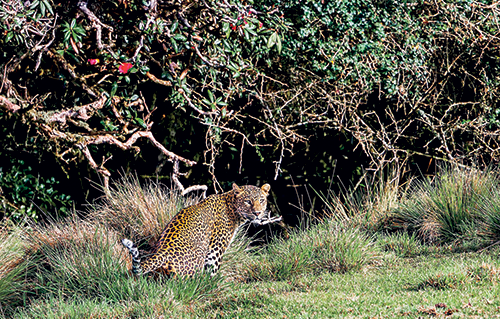

The classic hunt consists of stalk, chase and kill. Stalking distances vary according to prey type, and as far as the male leopards are concerned, they increase as the prey size increases. In captivity, leopards are fed 1-1.2 kg of meat per day or 365-438 kg per year. On the assumption that on average 25% of a kill consists of inedible portions, Schaller (1972) suggests that a leopard may need 487-584 kg of meat per year to survive in the wild.
But according to Turnbull-Kemp (1967), a leopard can eat from between 8.1-17.6 kg of meat in a 12 hour period. This factor perhaps explains why the leopard is catholic in its food habits. Foraging effort per individual also varies seasonally, with prey being relatively easily captured during the dry season. Although the leopard’s principal prey in Sri Lanka is the Spotted deer Axis axis, several other herbivores may function as buffer prey items.
The leopard always kills its large quadruped prey by seizing it by the throat with its teeth and then grasping it firmly round the neck and shoulders with its strong forelegs, and commences feeding on the soft parts in the belly first. Unless disturbed, it will stay by its kill until all the edible portions have been consumed.
In a study of 183 leopards, Amerasinghe et al. (1990) found hair of 12 genera of mammals, highlighting the fact that the leopard is more diverse in its food preference than was presumed before. Their study shows that in addition to the spotted deer, other mammals such as the wild boar Sus scrofa, mouse deer Tragulus meminna, black-naped hare Lepus nigricollis and even water buffalo Bubalus bubalis are also eaten by the leopard.
It is especially interesting to note the capacity of the leopard in Sri Lanka to subsist at times on much smaller prey such as rodents, frogs, snakes, and birds, when its usual prey are scarce. According to Eisenberg & Lockhart (1972), buffalo calves are rarely taken because of the vigilance of the cows. Occasionally, the leopard may eat carrion. In one instance, two leopards were seen feeding on an elephant carcass in Ruhunu National Park. One of the more significant observations regarding the leopard’s diet is the almost complete absence of domestic livestock, even from areas close to human settlements.
CONSERVATION: Leopards are an integral part of the food chain, and an unobtrusive part of the ecosystem, valuable both for their ecological role and for their exquisite beauty. The greatest threat to any wild cat comes from the increasing use of poison in agricultural areas. Hoogerwerf (1970) considered the critical element in the decline of the Javan tiger to be poison, almost certainly the work of agricultural settlers, for whom the predator is an unwelcome visitor. As Myers (1976) points out, given its propensity for scavenging, the leopard is more susceptible to taking poisoned meat.
Leopards are also widely poached for their skins, even within protected areas. Poaching still continues to be a threat throughout the leopards’ range in Sri Lanka. A 100 years ago, Clark (1901) estimated the number of leopards in the island to be about 1,660. At the beginning of the twentieth century at least 50% of the land was forested. Since then forest cover has declined to less than 23% of the land area.
The leopard is seriously affected by deforestation and the consequent loss of habitat. Given the low overall population, the leopard may be among the most seriously endangered species of large mammal in Sri Lanka. Viable conservation areas that support the leopard in Sri Lanka, and the establishment of connecting corridors, must be of sufficient size to ensure that at least minimum populations exist within their boundaries.
The article by late Professor Charles Santiapillai is extracted from the publication “for the leopard’