Features
Flying into Kai Tak Airport, Hong Kong

Hong Kong was a business centre and a popular intermediate port of call for all western countries for more than 800 years. Ships were anchored there before they ventured up the Pearl River to Canton (now Guangzhou) to conduct their business in commodities such as in tea, porcelain and silk. In return for these Chinese products, the British, to maintain the credit balance, introduced opium, grown in India, and sold it to China. Eventually, when China wanted to prohibit the importation and sale of opium, the British declared war. In 1842, after the end of the so-called first Opium war, China ceded Hong Kong Island to Britain. This was followed after the second Opium War ended. Britain obtained a 99-year lease of the now expanded Kowloon Peninsular and New Territories for a period of 99 years, commencing in 1898.


During the Japanese occupation in WW 2, the original runway was extended using prisoners of war labour. Cathay Pacific Airways was founded after the war in 1946 with a solitary war surplus DC-3 named ‘Betsy’ with the initial intention of importing wool from Australia. Meanwhile, the population in Hong Kong was growing with refugees fleeing Communist China. To house them all many highrise buildings were constructed. As labour was cheap, luxury and electronic goods began to be also manufactured in abundance in Hong Kong. In 1958, the short runway, at what was now called the Kai Tak aerodrome, was extended to 8,000 ft. and then later extended to accommodate the wide body, big jets, such as the Boeing 747, Douglas DC10 and Lockheed L1011 Tri Stars.
The problem with Kai Tak was that the landing approach to one end of its runway was over the Hong Kong harbour, between high ground in Kowloon and Hong Kong Island, involving a low turn at 550 feet at 2.2 miles. Even for veteran pilots it was exciting, especially in bad weather with high wind and low visibility, to which Hong Kong is often subjected to. Eventually, it became the busiest single-runway, cargo airport in the world, working to its full capacity.
From the early eighties, Air Lanka, too, had regular flights from Bangkok, Thailand to Hong Kong. During those days someone had built a cement factory in Hong Kong harbour and that used to spew out smoke. As a result, even on days with good weather the visibility was bad. On the hillside of a park called Lok Fu, at the end of the approach of the Instrument Guidance System (IGS), there was a ‘Checker board’ and pilots were expected to fly visually towards it.
Additionally, they had flashing lead in-lights also known as ‘rabbit lights’, mounted in the sea, directing the aircraft on a curved approach path to the landing threshold. Safeguards had to be in place such as two different electrical sources on alternative lights to prevent total failure. Closer to the touch down end, lights with limited beam width (to ensure accurate flying) were mounted on building roof tops as the final approach was low over these buildings. By law, no other flashing lights were allowed in the area. Not even for advertising thereby minimising the chances of pilots making mistakes. The lights were ‘on’ 24/7. There were two settings. High intensity during bad weather and day time and low intensity during night time.


Finally, Air Lanka invested in ‘fly by wire’ Airbus A340 aircraft, which needed no muscle at all but the excitement was still the same which necessitated each flight crew member to adjourn to the toilet before the top of descent for a ‘nervous pee’. This happened every time all the time! One day, soon after Air Lanka acquired the A340, I was required to operate an evening flight to Kai Tak. Due to the A340’s design, our crew had reduced to two (Captain and First Officer) in the flight deck from the previous three (Captain, First Officer and Second Officer/Flight Engineer). It was mainly to reduce the fixed costs of crew salaries. The S/O or F/E had a vital role to play besides operating the panel. He was an extra pair of eyes, when things got busy, vital actions wouldn’t be missed and mistakes not made.
After take-off from Bangkok we were told that a Director of Air Lanka and his wife were on board our flight. This officer and gentleman had a reputation of being a strict disciplinarian, a proud product of the Royal Air Force (RAF) College Cranwell, a former Royal Ceylon Air Force (RCyAF) Officer, and a Flight Instructor of some of my own Flight instructors in the SLAF. Having left the RCyAF, he had flown with the RAF. After retirement from the RAF he joined one of the many civil flying schools at Ratmalana as Chief Flight Instructor.
According to some of his students, although he was a very competent Flight Instructor, he ran a ‘tight ship’ and had a ‘short fuse’. Some students shivered in their boots. A definite ‘no-no’ in modern times. Being a close friend and neighbour of the then ‘Royal Family’ at Horagolla, he was later appointed a Director at Airport and Aviation Ltd Sri Lanka (AASL) and subsequently a Director at Air Lanka. The feedback I received by my own SLAF instructors and relatively junior Air Lanka First Officers who were trained by him, was that he didn’t shake hands and that his social behaviour was highly unpredictable. I had never met him but his reputation went ahead of him. It was an understatement to say that I was a bit apprehensive. I had heard that a few months before, when he was a Director at AASL he had chided one of his ex-colleagues for inviting his (the Director’s) wife to sit in the flight deck for the landing!
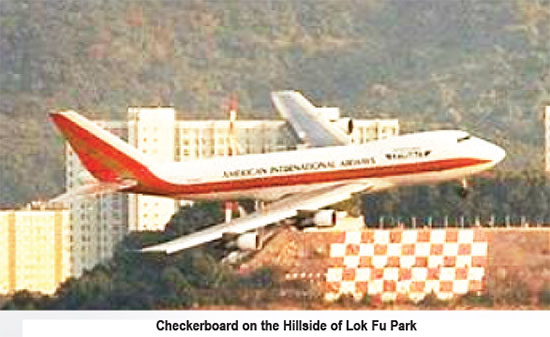

The flight was uneventful until the latter part of the descent where we were informed by Hong Kong Control that the expected IGS for Runway 13 was unserviceable and instead they offered us an older, non-precision approach known as a ‘Visual Step Down’. Although neither my First Officer nor I had done such an approach before, we were carrying the necessary maps and charts that would allow us to safely carry out such an exercise. The French, UTA Douglas DC 8 pilots with whom Air Ceylon pilots flew used to say, “If you could read and understand English, then you can fly anywhere”. We could do the same (read and understand). The only problem was that the right turn to the final approach, after Stone Cutters Island, was almost 100 degrees in comparison to the regular IGS Approach which was only 47 degrees to the right. Both turns need to be done manually keeping the runway in sight.
The change of approach also meant a delay to all inbound traffic as adequate traffic separation had to be maintained. Now dusk turned to night. At last we were cleared for our self-briefed approach. Just as we got to the minimum descent altitude (it was a ‘gin’ clear night), we looked out and could see nothing familiar. Upendra, my First Officer, suggested dutifully that we should go-around. Then, it struck me that if I go slightly left I may catch a glimpse of the lead-in lights, which were flashing 24/7 in the harbour. Sure enough the lights were still on. I announced “Lead-in lights in sight” and continued with a sense of relief.


This time when the speed was managed it went up to 250 knots and the engines spooled up! We had forgotten to ‘activate our approach’ in the rush when our workload increased. If a third crew member had been there he would have probably reminded us to programme our FMS Computers well ahead of commencing the approach. Since it was too late to turn our heads in to programme them, I then did the next best thing possible and called for “selected speed and 140 knots” (our target approach speed), which was selected by First Officer Upendra and we proceeded to land. That saved the day and engine power returned to normal, ending up in a good approach and landing in the night. I am sure our lady guest in the Flight Deck was impressed.
Every flight has its own share of ‘Threats and Errors’. By definition Threats are external factors beyond the control of the crew and Errors are mistakes made from within by the crew members themselves either collectively or individually. An error could turn into a threat and vice versa. The task of the crew is to mitigate threats and trap the errors made to make it a safe flight. The International Air Transport Association (IATA) carries out regular Line Orientated Safety Audits (LOSA) on member airlines to ensure that these principles of air safety are met.