Features
EXPLORING SOUTH EAST ENGLAND – Part 50

CONFESSIONS OF A GLOBAL GYPSY
By Dr. Chandana (Chandi) Jayawardena DPhil
President – Chandi J. Associates Inc. Consulting, Canada
Founder & Administrator – Global Hospitality Forum
chandij@sympatico.ca
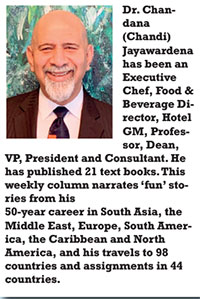
After returning from Scotland, I had two leisure days in London with my wife. Early morning on a Monday in late February, 1982, my United Nations (UN)/International Labour Organization (ILO) Fellowship Coordinator for the United Kingdom (UK), Larry Wilson, drove me to a small town, Cosham, in South East England. My one month stay there opened many doors for me to explore this beautiful region.
Today, the South East is the third largest region out of nine official regions of England (in 1982, known as the government office regions). The South East region consists of nine counties of Buckinghamshire, Oxfordshire, Berkshire, Hampshire, Surrey, Kent, East Sussex, West Sussex, and the Isle of Wight. I eventually visited 20 cities in this region.

Cosham
I lived in Cosham for a month while travelling across the region. Cosham is a northern suburb of Portsmouth lying within the city boundary but off Portsea Island. Its population in 1982 was around 10,000. I enjoyed going for long walks in a friendly neighbourhood. There were no significant tourist attractions there. However, I was happy to experience living with a local English family. All members of this young family were very friendly.
Every week day, they prepared a heavy English breakfast for me, and the family sat with me for supper around 6:00 pm. After that on most evenings, I played pranks on their two young children and their dog which amused the young parents. “Chandi, shall we watch some telly”, the parents usually invited me while switching to BBC Channel One to watch the TV news in the evening. Some other families in Cosham with a room or two to spare, also made a little extra income by accommodating international students from the nearby Highbury College of Technology.
Highbury College
The Highbury College’s new facility for Hotel & Catering programs was opened just before my arrival. At the College I was mentored by Freddy Watts, a Senior Lecturer in Food & Beverage Operations. I shadowed Freddy in all of his theory classes and practical sessions. He demonstrated to me how efficiently he ran the training bar while teaching his students to make over 60 most popular cocktails in the world, something I followed when I returned to Ceylon Hotel School to teach Bar Theory and Cocktail Making Practical Demonstrations.
Towards the end of my one month at Highbury College, I was invited to deliver a few guest lectures. I happily used that opportunity to practice my newly acquired teaching skills from the Turin Centre in Italy. When I asked Freddy one day, which were the best universities or colleges in UK to study hotel management, Freddy said, “The best is the University of Surrey. Then comes Ealing College, and the Westminster College, which is the oldest. Highbury College is now coming closer to those top three.”
Portsmouth
I became a regular evening visitor to the nearby historic city Portsmouth. It was one of the most densely populated cities in UK. Portsmouth is mostly located on Portsea Island. As one of the world’s best-known ports, Portsmouth’s history can be traced to Roman times and has been a significant Royal Navy dockyard and base for centuries. Portsmouth has the world’s oldest dry dock, ‘The Great Stone Dock’, originally built in 1698.
By the early-19th century, Portsmouth was the most heavily fortified city in the world, and was considered ‘the world’s greatest naval port’ at the height of the British Empire. By the mid-19th century, a ring of defensive land and sea forts, known as the Palmerston Forts had been built around Portsmouth in anticipation of an invasion from Continental Europe. I found the history of Portsmouth fascinating.
HMS Victory and Lord Nelson
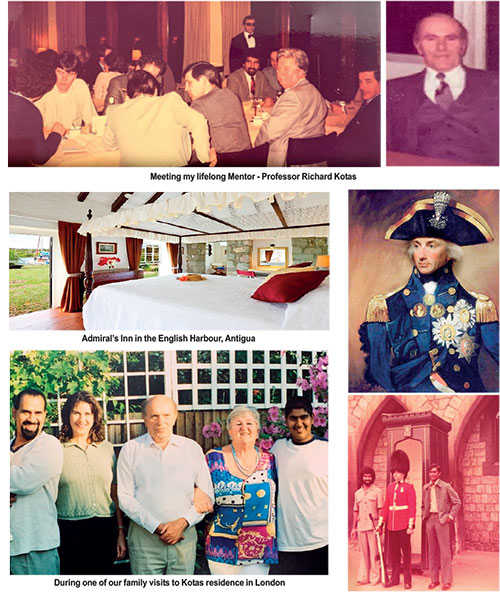
I became interested in one of the greatest British heroes of all time – Admiral Horatio Nelson (Lord Nelson). It stemmed from my frequent visits in and around the Trafalgar Square by foot and London buses in 1979 and 1982. Looking up at the most impressive 169 feet tall Nelson’s Column fired my curiosity about this legendary hero, who had injured one eye and lost one arm in two different battles.
Lord Nelson supposedly had popularized the term: ‘turned a blind eye’ when wilfully disobeying a signal from a superior to withdraw his ship during a naval engagement. His inspirational leadership, visionary strategy and unconventional tactics brought about a number of significant British naval victories during the French Revolutionary and Napoleonic Wars.
He is widely regarded as one of the greatest naval commanders in history. The Battle of Trafalgar in 1805 was one of the most decisive naval battles in history, when a British fleet under the command of Lord Nelson defeated a combined French and Spanish fleet off the coast of Spain. Lord Nelson died on his flagship, HMS Victory at the end of the Battle of Trafalgar.
As the legend has it, fatally wounded Lord Nelson, asked, “Did Britain win?” According to the tour guide who took me to Lord Nelson’s cabin on HMS Victory, after hearing the good news, Lord Nelson gave his final order, “Bury me in England” and took his final breath. As the voyage back to Portsmouth would have taken a several days, naval officers arranged to have Lord Nelson’s body placed in a cask filled with brandy and rum.
Upon arrival at Portsmouth, however, the story goes that when the cask was opened it was empty of any liquor. The pickled body was then removed. Upon inspection, it was discovered that the a few liquor-addicted sailors had drilled a hole in the bottom of the cask and drunk all the brandy and rum. “Now you understand how the popular term – ‘Full Bodied Wine’ originated!” our guide joked.
I liked watching famous movies about Lord Nelson such as ‘Bequest to the Nation/The Nelson Affair’ (with Peter Finch as Lord Nelson and Glenda Jackson as his mistress – Lady Hamilton). When I lived in the West Indies/the Caribbean for nearly a decade from the early 1990s, my museum visits sparked further interest about this legendary character. During Lord Nelson’s near-decade long early period of naval duty in the Caribbean, he left records and myths about both his professional life and personal life, including affairs and slave ownership.
After serving in and around Port Royal, Jamaica (which was my second home), Lord Nelson had been transferred to the islands of Antigua and Barbuda. In his late twenties he commanded this important (due to its close proximity to the islands of the French West Indies), naval base within the English Harbour. The base is named after its most famous resident, as ‘Nelson’s Dockyard’, which is now a UNESCO World Heritage Site.
Currently, his former residence, is an expensive 10-bedroom boutique hotel with an amazing historical charm – Admiral’s Inn. In the year 2000, during an official trip for my then employer, the University of the West Indies, I did a special trip to the English Harbour and managed to stay for one night in the bedroom used by Lord Nelson. During my travels in 26 Caribbean countries, this stay was one of the most memorable.
South Downs
“Chandi, get ready to move from Cosham to South Downs for a few days. I have arranged a special management observer period for you at a Holiday Inn in that area”, Larry Wilson told me over the telephone. Arriving in South Downs in Larry’s car, I could not take my eyes off a range of chalk hills that extends over many counties with steep escarpment on one side. The South Downs are characterised by rolling chalk downland with close-cropped (by the sheep) turf and dry valleys, and are recognised as one of the most important chalk landscapes in England.
The South Downs are relatively less populated compared to South East England as a whole. There is a rich heritage of historical features and archaeological remains, including defensive sites, burial mounds and field boundaries. The downland is a highly popular recreational destination, particularly for walkers, horse riders and mountain bikers.
My observer period at the Holiday Inn focused mainly on training new food and beverage servers. Developed by their corporate offices, the on-the-job training sessions covered the very basics of customer service in a most effective manner. Having recently completed a training program at the ILO head office in Switzerland on ‘Modules of Employable Skills’, my role at the Holiday Inn quickly changed from a mere observer to a facilitator.
This new experience was helpful to me when, one year later, as a consultant, I developed a two-week food and beverage training session for hotel workers in Sri Lanka. This was on the invitation of my friend, Imtiaz Cader, the General Manager/Director of the Holiday Inn in Colombo.
Winchester
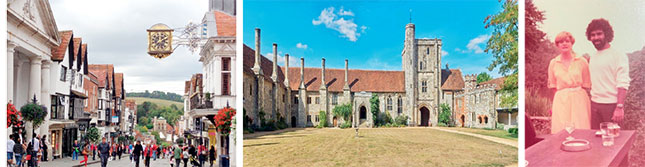
I was happy to receive an invitation from a family friend, Mary Anderson to spend a couple of days at her house in Winchester. In 1980, Mary travelled to Sri Lanka to attend our wedding. Mary came with her granddaughter Sarah to pick me up from the coach station and took me on a long tour covering many tourist spots of their historic city.
Winchester is a city on the edge of South Downs National Park. Mary took great pride in taking me to see the medieval Winchester Cathedral. The Great Hall of Winchester Castle houses the medieval round table linked to the mythological figure, King Arthur who was the head of the Kingdom Camelot and the Knights of the Round Table.
“I am too old to do the long Keats’ walk by the River Itchen. Sarah, you go with Chandi”. Mary sat down to rest with a cup of tea. After a beautiful walk passing the famous city mill and shop, Sarah took me along the Water Meadows Alms-houses (bede-houses) established from the 10th century to provide a place of residence for poor, old and distressed people. The oldest Alms-house still in existence is the Hospital of St. Cross in Winchester, built around 1,000 years ago.

Windsor
A friend of mine from London drove me to Windsor, which is a town on the River Thames, just west of London. It is the home to Windsor Castle, a residence of the British Royal Family. Built by William the Conqueror in the 11th century, the castle was extensively remodelled by subsequent monarchs. We took part in a guided public tour.
St George’s Chapel at Windsor Castle built in the late-medieval Perpendicular Gothic style. It was built in the 14th century by King Edward III and extensively enlarged in the late 15th century. It is located in the Lower Ward of the castle. The chapel has been the scene of many royal services, weddings and burials, over the centuries.
Guildford
UN/ILO arranged for my final week in UK to be in Guildford. I found the medieval Guildford Castle, in the centre of town to be very impressive. The immaculately landscaped gardens and views from its square tower were beautiful. I enjoyed a visit to Loseley Park, a large a 16th-century Tudor manor house with a walled garden. As an artist, I was particularly interested in visiting the nearby Watts Gallery, and Artists’ Village, which displayed Victorian paintings and sculptures.
In the later years, I visited a few other cities in South East England, including Canterbury, Tunbridge Wells, Folkstone, Eastbourne, Brighton, Southampton, Bournemouth, Torque, Plymouth; for leisure, work or research.
University of Surrey
I then moved to Guildford for a week. My accommodation was in the student residence of the University of Surrey. It is a public research university which had received its royal charter in 1966, along with a number of other institutions previously known as colleges of technology. Over the years, the university’s research output and global partnerships have led to it being regarded as one of UK’s leading research universities.
In March, 1982, I attended a week-long management development program there, designed for middle managers of the British hotel industry. Our program focused on hotel design, marketing, finance, and food and beverage controls. I was the only international attendee of this program.
During the management development program, we had our lunches and dinners at the training restaurant of the Department of Tourism and Hotel Management of the University of Surrey. Each table for dinner was hosted by one of the professors or a senior lecturer. Around mid-week, at the dinner table where I was seated, there was no host, but a vacant chair next to me. Just before the service began, a middle-aged gentleman sat at that chair and started a friendly conversation with me. That chat changed and influenced my professional life significantly, over many decades.
“I am Richard Kotas. Where do you come from?” the gentleman asked me soon after sitting at the head of the table. During the discussion over dinner, we learnt a lot about each other. I was very impressed about his life story. After leaving a labour camp in the Nazi Germany after World War II, Richard Kotas arrived in UK as a refugee. His whole family in Poland, was sadly displaced. “All I had was my father’s wristwatch, five British pounds and the ability to speak about five words in English,” he old me explaining his humble beginnings in a new country.

In 1982, Richard Kotas was a highly respected Senior Lecturer and author who had published over a dozen text books related to hotel finance and accounting. He then gave me a signed copy of a very popular textbook titled, ‘Food and Beverage Control’ which he had co-authored. “This is for you Chandi. I will discuss this book, cover to cover, over the next two days with your group”, he said with a friendly hand shake.
Twelve years after that dinner meeting, Richard Kotas and I co-authored a British text book which became popular in many universities in the Commonwealth. It was based on my master’s degree dissertation, which he supervised in 1984. I got into writing and editing text books, mainly due to the encouragement and coaching by Richard Kotas, over the years.
Over that dinner in March 1982, Richard Kotas informed me that, the world’s first master’s degree in International Hotel Management will commence at the University of Surrey in September 1983, with him as the Program Coordinator. “You would be a good candidate for this master’s degree”, he encouraged me, and I immediately said, “Yes!”. The very next day, he arranged an appointment for me to be interviewed by his Head of Department.
Unfortunately, I was rejected by Professor Philip Nailon, Head of the Department of Tourism and Hotel Management, as I did not have the entry qualification of a four-year honour’s bachelor’s degree. Rejection always was a motivator for me, and I continued to pursue then possibilities. “Your credentials are impressive and we are happy to enrol you in the fourth year of our bachelor’s degree, before joining the master’s degree.”
After checking the program fees, I realised that I simply could not invest the money for two years of studies in UK. “There must be some other way for me to bridge the gap and join the first cohort of the master’s degree” I gently pushed towards achieving my objective. Professor Nailon then said, “OK. When you return to Sri Lanka, look for reputed university programs equivalent to the fourth-year level academic studies, and let me know if you find something good for me to re-consider your application to the MSc in International Hotel Management.” I was certainly determined to do so.
According to Professor Richard Kotas, I was his best student in 1983/84 during my master’s degree studies at the University of Surrey. He was my favourite teacher of all time. Later, he became my boss, co-author, co-presenter of seminars, business partner, fellow board member, lifelong mentor and more importantly; loyal friend. Over the years, we did joint-assignments in UK, Sri Lanka and Jamaica. In 1990, when he was the Director of the School of Hotel Management at Schiller International University in London, he hired me as his deputy.

Professor and Mrs. Kotas were like my parents and they also loved my wife, like the daughter they never had. Over 38 years, every time I was in West London, I visited Professor and Mrs. Kotas and had a home-cooked Polish meal in their home. The last time I did so was in January 2020, when I spent six hours with them, on my way from Toronto to Colombo.
During that meeting, we compared fruits of our new mutual hobby – poetry. He gave me signed copies of his two latest books, with his poems. I read some of my new poems and sought Professor Kotas’s input. “My dear Chandi, your poetry is beautiful. You must publish a book of poetry”, he planted a seed in my mind. He never saw my book of poetry, ‘Emotions’ which was published in 2022. Professor Kotas passed away a few months after my final meeting with him in London in 2020, when he had just turned 91. RIP, my dear friend! Thank you for everything! I love you.