Features
EXPLORING ITALY Part 47

CONFESSIONS OF A GLOBAL GYPSY
By Dr. Chandana (Chandi) Jayawardena DPhil
President – Chandi J. Associates Inc. Consulting, Canada
Founder & Administrator – Global Hospitality Forum
chandij@sympatico.ca
To Europe on a UN Fellowship
Early January, 1982 I departed for Europe on a 13-week, fellowship fully-funded and arranged by the United Nations Development Program (UNDP), which is a United Nations organization tasked with helping countries eliminate poverty and achieve sustainable economic growth and human development. it is the largest UN development aid agency since its formation in 1965, headquartered in New York City and offices in over 150 countries. The purpose of the fellowship was for me to acquire relevant knowledge and obtain a teaching qualification to justify my new appointment as a Senior Lecturer at the Ceylon Hotel School (CHS).

My wife accompanied me and we looked forward to visiting a dozen countries in Europe. We were in an adventurous mood. We travelled from Colombo to Paris and then to Lyon before proceeding to Turin, where UNDP had arranged for me to attend a five week-long ‘Training Methodology’ study program at the Turin Centre – the professional training and education arm of the International Labour Organization (ILO). On a cold, snow-covered winter day, we arrived at the Turin Centre. We were immediately greeted with a warm, Italian welcome.
The centre had an atmosphere of a hotel as well as, a small university. It had been built in 1961 to celebrate the 100th anniversary of modern Italy. After the year-long centennial celebrations, the Italian government had gifted the entire complex to the United Nations who converted it to the International Training Centre and three other educational institutes of the ILO in 1964. It is a beautiful centre built in a large park on the banks of River Po. Conference rooms and classrooms were located in over 20 pavilions. Facilities included a restaurant, cafeteria, bar lounge, bank, travel agency, post office, medical centre, indoor and outdoor sports.
Most of the 300 double bedrooms were occupied by ILO Fellows mainly from developing countries around the world studying in short programs, and visiting members of the faculty. I quickly realized that I was unique among nearly 600 residents of the Turin Centre in three aspects. I was the only Sri Lankan, only hospitality professional and the only Fellow travelling with his/her spouse. We loved the Turin Centre, its international atmosphere and Italian hospitality.
Training Methodology
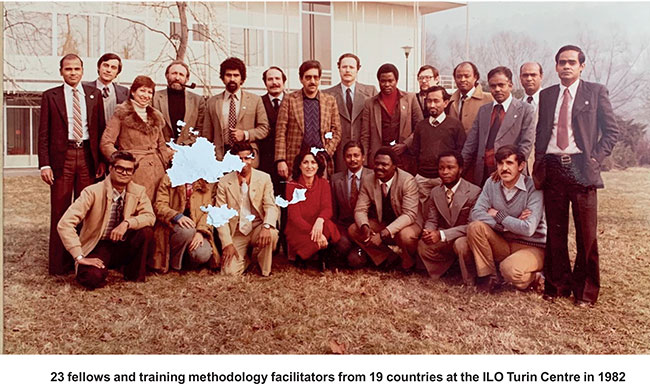
The program I took at the Turin Centre had a few courses focused on the latest theories and practices in pedagogical education and training methodology. The program with 16 Fellows from 13 countries was facilitated by five ILO experts who came on short secondments from universities in five other countries. Although, well diverse in terms of nationalities, my cohort of this program had no female Fellows. Two Italian ladies, who were full-time employees of the Turin Centre, coordinated the program and our logistics, and added that essential female charm to the program. I loved the global flavour of the program.
The other participants came from different professional specializations including, medicine, law, engineering, architecture, banking, finance, statistics and social work. The common element for the 16 of us was that we were all educators of postsecondary institutions. In addition to learning to become better educators, we were also trained to design and implement workplace training. What I learnt at the Turin Centre helped in my both careers in post secondary education and hotel management over many decades.
In the early 1980s pre-PowerPoint era, most post secondary educators used only black boards and white boards in classrooms. At that time, the overhead projector was the trendiest classroom teaching tool. There was a special session at the Turin Centre to train us to make colourful overhead projector slides. With my background in visual arts, I was able to excel in this course. When I returned to CHS after my training in Europe, for each lecture I used many colourful overhead projector slide presentations. They not only added colour to my lectures, they also enhanced my popularity as a Senior Lecturer.
After learning the basic teaching skills, our program in Turin focused on Microteaching, a concept developed and made popular at Stanford University, USA in the 1960s in training professors to become better teachers. During the first week, we all had to do a condensed version of our favourite lecture in 10 minutes focusing on teaching one simple skill, while all of our mini lectures were recorded. As the least experienced teacher in the group, I picked ‘Organizing Events at Resorts’ as my topic.
When the videos were shown in the class the next day, each presenter and the other 15 Fellows critiqued each mini lecture. After four weeks of a very high level of education, during our last week, we repeated the same process with 10 minutes per Fellow on the same topics. Finally, the facilitators showed our group, the before and after recordings of all 16 mini lectures. The improvements, we observed were extremely impressive, motivating and enhanced the self-confidence of all Fellows. I knew at once, that my teaching skill improvement in just five weeks had progressed more than I had hoped. Thank you, UNDP and ILO!
Enjoying Italy
Although English was the medium of instructions, we were given mini lessons of spoken Italian every evening during the weekdays. The aim here was for the Fellows to say a few Italian words when the Turin Centre took us to the local markets and on four weekend bus tours to touristic places in other major cities.
We met a few local Italians at the bar lounge of the Turin Centre. They all were very friendly and one family became extra friendly with us. “Where are you from? How did you get a such a nice tan?” they asked. When we tried to explain in our broken Italian that we were born in Sri Lanka with permanent tans, they said that they preferred to speak in English to improve before a forthcoming trip to USA to meet extended family had migrated to America decades earlier.
Our new Italian friends offered to take us to their home on our first Sunday in Turin. After picking us up, we proceeded to their home located in a beautiful area in the suburbs of Turin. We joined about 12 members of their family gathered around two large kitchen tables to enjoy food prepared by our host’s mother and grandmother. That was a memorable feast with all types of Martini vermouths, Northern Italian appetizers, home-made bread dipped in olive oil, slow-cooked meat and poultry dishes, varieties of wines from the Piedmont region, home-made desserts and lots of strong coffee.
A cousin of our host in trying to practice his English, asked us, “Do you know that Italy is the # one country in wine production in the world, but the French exports 50% more wine per year than us?” With an attempt to be politically correct, I just smiled. He continued, “That is because we enjoy drinking our great wines by ourselves, unlike the French!”, and made an infectious loud laugh. All around the table joined him including us.
The meal lasted over six hours. We all sat around the tables, ate, drank and laughed while listening to two older uncles of our host arguing about soccer and Italian politics, all the while chain smoking. When my wife, who was not used to eating so much food and inhaling smoke from cigars and cigarettes felt a bit tired, they let her rest in the master bedroom. After a nap when she re-joined the prolonged hospitalities, the grandmother said in Italian, “Bellissima giovane moglie (beautiful young wife), now that you had a nice beauty nap, time to enjoy the new dishes I just made.” Italian hospitality was the best we ever experienced during our global travels over the next 15 years.
Before they dropped us back at the Turin Centre in the late evening, I asked if they were celebrating a special occasion. Our friend Piccolo said, “No, that was our weekly, family get-together. You are invited next Sunday too!” Unfortunately, we could not join them again as the Turin Centre took us on bus tours every weekend after that. We visited Florence, Rome, Vatican City and Genoa. First, we covered key attractions of Turin over a weekend and a few evenings.

Turin
Turin had been the first capital of the modern Italy from 1861 to 1865 when the Kingdom of Italy claimed most of the territory which covers present-day Italy. Florence followed Turin to become the capital from 1865 to 1871, and Rome became the capital city of the Kingdom of Italy from 1871 to 1946. Since the national unification in 1861 until 1946, Italy had been a kingdom ruled by the House of Savoy, reigning royal house of Italy. After the voters chose to replace the monarchy (forced to leave Italy in exile) with a republic in 1946, Rome continued as the capitol. However, Turin is special as the first capitol of Italy and the home town of their first king, Victor Emmanuel.
In 1961, on the occasion of the 100th anniversary of the unification of Italy, three exhibitions had been organized in Turin. Although the historic, royal palaces and museums were the main tourist attractions of Turin, the exhibition centres and large business corporations added a modern dimension to a dynamic city. The headquarters of the large car manufacturer, FIAT (Fabbrica Italiana Automobili di Torino) and large multinational, alcoholic beverage company Martini & Rossi were in Turin.
The most impressive thing we saw in Turin was the Shroud of Turin, also known as the Holy Shroud. It is a length of linen cloth bearing the negative image (from blood, sweat and dust) of a thin and tall man. Some describe the image as depicting Jesus of Nazareth and believe the fabric is the burial shroud in which he was wrapped after the crucifixion. This has not been proven, as lifeless bodies of people who were punished by crucifying 2,000 years ago were all believed to be wrapped in burial shrouds.
Florence
Florence was a delightful, former capital city. As an artist I was disappointed that Leonardo da Vinci’s the Last Supper was closed to the public at the time we went to Florence. As the iconic mural painting’s appearance had badly deteriorated by the late 1970s, it had to be restored over a couple of decades. I was determined to see this masterpiece, but had to do a trip in 1990s to realize that dream. We were taken to see many other masterpieces of Renaissance art and architecture including Michelangelo’s ‘David’ sculpture.
Rome
Our visit to Rome was during a long weekend. All members of our tour group were first time visitors to Rome. We agreed that no justice could be made to this great city of its ancient glorious heritage in three days. However, I was happy that we were able to visit most of the popular tourist sites in Rome. We visited several districts of Rome, but spent more time in the Colosseo district, containing the most ancient attractions like the Colosseum, Capitoline Hill and the Roman Forum. We also tossed a couple of coins into the Trevi Fountain, as our guide promised us that those who do so would return to Rome again!

The Vatican City
The Vatican City was fully crowded as we went there on a Sunday. Our group liked different aspects of the Vatican City. One of my favourites was the Vatican Museums with ancient Roman sculptures such as the famed ‘Laocoön and his sons’ as well as Renaissance frescoes in the Raphael Rooms. When our guide asked us to rank the best attraction in The Vatican City, I favoured the Sistine Chapel ceiling showing the mesmerizing work by the great Michelangelo.
Genoa
Genoa was a quick visit. This historical port city was very colourful. It appeared that some large groups of tourists arrived in Genoa by boat and ferry services. Although most of the city’s museums and historical sites were impressive, my most memorable was visiting the house where Christopher Columbus was said to have been born in Piazza Dante. Our tour guide took us to his favourite site, which was the Lanterna, which he claimed to be the oldest European lighthouse. He had a final surprise for us. He arranged a romantic boat ride for us in the harbour around sunset.
We returned to the Turin Centre with great memories of Italy’s three capitols and Genoa. We also made many new friends, learnt more about the outstanding wines and gastronomic treasures of Italy. We were sad that our memorable stay of five weeks in Italy was coming to an end. I was determined to return to Italy, which I did on a few occasions over the next few decades. We gradually became excited to pack our bags to get ready to explore Switzerland, for the very first time, in February, 1982.