
Features
Events leading to the signing of the Indo-Lanka Agreement

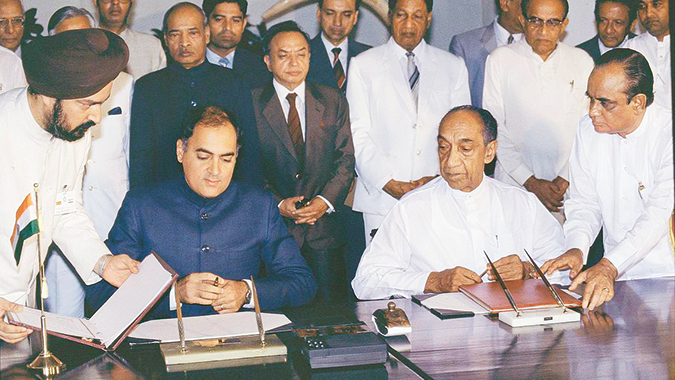
JR tells Rajiv “We can forgive but we cannot forget”
(Excerpted from volume ii of the Amunugama autobiography)
It was at this dismal stage that a new development in the long drawn out negotiations emerged. Due to his cricketing contacts Gamini became close to N Ram of the Kasturi family controlling `The Hindu’ newspaper which though originating in Madras had an all-India coverage with a strong presence in New Delhi. This was later seen when ‘The Hindu’ destabilized the Rajiv regime with their ‘scoop’ on the Bofors scandal.
The Kasturis were Brahmins who were on top of the South Indian social register. In their background correspondence Ram and Gamini had the concurrence of Rajiv Gandhi, if not of the Indian foreign policy establishment. It is said in JRJ’s biography by Wriggins and De Silva that at this stage the LTTE through back channels had indicated that they were in favour of an agreement if the Northern and Eastern provinces were joined. A new element of an Indian guarantee of an enforcement of an agreement between the two parties now entered the scene.
As Bernard Tillekeratne has written “Ram’s letter of 12th June 198 7….. outlined a set of proposals on the important precondition that India would be the mediator in all the discussions and even more importantly that it would underwrite the implementation of any agreement reached. This letter was one of the first positive developments that culminated in the Indo-Lanka Accord of 29th July 1987”.
Regarding the allocation of powers to the Provincial Councils JRJ cut the Gordian knot by suggesting that we adopt ‘in toto’ the provisions of the Indian constitution regarding the devolution of powers to the States. Thus, there would be three lists as in India – the powers of the Centre, the powers of the Provincial Councils and a concurrent list in which certain powers were exercised by both the centre and the periphery.
Earlier the discussion centered on devolution only to the North-Eastern Provincial Council. JRJ decided that all areas in the country should be brought under the second tier scheme. Once this formula was accepted the difficult task of ‘selling’ it to the Sinhala and LTTE protagonists were undertaken by the two parties. The Indian operation was undertaken by Dixit and his political secretary in Colombo. After his deputy met Prabhakaran and his advisors in the Vanni several times, though it was later disputed by the LTTE, Dixit informed New Delhi that he had succeeded in persuading the LTTE leaders to lay down their arms once the agreement was signed.
JRJ was for the immediate signing of the accord as he knew that opposition would build up not only from the SLFP and JVP but also from factions within his own Government. It became clear that Premadasa was against such an agreement and was being set up as a virulent opponent of India with Athulathmudali’s encouragement. Once I was asked to bring some documents to the Cabinet room while Cabinet sessions were in progress. As I climbed up the stairs I ran into Prime Minister Premadasa rushing down the steps in anger. However there was no one following him to cool him down as they usually do in those Cabinet dramas.
Gamani Jayasuriya who represented the Sinhala Buddhist lobby resigned in protest. During this time I associated with Gamani Jayasuriya as we were both members of the Governing Council of CNAPT (Ceylon National Association for the Prevention of Tubercolosis)in which my friend of University days, Fonseka, was secretary. Fonseka, who was a well-known astrologer, had predicted that Gamani would be the Prime Minister when this fracas was over. After resigning Gamani would visit Fonseka almost daily to check whether his prediction was coming true. In the event it did not happen and Gamani died suddenly, a very disappointed man. All this showed that the time was fraught with confusion and society was in turmoil which was to break out in a long period of terror.
Indo-Lanka Accord
I was one of the few participants who was present at President’s House when the Indo-Lanka accord was signed in the afternoon of July 29. I accompanied Gamini Dissanayake for the signing of the accord by Rajiv Gandhi and JRJ. Rajiv was accompanied by Foreign Minister Narasimha Rao and advisor Natwar Singh. On our side, Foreign Minister Hameed, Hurulle, Minister of Buddhist Affairs, Minister Devanayagam representing the Tamils and the Eastern Province and Gamini Dissanayake were present. The Prime Minister Premadasa, Athulathmudali and, surprisingly, Ronnie de Mel boycotted the meeting.
It was clear that both Rajiv and JRJ looked on Gamini as the coming man in Sri Lanka. In JRJ’s eyes his search for a loyal follower for future UNP leadership was focused now without a doubt on Gamini. When all the signing was done Rajiv went up to a mike set up in the spacious garden and said a few words of conciliation. All eyes were on JRJ when he ambled up to the mike cool as he could be under the circumstances, and gave a mini lecture on Indo-Sri Lanka relations. He ended up by looking Rajiv straight in the eye and, distilling in words the agony that India had imposed on him by their derailing of his efforts to remake Sri Lanka, said to India; “We can forgive but we cannot forget”. He then led Rajiv on foot to his office in President’s square for a no holds barred Press Conference presided over by the two leaders.
This Press Conference was a historic one. The whole of Colombo was shut down and there was an eerie silence in the administrative square which housed the President’s office. The area was guarded by a strong police contingent. Only a few hours before, the armed services had evicted a large contingent of protesters led by Bhikkhus and the SLFP, who had staged a sit in near the Fort Railway station. Mrs. Bandaranaike herself had been present and had been bundled out by the Police adding to the violence that was unleashed by UNP goons against the protesters who were non-violent.
We could hear the police sirens from the battle grounds in the Pettah. Later we heard that about a dozen protesters were killed. There were reports that gangs of protesters were approaching Colombo city from the suburbs. JR appeared to be unfazed before the media but I knew that he was worried by the rising violence which was passing from SLFP control to the violent hotheads of the JVP. JRJ dominated the press conference with his short introduction and the taking of questions from the global media.
When asked by the press as to the delay in reaching an agreement he blamed himself He said, “It was a lack of courage on my part, a lack of intelligence on my part, a lack of foresight on my part”. It was a bravura performance rarely seen in modern politics. Rajiv looked on stunned by JRJ’s candour. The press then asked him ‘who else’ hoping to cast the net wide. JRJ replied with a smile ‘the media’ drawing a laugh from Rajiv and the hard-bitten journalists who had come to cover the historic event.
Looking back this conference was the biggest event dominated by JRJ during the last days of his regime. He spoke bravely when the country was in flames and his own fate was in the balance. From now on he was put on the defensive by the JVP, supported by the SUP, which unleashed a violence in the South which could not be contained by him and was to spill over to the Premadasa era till the JVP leaders were physically eliminated in 1989. Sri Lanka entered an era of uncertainty and social disruption which blighted the legacy of President Jayewardene which held spectacular promise in its first years. The monolithic UNP which held sway earlier was fragmented and it took all the leader’s skills to even keep it together and pass the baton on to Premadasa. But on that day the future was uncertain and posters threatening to ‘Kill the old man’ began to appear all over the country. An attempt was made on Rajiv’s life by a JVP indoctrinated naval rating and two Indian destroyers steamed into Colombo harbour to show that India will not stand idly by. It was a time of a national tragedy and all eyes were on the implementation of the Accord. The violence unleashed by the JVP compelled JRJ to ask Rajiv for the induction of the Indian Peace Keeping Force [IPKF] which was the first time after independence that a foreign military force was stationed in strength in the country with their own command structure and tasks which were identified by their own leaders.
The President could not deal with the military situation in his own country as he could not do battle in both the North and South of the country at the same time. It must be mentioned here that our military top brass concurred with this decision though they were unhappy to be ‘confined to barracks in the North’. This was particularly so because the Jawans’ who were flown in from South Indian bases were of poor quality.
On a visit to Katunayake I saw them emplane for the North from there. Sonic were dragging well fed goats with them, obviously for a tasty ‘mutton curry’ in their camp. Others were crowding the duty free shop buying everything available on their payday. Though they were under orders to confine themselves to the Northern and Eastern theatre, their intelligence had not indicated that Trincomalee district was multi-ethnic. Due to the activity of the IPKF and the LTTE and the enforced inactivity of the Sri Lankan army, the Sinhalese and Muslims of the East started to stream south for safety, adding more pressure on JRJ who could not depend on Premadasa or Lalith to support him. Only Gamini Dissanayake stood by him and I shuttled between ‘Braemar’ at id Dixit’s residence to seek information on the plans of the IPKF, since the chain of command was broken. To make matters worse, Dixit himself was not kept informed by the Indian Military in Trincomalee and he was getting alarmed and even threatening quit if he was being undercut by Delhi.
LTTE and JVP Reaction
According to the Indo-Lanka agreement the LTTE was to hand over their weapons to the Sri Lankan armed forces under Indian supervision. What actually happened was a farce which was enacted by the LTTE in violation of the agreement. The LTTE hid its heavy weapons and only offered a token pistol to the army. The other Tamil parties were ready to comply but had the legitimate fear that once they disarmed, they would be massacred by the LTTE. Government made plans for reconstruction of the North and East. The Indian High Commission under Dixit went on overdrive to please Rajiv but the media and the opposition in the South began a virulent campaign against the Indians. For the first time the hitherto monolithic UNP began to crack, largely because the PM and his coterie of MPs showed their displeasure in no uncertain terms.
Premadasa made his famous Angoda Temple speech criticizing the Accord and by implication the President. SLBC brought the tapes of the speech to me and asked for instructions regarding broadcasting it that night with the news. At this point news of my dilemma had reached Premadasa through his henchmen in SLBC.I got a call from Wijayadasa the PM’s Secretary, telling me that his boss was very disturbed by the delay and that I should not be guided by Gamini Dissanayake’s advice on this matter. It was a hot potato and I took the tapes and the DG of SLBC Anura Goonesekere to ‘Braemar’ for the President’s instructions. JRJ was worried and did not have his usual ‘sang froid’. He asked me what we should do and I suggested that we should use an edited version leaving out the venomous attacks. He agreed and we broadcast a watered down version that night.
That seemed to have satisfied the PM who had been informed by his henchmen that we would censor his speech ‘in toto’. Perhaps he was spoiling for a fight on this issue. JRJ on the other hand was very keen to retain the PM’s support at this crucial juncture. He was aware that the SLFP had dangled a carrot before Premadasa saying that the SLFP would back him and Mrs. B would not enter the fray if he sabotaged the Accord. It was a time of moves and countermoves and the Government which was designed to last forever and a day was on the edge of crumbling. Two Southern MPs who had ridden on JRJ’s coattails did not vote for the 13th amendment designed to give effect to the Accord. Another MP from the south who was considered to be a tough guy from Tangalle was murdered by the JVP on his way back from Colombo to his electorate.
The JVP under Rohana Wijeweera who was in hiding with his top leaders as his party was proscribed, launched a murderous attack on all those who supported the Accord, including the leaders of the left-particularly the LSSP, CP and the NLSSP who though advocates of revolution were ill prepared for political violence on this massive scale. While the LTTE had murdered left leaders of the North, the JVP followed suit by murdering leftists in the South. The CP which was active in the grassroots in the South and was a rival to the JVP was decimated.
An early indication of the ruthlessness of the JVP was the horrific murder of the popular student leader of the Colombo campus named Daya Pathirana who opposed their taking control of the student movement which was a power base for their politics. Another innovation of the JVP was the mass induction of young monks, particularly from the universities, as a cover for their political work and military operations. As De Silva and Wriggins have written, many of these monks made bloodcurdling threats which even embarrassed JVP members. As the encounters became even more violent some of these monks gave up robes and emerged as front line leaders of the party. Others, as I have described earlier, jumped ship by migrating to Europe where their supporters had infiltrated the new temples built by JVP oriented migrants in the hig cities.
Interlude
While the JVP and its allies stepped up their protests, the North saw a period of peace which was acclaimed by the international community. A relief and rehabilitation package was negotiated with international donors and inter district movement, particularly visits of Buddhists to Nagadipa, was encouraged. University administrators held their annual conference in Jaffna and we were able to arrange special railway trips from Colombo to Jaffna. Local and foreign journalists were encouraged to report from the North and business slowly resumed, particularly in respect of agricultural produce which was in high demand in the South. The situation was slowly returning to normal when several unfortunate events, some by design, upset the fragile peace. The first was the internecine conflict between the Tamil militants.
Many non LTTE groups became close to the IPKF and on occasion became their informers and proxies. At this stage the LTTE launched murderous attacks on the other Tamil parties partly because they had not given up their claim to be the ‘sole representative’ of the Tamil people and partly because the truce with the Sinhala forces enabled them to turn their attention to the rivals closer home who were being disarmed by the IPKF. The upshot was that ‘the short stay’ of the IPKF promised by Rajiv became a farce and they got bogged down in a disastrous war which finally led to the assassination of Rajiv himself. The LTTE was refusing to play by the Indian playbook and the country was slipping further and further into a cycle of violence over which nobody had control. This was a nightmare period for JRJ, who assailed in the North and South, had to confront dissatisfaction within his party ranks, led by the PM no less. Soon it became life threatening to the party leaders when an assassination attempt was launched by a JVP cadre who was a senior member in the party, inside Parliament itself The mistrust in the party had grown to such an extent that the PM was initially suspected of being one of the conspirators.
Assassination Attempt
While the UNP parliamentary group was meeting as customary in a committee room in parliament an employee opened a door to the room and lobbed a hand grenade into it. Without doubt the target was JRJ whom the JVP had built up as a hate figure. Luckily for the 81 year old President the grenade hit his desk and rolled away from him and exploded further away killing the MP for Morawaka, Abeywickreme. Lalith Athulathmudali was seriously injured and had to be rushed for emergency surgery. the Prime Minister was also injured but not seriously. According to the President he had been saved because the PM had pushed him under the table so that the shrapnel did not hit him. Within a short time after the attack I got a telephone call to say that the President wanted me to come immediately to the Army OPS Combine office in Flower road.
When I went there JRJ had just arrived with blood splattered all over his tunic. He was in shock and asked us what we should do? I had read much about the Kennedy assassination and told him that we had to immediately do two things. One was to ensure that there was no further attacks due from a wide ranging conspiracy and secondly to inform the country that he was safe and that the conspiracy had failed. He agreed and I sent for a Rupavahini camera crew and alerted the channels about an imminent announcement by the President.
JRJ wanted a few minutes to compose himself and faced the cameras in a live broadcast with the blood on his tunic seen clearly. He identified the attack as an assault on democracy and went out of his way to assure the public that the PM, though slightly injured, was safe. That took the sting out of the speculation that the PM had engineered this attack. It was a miracle that the President had survived but it added to his woes as a leader and encouraged some ministers, especially Ronnie de Mel and Nissanka Wijeratne to think of jumping ship. JRJ by shrewdly bringing in the PM as a victim ensured that the party would not be weakened further. The Thirteenth Amendment
Action now shifted to the 13th amendment which was to give legal effect to the provisions of the Indo-Lanka agreement. Challenges to it were launched by different opposing parties including the alliance of major opponents called the Mavbima Surakeeme Viyaparaya [MSV] which was led by Maduluwawe Sobhita. It was a powerful organization and with the JVP raising the ante with violence, the judgement of the full bench of the Supreme Court on the Constitutional amendment bill became absolutely crucial.
JRJ was confident of his two third majority in Parliament. But if it came to a need for approval in a referendum, the bill was as good as dead. Everybody was on tenterhooks while awaiting the verdict. Premadasa also realized at this juncture that he had gone too far. This was a period when, for the first time, JRJ and Premadasa were really estranged. With all the hostility to Premadasa in the party JRJ had stood by him and had given him his due. He remembered the time when he and Dudley had paid a salary to the up-and-coming Premadasa with their personal funds. Even at this stage he was loath to discipline the PM but he sent a clear message that he was annoyed by removing Sirisena Cooray from the Executive Committee of the party, together with Ronnie de Mel who had resigned from the Cabinet by then.
Premadasa then pulled back stating that he was willing to abide by the decision of the Supreme Court regarding the 13th amendment. This was because he had been assured by Raja Wanasundera who was a senior judge sitting on this very bench, that a referendum will become necessary. Raja was a close friend of M Fernando who acted as Premadasa’s emissary on this issue. But this tactic backfired because Justice Parinda Ranasinghe provided a majority to the verdict of the Bench of judges which held that a referendum was not necessary and that the amendment could be passed with a two third majority in Parliament. JR cracked the whip, and the Bill was passed in the midst of unprecedented security, when the MPs had to be bussed with an armed escort to Parliament and back to the heavily guarded hotel in Colombo which was booked for them. The PM true to his word moved the Bill in Parliament. But Colombo was like a war zone and the Government appeared to be tottering. This was a nightmare for JRJ, with his party officials being killed en masse and even some of his MPS like De Silva of Habaraduwa and Tikiri Banda of Galagedera being killed in a brutal fashion.








by Dr Gotabhya Ranasinghe
Senior Consultant Cardiologist
National Hospital Sri Lanka
When we sought a meeting with Hon Dr. Ramesh Pathirana, Minister of Health, he graciously cleared his busy schedule to accommodate us. Renowned for his attentive listening and deep understanding, Minister Pathirana is dedicated to advancing the health sector. His openness and transparency exemplify the qualities of an exemplary politician and minister.
Dr. Palitha Mahipala, the current Health Secretary, demonstrates both commendable enthusiasm and unwavering support. This combination of attributes makes him a highly compatible colleague for the esteemed Minister of Health.
Our discussion centered on a project that has been in the works for the past 30 years, one that no other minister had managed to advance.
Minister Pathirana, however, recognized the project’s significance and its potential to revolutionize care for heart patients.
The project involves the construction of a state-of-the-art facility at the premises of the National Hospital Colombo. The project’s location within the premises of the National Hospital underscores its importance and relevance to the healthcare infrastructure of the nation.
This facility will include a cardiology building and a tertiary care center, equipped with the latest technology to handle and treat all types of heart-related conditions and surgeries.
Securing funding was a major milestone for this initiative. Minister Pathirana successfully obtained approval for a $40 billion loan from the Asian Development Bank. With the funding in place, the foundation stone is scheduled to be laid in September this year, and construction will begin in January 2025.
This project guarantees a consistent and uninterrupted supply of stents and related medications for heart patients. As a result, patients will have timely access to essential medical supplies during their treatment and recovery. By securing these critical resources, the project aims to enhance patient outcomes, minimize treatment delays, and maintain the highest standards of cardiac care.
Upon its fruition, this monumental building will serve as a beacon of hope and healing, symbolizing the unwavering dedication to improving patient outcomes and fostering a healthier society.We anticipate a future marked by significant progress and positive outcomes in Sri Lanka’s cardiovascular treatment landscape within the foreseeable timeframe.

by Fr. Emmanuel Fernando, OMI
Jesuit Fr. Aloysius Pieris (affectionately called Fr. Aloy) celebrated his 90th birthday on April 9, 2024 and I, as the editor of our Oblate Journal, THE MISSIONARY OBLATE had gone to press by that time. Immediately I decided to publish an article, appreciating the untiring selfless services he continues to offer for inter-Faith dialogue, the renewal of the Catholic Church, his concern for the poor and the suffering Sri Lankan masses and to me, the present writer.
It was in 1988, when I was appointed Director of the Oblate Scholastics at Ampitiya by the then Oblate Provincial Fr. Anselm Silva, that I came to know Fr. Aloy more closely. Knowing well his expertise in matters spiritual, theological, Indological and pastoral, and with the collaborative spirit of my companion-formators, our Oblate Scholastics were sent to Tulana, the Research and Encounter Centre, Kelaniya, of which he is the Founder-Director, for ‘exposure-programmes’ on matters spiritual, biblical, theological and pastoral. Some of these dimensions according to my view and that of my companion-formators, were not available at the National Seminary, Ampitiya.
Ever since that time, our Oblate formators/ accompaniers at the Oblate Scholasticate, Ampitiya , have continued to send our Oblate Scholastics to Tulana Centre for deepening their insights and convictions regarding matters needed to serve the people in today’s context. Fr. Aloy also had tried very enthusiastically with the Oblate team headed by Frs. Oswald Firth and Clement Waidyasekara to begin a Theologate, directed by the Religious Congregations in Sri Lanka, for the contextual formation/ accompaniment of their members. It should very well be a desired goal of the Leaders / Provincials of the Religious Congregations.
Besides being a formator/accompanier at the Oblate Scholasticate, I was entrusted also with the task of editing and publishing our Oblate journal, ‘The Missionary Oblate’. To maintain the quality of the journal I continue to depend on Fr. Aloy for his thought-provoking and stimulating articles on Biblical Spirituality, Biblical Theology and Ecclesiology. I am very grateful to him for his generous assistance. Of late, his writings on renewal of the Church, initiated by Pope St. John XX111 and continued by Pope Francis through the Synodal path, published in our Oblate journal, enable our readers to focus their attention also on the needed renewal in the Catholic Church in Sri Lanka. Fr. Aloy appreciated very much the Synodal path adopted by the Jesuit Pope Francis for the renewal of the Church, rooted very much on prayerful discernment. In my Religious and presbyteral life, Fr.Aloy continues to be my spiritual animator / guide and ongoing formator / acccompanier.
Fr. Aloysius Pieris, BA Hons (Lond), LPh (SHC, India), STL (PFT, Naples), PhD (SLU/VC), ThD (Tilburg), D.Ltt (KU), has been one of the eminent Asian theologians well recognized internationally and one who has lectured and held visiting chairs in many universities both in the West and in the East. Many members of Religious Congregations from Asian countries have benefited from his lectures and guidance in the East Asian Pastoral Institute (EAPI) in Manila, Philippines. He had been a Theologian consulted by the Federation of Asian Bishops’ Conferences for many years. During his professorship at the Gregorian University in Rome, he was called to be a member of a special group of advisers on other religions consulted by Pope Paul VI.
Fr. Aloy is the author of more than 30 books and well over 500 Research Papers. Some of his books and articles have been translated and published in several countries. Among those books, one can find the following: 1) The Genesis of an Asian Theology of Liberation (An Autobiographical Excursus on the Art of Theologising in Asia, 2) An Asian Theology of Liberation, 3) Providential Timeliness of Vatican 11 (a long-overdue halt to a scandalous millennium, 4) Give Vatican 11 a chance, 5) Leadership in the Church, 6) Relishing our faith in working for justice (Themes for study and discussion), 7) A Message meant mainly, not exclusively for Jesuits (Background information necessary for helping Francis renew the Church), 8) Lent in Lanka (Reflections and Resolutions, 9) Love meets wisdom (A Christian Experience of Buddhism, 10) Fire and Water 11) God’s Reign for God’s poor, 12) Our Unhiddden Agenda (How we Jesuits work, pray and form our men). He is also the Editor of two journals, Vagdevi, Journal of Religious Reflection and Dialogue, New Series.
Fr. Aloy has a BA in Pali and Sanskrit from the University of London and a Ph.D in Buddhist Philosophy from the University of Sri Lankan, Vidyodaya Campus. On Nov. 23, 2019, he was awarded the prestigious honorary Doctorate of Literature (D.Litt) by the Chancellor of the University of Kelaniya, the Most Venerable Welamitiyawe Dharmakirthi Sri Kusala Dhamma Thera.
Fr. Aloy continues to be a promoter of Gospel values and virtues. Justice as a constitutive dimension of love and social concern for the downtrodden masses are very much noted in his life and work. He had very much appreciated the commitment of the late Fr. Joseph (Joe) Fernando, the National Director of the Social and Economic Centre (SEDEC) for the poor.
In Sri Lanka, a few religious Congregations – the Good Shepherd Sisters, the Christian Brothers, the Marist Brothers and the Oblates – have invited him to animate their members especially during their Provincial Congresses, Chapters and International Conferences. The mainline Christian Churches also have sought his advice and followed his seminars. I, for one, regret very much, that the Sri Lankan authorities of the Catholic Church –today’s Hierarchy—- have not sought Fr.
Aloy’s expertise for the renewal of the Catholic Church in Sri Lanka and thus have not benefited from the immense store of wisdom and insight that he can offer to our local Church while the Sri Lankan bishops who governed the Catholic church in the immediate aftermath of the Second Vatican Council (Edmund Fernando OMI, Anthony de Saram, Leo Nanayakkara OSB, Frank Marcus Fernando, Paul Perera,) visited him and consulted him on many matters. Among the Tamil Bishops, Bishop Rayappu Joseph was keeping close contact with him and Bishop J. Deogupillai hosted him and his team visiting him after the horrible Black July massacre of Tamils.
Sri Lanka-Singapore Free Trade Agreement
By Gomi Senadhira
senadhiragomi@gmail.com
“You might tell fairy tales, but the progress of a country cannot be achieved through such narratives. A country cannot be developed by making false promises. The country moved backward because of the electoral promises made by political parties throughout time. We have witnessed that the ultimate result of this is the country becoming bankrupt. Unfortunately, many segments of the population have not come to realize this yet.” – President Ranil Wickremesinghe, 2024 Budget speech
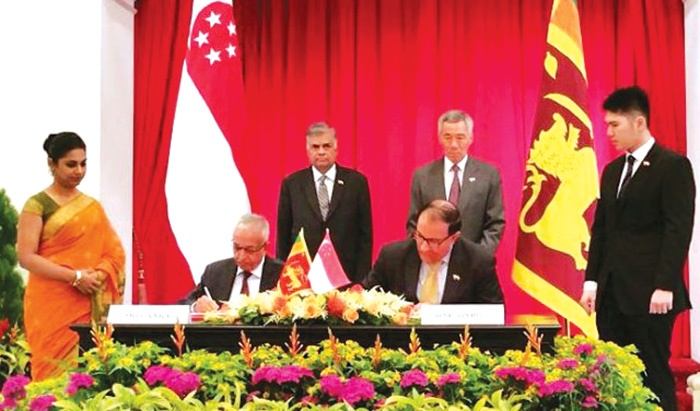
Any Sri Lankan would agree with the above words of President Wickremesinghe on the false promises our politicians and officials make and the fairy tales they narrate which bankrupted this country. So, to understand this, let’s look at one such fairy tale with lots of false promises; Ranil Wickremesinghe’s greatest achievement in the area of international trade and investment promotion during the Yahapalana period, Sri Lanka-Singapore Free Trade Agreement (SLSFTA).
It is appropriate and timely to do it now as Finance Minister Wickremesinghe has just presented to parliament a bill on the National Policy on Economic Transformation which includes the establishment of an Office for International Trade and the Sri Lanka Institute of Economics and International Trade.
Was SLSFTA a “Cleverly negotiated Free Trade Agreement” as stated by the (former) Minister of Development Strategies and International Trade Malik Samarawickrama during the Parliamentary Debate on the SLSFTA in July 2018, or a colossal blunder covered up with lies, false promises, and fairy tales? After SLSFTA was signed there were a number of fairy tales published on this agreement by the Ministry of Development Strategies and International, Institute of Policy Studies, and others.
However, for this article, I would like to limit my comments to the speech by Minister Samarawickrama during the Parliamentary Debate, and the two most important areas in the agreement which were covered up with lies, fairy tales, and false promises, namely: revenue loss for Sri Lanka and Investment from Singapore. On the other important area, “Waste products dumping” I do not want to comment here as I have written extensively on the issue.
1. The revenue loss
During the Parliamentary Debate in July 2018, Minister Samarawickrama stated “…. let me reiterate that this FTA with Singapore has been very cleverly negotiated by us…. The liberalisation programme under this FTA has been carefully designed to have the least impact on domestic industry and revenue collection. We have included all revenue sensitive items in the negative list of items which will not be subject to removal of tariff. Therefore, 97.8% revenue from Customs duty is protected. Our tariff liberalisation will take place over a period of 12-15 years! In fact, the revenue earned through tariffs on goods imported from Singapore last year was Rs. 35 billion.
The revenue loss for over the next 15 years due to the FTA is only Rs. 733 million– which when annualised, on average, is just Rs. 51 million. That is just 0.14% per year! So anyone who claims the Singapore FTA causes revenue loss to the Government cannot do basic arithmetic! Mr. Speaker, in conclusion, I call on my fellow members of this House – don’t mislead the public with baseless criticism that is not grounded in facts. Don’t look at petty politics and use these issues for your own political survival.”
I was surprised to read the minister’s speech because an article published in January 2018 in “The Straits Times“, based on information released by the Singaporean Negotiators stated, “…. With the FTA, tariff savings for Singapore exports are estimated to hit $10 million annually“.
As the annual tariff savings (that is the revenue loss for Sri Lanka) calculated by the Singaporean Negotiators, Singaporean $ 10 million (Sri Lankan rupees 1,200 million in 2018) was way above the rupees’ 733 million revenue loss for 15 years estimated by the Sri Lankan negotiators, it was clear to any observer that one of the parties to the agreement had not done the basic arithmetic!
Six years later, according to a report published by “The Morning” newspaper, speaking at the Committee on Public Finance (COPF) on 7th May 2024, Mr Samarawickrama’s chief trade negotiator K.J. Weerasinghehad had admitted “…. that forecasted revenue loss for the Government of Sri Lanka through the Singapore FTA is Rs. 450 million in 2023 and Rs. 1.3 billion in 2024.”
If these numbers are correct, as tariff liberalisation under the SLSFTA has just started, we will pass Rs 2 billion very soon. Then, the question is how Sri Lanka’s trade negotiators made such a colossal blunder. Didn’t they do their basic arithmetic? If they didn’t know how to do basic arithmetic they should have at least done their basic readings. For example, the headline of the article published in The Straits Times in January 2018 was “Singapore, Sri Lanka sign FTA, annual savings of $10m expected”.
Anyway, as Sri Lanka’s chief negotiator reiterated at the COPF meeting that “…. since 99% of the tariffs in Singapore have zero rates of duty, Sri Lanka has agreed on 80% tariff liberalisation over a period of 15 years while expecting Singapore investments to address the imbalance in trade,” let’s turn towards investment.
Investment from Singapore
In July 2018, speaking during the Parliamentary Debate on the FTA this is what Minister Malik Samarawickrama stated on investment from Singapore, “Already, thanks to this FTA, in just the past two-and-a-half months since the agreement came into effect we have received a proposal from Singapore for investment amounting to $ 14.8 billion in an oil refinery for export of petroleum products. In addition, we have proposals for a steel manufacturing plant for exports ($ 1 billion investment), flour milling plant ($ 50 million), sugar refinery ($ 200 million). This adds up to more than $ 16.05 billion in the pipeline on these projects alone.
And all of these projects will create thousands of more jobs for our people. In principle approval has already been granted by the BOI and the investors are awaiting the release of land the environmental approvals to commence the project.
I request the Opposition and those with vested interests to change their narrow-minded thinking and join us to develop our country. We must always look at what is best for the whole community, not just the few who may oppose. We owe it to our people to courageously take decisions that will change their lives for the better.”
According to the media report I quoted earlier, speaking at the Committee on Public Finance (COPF) Chief Negotiator Weerasinghe has admitted that Sri Lanka was not happy with overall Singapore investments that have come in the past few years in return for the trade liberalisation under the Singapore-Sri Lanka Free Trade Agreement. He has added that between 2021 and 2023 the total investment from Singapore had been around $162 million!
What happened to those projects worth $16 billion negotiated, thanks to the SLSFTA, in just the two-and-a-half months after the agreement came into effect and approved by the BOI? I do not know about the steel manufacturing plant for exports ($ 1 billion investment), flour milling plant ($ 50 million) and sugar refinery ($ 200 million).
However, story of the multibillion-dollar investment in the Petroleum Refinery unfolded in a manner that would qualify it as the best fairy tale with false promises presented by our politicians and the officials, prior to 2019 elections.
Though many Sri Lankans got to know, through the media which repeatedly highlighted a plethora of issues surrounding the project and the questionable credentials of the Singaporean investor, the construction work on the Mirrijiwela Oil Refinery along with the cement factory began on the24th of March 2019 with a bang and Minister Ranil Wickremesinghe and his ministers along with the foreign and local dignitaries laid the foundation stones.
That was few months before the 2019 Presidential elections. Inaugurating the construction work Prime Minister Ranil Wickremesinghe said the projects will create thousands of job opportunities in the area and surrounding districts.
The oil refinery, which was to be built over 200 acres of land, with the capacity to refine 200,000 barrels of crude oil per day, was to generate US$7 billion of exports and create 1,500 direct and 3,000 indirect jobs. The construction of the refinery was to be completed in 44 months. Four years later, in August 2023 the Cabinet of Ministers approved the proposal presented by President Ranil Wickremesinghe to cancel the agreement with the investors of the refinery as the project has not been implemented! Can they explain to the country how much money was wasted to produce that fairy tale?
It is obvious that the President, ministers, and officials had made huge blunders and had deliberately misled the public and the parliament on the revenue loss and potential investment from SLSFTA with fairy tales and false promises.
As the president himself said, a country cannot be developed by making false promises or with fairy tales and these false promises and fairy tales had bankrupted the country. “Unfortunately, many segments of the population have not come to realize this yet”.
(The writer, a specialist and an activist on trade and development issues . )



US sports envoys to Lanka to champion youth development

Rahuman questions sudden cancellation of leave of CEB employees


