Midweek Review
Enginee‘ring’

Ring to bring discipline to a profession
By K.A.I Kalyanaratne
It was while sipping a cup of tea during a short break, this strange story of a ring and its nexus with a bridge was revealed. Seated next to me was another faculty member of the Institute who received a call on her mobile phone. Thinking that these calls are normal she carefreely responded. However, it appeared that the call was somewhat strange, as the expression on her face showed that she was worried and inquisitive. For the sake of courtesy, I decided not to inquire about it. Anyway, on her own she said that a nephew of hers, domiciled in Canada, had recently visited Sri Lanka a few days ago, and unfortunately, he had misplaced his ring. He could recollect that he spent the previous night in a hotel in Colombo. He, therefore, suspected that he had left the ring at that hotel. Now I probed whether it was his wedding ring. She said ‘No’. It was only thereafter the true story came to light.
The story is an extremely strange one. The particular ring had a close connection with a bridge that had collapsed a long time ago in Canada. Her nephew was extremely worried and sad that he would not be able to trace it. It was, in fact, an extremely strange and sentimental one. This young boy, who was in his early twenties, had recently graduated from a prestigious Canadian university, and wearing that ring had been a part of his graduation ceremony. In fact, the boy had been successful in receiving a merit pass as a full-fledged engineer. Then I asked as to why wearing of the ‘ring’, over and above the degree cloak and garland, was so significant. In Canadian universities all graduating engineers are expected to wear a ring in addition to all other ceremonial garments and rituals. The ring in this context, therefore, was more than an adornment.
Holy combination

Facts: rings, a multipurpose fulfiller
The common fact is that most of us wear rings as mere ornaments, while a few others appear to use the item as a conspicuous display of wealth. However, over the years the ring has been raised to an exalted position, and it has now become a foremost item in our list of jewellery. In today’s society rings perform some symbolic functions concerning marriage, exceptional achievement, high status or authority or membership in an organisation. In Sri Lankan society the ring has crept into the mythical and mystical arena as well. It is common belief that wearing of charmed rings will eliminate the malefic effects of certain astrological settings. Some believe that rings studded with certain gemstones are endowed with supernatural significance. Rings have also given rise to some hilarious and unusual clustering of adjectives. A cocktail-ring for instance, is an oversised ladies’ ring with a large center stone often surrounded by tiny stones. It has earned some synonyms such as cluster-ring, statement-ring and dinner-ring. Doctoral ring is a gold ring worn by a scholar who earns a doctoral degree at a Danish or Swedish university. In the United States it is commonly worn by priests who have earned their doctorate in theology. When worn by bishops or higher-ranking priests, it changes to an ‘Episcopal-ring’.
In lieu of the more common engagement rings some present to their partners ‘Eternity Rings’. Gordon Brown, former Prime Minister of the United Kingdom (from 2007 to 2010) has been known for purchasing an Eternity Ring for his wife, as a recompense for not having originally proposed to her with an engagement ring.
Apart from the above, quite distinct is the Signet Ring. Literatures shows that Signet Rings have been used as far back as 3500 BC, and the people of Mesopotamia had been using them as a symbol of authenticity. A further distinction is that as a Signet Ring is personalized for its owner, no two Signet Rings are alike. Our signatures are a development of the Signet Ring, it being used today to identify how one’s name is written by oneself.
How and why: Aspects of rings

Rings in literary works
In our own literature the signet ring is referred to as the perasmudda (පේරැස්මුද්ද), in which is embossed the name of the king. This is the seal of the ruler. The term appears in this context in many literary works including the Daham Sarana, of 12th century AD, Saddharmarathnavaliya of 13th century AD, and the Pansiya Panas Jatakaya of 14th century AD. However, in later periods the swan became the sign of authority. Swan is හස් (has) and sign is සන sana in Sinhala. It thus became හස්සන hassana and later අස්සන assana. The currently used අත්සන athsana is thus a corrupt word, as many speculate on its origin under the premise that we use our hands for signing, little knowing that many disabled persons use their legs to sign.
Rings in Shakespearean plays
Among Shakespeare’s plays, Romeo and Juliet identifies a ring as a token of love, a popular thinking that has continued to date. In another play, Cymbeline, a ring is considered as a way of identifying an individual. In the famous, All’s Well That Ends Well, the king of France is troubled by the sight of a ring that was once in his possession. The king once gave that ring to a lady called Helena. However, when the king later saw that that particular ring was worn by her husband, after her death, he became worried that Helena had been murdered.
Collapse of the Quebec Bridge
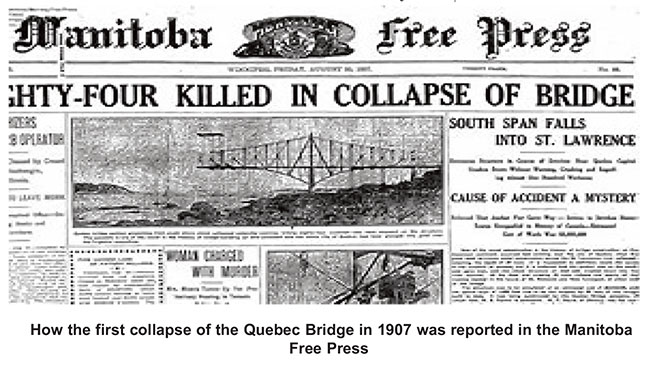
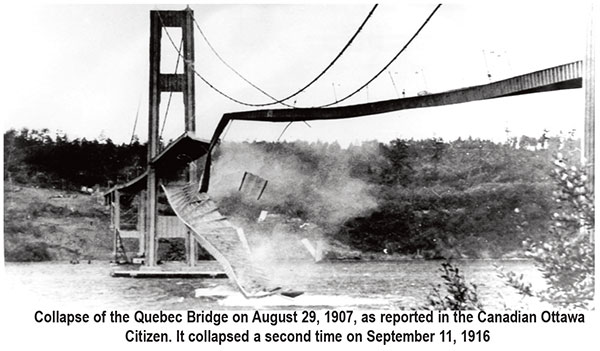
In our sojourn thus far through the ancient civilisations as well as the more recent literary works we could not establish any connection between a bridge and a ring, or for that matter, the relationship between a ring and a profession or the link a ring had with any other man-made construction. But strangely it happened after the collapse of the Quebec Bridge on two occasions, the first collapse on August 29, 1907, and the second on September 11, 1916, that is, within a short span of nine years. Further, these two disasters were considered the biggest construction failures ever and worst engineering disasters in the century. The impact of the disasters can be measured when one considers the importance of the particular bridge. It is the road, rail and pedestrian bridge across the lower Saint Lawrence River between Sainte-Foy and Lévis, Quebec, Canada, and also a part of the National Transcontinental Railway. Records reveal that the two collapses cost 88 human lives, additional persons being injured. Taken together it needs to be considered as an unpardonable tragedy of the highest order. The bridge was finally completed in 1917, a year after the second disaster.
Rise of new ring-ritual: wearing of iron ring

worn iron rings on their little fingers

The two successive disasters cast an unpardonable black-mark directly on the engineers who were involved in this critical construction, and indirectly on the engineering community. Thus, with the sacred intention of making the engineering profession a noble one, the Canadian engineering community strived to consider how best professional discipline could be inculcated in them, and infused into the system for all times. Deviating from the ordinary practices of issuing instructions or taking oaths, a group of Montreal engineers thought of an ingenious method to make their lot self-disciplined, and introduce the desired professional obligations in the form of wearing an iron ring. After the decision was unanimously accepted, the tradition cum ritual of wearing an iron ring by engineers was set in motion in 1922. This group further decided that seven of Canada’s most prominent engineers, function as the centre, termed as the Corporation of the Seven Wardens, to provide cohesiveness to all Canadian engineers.
Rudyard Kipling
These engineers wished to formalize the ritual, and went to the extent of seeking the advice of one of the foremost erudite persons of the time. Their ultimate choice was Rudyard Kipling, an English journalist, short story writer, poet and novelist. He proposed that the ritual be called ‘The Ritual of the Calling of an Engineer’. The more experienced senior engineers volunteered to receive, welcome and support the young engineers. The ritual was subsequently copyrighted in Canada and the US, and thereafter, the ring was registered. Now the young engineers getting qualified from Canadian and US universities are educated by their senior members on the two major disasters, the history of the ritual and their commitments and obligations.
Stainless steel ring
Even the young engineer who narrated the ‘Ring Story’ to my faculty colleague had incorrectly understood that originally these iron rings were made out of the remnants of the collapsed bridge. Of course, the story has a sentimental value. But the fact is that the original rings were turned out of a material familiar to engineers. However, considering that ‘iron’ is not the most suitable material to be associated with this noble purpose, many a member now select stainless steel for their ring.
The engineers wear the ring on the little finger of their working hand. The idea is that it is visible all the time when they are working hands-on, either on a computer or in a site, always reminding them to be mindful of the commitment to their call as responsible engineers.
(K.A.I Kalyanaratne is a Consultant, Publications, Postgraduate Institute of Management University of Sri Jayewardenepura and Vice President, Hela Havula)