Life style
Ena de Silva birth centenary : outdoors woman and designers extraordinary

By Rajiva Wijesinha
Ena de Silva was born on October 23rd a hundred years ago. There will be public celebrations of her life and achievement, spearheaded by the architects who worked with Geoffrey Bawa, and for her too over the years. But given the joy of her personal impact, I thought there should also be a celebration of the companionship she provided to so many. I shall therefore have to lunch on that day a range of those who accompanied her on her different trips in the wilds. I was lucky enough to join with her for the first time on one of these early in 1984, and after that there were several over three decades. I have written about these in Exploring with Ena which was published by Godage & Bros a few months after coronavirus had stopped travel within the country. But that covered a lot of our times together, whereas today I thought of celebrating the different rhythms of the times and places where we stayed with larger groups.
On that first trip we were rained in, Ena and two of her nephews and Shanthi Wilson and my sister and me, and also an English friend, leading her sister to claim that Ena was leading the children of four families astray. That was the keynote of Ena’s personality, her youthfulness that led her to spend so much time with the next generation, more energetic than most of them. Indeed, as the years passed, she would refuse to stay in, and with my driver Kithsiri willing to do anything for her, set off with him and just one other person, me usually, in the long mornings between breakfast, after a dawn round, and lunch.
After that first memorable stay at the Yala bungalow, there were several more to the different bungalows in the park over the next few years, including during the height of the JVP problems, so that sometimes we had Yala practically to ourselves. By then the carefree days of single bliss had passed for several of what was termed the hard core of her companions, and my sister Anila and her nephews Raji and Suren brought along spouses, as did Anila’s friend Priyani Tennekoon, who had married Harin Abeysekera.Food on these excursions was fantastic, Ena bringing heaps of baskets and boxes down from Aluvihare, including her signature Alu chicken, lavishly put together by her faithful Suja, who she claimed had not known even to boil water when she first began to work for Ena. But she turned into the most fantastic cook, and Ena’s major domo Piyadasa and the last and longest serving of her drivers Karim – who could, with his army experience, she said, do everything except drive – packed skilfully, so that after we had stuffed ourselves there was plenty too for the Yala staff, over several days.

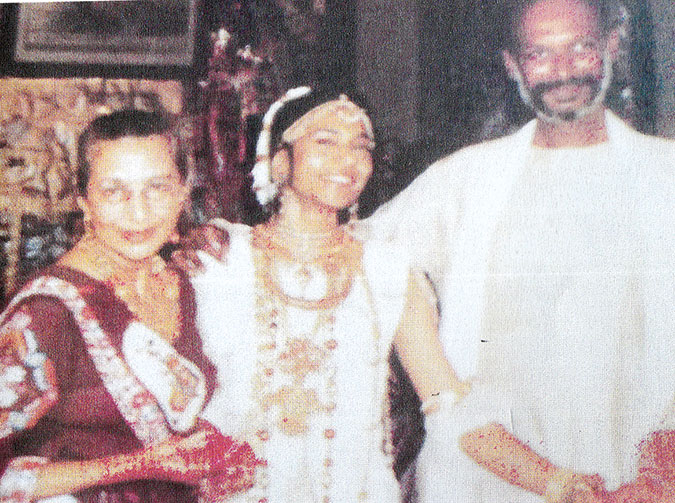
Ena (left) with son Anil Gamini Jayasuriya (right) at his sister Anula Kusum’s wedding in 1989
In 1987 we had Christmas at Yala, the Talgasmankada Bungalow down by the Manik Ganga, isolated enough for Ena to hang Japanese lanterns on the trees surrounding it. That was when she started producing turkey and ham, the latter cured at Aluvihare. Her daughter Kusum was with us that year, and again in 1990 when her American husband was also there, as also in 1991. But on that latter occasion the bungalow was filled to overflowing – we got there only the day after Christmas – and Raji who had booked it was duly reprimanded. The goodwill he had generated, when he once took down the salaries of the staff when officials were fearful of the JVP, was not enough to excuse that particular excess.
I don’t think that was the reason, but after that there were no more Christmases in the park at Yala. But instead we moved to Wasgamuwa, where we had two sensational Chrismases, at the Kadurupitiya bungalow. Then, as once later for the new year at the Ondaatje Bungalow outside Yala, we were joined by Ismeth and Dileeni Raheem, the latter as accomplished in cakes and deserts as Ena was in everything else, and I’m afraid I remember those excursions as much for the food as for the hordes of elephants we saw.
Another companion from the nineties on was Shirley Perera, who had been Deputy Director of the Wild Life Department, and then started after premature retirement to work for Ena at Aluvihare, to supervise the carpentry and brass which she had started to provide occupation for the young men of the village. She had started carpentry in the eighties, because she said they would otherwise get into mischief, a salutary step when the JVP was getting into its stride. As a consequence, I have always believed, no young men from Aluvihare died in those dreadful days.
Shirley had been introduced to Ena by Nihal Fernando, another devotee of wild life, whose daughter Anu was also with us on one memorable trip. But that was later, not when with him and Shirley we had made a couple of memorable excursions in the eighties into Block 2, across the Manik Ganga. He was a soothing presence of our trips, coping admirably with the excited conversation of Ena’s young companions, contributing occasionally to Ismeth Raheem’s learned accounts of subjects as varied as ancient irrigation systems and the contribution of the photographer Julia Cameron, whose grave is at Bogawantalawa.
It was through Shirley that in 1992 Ena and Nirmali Hettiarachchi and I first went to Wasgamuwa, and also to Maduru Oya, before those parks were opened to the public. In Wasgamuwa we slept in the open, near the Mahaweli river in which we had to bathe, wary of passing elephants. In Maduru Oya we were put up by the Warden, who took us round the place, including to an ancient spill built in what modern engineers had chosen as the best place for an outlet for the reservoir.
Though that was the only jungle trip with Nirmali, she had become a good friend, and contributed too to what was called K2, the Restaurant Kitchen Ena had set up on the main Kandy Dambulla Road, to supplement K1 where Suja produced the most wonderful meals on order. K2, open to passers by, was set up by Ena to provide occupation for the middle aged ladies of the village, and she recruited the most delightful crew, who had to be taught not only to serve, but also to cook systematically. Nirmali taught them puddings, though characteristically Ena converted her pineapple upside down into a concoction dripping with melted jiggery, though which bits of pineapple peeped.
Twice I went with Ena to Anderson’s Bungalow in Horton Plains, driven by Sheran Fernando for I could not go up when the rest went. They did not know him but he and Ena’s nephew Suren soon palled up, and the latter became with him, long after I had ceased to go there, a habitue of the Art Centre Club at the Lionel Wendt. The second trip to Horton Plains was arranged by Raji, for Nihal Fernando and his wife Dodo, and also an old family friend Ben Fonseka, who was a friend of my father too. That was when early morning we saw a leopard, which Nihal managed to capture on film. But it was the first trip that was especially memorable, when we climbed Kirigalpoththa and Totapola, and swam in the freezing water below Baker’s Falls,
And one night we drove on the plains while the full moon danced through clouds in the sky, lighting up sambhur in silhouette, We had permission for this, though I presume not formally, from the warden who had joined us for dinner. This was a delightful youngster called Ambepitiya, who sadly fell victim to terrorists a few years later, though whether LTTE or JVP I cannot remember. It was the LTTE that did for our bungalow keeper at Maradanmaduwa in Wilpattu. We had gone there for the New Year in April 1984, Richard de Zoysa’s mother Manorani coming with us, though Richard himself only just dropped in fleetingly on his motor bike, en route to the north where he was working for Lalith Athulathmudali who had been made Minister of National Security.
I can still see the striking face of the bungalow keeper Tennekoon, who was prematurely grey, worried about his first baby, whom Manorani treated. A few months later he and his family were all dead, when the LTTE attacked the Sri Maha Bodhi at Anuradhapura. And later the helper at Mahasilawa, whom I remember weeping for his cat when a python caught it, also vanished when the LTTE struck down there.
As Yala became more popular when dangers diminished, and bookings were less easy to obtain, and had to be for just short periods, Raji rented a house outside the park, Rapp’s Lodge as he called it, where we stayed on several occasions, looked after by a waiter he had got from the Mahaweli Reach hotel, who could also cook. Once I remember I spent my birthday there, joined on that occasion by Nigel Hatch, with whom I had made my first memorable excursion with Ena during the Wesak break of 1983, or a loaf as she described it when, almost as soon as we got to Aluvihare, she proposed we take off that night. Also with us for that birthday was Raji’s first wife Mali who had been with us so often in the eighties, and also Amila de Mel, who has taken charge now of the Aluvihare Cooperative, which still continues with Ena’s batik and handloom work though the carpentry and brass and K2 are now history. Suja however still continues to provide the occasional feast on order at K1, and has provided me with Alu chicken today, essential if Ena is to be properly commemorated.
Then there were other wonderful holidays, at Priyani’s rambling walauwe at Rambukkana, at the Bandarawela Tourist Resort, from where we went to Maligawila and Buduruvagala, and also at Belihuloya when it was an Affiliated University and I was able to take friends to spend the New Year there. On one occasion Ena had to rush back to Colombo because her sister was ill, but on the other Harin and Priyani and their son and Ena and Shanthi and I had a memorable few days, Shanthi commandeering Harin to drive her to Nuwara Eliya for some work, while Ena and Priyani and I had a leisurely drive across the escarpment to Diyaluma.
During my sabbatical, Kithsiri drove just her and me on long meandering trips all over the country, which included stays at the Teldeniya and Deniyaya Resthouses (the latter where we had stayed on that long ago journey with Nigel in 1983), the seaside at Jaela (for I had to get to Kelaniya University to make sure that Manique Gunasekara got the Chair, an appointment long delayed), and the Eagle’s Nest up in the clouds at Ohiya. One of these journeys started at Mirissa Hills, the Syrian Castle like home of Miles Young who the following year took us on a wonderful tour of China, to Hangzou and Suchou as well as his house in the old French quarter of Shanghai. That was the year after Ena and I had had a wonderful time together in India, when she had taught batik to workmen in Ujjain and she and I sneaked off for a day and a night in the magical town of Mandu. Before that, soon after Kithsiri had acquired the yellow fiat she adored, and in which we had our sabbatical tours, we had had had a wonderful trip over Christamas to Mannar, just Kithsiri and Ena and me, when we went to Madhu on Christmas Day, and to Talaimannar, and relished the magnificent bird life, especially as the sun set gloriously over the channel between island and mainland.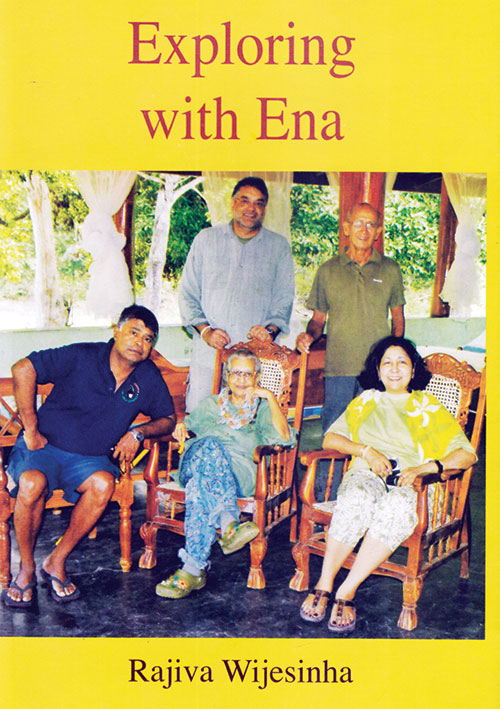

In this century we did not get to the parks quite as often, but apart from that birthday stay in 2003, she did cater for stays I arranged for foreign friends, in Yala once and in Wasgamuwa on another occasion. And when Ena turned 90, in 2012, it was clear that the best place to celebrate this was in Yala. The booking was arranged by Ajitha Madanayake, whom Raji had introduced to us in the mid-eighties, and who often went on trips with Ena after that. Raji was back from New Zealand for the birthday, and Shanthi Wilson was there too, and the main birthday cake was in the shape of an elephant.
That was my last loaf with Ena, though I saw her frequently over the next couple of years, spending much time with her on the rock above her house, with its magnificent view, with Piyadasa clambering up the rock steps to provide patties and tea. And Shanthi and I were there the night before her 93rd birthday though the next day, having cut her cake, she collapsed. When I went up a week later, to hold her hand as she lay dying, I remembered that on the preceding New Year’s Eve, she had told me she was ready to go.
‘You can’t,’ I said. ‘People in our family live to be 93’. I cited my father and my grandmother, whose cousin had been Ena’s mother.
‘So you mean I have to live till I’m 93?’ she said. I nodded and she sighed. But she stayed the course, and even those brief moments together in 2015, including when though she had been ill she sat on the lawn with me one evening as dusk fell, are amongst my cherished memories of a wonderful companion.