Life style
Don’t shun sunshine Vitamin

While most of us avoid the hot sun at noon, we deprive ourselves of ‘Sunshine Vitamin’ or Vitamin D which is at its peak during that time of the day. In an interview with the Sunday Island, Head of the Department of Nutrition at the Medical Research Institute (MRI) and President of the Sri Lanka Medical Nutrition Association (SLMNA), Dr. Renuka Jayatissa throws light on the latest research which has unearthed new knowledge about this natural nutrient boosting our immunity which we often take for granted.
by Randima Attygalle
Known as ‘Sunshine Vitamin’, Vitamin D is produced by the body when the skin is exposed to sunlight. Vitamin D also functions as a hormone and every body cell has a receptor for it. Sun exposure at mid-day (from 10 a.m. to 3 p.m.) is the best way to boost vitamin D levels, says Head of Nutrition at the Medical Research Institute (MRI), Dr. Renuka Jayatissa. “Although morning sunlight was traditionally believed to be the best source of vitamin D, new knowledge confirms that 10 to 15 minutes of exposure to midday sun is the best time to make use of sunshine. The exposure becomes even more important as dietary intake of vitamin D is not sufficient.
The findings of local research speak for the changing nature of vitamin D intake, contrary to the popular belief that those from tropical nations are the most benefitted by this nature’s panacea. While the population from the Central and Sabaragamuwa Provinces are the most vulnerable to the deficiency due to the climatic patterns, the North Central Province is the least vulnerable given the hot climate of the region and the agrarian lifestyle. “The findings also reveal that 50% of adolescents of the country and nearly 95% of women are vitamin D deficient. This situation is alarming as it is a precursor to a host of other health issues including immunity problems, loss of bone density and muscle weakness,” explains Dr. Jayatissa who warns that COVID-19 pandemic has compounded the situation with restricted movement and children being home bound.

“The school interval is limited only to half an hour and this too during mid-morning. As most children may take their first meal for the day during the interval, there is hardly time for play,” observes the nutrition specialist. Recommendations have already being made to the School Committees of the Education Ministry to give children another mid-day break so that they are exposed to the peak period of sun, says Dr. Jayatissa. “Vitamin D is crucial for children on the threshold of puberty (10-15 years) as it affects growth and immunity.”
The rising elderly population in the country too calls for interventions to mitigate vitamin D deficiency as fractures are a common repercussion. Vitamin D deficiency can lead to a loss of bone density which in turn can cause osteoporosis and fractures. “With the elderly population multiplying in years, disability will be an added burden,” warns Dr. Jayatissa. Vitamin D is crucial for calcium absorption and bone metabolism. Low bone density results in loss of calcium and other minerals in bones. Older adults, especially women are at an increased risk of fractures due to this.
Risk factors for vitamin D deficiency are many. Besides lack of exposure to sunlight, having dark skin, being overweight or obese, being elderly, lack of dairy and fish in diet, excessive use of sun screen are among them. “Obesity is a risk factor for the deficiency as increased fat cells in the body require larger doses of vitamin D,” observes the physician who goes onto note that lifestyle patterns too trigger the condition. “Although those who live far from the equator are traditionally considered to be lacking vitamin D, their understanding of this drives them to be exposed to the sun as much as possible. Walking or cycling to work, walking to a cafeteria, traveling to tropical regions during summer etc. push them to bridge the gap. Ironically in our part of the world, apart from farmers and other workers such as those in the construction industry and the manual labour force, people are deprived of sun exposure.”
Since symptoms of vitamin D deficiency are often subtle, many people will not realize that they are lacking it. “However this could affect the quality of life,” remarks Dr. Jayatissa. Height gain is seriously threatened by the condition, she says. “Compared to taller communities such as the Dutch whose average height for males is about 180 cm, Sri Lankan average height is about 168 for men and 153 for women. This may even decrease in time to come, unless the situation is urgently addressed”. Sun exposure as the vitamin D booster cannot be undermined, especially because very few foods such as fish, fish liver oils, egg yolks and fortified dairy and grain products contain vitamin D, notes the nutrition specialist.
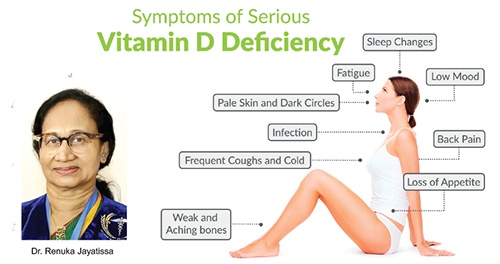
Keeping the immune system strong is one of the key roles of vitamin D. During the pandemic, this becomes even more valid as a strong immune system can fight off viruses and even bacteria that cause illness. Studies have confirmed that vitamin D can reduce the risk of respiratory tract infections. “Migraines in young people could also be a cause of the deficiency and muscle cramps in the night among the elderly could also be a strong symptom,” points out Dr. Jayatissa. Bone and back pain, impaired wound healing and even low moods are among the other symptoms.
Certain studies have also found that vitamin D can help treat skin conditions such as psoriasis and eczema. While sunshine can do wonders to your skin and body, too much of it can be risky, points out the physician. “Sun spots as a result of sunburn, skin aging, heat stroke and skin cancer are among them.” Administering vitamin D supplements should always be done on clinical advise as vitamin D toxicity entails its own dangers, concludes Dr. Jayatissa.