Features
DISABILITY RIGHTS : THE SRI LANKA CONTEXT

The world as we know it, has been on a pathway towards development, to make the lives of the people who live in it easier, efficient and convenient. It is most important that all persons, conventionally abled and differently abled, are protected by the full coverage offered by human rights, as human rights are not rights that are assigned to you based on your physical or mental capabilities, but it is a birthright of every individual which arises from the mere fact of being born as a human being.
The levels of ‘ability’ of a person varies drastically not only within a state but internationally amongst all members of the human race. The United Nations Convention on the Rights of Persons with Disabilities of 2006 is currently one of the foremost international instruments that serves today’s topic.
Article 4, places an obligation on state parties ‘to ensure and promote the full realization of all human rights and fundamental freedoms for all persons with disabilities without discrimination of any kind on the basis of disability.’
Further, the rest of the other Articles go on to provide for the freedom of expression, personal mobility, privacy and work and employment and the right to education.
Sri Lankan context
Shifting this conversation to the Sri Lankan Perspective, the Department of Census and Statistics in 2012, reported that an estimated 8.6% of the people of Sri Lanka have some form of disability. This equates to one in 12 people, and the World Percentage is well above that.
In consideration of the entire World’s population; Buddhists count seven to eight percent, Hindu’s count – 15 %, Muslims count 23 %, Christians count 31%, and Europeans nine percent and North Americans five percent, the number of disabled persons, 8.6% in Sri Lanka and 13 – 14% around the world, is a significant population on any standard and the rights and interests and well being of this population is equally or more important to any other population living on earth.
The majority of those who are conventionally abled may think they are not disabled at the moment, but who knows whether one of us crossing the road this evening will be knocked down by a car, or fall down a flight of steps, or something fall on our head, and immediately we become transferred to that disabled population.
That is why this discussion is imperative, and it is our bounden duty to ensure that the legal framework and its enforcement will be at optimal level, within our respective jurisdictions. Sri Lanka ratified the International Convention on the Rights of Persons with Disabilities in 2016, as such, is subject to all the state obligations that are provided for under the Convention.
Article 12 (1) of the Constitution of Sri Lanka entitles every person to the Equality and the Equal Protection of the Law, however, it must be observed that Article 12(2) which is the non-discrimination clause, does not expressly prohibit discrimination based on disability.
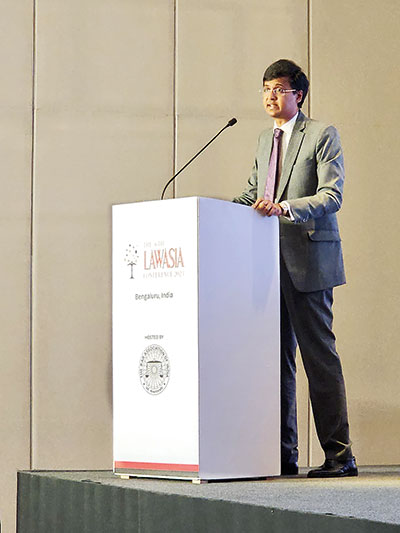
Rajeev Amarasuriya presenting a paper at the 36th Law Asia conference in Bengaluru, India
Article 12 (4) sets out that “Nothing in this Article shall prevent special provision being made, by law, subordinate legislation or executive action, for the advancement of women, children or disabled persons”.
Legislation that addresses the matter of discussion today is “The Protection of the Rights of Persons with Disabilities Acts of 1996”. This being an Act passed nearly three decades ago, there is much room for improvement and in this respect for fresh legislation.
One shortfall is the definition of disability in the Act which followed the old school of thought, better known as the ‘medical model’ where disability was approached only in a medical standpoint, however this has grown to cause marginalization and isolation of those suffering from disabilities.
The new school of thought, that is the ‘Social Model of Disability’ stems from the belief that the difficulty faced by persons with disabilities could be mitigated by taking societal measures and implementing structural mechanisms to ensure that such persons are able to function on an equal platform with those who are conventionally abled.
It is important that the image that has been created surrounding a person who is ‘Disabled’ must be re-painted as today there are more and more differently abled people serving society as prominent contributors and reaching every societal, academic and career milestone that a conventionally abled person would be able to reach.
A few of the recent emergence in terms of the law and national policy would be the National Policy on Disability which was formulated by the Ministry of Social Welfare in 2003. The other significant Regulation is the Disabled Persons (Accessibility) Regulations of 2006.
When speaking of the accessibility rights, we have a more recent and progressive judgment of the Supreme Court of Sri Lanka, in the case Dr. Ajith Perera vs Minister of Social Services.
This matter was brought to the attention of the Supreme Court by one Dr. Ajith Perera who, apart from being disabled as a result of an accident, was an advocate and an activist for the mitigation of difficulties faced by those physically disabled in day-to-day life.
In 2009 an order was obtained from the Supreme Court by a matter brought forward by Dr. Ajith Perera, in the public interest, directing that Parts of NEW public buildings or public spaces, especially toilet facilities shall be designed and constructed in accordance with the `design requirements specified in the regulations in force, and further consequences set out for non-compliance with the said order.
Despite this order been given and despite the fact that the Regulations declared that all existing public buildings, and public places, must be brought into conformity with the provisions of the Regulations, within a period of 11 years from when the Regulations becoming operative, this was not so done.
As such, in 2018, this matter was once again brought to the attention of the Supreme Court and His Lordship Justice Prasanna Jayawardena, taking due consideration of international standards and international jurisprudence, pertaining to the rights of disabled held as follows, “…the failure on the part of the State and its agencies to satisfactorily implement, comply with and enforce the provisions of the Act and the Regulations has denied and continues to deny the petitioner and others who are similarly circumstanced, of the opportunity of equality and the protection assured to them by the provisions of the Act and the Regulations and, thereby, has violated the fundamental rights guaranteed by Article 12 (1) of the Constitution…”
Disability is an inevitable fact of life for nearly everyone; almost everyone will be partially or permanently disabled at some stage of their lives and it is of vital importance that the world takes positive and affirmative action in the implementation of these rights.
In conclusion, as declared by Hellen Keller, famed author, traveler and social and political activist, who was left both blind and deaf at infancy ; “I am only one; but still, I am one. I cannot do everything but I can still do something; I will not refuse to do something I can do.”