
Life style
Diminishing Dumbara patterns call for revival

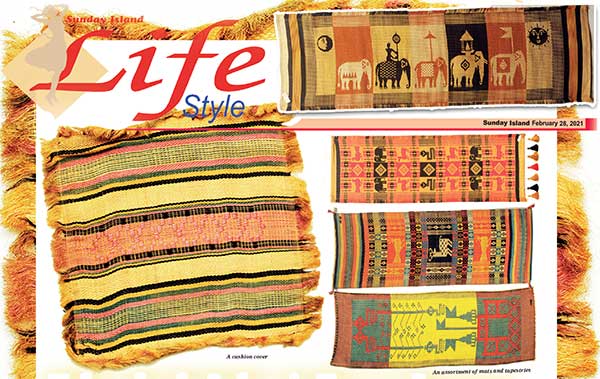
The Anthropology Department of the Colombo National Museum is home to a striking repertoire of Dumbara designs. The collection which is open to the public only through temporary exhibitions, urges the revival of this fast diminishing traditional form of Lankan art which is described as a kind of ‘artistic meditation.’
by Randima Attygalle
The staff of the Anthropology Department of the Colombo National Museum treats me to a feast of painstakingly designed exotic dumbara mats, tapestries, cushion covers, purses and much more. I marvel at the skill of the traditional Lankan artisan which is often taken for granted, bargained over, driven to substitute with other means of income today.
Once the staple of the picturesque Dumbara valley (valley of the mist) or Dumbara mitiyawatha, the craft was even sought by royalty. Some of the descendants of the master weavers who enthralled Kandyan monarchs with their art, still labour to keep their family tradition alive in villages of the Dumbara valley such as Thalagune and Menikhinna. They work against many odds. The base for the craft is the hemp leaf (niyanda hana) botanically termed Sansevieria zeylanica which is hard to source today. This drives the weavers to find substitutes such as cotton.
“The difficulty in sourcing traditional inputs and the poor market price for this time consuming craft force many weavers to abandon it. In the olden days, low pit looms were used to weave hemp. Today these are replaced by cotton and standing looms. The natural dyes are today replaced with synthetics,” notes the Director General, Department of National Museums, Sanuja Kasthuriarchchi.
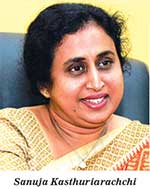 One of the chief keepers of the tangible history of ours, Kasthuriarachchi with her special interest in traditional local arts, moots public-private collaborations to revive this one-of-a-kind Sri Lankan craft. Unless the weavers are offered incentives and assisted to find markets, their art would soon be confined only to museums, she laments. “This environmental-friendly form of art deserves pride of place in homes, offices and hotels and a national boost is necessary.”
The Colombo National Museum’s collection of dumbara designs are a mix of donations and purchases. The entire collection, however, is not meant for public viewing, given the restrictions in exhibiting space. “We do our best to enable public access through our temporary exhibitions from time to time,” says the DG. The collection also facilitates research. They are important for the study of the use of colours, the distinct patterns of fauna and flora and other inherent weaving skills of master weavers.
An intense research on Dumbara craft by the Anthropology Department of the Colombo National Museum is underway. The community-based research in the traditional weaving villages of Dumbara which was to commence last year was suspended due to the pandemic. Museum officials hope to recommence the project once normalcy returns.
“Today the craft has been diversified and has added handbags, file covers, pencil holders etc. to its portfolio. Yet, unless the craftspeople are given a sense of security including assured markets locally and globally, this craft will not last up to the next generation,” remarks Manoj Hettiarachchi. The Museum’s anthropology curator. Museum officials encourage the public to add to their Dumbara collection.
‘An investment in the national interest, such donated exhibits from private collections will be conserved for posterity. They are treated against possible insect attacksand other hazards.’
The dumbara patterns were perfected by men and women of the kinnaraya caste, notes Ananda Coomaraswamy in his work,
Mediaeval Sinhalase Art. The historian also mentions ballads known as kinnara kavi sung by ancient dumbara weavers.
The labour-intensive fibre-production process is described by Coomaraswamy in his book. The rounded green leaves of the hana plant are gathered and scraped against a log known as the niyanda poruwa with a wooden tool (ge-valla) shaped like a spoke shave. ‘This scraping removes the fleshy part of the leaf, leaving the white fibre, which is oiled and brushed and then ready for use almost immediately. Part of the material is left white, the rest dyed red, yellow or black.’
As Coomsraswamy describes: ‘the red colour is obtained by boiling the fibre with patangi wood, korakaha leaves and gingelly oil or seeds; the yellow from a decoction of venivel; the black with the help of gall nuts, aralu and bulu.’ Added to these three traditionally used natural colours mentioned by Coomaraswamy are an assortment of others including green and blue sourced by artificial dyes.
The loom is described as a ‘low horizontal contrivance’ and the weaver squats on the mat itself, supported by a few flat logs between it and the ground. The pattern is picked up with the weaver’s lathe (vema); this lathe, having an eye at one end, serves as a bodkin called heda liya with which to draw the weft threads through the warp.’
Perfectly plain mats are called pannam kalala, Coomaraswamy documents. These are usually decorated with birds, as is usually are kurullu kalala. Those with a variety of patterns are veda kalala or veda peduru. Among the notable dumbara patterns are toran-petta, tarava,tani-vel iruwa, depota lanuwa, taraka petta, pannam petta, tunpota lanuwa, del geta lanuva and mal gaha. Animal patterns of birds, deer, cobra and elephants were also popular.
Pic credit: Department of National Museums



Institute of Hospitality Sri Lanka
 The 32nd Annual General Meeting (AGM) of the UK-based Institute of Hospitality’s Sri Lanka Chapter was held recently at the Ramada Hotel Colombo,.The event provided an evening of camaraderie , reflection of the past and present achievements,setting new benchmarks for the future
The AGM had the presence of two distinguished guests, the Chief Guest Opposition Leader Sajith Premadasa, and the Guest of Honour British High Commissioner to Sri Lanka, Andrew Patrick. Their inspiring speeches were lauded by all hoteliers who were present at the occasion
A special thanks was extended to Robert Richardson, CEO of the Institute of Hospitality UK, along with his team, sponsors, committee members, and all attendees for making the event memorable.
Dr. Harsha Jayasingh, Past President of the Institute of Hospitality (UK) Sri Lanka Chapter, emphasised the Institute’s longstanding history and the strength of its Sri Lankan branch. “The Institute of Hospitality (IH) UK has a history of 86 years, and we are proud to be the Sri Lanka Branch. IH Sri Lanka is much stronger now with many members from all areas of the hospitality industry,” he stated.
Dr. Jayasingh highlighted the significant role of tourism in Sri Lanka’s economy,. He said tourism it is the third-largest source of revenue for the country. “Tourism accounts for about 13.3% of total foreign exchange earnings and employs 450,000 people directly and indirectly. The hospitality industry in this island of pearl holds tremendous potential for economic growth, job creations, and cultural exchange,” he added.
He also pointed out more women should be attracted to the industry and advocated for the use of technology in hospitality sector to attract the younger generation.
The newly appointed Chairman Ramesh Dassanayake spoke about the challenges faced by the industry, including the reluctance of youth to join the sector. . Dassanayake expressed concerns over the migration of staff between hotels and the overall ‘brain drain’ in the sector. ” We must maintain high standards in the hotel We must try to attract tourists to Sri Lanka, we must have with many facilities Hence, hotel schools and other professional institutions involved in skills development mustincrease their intakes,” he pointed out.
Chief Guest Sajith Premadasa emphasised the importance of eco tourism and said “We need to have an environmental policy related to tourism in place,” . .
The 32nd AGM of the Institute of Hospitality UK, Sri Lanka Chapter, was a testament to the strength and potential of Sri Lanka’s hospitality industry. The insights and commitments shared during the event set a new benchmark for the future.(ZC)


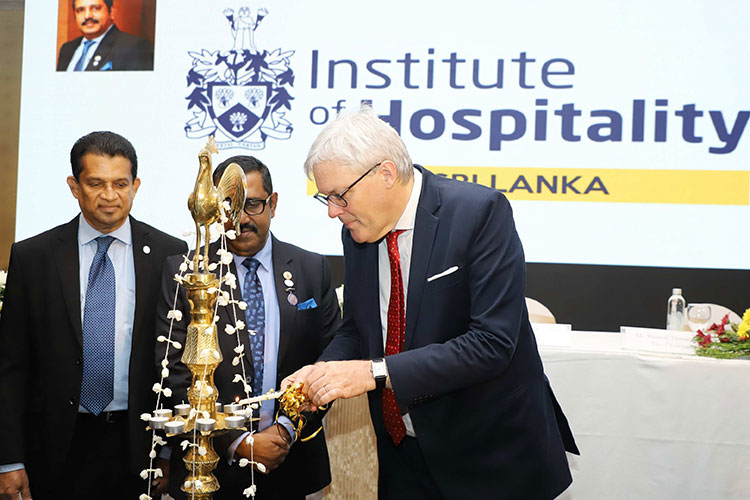
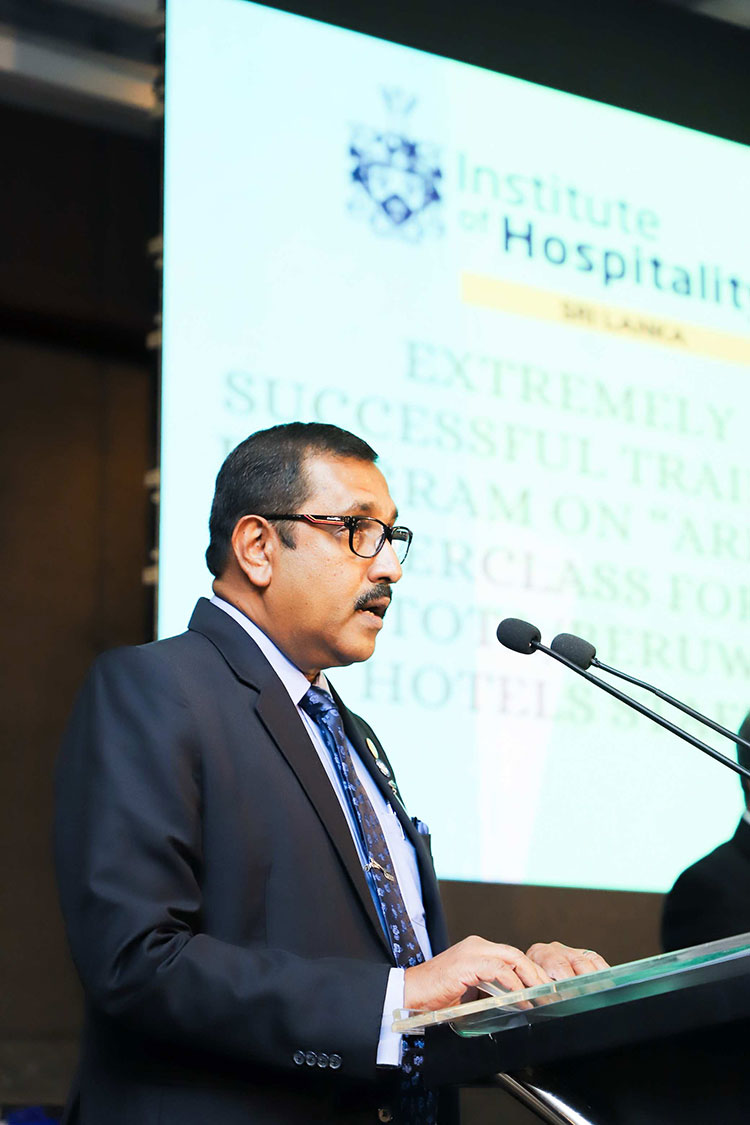

Pix by Thushara Attapathu
Life style
He recognizes human identity beyond boundaries of gender, race, nationality and religion.

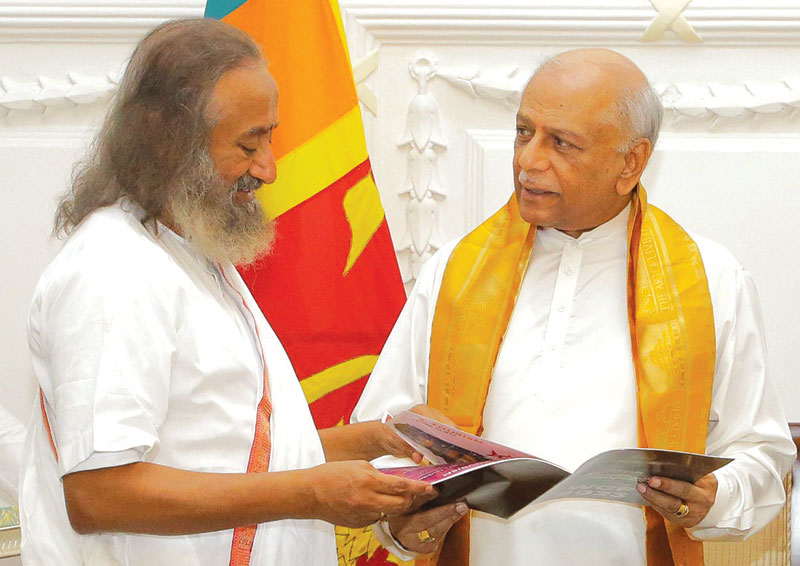
Visit of Sri Gurudev to Sri Lanka
Humanitarian, spiritual leader and Global Ambassador of Peace Gurudev Sri Sri Ravi Shankar (Sri Gurudev) was in Sri Lanka on a three day tour on the invitation of the Prime Minister of Sri Lanka Dinesh Gunewardene. Gurudev who inspired a wave of volunteerism and service to moot one of the largest volunteer-based organisations in the world – The Art of Living – visited the various projects under the aegis of the foundation and launched twelve vocational and technical centers around the island. He was accompanied by thousands of followers from Sri Lanka and around the world.
Gurudev who visited Sri Lanka for the sixth time also had a first day cover launched in honour of his visit. He is a strong proponent of spreading happiness, using the unique Sudarshan Kriya, yoga, meditation and practical wisdom to unite people, empower individuals and transform communities. His programmes provide techniques and tools to live a deeper, more joyous life, while his non-profit organisations recognize the human identity beyond the boundaries of gender, race, nationality and religion.
The Art of Living which has more than 30,000 teachers and over one million volunteers across 180 countries has touched in excess of five hundred million people around the world. CNN called it “Life Changing” and The Washington Post headlined it, “Fresh air to millions”.
In Trincomalee, Gurudev met with war victims and had a heartwarming engagement with the children from the children’s homes run by the Foundation. He also visited the Koneswara Temple in Trincomalee and graced the Kumbhabhishekam at Seetha ecogPnize the human identity beyond the boundaries of gender, race, nationality and religion. Amman temple at Nuwara Eliya. He held discussions with the trustees on the progress of the foundation’s social service projects, while also holding a special event – Ekamuthuwa – attended by a large number of dignitaries and his devotees from around the world.
His time with the Prime Minister was spent discussing the prospects of unity in diversity and uniting Sri Lanka by adding happiness into the formula of living. In addition he had discussions with the Speaker of the Parliament of Sri Lanka Mahinda Yapa Abeywardena, prominent business stewards and civil society leaders.
by Zanita Careem
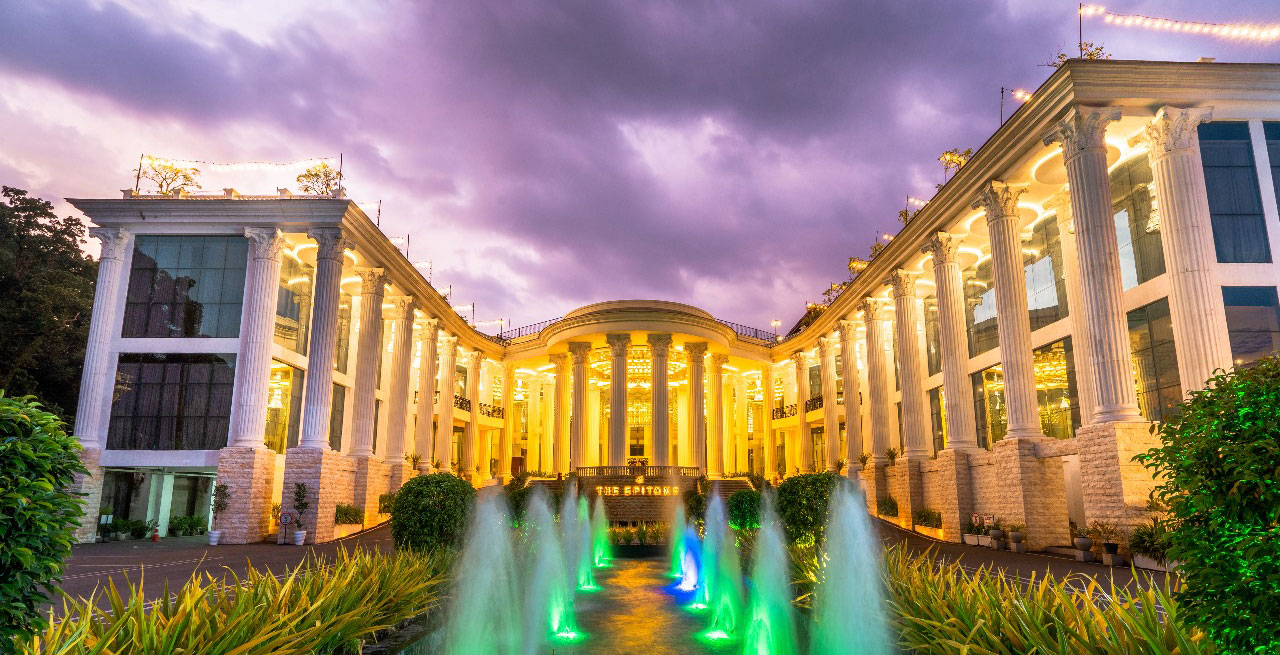
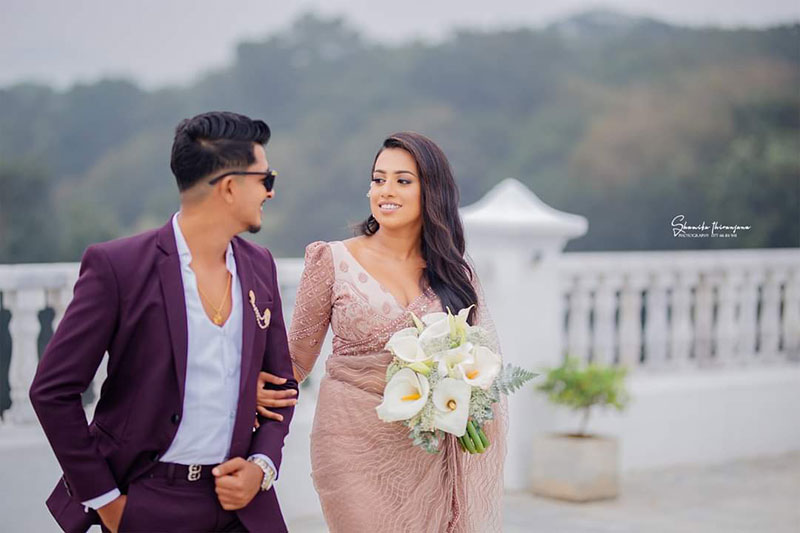
Envison your dream wedding day come to life at the Epitome Hotel, a prestigious city hotel in Kurunegala offering an unrivalled luxury rendors experience for weddings.
The venue is designed to embody opulence and luxury from all quarters for a spectacular wedding in kurunegala,Thier ballroom is the largest banquet facility in Sri Lanka It can be divided into six luxurious pillarless wedding halls on the ground floor and 25pax smaller banquet halls.
It can be easily named as a five star heaven in the heart of the city contributing to a myriad of immense experiences tailored to inspire and delight wedding experiences.
From opulent décor set up to exquisite table decor, lavish food, every detail is meticulously curated to spark your imagination and ignite creativity for a perfect wedding. The previous prestigious wedding shows season one and season two attracted large crowds
were unique events which gave the wedding vendors and potential clients had an opportunity to connect and interact with each other. Beyond being a showcase it was a chance for the wedding vendors to unite and contribute to the vibrancy of the wedding industry. The wedding show covered all area of the bridal industry providing a comprehensive variety of bridal supplies from Sri lanka and became the most popular bridal exhibitions in Kurunegala.This bridal exhibitions allowed brides and grooms to experience first hand the products and services available from suppliers in Sri Lanka
These wedding shows held at The Epitome created a benchmark and gave an opportunity for vendors to create connections to the utmost satisfaction said Harshan Lakshita Executive Director. of the magnificent Hotel
Our wedding shows featured experts and professionals in every field‘ It covered all areas of the bridal industry provided a comprehensive variety of bridal supplies from Sri lanka and became most popular bridal exhibition in this region.We are always open to everyone to join us at our wedding shows in the future. It is an opportunity to discover the incredible talent within our local wedding and bridal vendors to make meaningful relationships and plan thier special day at our breathtaking hotel The Epitome said General Manager Kavinda Caldera
The Epitome Hotel’s bridal show which will be held end of June will buzz with great ideas,advice and inspiration for all those who plan thier dream wedding
…….
The Hotel Epitome’s Wedding Season 3 will marked excellence, celebration and inspiration for those in the wedding industry. The exhibition halls will resonate with ideas on exquisite bridal wear to decor, florists , photography etc and showshowcase the rich tapestry of talent within the local wedding industry. .





US sports envoys to Lanka to champion youth development

Rahuman questions sudden cancellation of leave of CEB employees


