Features
Deshabandu Dr. T. Publis Silva Longest-standing Sri Lankan Chef and National Treasure

PLACES, PEOPLE & PASSIONS (3Ps)
Part six
Dr. Chandana (Chandi) Jayawardena DPhil
President – Chandi J. Associates Inc. Consulting, Canada
chandij@sympatico.ca
Profile
Publis is a household name in Sri Lanka as a chef, author, TV personality, and to many, a national treasure. He joined Mount Lavinia Hotel in 1956 as a kitchen labourer. In the early-1970s he was trained by the Hyatt Corporation in USA, who managed the hotel at that time. Publis was promoted as the Executive Chef in 1984, and then promoted as the Director Culinary Affairs & Promotions in 2003, a position he has held for 20 years. During his 67-year long career at Mount Lavinia Hotel, he also did a stint in the Maldives and was responsible for organizing numerous Sri Lankan food festivals and promotions in 33 countries.
I first met Publis Silva in 1972 at the Mount Lavinia Hyatt Hotel, when he was the Assistant Chef, and I was a Trainee Waiter. The next time I met him was in 1990 and we worked closely as the Executive Chef and the General Manager. We then co-wrote a book which was the maiden attempt in book publishing by each of us. After I left Sri Lanka in 1994 we kept in touch, and he made sure that I received a signed copy of each of his books. Today I am his proudest fan.
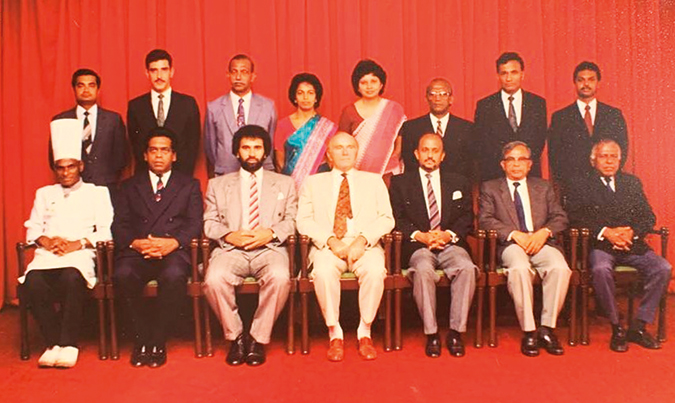
Management team of MLH with Consultant Director of IHS, Professor Richard Kotas in 1991.
First Impressions in 1972
By early 1970s Mount Lavinia Hotel (MLH) became the first ever hotel in Ceylon to get an international brand name. Hyatt Hotels Corporation in USA managed MLH. At that time, to graduate from the Ceylon Hotel School (CHS), each student had to do two mandatory co-op placements or in-service periods. Four of my CHS batchmates and I were fortunate to be allocated to MLH for our first in-service in 1972/1973 tourist season.
After the American General Manager from Hyatt corporation, Robert McFadden, met with us on our first day, we were introduced to a few key members of the hotel team, including Publis Silva, who was the Assistant Chef of MLH at that time. He was in his mid-thirties, and I was in my late teens.
My first impression of Publis was special. By then he had worked in the MLH kitchens for 16 years and gradually had risen to the second in command position of the kitchen department. He had also undergone training with three European Executive Chefs sent to MLH by Hyatt.
After the departure of those expatriate chefs, Just before the 1972/1973 tourist season, the hotel had appointed an Acting Executive Chef, a young Sri Lankan from a prominent family in Colombo, who was trained by Publis. I watched how Publis treated this young chef with respect and fully supporting him. Publis is a professional who always respected superiors, irrespective of their level of experience or knowledge.
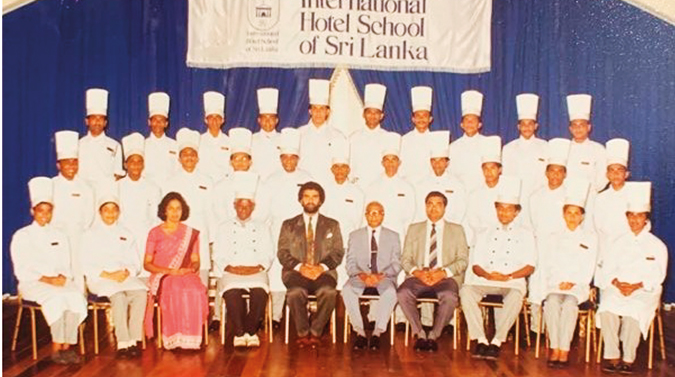
Chef Publis and I with IHS leadership team and the first batch of culinary students.
Christmas of 1972
I remember Publis leading the kitchen brigade in preparing the Christmas Eve dinner in 1972. I sought Chef Publis’s help in understanding some of the dishes I was not familiar with. Despite being very busy that day Publis went into detailed explanations in Sinhala. He wanted us to be well-informed Trainee Waiters. With the additional knowledge I gained by talking with Publis, I managed to earn some extra tips that evening. He was always very helpful and friendly.
Working in the same team in 1990
Eighteen years later In 1990, when I returned to MLH as the General Manager, Publis worked on my team as the Executive Chef. I quickly appreciated that Publis is a great asset to the hotel. Whatever task I delegated to him was done promptly and efficiently. His knowledge of the history of MLH, and the culture of the company were useful to me in settling down in my new and the last job position in Sri Lanka.
Publis was the first to come to work every day and did the longest shift, among all managers. He hardly took any off days, and never needed any sick leave. He was always healthy and fit as a fiddle. MLH was and is his temple. When we worked together on new à la carte menus, I realized that Publis was also open to new suggestions. When the owners of MLH agreed to my suggestion to establish an International Hotel School (IHS) within MLH, Publis became a big supporter of my vision.
Establishing IHS in 1991
IHS was launched with a bang in 1991. It was an immediate success with five international accreditations and pathways and students from five countries. I worked as the Managing Director of IHS and Publis worked as the Adviser in Culinary courses. We also established a Program Advisory Committee with experts from ten countries and introduced for the first time in Sri Lanka, ‘Hotel Administration’ seminars for senior managers. At the end of the 22-week culinary program of IHS, Publis choreographed a classical menu with 13 dishes, cooked, and served by IHS students. We invited all the Executive Chefs of five-star hotels in Colombo for this meal.
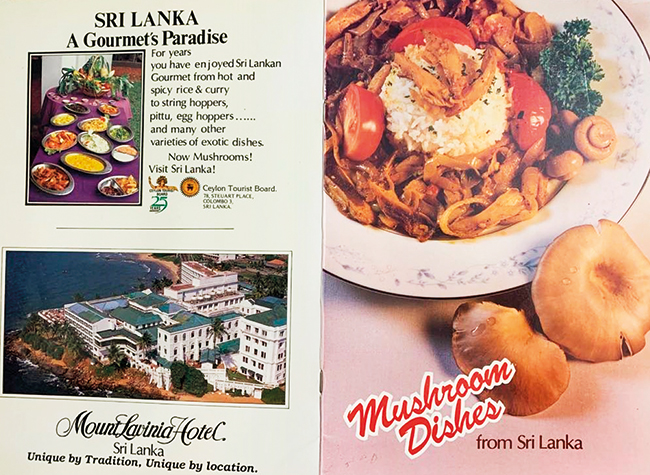
The first booklet prepared by Publis in 1991.
Getting into Book Publishing in 1992
One day Publis came to me with a suggestion for a new food promotion. “Sir, how about doing a mushroom promotion? We have a wide variety of mushrooms in Sri Lanka, but unknown to many.” After a brief discussion, I was very impressed with Publis’s wide knowledge of the subject. I learnt a lot from him about mushrooms. “OK, Chef. Let’s move forward with your suggestion. Can you produce a small booklet about mushrooms?” I planted a seed in his mind. Within a few days he found a sponsor to print the booklet. Publis was always prompt in making things happen.
The ‘Mushroom Week’ of MLH was held from 24th to 30th April 1991, in association with the Ceylon Tourist Board, the Mushroom Development and Training Centre and Export Development Board. The booklet compiled by Publis was sold for US$ 2.50 a copy. That was the beginning of the most outstanding journey of writing and publishing books on Sri Lankan gastronomy, by the longest-standing Sri Lanka chef.
After the success of the mushroom promotion, I wanted to explore other possibilities to showcase Publis’s amazing research and knowledge about local ingredients and traditional dishes. He was doing in-depth research on dishes specifically prepared for the royal families of the Kandyan kingdom, prior to 1815. However, when I suggested that he should author a ground-breaking Sri Lankan cookbook, Publis declined citing his lack of knowledge of the English language. I said to him, “why don’t you write the book in Sinhala?”, but he was too shy to undertake such a project.
I did not give up. I twisted his arm occasionally and gently, but it took a year before he agreed, on one condition. That was: I must work as his co-author. I agreed, but he did most of the work. My key contributions were writing a short introduction and finding a publisher. In 1992 we published ‘Sinhala Bojana’ in Sinhala and in 1993 we published ‘Traditional Sri Lankan Food’ in English.
After that, I left Sri Lanka, and we did not collaborate for scholarly publications, but proceeded with our own subjects of interest. Publis continued in creating the greatest volume of books dedicated to Sri Lankan food. I focused mainly on international hospitality management, tourism, and innovation. With those two books, both Publis and I commenced a 31-year journey of book writing and publishing, cumulatively totalling 47 books, so far…
Best Manager in 1993
The Chairman of MLH, Mr. Sanath Ukwatte and I decided to select the ‘Best Manager’ of the hotel in early 1993. Being such a generous person, the Chairman decided to present a car to the winner. We had an excellent team at MLH, but our choice was easy. We picked Publis and rewarded him with the prize of a car.
After my three-year expatriate contract, I left MLH in December 1993 and a few months later I left Sri Lanka for good to focus on my international career. On my last day at MLH, while my family was packing our bags to leave, Publis called me. When he said, “Sir, may I see you with our farewell present?”, I told him, “Chef, the management team already presented me with presents, last evening during the farewell party.” “No Sir, I want to come with my senior team of Chefs to give you something special.” Within a few minutes Publis and his team of 12 Sous Chefs and Chef de Partie came to my apartment at MLH and presented me with an engraved plaque.
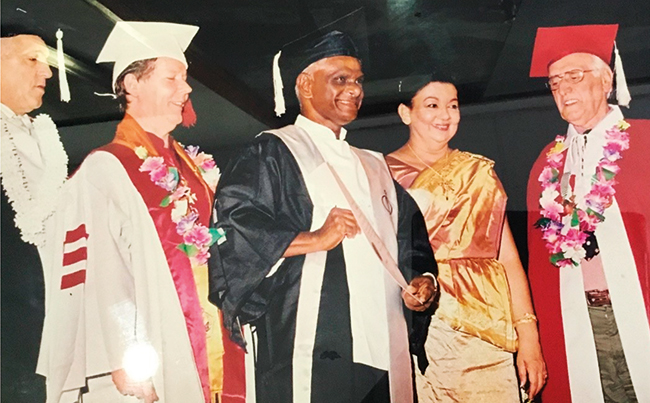
Receiving the Honorary doctorate from the Open University of Sri Lanka in 2018
A Loyal and Grateful Friend from 1994 to 2023
After 1994 I have stayed at MLH many times as a guest during family holidays, doing consulting assignments, presenting leadership development seminars, and doing a few IHS re-structuring projects. I chose MLH as the venue for two of my most important life events – the home coming wedding reception for my wife in 1999, and my 50th birthday party in 2003. On those two occasions, I never looked at the menu. When Publis asked me what I want in the menu I simply told him, “You decide on the menu, Chef. Anything good for you is good for me.” On both these special occasions, just as I expected, Chef Publis exceeded my expectations.
When it comes to memorable and magical events, there is no better venue than MLH, and no better Chef than Publis. MLH has been my home away from home during the last 30 years. Meanwhile, Publis made sure that I received a signed copy of each of his books. Every time he was generous with his appreciation and thanks for getting him to write and publish in 1992. Despite my repeated reminders to him that I don’t deserve such praise, Publis has been disobedient in that regard.
On April 20, 2023, while on a seven-week holiday in Sri Lanka I received a message through a friend that Dr. Publis Silva wants to see me before my departure. When he heard that I ws being hosted to dinner at Ellen’s Place – an inn in Colombo eight, by a few hotelier friends, Publis showed up early. Unfortunately, my previous engagement was delayed by an hour, and poor Publis stayed on patiently in spite of his family having a religious ceremony at his house on the same evening.
After a brief chat he presented me with a signed copy of his latest book: ‘MAHASUPAWAMSAYA: The Great Chronicle of Sri Lankan Culinary Art’. I glance through the book to find that it has a total of 1,074 pages! Chef Publis never ceased to amaze me!
I was deeply touched with the message that he hand wrote on the front page of the book he presented to me. It said: “This is presented to you, who supported me and encouraged me to write books.” For over 50 years, the privilege has been mine to get many opportunities to associate with the greatest Sri Lankan Chef, who is indeed a National Treasure.
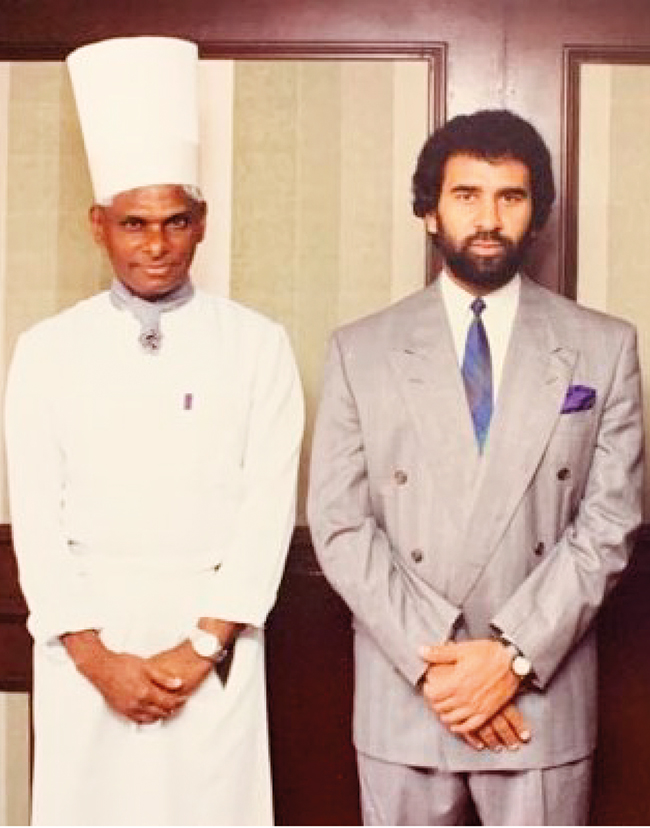
‘MLH Best Manager’ Winner, Chef Publis and I in 1993.
Questions and Answers
After I returned to Canada, soon after our last meeting in 2023, I sent the following ten questions to Deshabandu Dr. T. Publis Silva:
Q: Out of all the places you have visited in Sri Lanka and overseas, what is your favourite and most interesting place?
A: Mount Lavinia Hotel and I are inseparable. Hence, I can proudly say that my favourite place out of every country and city I have ever been to is, Mount Lavinia (Galkissa).
Q: You have inspired generations of culinary professionals. Thinking of the other side of the coin, in your career, who inspired you most?
A: In 1950s, the first à la carte restaurant in Ceylon was opened at MLH and its kitchen was developed and managed by Bass (Head Cook) R. K. M. Silva.He was a real inspiration for me and taught me a lot of valuable lessons. After his passing, to pay my respects, I created a dish named after him called “Seer RKM.” and placed it in menus across the hotel, as well as in my books, especially the Sinhalese Practical Cookery book which was used in many culinary schools and institutions across Sri Lanka.
Q: At the present time, apart from cooking, researching, and writing, what is your key passion in life?
A: To make food that is medicine is my current key passion and goal in life. This mainly includes using the abundant varieties of fruits, vegetables, legumes, seeds, cereals, and beans to dishes which are brimming with health properties. To add into it, the art of putting love and attention into the food we make while being mindful in the whole cooking process ensures we keep the maximum nutrition value of the food while preserving the flavour and the aroma of the food.
In the modern world, non-contagious diseases such as diabetes and cancer are more prevalent and deadly and eating the right type of food can ensure we can prevent or control these diseases.
Q: Can you tell our readers about your interesting adventures before joining MLH in 1956?
A: As a kid of six years old, I used to go to the beach in Ratgama with my friends and the entire beach was ours to explore. I remember we used to pluck coconuts from the trees, husk and crack the shells and then eat the kernel. One day when a piece of kernel fell in the sand, I washed it with sea water. When I ate it I experienced a better taste. This was one of my initial curiosities into the culinary world.
When I was around 20 years old, without a job and after marriage, I used to push carts in Colombo to earn a living. My passengers usually head for the market to sell produce and usually there were leftovers. I used to pick them up and then cook dishes from those.
I remember the first time I used a leftover karawala (dry salted fish) bone in a vegetable curry, the flavour made me feel like I was in heaven and to-date, that was the best food I remember having experienced. These are a few of my stories about the hardships I faced and how I developed a passion for cooking.
Q: In 1970 when MLH became the first hotel in Sri Lanka to be managed by an international hotel chain, what did you learn from the Hyatt Corporation, USA?
A: Hyatt Corporation brought in international chefs and I with all our MLH kitchen staff learned a lot from them. I especially learned about butchery and meat from French, German and Swiss chefs and I respect them for further igniting my passion to research about all kinds of food.
Q: Can you give the readers some numbers from your 67-year long career in culinary arts – total number of books, TV shows, food festivals, weddings catered for (including BMICH) etc.?
A: I have written 20 books, attended a countless number of TV shows, and I remember celebrating the 10,000th wedding catered when Dr. Chandana Jayawardena was the General Manager of MLH. In 1992, as the long-standing catering partner of BMICH – national convention centre, MLH did the catering for the largest wedding to be held in Sri Lanka. We prepared and served 2,400 invitees a sit-down Biriyani dinner within 90-minutes. I must mention that Dr. Chandana Jayawardena was also the person who pushed me into writing more books and my first book was written along with his collaboration. I have also visited 33 countries to promote Sri Lankan food and culture.
Q: You have recorded numerous achievements, including two Guinness World Records, an honorary doctorate, and the national award of Deshabandu. What do you consider as your greatest achievement during the last 77 years?
A: The greatest achievement for me was the Guiness World Record for the world’s largest milk rice ever made. It contained 1000kg of rice and 2000kg of coconuts. During that huge undertaking, it felt like I was the conductor of a symphony orchestra with 120 chefs. They were ready to obey each command, I told them when to add the rice, when to add the milk, when to add the water, when to lower the fire, and finally, the end-product which was 62 feet long and five feet wide was a world record breaking milk rice with a consistent flavour and each piece was enjoyed by those who attended to witness the world record.
Q: Your book MAHASUPAVANSHAYA, has over 1,000 pages and you led a large team of researchers in producing this book. Tell our readers more about that remarkable process ?
A: It took me and my team over 30 years to complete the book, we went across Sri Lanka gathering a vast volume of information and our research took us to some parts in Africa as well. Professors and students from Sri Jayewardenepura University helped me a lot along with a team of 12 chefs from MLH. During my research, while learning about the history of culinary arts in Sri Lanka, I learned that during the time of King Dutugamunu, they used a Stone Oruwa (a stone boat) filled it with water, filled it with heated rocks and that brought the water to a heated temperature, which ultimately made the Stone Oruwa act as a chafing dish to keep any food containers placed inside hot. This was the first recorded usage of a chafing dish in the world.
Q: What does a normal day of the Director Culinary Affairs and Promotions of MLH, look like?
A: The first thing I do when I arrive at my office in the morning is to search for new innovations in the culinary field. I keep myself as a student and learn new things every day. I ensure that anything I learn I teach to the next generation and then search for new innovations again. This cycle encapsulates my normal day as the Director of Culinary Affairs and Promotions. For example, my thinking of culinary innovation led me to learn that, if we take the Kos Tree (Jak Fruit Tree), there are abundant uses we have, and each piece of the entire Kos Tree can be used in some culinary way.
Q: What is your advice to young chefs who dream of having a long career in culinary arts?
A: In the world, I believe that the best thing someone can learn is to cook, I ask of the entire younger generation to learn cooking as I believe that if anyone learns about cooking, it will be one of the most important and useful skills acquired in life.
Next week, 3Ps will feature a university professor who is also a leader in tourism in Sri Lanka…