Features
Degrees of culpability

by Kumar David
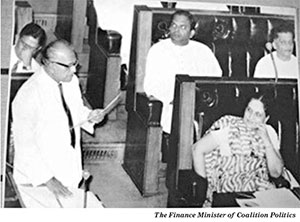
Today I am courting an avalanche of invective and censure from hyperactive readers. You live only once so why not I live dangerously? My objective is serious. It’s about left leaders who did ‘this or that’ and whose plans misfired. Can we distinguish between the unforeseeable, plain bad luck, errors of judgement made in good faith, opportunists, sons of bachelors and progeny of female canines? I intend to argue that the coalition tactic of NM et al is a case of bad luck and error of judgement, not greed and corruption. Conversely the politics of Tissa, Vasu and DEW is not forgivable, it is opportunism. I did not support NM’s Coalition Resolution at the fateful 1964 LSSP Party Conference, so I don’t need to make excuses for his standpoint. A large number of other MPs, Provincial Councillors and Local Representatives belong to even lower breeds.
A comment one hears is “It was easy to convert (some say corrupt) NM, Colvin et al to Sirima”, but that is wrong. The LSSP and CP made a political decision, a wrong not a corrupt decision and that is the starting point of my intervention. The left in the 1960s and early 70s, not only in Ceylon but also Algeria, Chile, India, Indonesia and in fact almost everywhere theorised that world-wide a period in which a broad anti-comprador, anti-imperialist unity would be the vehicle of progress had dawned. In the terminology of the time “an alliance of all progressive forces including the national bourgeoisie was necessary”. Hector was the principle architect of this model in the LSSP and theorised extensively in his writings. Was this a bogus theory that NM etc. adopted to secure cabinet posts and sinecures, which is what the Dead-Left is doing today in snuggling up to the Rajapaksas? Did NM covet a job in Sirima’s cabinet – Nonsense! It is no secret that the ‘golden brained’ left leaders despised their soon to be counterpart morons in Sirima’s Cabinet.
In the context of the Cuban and Algerian revolutions, the launch of the non-aligned movement and stunning victories in Vietnam, the majority in the left believed that global class power correlations had been transformed. Socialism it seemed was a low hanging fruit to be plucked with ease; and given the intellectual superiority of the left leaders and the powerful party and working class organisations that stood behind them, the challenge had to be grasped. But it was not the prowess of individuals and most certainly not a deficit of moral probity that settled the outcome, it was the way in which objective reality evolved. The global economic plunge rooted in the end of the post-war boom of Western capitalism, two oil price crises, the disorientation the left suffered globally due to the madness of the Cultural Revolution and the vicious counter-attacks of neo-liberalism, were neither foreseen nor factored in. Many left populist regimes suffered defeat: Algeria (Boumédiène’s coup 1965), Indonesia (removal of Sukarno in 1967), Chile (Pinochet’s coup of 1973) and Pakistan (overthrow of Bhutto in 1977). The only bright spots were that Cuba survived but only just and Vietnam won. The expulsion of the left in 1975 from the Coalition that prefigured the JR regime fitted this emergence of the global hegemony of Regan-Thatcher neo-liberalism.
Can we blame the failure of the Coalition (hence the downfall of NM etc.) on global bad luck alone and say that big mistakes in domestic affairs were not made? No, that would not be true. Though NM rebuilt the nation’s finances he pushed too hard and too far. The austerity measures hurt the masses too much; he should have been cunning and relaxed in about 1973 though it would have slowed down the resuscitation of nation’s financial viability. True the 1971 JVP Insurrection was, to borrow Lenin’s terminology

, an infantile leftist disorder of theoretically clueless and strategically disoriented youth, but the left parties should not have eviscerated these misguided intellectually late maturing adolescents so harshly and they should have intervened to protect them from massacre by the state. The military and police tasted blood in 1971 and again in 1989 and let the Tamils have the full force of it later. There are fundamental errors in the 1972 Republican Constitution as well. So yes, the left in coalition did err.
The errors and misjudgements that I briefly summarised, are as different from the opportunism and greed for Cabinet posts and perks of the leftists of the next generation, as heaven is from earth. I don’t want to take off on a protracted exercise of scolding and denigrating the Dead-Left but I want to drive home the difference between the reasons for the defeat of the first generation of leftists and the narrow aims of the next generation. However even this second generation of pygmy leftists are a cut above blackguard mainstream politicians whose hands are deep in the honey pots of public finance, nepotism and racism. Since the county is overloaded with this moan, further comment from me is redundant. I am, to be sure like most readers and columnists, very tired of upbraiding the regime, its leaders and its parliamentarians. Nine out of ten opinions one reads and 99 of every 100 conversations one engages in, lambasts the government of the day. Can’t it become the defined and accepted editorial policy of all newspapers, websites and TV stations that devote their attention to Sri Lanka, that we don’t need to repeat this; can’t it be taken as given. Consider how much newsprint and digital resources we could save! If that could be agreed then neither I or legions of other commentators would not need to say that the old left leaders erred, sometimes grievously but they are demi-gods in comparison with the sons of bachelors and of curs that fill the political scene these days.
This compels me to repeat a theme that I introduced just three weeks ago and I feel disappointed that did not evoke much support. It is unfortunate but true that the people of Lanka have become habituated to electing blackguards from the village level up to Kotte at all levels of representative assembly. The redeeming feature is that our people are as short of patience as they are blighted of memory. Months ago I was the first to emphasise that the popularity of the Double-(Raja)Paksa Presidency and Government had collapsed. A regime elected by near unprecedented majorities had become the country’s most despised in a period measured in months. It is imperative therefore, given this character and temperament of our people that legislative (or constitutional) reforms be enacted to enshrine the Right to Recall at all levels of our electoral system. I am disappointed that my suggestion has not evoked interest.
Indian anti-corruption activist Anna Hazare sought empowerment of the electorate to recall elected representatives many years ago. That is giving the electorate power to remove or de-elect an MP before the expiry of his/her term of office. It is logical that if people elect representatives they should also have the power to remove them. It is a tool to exercise greater control and a whip to ensure greater accountability including the right to remove the corrupt and the criminal. Recall confers on the electorate the power to ‘de-elect’ their representatives through a direct vote initiated when a minimum number of voters registered in an electoral role sign a recall petition. The most useful aspect of the right is not actual recall which may be used infrequently, but the threat which will deter MPs from abusing their position. The other advantage of the system is that it will deter candidates from spending millions of rupees on elections because the opportunities for earning by indulging in corrupt practices is not guaranteed. It is incontestable that Sri Lanka has an urgent need for the right to recall Members of Parliament, Provincial Councils and Local Government bodies at all levels.
In the United States there have been upward of 150 recall elections of Governors, Senators, Mayors, State Legislators and City Council members from 1911 till the present time; about 75 were successful. Recall of Members of the British Parliament in now possible under legislation enacted in 2015 for defined offences less than those resulting in automatic disqualification. These petitions are automatic and triggered by a Local Returning Officer of Elections, not by popular initiative. If the subsequent recall petition is signed by at least 10% of the electorate, a by-election is called. On 1 May 2019, Fiona Onasanya was the first MP to be removed from office. Many countries on the American continent (Argentina, Canada, Columbia, Mexico, Peru and Venezuela among others) have Federal or State recall laws which have been successfully used. Switzerland, India, Germany, Ukraine, Latvia and the old Soviet Union have recall legislation in different forms covering the whole nation or certain States/Provinces. In strong federal systems provinces can enact legislation for themselves. The powers and mechanisms pertaining to these Right to Recall laws vary a great deal and are tailored to suit each case.