Features
CONFESSIONS OF A GLOBAL GYPSY JUDO FIGHTING IN INDIA

Continuing from last week’s column: ‘Judo Fighting in Sri Lanka’.
The First National Judo Team of Sri Lanka
In 1982, when the National Judo Association of Sri Lanka invited me to be on the first-ever national Judo team, I was pleasantly surprised and overjoyed. I quickly negotiated two weeks special leave from my job as a Senior Lecturer of the Ceylon Hotel School, to travel to India. The national team comprised of members from four Judo clubs.
The 10-member team was led by Kithsiri De Zoysa (Kiththa) of my club – Colombo YMCA, as the team captain. The other members of the national team were Raja Fernando, A. H. Jinadasa (Jinna), D. H. Ranjith and M. F. M. Izamudeen of the Colombo YMBA; W. K. Godwin of Sri Lanka Police, T. B. Koswaththa of Gampola Judo Club, Gamini Nanayakkara (Nana), K. Navarathnam (Nava) and Chandana Jayawardena of the Colombo YMCA.
Upali Sahabandu, a Senior Superintendent of Police at that time, was the team manager. Upali had a tough job keeping an eye on some of the playful, Judokas who were in their twenties. Upali was a good leader and an experienced Judo fighter. In the middle of the hot summer of 1982, eleven of us departed for India for two weeks with hope, anxiety and ambition.
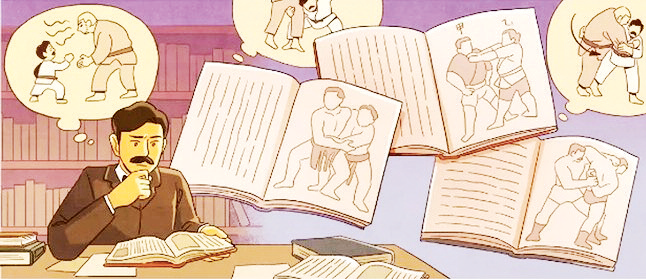
We flew from Colombo to Madras on August 13, 1982. After that, the plan was to take a two-day long, train ride from Madras to New Delhi. Then we would proceed to Ghaziabad, where an international Judo tournament was being held. The key reward for the competing teams from South Asian countries was the possibility of winning the prestigious ‘Professor Jigoro Kano Cup (India)’. It paid tribute to the father of Kodokan Judo in Japan.
India
I was excited to arrive in India. It was the 20th country I visited, during my early stage of global travel. I had set an ambitious target to eventually, travel to over 100 countries (yet to achieve in 2022). Although it was the first time I visited India, my whole life had significant Indian influences. My father’s mother’s parents were from a Brahmin family who had migrated from India to Ceylon. My elder sister went to India on a scholarship to study for five years at the Allahabad Agricultural Institute, India (now, Sam Higginbottom University of Agriculture, Technology and Sciences).
Vijaya brought the island under his control establishing himself as king. He was followed by 123 kings and queens who ruled Sri Lanka for next 2,361 years. About 75% of Sri Lankans – Sinhalese are descendants from that wave of North Indian migration. Another 15% of Sri Lankans – Tamils are descendants from different waves of South Indian migration over the centuries. Therefore, 90% of Sri Lankas have some form of Indian connection.
I had studied a little about the lives, philosophies and contributions to the mankind by some famous sons of India whom I admire – Gautama Buddha, Mohandas Gandhi, Jawaharlal Nehru and Jiddu Krishnamurti. Indian religions (Buddhists plus Hindus totalling over 80% of Sri Lankans), Ayurveda, meditation, yoga, sports, festivals, cuisine, and culture were common elements in India and Sri Lanka. These helped to create a bond among the populations living in two countries, only 21 miles apart, that had lasted over 26 centuries.
In the early 1970s, I frequently left my grade 11 and 12 classes at Ananda College, soon after the attendance registers were marked to watch over 50 Hindi movies (without any knowledge of my parents!). Seated in the gallery which cost only 50 cents, the language was no barrier for my enjoyment of the music and beautiful singing. It was clearly evident that some of the popular Sri Lankan movies at that time, were influenced by the storylines, productions, songs and box office winning formulas of Indian movies. I liked old Hindi songs of Lata Mangeshkar, popular movies of Raj Kapoor, artistic movies of Satyajit Ray and also the opening batting of Sunil Gavaskar.
In the early 1980s, there were hardly any imports to India of non-essential items. Coming from Colombo where roads were filled with re-conditioned Japanese cars, we were surprised to see only a limited number of locally manufactured brands of vehicles on the roads in India. We did not notice any makes other than TATA buses and trucks, Hindustan and Premier Padmini cars. Soon after we landed in Madras, we had numerous offers to sell bottles of imported liquor and cigarettes that we were privileged to buy from duty free shops at the airport.
Madras
Our AirLanka flight from Colombo took a short 70-minutes to reach Madras. We were given a warm welcome by a small group of Indian Judokas. Our accommodation was arranged in Madras at the Sri Lanka Maha Bodhi Centre which included a small temple, named Buddha Vihar – the only Buddhist temple in Madras. It was located opposite to Egmore Railway Station, which was an impressive, early 20th century building and one of the prominent landmarks of Madras. On our second evening in Madras, our Indian friends arranged a friendly Judo meet and a brief tour of Madras.
Madras was the shortened name of the fishing village Madraspatnam, where the British East India Company had built a fort and factory/trading post in the mid-seventeenth century. The government of Tamil Nadu officially changed the name of the city to Chennai in 1996, in order to break free from the legacy stamped by British colonisers. Madras, on the Bay of Bengal in Eastern India, is the capital of the state of Tamil Nadu, which had a population of 50 million in 1982 (increased to over 77 million in 2022).
The city is home to Fort St. George, built in 1644 and now a museum showcasing the city’s roots as a British military garrison. Madras has the famous 13-kilometre-long Marina Beach along the Bay of Bengal. It is the longest and the most crowded, natural urban beach in India and the second longest in the world (after Praia do Cassino Beach, Brazil,). In 1982, with an urban / metropolitan population of 4.5 million (over nine million in 2022), Madras was the fifth most populated city in India.

52-hours on Janta Express
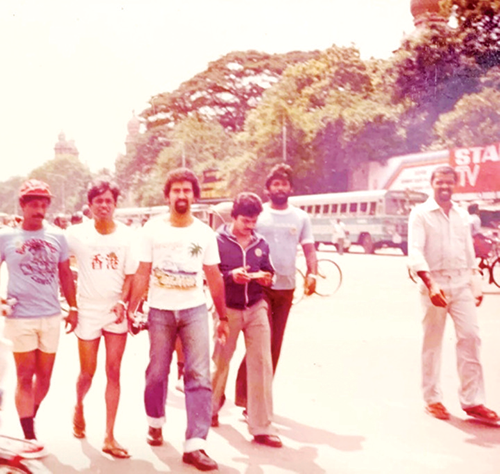
After two days in Madras, we took the longest (around 2,200 kilometres) train ride any of us had ever experienced. Although the journey was expected to take 46 hours, several delays resulted in us being on the train for 52 hours. None of the passengers complained about that six-hour delay. We quickly got used to the train and its hard seats in the economy class. We were given seats in a corner of our compartment, next to a bathroom. There, we regularly showered to be comfortable in the midst of a heat wave and nearly unbearable humidity.
This train had three tiers of bunks to sleep. Our Captain, Kiththa was nearly starving as he wanted to reduce his weight by five pounds before pre-game weighing in Ghaziabad, to qualify for a lower weight category fight. His plan was to eat a lot after the weighing to gain weight and more strength. In spite of our jokes, Kiththa remained in a top level bunk to avoid any temptation to eat while the rest of us ate. Occasionally he looked down at us having a lot of fun and laughing loudly. He came down only a couple of times to use the toilet.
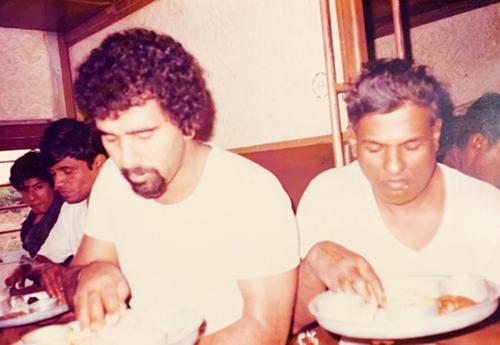
At the main station stops, food vendors sold us warm food served on large aluminium plates. We had to pay first and eat quickly before the train moved, as the vendors wanted their aluminium plates back. Food was always delicious although we were not sure of the hygienic conditions in which the fit was prepared. As we were starving, we did not care too much about such things. In between our stops, hot meals, showers, pranks, jokes, naps; we also played 304 card games. Even though we came from different clubs, that 52-hour long train ride made us become a closely-knit team, proud to represent our country in India.

Delhi
We were exhausted by the time we arrived in New Delhi, the capital of India. A few of us also suffered from food poisoning. After some rest, we went sightseeing. The seat of all three branches of the government of India – Rashtrapati Bhavan (President’s residence/office), Parliament House and the Supreme Court, are in Delhi. With a 340-room main building on a 320-acre presidential estate, Rashtrapati Bhavan is considered the largest residence of any head of state in the world. The New Delhi district formed a relatively small part of the megacity of Delhi which had a population of six million in 1982, but has now grown to have nearly 30 million in 2022 (second only to Tokyo).
In Old Delhi, a neighbourhood dating to the 1600s, stands the imposing Mughal-era Red Fort, a symbol of India. Nearby is the sprawling Jama Masjid Mosque, whose courtyard can accommodate 25,000 people. Chandni Chowk, a vibrant bazaar filled with food carts, sweet shops and spice stalls, was colourful and interesting. The Red Fort had served as the main residence of the Mughal Emperors. Emperor Shah Jahan commissioned the construction of the Red Fort, when he decided to move his capital from Agra to Delhi.
Every year on India’s Independence Day (15 August), the Prime Minister hoists the Indian flag at the fort’s main gate and delivers a nationally broadcasted speech from its ramparts. Unfortunately, we missed this event in 1982 by a day. In Delhi we met another Judoka from Sri Lanka, Gamini Rupasinghe, who had arrived in India for a different assignment. Having earned black belts in both Judo and Karate, Gamini was unique among Sri Lankan martial artists. Gamini joined us for a short period.
We had a free evening, so we decided to see a Hindi movie after dinner. In Delhi, some large cinemas had movies placed on a loop, continuing 24-hours non-stop. The choice of top summer movie releases was wide. We decided to see – ‘Prem Rog’ (Sickness of Love) which had received high critical acclaim as an all-time classic by Raj Kapoor. It was also one of the two biggest Bollywood box office hits of 1982. It was the correct choice for us. Prem Rog led the 30th Filmfare Awards with 12 nominations and won four including the Best Director of the year award for Raj Kapoor.
Tournaments in Sonipat and Ghaziabad
We moved to an adjoining district in a neighbouring state, about an hour from Delhi. Ghaziabad was the venue for our main tournament. It was a relatively small city of around one million residents. We were provided with accommodation in a quiet old building. We were happy there until we found out that it was a closed hospital. One night, our team member from Sri Lanka Police, Godwin, moved from his bed saying that our dormitory was too warm.
Next morning, over breakfast, Godwin was boasting and told us, “Machang, while you guys were suffering in that warm dormitory, I was lucky to find a ‘cool’ marble bed in another room. I had a nice sleep without any sweat or getting disturbed by noises from you guys.” His happiness was short-lived when we heard from the security guard that the dark, eery looking room with the marble slab was actually the morgue of the haunted old hospital! After that, our team fun was full of ghost jokes and scary pranks with mid-night screams. Godwin was not amused.

JUDO…
Just before our main tournament, we received an additional invitation. Haryana State Judo Association invited the Sri Lanka National team to a quickly organized tournament. It was advertised as ‘North India vs. Sri Lanka Judo Meet’. It was held in a small city called Sonipat. Kiththa and Raja won their bouts and Jinna won a silver medal. That meet was a good practice for the main tournament.
One of the biggest challenges we had was that the mats used for the tournament were wrestling mats. In Sri Lanka, we always fought on proper Judo tatami mats gifted by the Japanese Embassy. Those Japanese mats had a tatami finish and were made of vinyl with an inner compressed sponge and anti-skid bottom.
In spite of that challenge, we did relatively well on the mat. Sri Lanka team had mixed results at the third ‘Professor Jigoro Kano Cup (India)’ tournament. Nana won a gold medal. A few of the team won silver medals. I lost in semi-finals in my category, but managed a draw at a five-Judoka team event.
Judo adventures will continue next Sunday…

By Dr. Chandana (Chandi) Jayawardena DPhil
President – Chandi J. Associates Inc. Consulting, Canada
Founder & Administrator – Global Hospitality Forum
chandij@sympatico.ca