
Features
Channel 4 resurrects Easter Sunday, rips open can of squirming worms

by Rajan Philips
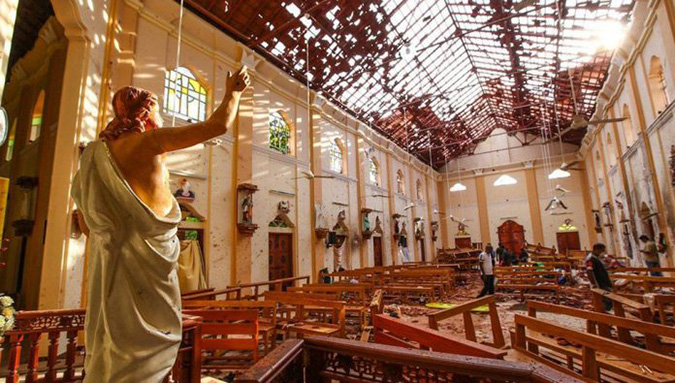
Channel 4 has resurrected Easter and divided the political waters. Like Moses leading the Israelis through the divided waters of the Red Sea, Cardinal Malcolm Ranjith is leading his faithful through the divided political waters of the country. Without taking a position on the Channe 4 documentary, the Cardinal has hit the nail on the head by calling for a “free, impartial, just, transparent and broad based investigation” into Channel 4 revelations by “an independent international investigation team”. At the same time, Cardinal Ranjith has confirmed his willingness “to forgive the perpetrators of the Easter Sunday attacks if they accept responsibility and repent,” emulating the Truth and Reconciliation experience in South Africa.
Forgiving is core to transitional justice, just as remembering and commemorating is an essential part of healing for the victims of injustice. Covering up crimes, on the other hand, is to perpetuate injustice and to reward those who wrong at the expense of those who have been wronged.
In instances of political crimes, grievously wronged. While enough is being said about the veracity, or otherwise, of the Channel 4 Despatches, the real consequence of Channel 4 goes beyond connecting the dots leading up to 2019 Easter Sunday. Quite inadvertently, Channel 4 has provided a broad wraparound encompassing all the political crimes of this century and the state’s unwillingness to solve any of them.
What has been brought into sudden relief is the whole web of crimes from the murder of Lasantha Wickrematunge to the massacres of Easter Sunday. You can extend the web before and after – to the murder of Kumar Ponnambalam literally at the turn of the millennium, to the killing of Dinesh Schaffter less than a year ago. On the former, a government lawyer actually said in court that the case file had gone missing. On the latter, the police are still trying to officially figure out how Mr. Schaffter died, even though everyone who knows about the case knows how he died. In between lies a whole web of unsolved crimes, Scot-free criminals, and well-protected masterminds. Channel 4 has ripped open a whole can of squirming worms. Closing the can seems to be finally becoming an impossible task.
Cover-up politics
Gotabaya Rajapaksa jumped the gun in rushing to his own defense with a silly statement under a sillier signature as the Seventh Executive President (who on earth will sign like this except the organic man). His still faithful loyalists came out to join him thinking that the tide had begun to turn. It has, but the other way around. Channel 4 skeptics and establishment minnows are being drowned out by calls for an international inquiry in one form or another. Even Maithripala Sirisena and Namal Rajapaksa are for it. Erstwhile (Mahinda) Rajapaksa loyalists are letting themselves off the leash and are going on a tear for Gota. There is even a new political explanation for the Easter bombings. It was not so much to win the presidential election as it was to secure the family nomination as a presidential candidate. It is turning out to be Gota vs. the Rest – of the family, that is, not necessarily the country.
In Geneva, Ambassador Himalee Arunatilaka (a career diplomat, finally displacing the guest artist that Gotabaya sent to UNHRC) is doing the thankless job of insisting that extensive and comprehensive investigations have been carried out by the government with the assistance of the Australian Federal Police, the FBI of the United States and INTERPOL. But she knows what all informed Sri Lankans and those listening to her in Geneva know. They know that nothing by way of the whole truth has come out of these investigations to conclusively indicate who knew and did what and when.
The Supreme Court ruling has become a convenient red herring for Gota apologists. The Court ruling was on a Fundamental Rights application against those in power for their dereliction of duty. It is not the last word on who conspired with whom to cause what happened on Easter Sunday. Nor does what is reported as 79 indictments so far answers the question whether there was a mastermind pulling strings behind the bombings.
President Wickremesinghe is reported to have told his cabinet that the Channel 4 documentary does not concern the government and it would be up to the individuals concerned by it to decide to respond or not. That position did not last long, so he announced another Parliamentary Select Committee hearing, and to top it up with yet a different committee headed by a former Supreme Court Judge.
The Catholic Church has rejected it. What is coming out loud and clear is that the Channel 4 revelations deserve to be investigated, with credible international presence or observation. No one is buying the establishment line, which is also the Gota line, that there has been enough investigation and inquiry already. No one believes that the Easter attacks were the result of some spontaneous eruption of Islamic Fundamentalism. The concern goes beyond Easter, and includes all the political crimes before and after.
Political Violence and Political Crimes
Sri Lanka’s web of political crimes should not be viewed in isolation from the fields of killing that Sri Lanka suffered during the JVP insurrection and the LTTE ‘war’. At the same time, it is necessary to note that there are differences between political violence of the past and the political crimes that have been multiplying even after political violence was ended. The last decades of the 20th century were engulfed in political violence. The early decades of this century are being marred by political crimes.
The JVP is now reborn and is now recognized as an agent of hope within the political system – quite a world apart from its earlier role as an agent of disruption against the system. The LTTE violence is now history, but its legacy continues in the politics over reconciliation and in the harassment of Tamils and Muslims in the North and East under cover of pseudo Archaeology. Even though political violence has ended, the culture of violence it created and the resources of violence it amassed have facilitated the emergence of political crimes and their continuation.
A characteristic of political violence, whether it was JVP or LTTE, was that it was not conducted in the interests of political families or for electoral gains of political families or organizations. I am not suggesting this characteristic is a redeeming feature of violence, or a justification for it. Only to contrast with the web of political crimes that has now become a fact of life, and which involves the interests of one or more political families. Some are more prominent at the national level; others rule the roost at the local levels without national notoriety.
While contrasting political violence and political crimes, it is also possible to see the 2019 Easter Sunday tragedies as a coming together of the two. Quite literally, the web of allegations has brought together those who were active in the political violence of the LTTE and those who were spearheading the violence of the state against the LTTE. The specific intersection of the Rajapaksa family and LTTE renegades started long before 2019 Easter Sunday and has been continuing since. The linkage between them that is now alleged by Channel 4 was quite definitively exposed by Amnesty International over what it called the “the collapse of Joseph Pararajasingham murder case.”
That was when S. Chandrakanthan (aka Plillayan) was controversially acquitted along with four others in the 2005 assassination of TNA MP Joseph Pararajasingham, who was killed while attending Christmas Mass at the Batticaloa Cathedral. The Attorney General announced that he would be dropping the charges against the suspects. Mr. Chandrakanthan has since become an MP, and is now a State Minister. He is not the only one enabled by the Rajapaksas to overcome murder conviction and enter parliament. Premalal Jayasekara from the Ratnapura District is another such beneficiary. And the two men represent not the cover up of crimes but the celebration of them by parliament itself, which was once “the supreme instrument of state power.”
What Channel 4 has unintentionally done is to disrupt the process of normalization of crimes, and the acquiescence of Sri Lankan society to get on with life while turning a blind eye to the perpetration of political crimes and their cover up. Those who rush to question the veracity of Channel 4 revelations, should also pause to reflect on the unanswered questions surrounding so many individual killings and involving the politically powerful. The debate over Channel 4 has brought to surface the moral contradictions of Sri Lankan society. And the debate has taken a new turn.








by Dr Gotabhya Ranasinghe
Senior Consultant Cardiologist
National Hospital Sri Lanka
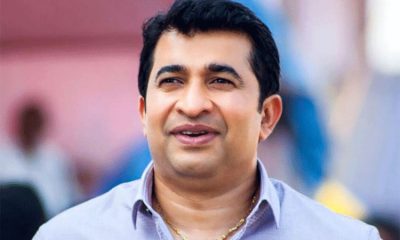
When we sought a meeting with Hon Dr. Ramesh Pathirana, Minister of Health, he graciously cleared his busy schedule to accommodate us. Renowned for his attentive listening and deep understanding, Minister Pathirana is dedicated to advancing the health sector. His openness and transparency exemplify the qualities of an exemplary politician and minister.
Dr. Palitha Mahipala, the current Health Secretary, demonstrates both commendable enthusiasm and unwavering support. This combination of attributes makes him a highly compatible colleague for the esteemed Minister of Health.
Our discussion centered on a project that has been in the works for the past 30 years, one that no other minister had managed to advance.
Minister Pathirana, however, recognized the project’s significance and its potential to revolutionize care for heart patients.
The project involves the construction of a state-of-the-art facility at the premises of the National Hospital Colombo. The project’s location within the premises of the National Hospital underscores its importance and relevance to the healthcare infrastructure of the nation.
This facility will include a cardiology building and a tertiary care center, equipped with the latest technology to handle and treat all types of heart-related conditions and surgeries.
Securing funding was a major milestone for this initiative. Minister Pathirana successfully obtained approval for a $40 billion loan from the Asian Development Bank. With the funding in place, the foundation stone is scheduled to be laid in September this year, and construction will begin in January 2025.
This project guarantees a consistent and uninterrupted supply of stents and related medications for heart patients. As a result, patients will have timely access to essential medical supplies during their treatment and recovery. By securing these critical resources, the project aims to enhance patient outcomes, minimize treatment delays, and maintain the highest standards of cardiac care.
Upon its fruition, this monumental building will serve as a beacon of hope and healing, symbolizing the unwavering dedication to improving patient outcomes and fostering a healthier society.We anticipate a future marked by significant progress and positive outcomes in Sri Lanka’s cardiovascular treatment landscape within the foreseeable timeframe.

by Fr. Emmanuel Fernando, OMI
Jesuit Fr. Aloysius Pieris (affectionately called Fr. Aloy) celebrated his 90th birthday on April 9, 2024 and I, as the editor of our Oblate Journal, THE MISSIONARY OBLATE had gone to press by that time. Immediately I decided to publish an article, appreciating the untiring selfless services he continues to offer for inter-Faith dialogue, the renewal of the Catholic Church, his concern for the poor and the suffering Sri Lankan masses and to me, the present writer.
It was in 1988, when I was appointed Director of the Oblate Scholastics at Ampitiya by the then Oblate Provincial Fr. Anselm Silva, that I came to know Fr. Aloy more closely. Knowing well his expertise in matters spiritual, theological, Indological and pastoral, and with the collaborative spirit of my companion-formators, our Oblate Scholastics were sent to Tulana, the Research and Encounter Centre, Kelaniya, of which he is the Founder-Director, for ‘exposure-programmes’ on matters spiritual, biblical, theological and pastoral. Some of these dimensions according to my view and that of my companion-formators, were not available at the National Seminary, Ampitiya.
Ever since that time, our Oblate formators/ accompaniers at the Oblate Scholasticate, Ampitiya , have continued to send our Oblate Scholastics to Tulana Centre for deepening their insights and convictions regarding matters needed to serve the people in today’s context. Fr. Aloy also had tried very enthusiastically with the Oblate team headed by Frs. Oswald Firth and Clement Waidyasekara to begin a Theologate, directed by the Religious Congregations in Sri Lanka, for the contextual formation/ accompaniment of their members. It should very well be a desired goal of the Leaders / Provincials of the Religious Congregations.
Besides being a formator/accompanier at the Oblate Scholasticate, I was entrusted also with the task of editing and publishing our Oblate journal, ‘The Missionary Oblate’. To maintain the quality of the journal I continue to depend on Fr. Aloy for his thought-provoking and stimulating articles on Biblical Spirituality, Biblical Theology and Ecclesiology. I am very grateful to him for his generous assistance. Of late, his writings on renewal of the Church, initiated by Pope St. John XX111 and continued by Pope Francis through the Synodal path, published in our Oblate journal, enable our readers to focus their attention also on the needed renewal in the Catholic Church in Sri Lanka. Fr. Aloy appreciated very much the Synodal path adopted by the Jesuit Pope Francis for the renewal of the Church, rooted very much on prayerful discernment. In my Religious and presbyteral life, Fr.Aloy continues to be my spiritual animator / guide and ongoing formator / acccompanier.
Fr. Aloysius Pieris, BA Hons (Lond), LPh (SHC, India), STL (PFT, Naples), PhD (SLU/VC), ThD (Tilburg), D.Ltt (KU), has been one of the eminent Asian theologians well recognized internationally and one who has lectured and held visiting chairs in many universities both in the West and in the East. Many members of Religious Congregations from Asian countries have benefited from his lectures and guidance in the East Asian Pastoral Institute (EAPI) in Manila, Philippines. He had been a Theologian consulted by the Federation of Asian Bishops’ Conferences for many years. During his professorship at the Gregorian University in Rome, he was called to be a member of a special group of advisers on other religions consulted by Pope Paul VI.
Fr. Aloy is the author of more than 30 books and well over 500 Research Papers. Some of his books and articles have been translated and published in several countries. Among those books, one can find the following: 1) The Genesis of an Asian Theology of Liberation (An Autobiographical Excursus on the Art of Theologising in Asia, 2) An Asian Theology of Liberation, 3) Providential Timeliness of Vatican 11 (a long-overdue halt to a scandalous millennium, 4) Give Vatican 11 a chance, 5) Leadership in the Church, 6) Relishing our faith in working for justice (Themes for study and discussion), 7) A Message meant mainly, not exclusively for Jesuits (Background information necessary for helping Francis renew the Church), 8) Lent in Lanka (Reflections and Resolutions, 9) Love meets wisdom (A Christian Experience of Buddhism, 10) Fire and Water 11) God’s Reign for God’s poor, 12) Our Unhiddden Agenda (How we Jesuits work, pray and form our men). He is also the Editor of two journals, Vagdevi, Journal of Religious Reflection and Dialogue, New Series.
Fr. Aloy has a BA in Pali and Sanskrit from the University of London and a Ph.D in Buddhist Philosophy from the University of Sri Lankan, Vidyodaya Campus. On Nov. 23, 2019, he was awarded the prestigious honorary Doctorate of Literature (D.Litt) by the Chancellor of the University of Kelaniya, the Most Venerable Welamitiyawe Dharmakirthi Sri Kusala Dhamma Thera.
Fr. Aloy continues to be a promoter of Gospel values and virtues. Justice as a constitutive dimension of love and social concern for the downtrodden masses are very much noted in his life and work. He had very much appreciated the commitment of the late Fr. Joseph (Joe) Fernando, the National Director of the Social and Economic Centre (SEDEC) for the poor.
In Sri Lanka, a few religious Congregations – the Good Shepherd Sisters, the Christian Brothers, the Marist Brothers and the Oblates – have invited him to animate their members especially during their Provincial Congresses, Chapters and International Conferences. The mainline Christian Churches also have sought his advice and followed his seminars. I, for one, regret very much, that the Sri Lankan authorities of the Catholic Church –today’s Hierarchy—- have not sought Fr.
Aloy’s expertise for the renewal of the Catholic Church in Sri Lanka and thus have not benefited from the immense store of wisdom and insight that he can offer to our local Church while the Sri Lankan bishops who governed the Catholic church in the immediate aftermath of the Second Vatican Council (Edmund Fernando OMI, Anthony de Saram, Leo Nanayakkara OSB, Frank Marcus Fernando, Paul Perera,) visited him and consulted him on many matters. Among the Tamil Bishops, Bishop Rayappu Joseph was keeping close contact with him and Bishop J. Deogupillai hosted him and his team visiting him after the horrible Black July massacre of Tamils.
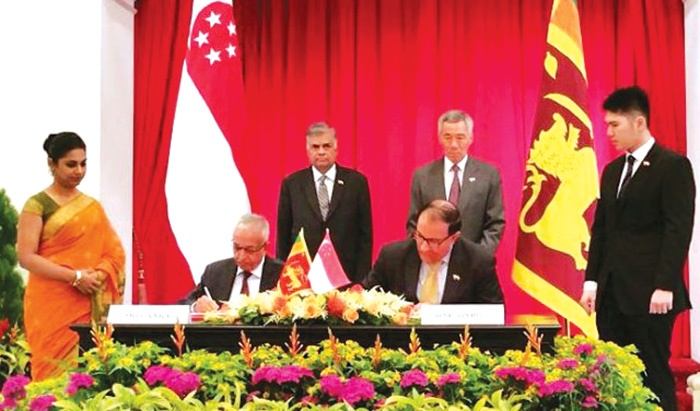
Sri Lanka-Singapore Free Trade Agreement
By Gomi Senadhira
senadhiragomi@gmail.com
“You might tell fairy tales, but the progress of a country cannot be achieved through such narratives. A country cannot be developed by making false promises. The country moved backward because of the electoral promises made by political parties throughout time. We have witnessed that the ultimate result of this is the country becoming bankrupt. Unfortunately, many segments of the population have not come to realize this yet.” – President Ranil Wickremesinghe, 2024 Budget speech
Any Sri Lankan would agree with the above words of President Wickremesinghe on the false promises our politicians and officials make and the fairy tales they narrate which bankrupted this country. So, to understand this, let’s look at one such fairy tale with lots of false promises; Ranil Wickremesinghe’s greatest achievement in the area of international trade and investment promotion during the Yahapalana period, Sri Lanka-Singapore Free Trade Agreement (SLSFTA).
It is appropriate and timely to do it now as Finance Minister Wickremesinghe has just presented to parliament a bill on the National Policy on Economic Transformation which includes the establishment of an Office for International Trade and the Sri Lanka Institute of Economics and International Trade.
Was SLSFTA a “Cleverly negotiated Free Trade Agreement” as stated by the (former) Minister of Development Strategies and International Trade Malik Samarawickrama during the Parliamentary Debate on the SLSFTA in July 2018, or a colossal blunder covered up with lies, false promises, and fairy tales? After SLSFTA was signed there were a number of fairy tales published on this agreement by the Ministry of Development Strategies and International, Institute of Policy Studies, and others.
However, for this article, I would like to limit my comments to the speech by Minister Samarawickrama during the Parliamentary Debate, and the two most important areas in the agreement which were covered up with lies, fairy tales, and false promises, namely: revenue loss for Sri Lanka and Investment from Singapore. On the other important area, “Waste products dumping” I do not want to comment here as I have written extensively on the issue.
1. The revenue loss
During the Parliamentary Debate in July 2018, Minister Samarawickrama stated “…. let me reiterate that this FTA with Singapore has been very cleverly negotiated by us…. The liberalisation programme under this FTA has been carefully designed to have the least impact on domestic industry and revenue collection. We have included all revenue sensitive items in the negative list of items which will not be subject to removal of tariff. Therefore, 97.8% revenue from Customs duty is protected. Our tariff liberalisation will take place over a period of 12-15 years! In fact, the revenue earned through tariffs on goods imported from Singapore last year was Rs. 35 billion.
The revenue loss for over the next 15 years due to the FTA is only Rs. 733 million– which when annualised, on average, is just Rs. 51 million. That is just 0.14% per year! So anyone who claims the Singapore FTA causes revenue loss to the Government cannot do basic arithmetic! Mr. Speaker, in conclusion, I call on my fellow members of this House – don’t mislead the public with baseless criticism that is not grounded in facts. Don’t look at petty politics and use these issues for your own political survival.”
I was surprised to read the minister’s speech because an article published in January 2018 in “The Straits Times“, based on information released by the Singaporean Negotiators stated, “…. With the FTA, tariff savings for Singapore exports are estimated to hit $10 million annually“.
As the annual tariff savings (that is the revenue loss for Sri Lanka) calculated by the Singaporean Negotiators, Singaporean $ 10 million (Sri Lankan rupees 1,200 million in 2018) was way above the rupees’ 733 million revenue loss for 15 years estimated by the Sri Lankan negotiators, it was clear to any observer that one of the parties to the agreement had not done the basic arithmetic!
Six years later, according to a report published by “The Morning” newspaper, speaking at the Committee on Public Finance (COPF) on 7th May 2024, Mr Samarawickrama’s chief trade negotiator K.J. Weerasinghehad had admitted “…. that forecasted revenue loss for the Government of Sri Lanka through the Singapore FTA is Rs. 450 million in 2023 and Rs. 1.3 billion in 2024.”
If these numbers are correct, as tariff liberalisation under the SLSFTA has just started, we will pass Rs 2 billion very soon. Then, the question is how Sri Lanka’s trade negotiators made such a colossal blunder. Didn’t they do their basic arithmetic? If they didn’t know how to do basic arithmetic they should have at least done their basic readings. For example, the headline of the article published in The Straits Times in January 2018 was “Singapore, Sri Lanka sign FTA, annual savings of $10m expected”.
Anyway, as Sri Lanka’s chief negotiator reiterated at the COPF meeting that “…. since 99% of the tariffs in Singapore have zero rates of duty, Sri Lanka has agreed on 80% tariff liberalisation over a period of 15 years while expecting Singapore investments to address the imbalance in trade,” let’s turn towards investment.
Investment from Singapore
In July 2018, speaking during the Parliamentary Debate on the FTA this is what Minister Malik Samarawickrama stated on investment from Singapore, “Already, thanks to this FTA, in just the past two-and-a-half months since the agreement came into effect we have received a proposal from Singapore for investment amounting to $ 14.8 billion in an oil refinery for export of petroleum products. In addition, we have proposals for a steel manufacturing plant for exports ($ 1 billion investment), flour milling plant ($ 50 million), sugar refinery ($ 200 million). This adds up to more than $ 16.05 billion in the pipeline on these projects alone.
And all of these projects will create thousands of more jobs for our people. In principle approval has already been granted by the BOI and the investors are awaiting the release of land the environmental approvals to commence the project.
I request the Opposition and those with vested interests to change their narrow-minded thinking and join us to develop our country. We must always look at what is best for the whole community, not just the few who may oppose. We owe it to our people to courageously take decisions that will change their lives for the better.”
According to the media report I quoted earlier, speaking at the Committee on Public Finance (COPF) Chief Negotiator Weerasinghe has admitted that Sri Lanka was not happy with overall Singapore investments that have come in the past few years in return for the trade liberalisation under the Singapore-Sri Lanka Free Trade Agreement. He has added that between 2021 and 2023 the total investment from Singapore had been around $162 million!
What happened to those projects worth $16 billion negotiated, thanks to the SLSFTA, in just the two-and-a-half months after the agreement came into effect and approved by the BOI? I do not know about the steel manufacturing plant for exports ($ 1 billion investment), flour milling plant ($ 50 million) and sugar refinery ($ 200 million).
However, story of the multibillion-dollar investment in the Petroleum Refinery unfolded in a manner that would qualify it as the best fairy tale with false promises presented by our politicians and the officials, prior to 2019 elections.
Though many Sri Lankans got to know, through the media which repeatedly highlighted a plethora of issues surrounding the project and the questionable credentials of the Singaporean investor, the construction work on the Mirrijiwela Oil Refinery along with the cement factory began on the24th of March 2019 with a bang and Minister Ranil Wickremesinghe and his ministers along with the foreign and local dignitaries laid the foundation stones.
That was few months before the 2019 Presidential elections. Inaugurating the construction work Prime Minister Ranil Wickremesinghe said the projects will create thousands of job opportunities in the area and surrounding districts.
The oil refinery, which was to be built over 200 acres of land, with the capacity to refine 200,000 barrels of crude oil per day, was to generate US$7 billion of exports and create 1,500 direct and 3,000 indirect jobs. The construction of the refinery was to be completed in 44 months. Four years later, in August 2023 the Cabinet of Ministers approved the proposal presented by President Ranil Wickremesinghe to cancel the agreement with the investors of the refinery as the project has not been implemented! Can they explain to the country how much money was wasted to produce that fairy tale?
It is obvious that the President, ministers, and officials had made huge blunders and had deliberately misled the public and the parliament on the revenue loss and potential investment from SLSFTA with fairy tales and false promises.
As the president himself said, a country cannot be developed by making false promises or with fairy tales and these false promises and fairy tales had bankrupted the country. “Unfortunately, many segments of the population have not come to realize this yet”.
(The writer, a specialist and an activist on trade and development issues . )



US sports envoys to Lanka to champion youth development

Rahuman questions sudden cancellation of leave of CEB employees


