Features
CHANGE OF LUCK – Part 18

CONFESSIONS OF A GLOBAL GYPSY
By Dr. Chandana (Chandi) Jayawardena DPhil
President – Chandi J. Associates Inc. Consulting, Canada
Founder & Administrator – Global Hospitality Forum
chandij@sympatico.ca
Resilience
On September 27 (World Tourism Day), I was very happy to participate as a Co-Chair of the Tourism Research Conference, at the International Tourism Leaders Summit organized by the University of Colombo, via Zoom. Re-building post pandemic tourism in a strategic manner was a key focus at this well-attended on-line summit. Recovering from the devastating impact from the global pandemic is vital for the economy of Sri Lanka as well as the other tourist destinations in the world.

Finally, Winning Big
The summer of 1973 was a good period for me. I had a productive internship at Lever Brothers. In spite of my disastrous academic results during my first year, my grades improved by the end of the second year at the Ceylon Hotel School (CHS). I also felt lucky when I finally won the neighbourhood track and field event as the overall winner. It was the fourth and final year that I led a team of my neighbourhood buddies. We organized this ambitious ten-event sports meet for children from nearly 100 houses in Bambalapitiya Flats. In the previous three years I came second, in spite of my efforts to win the overall trophy.
A fortnight after that I won the open championship at the second largest Judo tournament in Sri Lanka. Among ten different categories of bouts based on kyū and dan (Judo grades) and weights of the fighters, open event was the prime event of any Judo tournament. My opponent in the open final was stronger, heavier, more experienced in fighting than I. He was a tough Inspector of Police. I was still in my late teens and he was ten years older. My opponent was expected to win the final bout of the tournament easily. However, I had lot of support around the fighting area from my neighbourhood buddies and CHS batchmates. My aim was not to disappoint my fans by losing quickly with an ippon (full point for a perfect throw). I held my opponent at bay for the whole duration. Twice, extra fighting time was allocated by the referee.
In between, during a short break from fighting, I was kneeling down and adjusting my belt at a corner of the fighting mat. While catching my breath I told one of my friends cheering me by the ringside that my opponent was strong like a big tree. My friend, Roshan Arulanandan, told me, “Chandana, strong trees can also fall down with the right pressure.” To me that summed up a key concept of the art of Judo fighting. Breaking the balance of the opponent was a good tactic.
During the final three minutes of extra time, my strategy was to be very aggressive. I kept on pushing my opponent while holding his judogi (uniform) tightly as possible. That angered the Police Officer and he aggressively pushed me back. At that moment, I used his own strength and pulled him toward me while falling backwards with my right feet pushing him up. This sacrifice throw called ‘Tomoe nage’ (巴) is one of the traditional forty throws of Judo as developed by the founder of this martial art, Professor Jigaro Kano. It was not a popular throw as often it backfired when tried by less experienced fighters like me. That day it worked for me like a charm and my opponent went flying over me and fell flat. I won.
One More Year to Survive
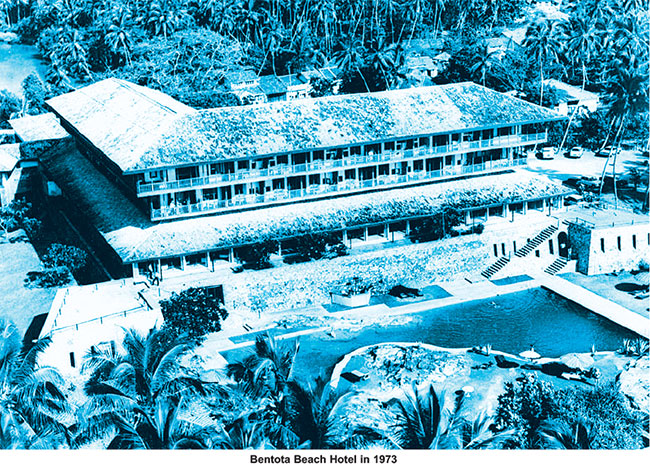
A week later, when I returned to CHS, I was motivated by my wins and recent successes. I showed a newly renewed optimism and a positive attitude. I was determined to do well in my third and final year at CHS. It was fun meeting my batch mates after the summer break and sharing our holiday experiences. I made up my mind to stay out of trouble and survive my final year. I did well in new subjects such as basic management, economics and cost calculations. My improving grades meant that I was able to secure a highly-sought-after placement for my second co-op – Bentota Beach Hotel. At that time, this property was considered the best resort hotel in Sri Lanka.

Training at the Best Resort
Bentota was a major resort area identified in the first master plan for tourism development in Sri Lanka, prepared by Pannell-Kerr-Forster Consulting. Most sections of the resort area, including the Bentota Beach Hotel, Hotel Serendib and the Bentota railway station were designed by arguably, the greatest architect in Sri Lanka, Geoffrey Bawa. He was among the most influential Asian architects of his generation. As the principal force behind the concept of ‘tropical modernism’, in Bentota Beach Hotel, Mr. Bawa created simply a masterpiece.
Arriving at Bentota Beach Hotel with four other CHS students for our co-op, I was fascinated with the first impressions of the hotel. It was like entering a fortress with steps out of rock, combined with beautiful landscaping and art which included batik ceilings, bronze sculptures and colourful and unorthodox furniture. To my great pleasure, I was informed by the management that I will spend equal number of weeks in three departments – restaurant, bar and kitchen. I commenced my eighth part-time job towards the end of the year 1973.
Serving at Bentota Beach Hotel
There were five CHS graduates in the executive team. The Hotel Manager (the title of the general manager was uncommon in Sri Lankan hotels, at that time) – Malin Hapugoda (years later, the Managing Director of Aitken Spence Hotel Group) and the Executive Chef – Paddy Withana (years later, the Chairman of the Sri Lanka Tourism Development Authority). They both were four years senior to me and were in their mid-twenties. Having being promoted to positions previously held by expatriate managers at the time of the hotel opening three years ago, these two CHS graduates were the most admired among local hoteliers. The Assistant Manager – Indrapala Munasinghe was a graduate of the first batch at CHS, and had just returned after a scholarship in France. Malin Hapugoda returned after a scholarship in Canada. As CHS students we were proud to work under these senior alumni of CHS. They were very supportive to us.
Given my previous experience as a trainee waiter at three other best hotels in the country – Pegasus Reef, Mount Lavinia Hyatt and Ceylon InterContinental, working at the restaurant of Bentota Beach Hotel was a piece of cake. The restaurant supervisors usually allocated us to serve non-tip earning tables of hotel executives, tour leaders and difficult customers. As specific tables were allocated to such diners, we quickly learnt their preferences and habits.

Exploring the Neighbourhood
We were provided with accommodation in the clerical staff quarters which was close to the hotel. We were also provided with all meals for free. After our eight-hour shifts we had plenty of time to have fun, sea bathe and explore Bentota as well as nearby towns Aluthgama and Beruwala. There were around a dozen of new hotels recently opened or nearing the opening. We learnt a lot about the fast developing hotel industry in Sri Lanka, by those informal visits. Depending on our pocket money we rotated our free-time ‘fun’ visits to the following places:
Hotel Lihiniya Surf – The Government Place
It lacked the ambiance of the two nearby hotels which were blessed by the architectural magic of Bawa. It was also managed by the government owned Ceylon Hotels Corporation, which somewhat created a different culture not that appealing to us. However, we went there occasionally to meet other CHS students doing their co-ops.


This was everybody’s favourite meeting place in Bentota. It was not grand like Bentota Beach Hotel, but had a casual charm and a welcoming atmosphere. It was also designed by Geoffrey Bawa. We had a lot of drinking, meeting, greeting and flirting experiences at their public bar facing the sea.
Hotel Ceysands – Site
This hotel was being built and we used to occasionally visit the site. Although the original architecture had no clear concept, we liked the location. As the hotel was built on a narrow strip of land sandwiched between the Bentota River and the Indian Ocean, it was somewhat romantic. All guests, employees and suppliers had to take boats to reach the hotel. Four years later, I joined this hotel as the Executive Chef and the Food & Beverage Manager.
Hotel Neptune – Site
This hotel was being built as the first hotel of the Aitken Spence Group, who later became one of the largest hotel companies in Sri Lanka. This was another hotel designed by Geoffrey Bawa, and they were clearly planning to compete with Bentota Beach. A few years later when the government star classification was implemented in Sri Lanka, Hotel Neptune earned three-stars. Bentota Beach Hotel became the first resort hotel to earn four-stars in Sri Lanka. The Aitken Spence Group then built a new hotel nearby – The Triton (son of Neptune, the Roman God of the Sea), which by early 1980s, became the first five-star resort hotel in Sri Lanka.
Hotel Swanee – Site
This hotel was opened during our stay in Bentota. During one of our night walks on the beach we discovered that the owners had an overnight religious ceremony with lots of food. We crashed the party and had a good time. I clearly remember criticizing the hotel design, which was like a ‘U’ and built far away from the sea. I never imagined that I would end up managing this hotel five years later.
Barberyn Reef Hotel –The Dating Place
With my short assignment at this hotel six months ago, I had some friends there. This hotel continued to be friendly, casual and inexpensive. As a result, it was the practical choice to visit with our newly acquainted girlfriends.

Confifi Hotel – The Free Beer Place
Chandralal, a graduate of the CHS who was one year senior to us, joined this hotel as the Executive Chef, around the same time. He was very generous. His salary in 1973 was Rs. 350 per month, which was the standard minimum salary for a new graduate of CHS, at that time. Every month he spent more than his salary to entertain us with free beer, devilled beef and cigarettes, every time we visited him. His family was very rich and he had to bring money from home to settle his bar bills as his popularity among us increased.
Brief Bentota – the wonder garden
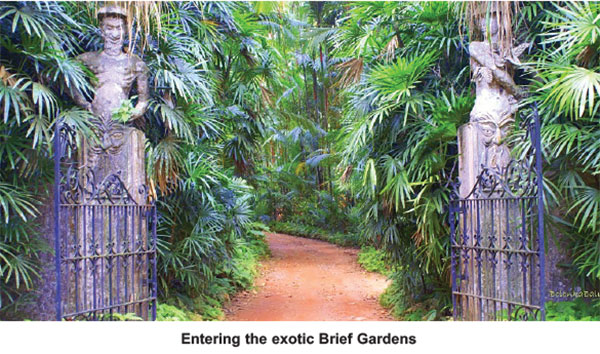
The only non-hotel meeting place for us was the Brief Gardens, which is a beautifully landscaped garden designed by landscape architect and owner Major Bevis Bawa (brother of the Architect Geoffrey Bawa). In addition to being the most renowned landscape architect in Sri Lanka, he had also served as the Aide-de-camp to four Governors of Ceylon. He was an interesting man who had lot of stories to share about how he offered a sanctuary to many top Sri Lankan artists as well as a few international visitors including Sir Laurence Olivier, Vivian Leigh and Agatha Christie. We befriended his Assistant, Dulan de Silva, who currently manages the property. Brief is is a remarkable home and garden of a remarkably talented and versatile man. Five years later I associated with Mr. Bevis Bawa professionally – I was managing a small hotel in Beruwala for John Keells Group and Mr. Bawa was the landscaping consultant for that hotel.
All in all, we had an enjoyable period of training and a fun-filled stay in Bentota. More about my work at the bar and the kitchen of Bentota Beach Hotel, next week…