
Editorial
C4, Grease Yaka and Trojan horse

Monday 25th September, 2023
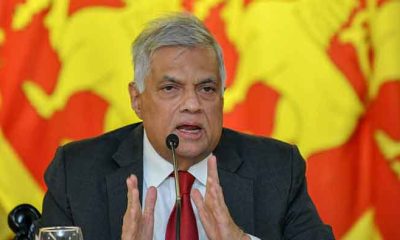
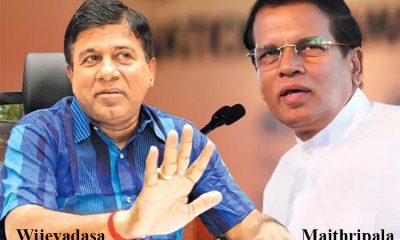
Channel 4’s recent programme on the Easter Sunday attacks may have made the Rajapaksas squirm and landed President Ranil Wickremesinghe in an awkward position, but former President Maithripala Sirisena has become an unintended beneficiary thereof. It could not have come at a better time for him; he has had to pay Rs 100 million as compensation to the families of the Easter Sunday terror victims, as per a court order, and the government is coming under increasing pressure to ensure that he faces criminal action for his failure to prevent the 2019 terrorist bombings, which took place when he was the President and Minister of Defence.
The Presidential Commission of Inquiry (PCoI), which probed the Easter Sunday attacks, has recommended that criminal proceedings be instituted against Sirisena. He is now at the mercy of President Ranil Wickremesinghe, who can have him prosecuted anytime. He has therefore opted to hold out an olive branch to Wickremesinghe, whom he wronged very badly during the latter stages of the Yahapalana rule, and indicated his willingness to support the UNP; he has gone to the extent of ousting his sidekick, Dayasiri Jayasekera, as the SLFP General Secretary for opposing moves being made to bring the UNP and the SLFP together again.
Sirisena however has got one thing right. He has said an international probe into the Easter Sunday attacks will be fraught with the risk of adversely affecting Sri Lanka’s sovereignty, and therefore what is needed is a thorough domestic investigation with foreign assistance and not a full-fledged international probe as such.
It is not possible that Channel 4 (C4) and those who are said to be behind its programme at issue are driven by a genuine desire to have justice served for the Easter Sunday carnage victims, for they had no qualms about backing Tiger terror, which claimed many more lives than the Easter Sunday attacks. Their real intention seems to be creating a precedent for international probes in Sri Lanka in a bid to achieve their goal of having a UN investigation conducted into alleged war crimes against the Sri Lankan military; C4 has craftily woven war crimes allegations into its programme on the Easter carnage. They have succeeded in making even the ardent opponents of the ongoing campaign for an international war crimes probe against Sri Lanka support their plan, albeit unwittingly.
The government however must not be allowed to use the possibility of the country having to face a UN war crimes probe, in case of an international investigation being held into the Easter Sunday attacks, to justify its unwillingness to have the carnage investigated afresh. Pressure must be amped up on it to launch a credible domestic probe into the Easter Sunday tragedy that shook the world. The Catholic Church and other campaigners for justice have had to call for an international probe because the unpardonable delay on the part of the government to complete the ongoing police investigations into the carnage, and implement the PCoI recommendations fully, is widely viewed as proof of a grand cover-up.
Sri Lankan politicians are adept at political escapism. They are as slippery as the so-called Grease Yaka (a naked voyeur or burglar, covered in grease, moving about at night), and capable of escaping capture when they find themselves on the wrong side of the law. Otherwise, by now, most of them would have been behind bars for their crimes. It is thanks to their escape artistry skills that they have avoided prosecution for their serious lapses that enabled the National Thowheed Jamaat terrorists to carry out the Easter Sunday attacks with ease. They have artfully turned the C4 programme to their advantage!
Sirisena has attempted another escape stunt amidst pressure mounting on the government to have criminal proceedings instituted against him in keeping with the PCoI recommendations. He has used the C4 allegations to assail the validity of the PCoI probe and recommendations; his call for a fresh investigation with international assistance is aimed at further delaying the legal and judicial processes pertaining to the Easter Sunday carnage.
When the PCoI final report became public in 2021, we argued that ideally a fresh probe had to be held based thereon, or if the government chose to implement its recommendations it had to do so expeditiously. If a thorough investigation had been launched at that time, it would have been possible to get at the truth and have justice served many moons ago. At least, the PCoI recommendations should have been implemented fully. Instead, the Rajapaksas opted to let the grass grow under their feet and thereby unwittingly helped bolster the claim that they were attempting a cover-up because they had a hand in the terror attacks. An ill repute is said to influence judgments.








Saturday 8th June, 2024
It was with shock and dismay that we received the news about death threats to COPF (Committee on Public Finance) Chairman Dr. Harsha de Silva over the ongoing parliamentary probe into the on-arrival visa scam. Dr. de Silva yesterday told Speaker Mahinda Yapa Abeywardena, in Parliament, that he was facing death threats and intimidation, and it was incumbent upon Parliament to ensure his safety. He stopped short of naming names, but revealed that some ruling party MPs were among those who had ganged up against him. The Speaker only said there had been no complaint, and he would look into the matter.
The SLPP-UNP government has been doing everything in its power to have all parliamentary committees under its thumb. The COPE (Committee on Public Enterprises), which once helped restore public faith in the legislature by exposing state sector corruption, has now become a mere appendage of the incumbent regime, thanks to the appointment of SLPP MP Rohitha Abeygunawardena as its Chairman. The SLPP-UNP combine also tried to oust COPF Chairman Dr. de Silva, but in vain. However, it knows more than one way to shoe a horse.
The COPF, under Dr. de Silva’s chairmanship, has been a thorn in the side of the government, which is struggling to cover up numerous corrupt deals. Dr. de Silva yesterday told Parliament that he found it extremely difficult to function as the COPF head due to severe resource constraints his committee was facing; he himself had to pay the salaries of some of his staff members besides burning the midnight oil.
The sheer workload he had to cope with as the COPF chief had taken its toll on his health, he said, informing the Speaker that he was at the end of his tether, and at times thought of resigning from the COPF. This is exactly what the government wants him to do; resource squeezes and threats are aimed at making him quit.
On 26 May, Dr. de Silva revealed, in an ‘X’ post, that the COPF had uncovered some vital information about the visa scam and it would reveal everything after its final meeting on the issue; the COPF was committed to exposing the truth behind the controversial tender, he added. In an editorial comment on 27 May, we warned him.
While thanking him for his bold stand, we pointed out that by making such a statement, he had thrown caution to the wind, and become a marked target, with the government making an all-out effort to delay the COPF investigation lest the truth should come out much to the detriment of its interests in this election year. Unfortunately, what was feared has come about; Dr. de Silva is complaining of death threats and government moves to strangulate the COPF financially to derail its investigations.
Dr. de Silva’s predicament exemplifies the fate that befalls the few good men and women in Parliament. It is hoped that all those who seek an end to the state sector corruption will rally behind Dr. de Silva, and bring pressure to bear on the government to ensure his safety. Let Dr. de Silva be urged to reveal the names of those who have issued threats, veiled or otherwise, to him and are trying to scuttle the COPF probes.
Friday 7th June, 2024
The SLPP-UNP government is going hell for leather to make bad laws as if there were no tomorrow. It is abusing its parliamentary majority, which has been retained with the help of some crossovers, for that purpose. The Opposition, the media and trade unions are up in arms, and understandably so. The incumbent regime is a dead man walking; it is so desperate that it is capable of anything. Hence the need for it to be restrained.
The Electricity (Amendment) Bill (EAB) plunged Parliament into turmoil yesterday, but the government secured its passage. The Supreme Court (SC) determined the entire EAB inconsistent with the Constitution and recommended changes thereto. After unveiling the Bill, sometime ago, Minister of Power and Energy Kanchana Wijesekera hailed it as an excellent piece of legislation aimed at straightening up the power sector to serve the public interest better.
The SC determination left him with egg on his face. He reminded us of the proverbial curate who, while eating a stale egg, assured his host, a Bishop, that parts of it were excellent. Wijesekera’s egg, as it were, made Parliament stink yesterday, but he sought to please his masters by praising it as a silver bullet.
EAB should have been discarded and a new one drafted in consultation with all stakeholders. But the government is apparently driven by an ulterior motive; its aim is not to serve Sri Lanka’s interests but to look after those of some moneybags.
It is not uncommon for Bills to contain some flaws, which are rectified either before or during the committee stage. But there is something terribly wrong with draft Bills that are full of sections inconsistent with the Constitution. The drafters of EAB have demonstrated their sheer ignorance of the supreme law, and that they are not equal to the task of drafting Bills. If they had read the Constitution at least perfunctorily, they would not have drafted such a bad law.
Ignorant and incompetent, they do not deserve to be paid with public funds and must be sent back to law school. They must be summoned before Parliament and questioned on their serious lapses, which have caused public faith in the national legislature to diminish.
Curiously, the MPs who demand that judges, doctors, Central Bankers, and other public officials be summoned before Parliament have taken badly drafted Bills for granted. The power sector trade unions yesterday alleged that EAB was of Indian origin and geared towards furthering the interests of Adani Group at the expense of Sri Lanka.
Most critics of EAB are agreeable in principle to the need for power sector reforms; the Ceylon Electricity Board should be given a radical shake-up, and transformed into a modern organisation capable of providing a better service at a lower cost. They only asked the government to tread cautiously, consulting all stakeholders and taking action to ensure that the country’s interests prevailed over everything else. But the government was in a mighty hurry to steamroller the Bill through Parliament, making the Opposition ask whether it was doing so at the behest of some external forces involved in controversial power generation deals here.
What is passed by the current Parliament can be either amended or abolished by a future parliament in a constitutionally prescribed manner. But that does not mean that a government is free to pass bad laws, making the country enter into long-term agreements with powerful nations and their investors. It looks as if the SLPP-UNP regime did not care two hoots about the consequences of its actions.

Thursday 6th June, 2024
The outcome of India’s parliamentary election (2024) has led to a ‘perspective ambiguity’. Prime Minister Narendra Modi lost no time in declaring victory for the BJP-led NDA alliance, which secured 293 seats in the 543-member Parliament, but he must be a worried man. The BJP is short of 32 seats to form a government under its own steam; it has lost 63 seats or about 20% of its parliamentary strength. It had 303 seats in the previous Parliament, and that number has dropped to 240.
Modi has become the second Indian Prime Minister to win a third term. The first PM to do so was Jawaharlal Nehru. But Nehru won an outright majority in Parliament in 1962; Modi has had to depend on smaller parties in his alliance to retain his hold on power. Modi must be reeling from a sharp drop in his victory margin in his own constituency, Varanasi; it has decreased to 152,000 from 480,000 in 2019 whereas Modi’s bete noire, Rahul Gandhi, won Raebareli by a staggering 390,000 votes.
Modi, who reigned supreme with 303 seats in the previous Parliament, is now dependent on parties such as Nitish Kumar’s JD-U and Chandrababu Naidu’s TDP to form a government. He has had to lead an alliance of strange bedfellows. Both Kumar and Naidu were bitter critics of Modi. Kumar helped form the oppositional alliance, the INDIA bloc, before switching his allegiance to PM Modi. Naidu also closed ranks with the BJP in the run-up to the election. These politicians have been described as extremely ambitious and highly unpredictable, and whether Modi will be able to manage them and consolidate his grip on the NDA alliance remains to be seen. They will demand plum ministerial posts in return for their support. The TDP is said to be eyeing Transport and Health portfolios! That is the name of the game in coalition politics, where it is not uncommon for the tail to wag the dog, so to speak. These two political leaders are however not the only problem Modi will have to contend with. The next five years will feel like an eternity for PM Modi.
Nothing would have been more shocking for the BJP than its defeat in Uttar Pradesh’s Faizabad constituency, where the Ram Mandir has been built. Modi may have thought he would be able to win the Lok Sabha election hands down after the consecration of that temple, which became a centrepiece of the BJP’s election campaign. The BJP lost that seat to the Samajwadi Party! Modi must be disappointed that the Ram Mandir hype failed to trigger a massive wave of support for his party. This particular defeat signifies a massive setback for the BJP’s ethno-religious agenda.
Modi’s divisive election campaign failed to yield the desired result. The BJP’s failure to secure an outright majority could be attributed to a host of factors, some of them being the suppression of the Opposition, the arrogance of power, chronic unemployment, and the rising cost of living. The BJP also did not care to reimage itself in a positive light to attract the youth.
Modi will hereafter see the Congress-led INDIA bloc with 223 seats, in his rearview mirror. The Congress (99 seats) and its allies have eaten into the BJP support base considerably, but they have a long way to go before being able to capture power.
The bumpy ride ahead for the BJP-led coalition government to be formed may improve the INDIA bloc’s chances of bettering their electoral performance and turning the tables on the BJP and its allies in time to come. Modi will have a lot to worry about in his third term.



US sports envoys to Lanka to champion youth development

Rahuman questions sudden cancellation of leave of CEB employees


