
Life style
Breast Cancer

focus on early detection
Breast is an organ paramount for the nourishment of offspring as well as it denotes female identity and beauty.
The month of October is named as Breast Cancer awareness month by the World Health organization (WHO) to make people aware of the burden of the Breast Cancer and motivate them for early detection which is the corner stone for cure of this, otherwise dreaded disease.
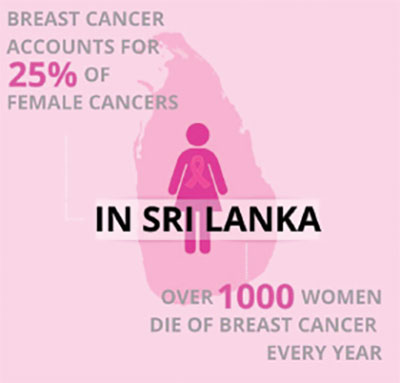
 Annually around 4,000 women in Sri Lanka diagnosed to have Breast Cancer and unfortunately a third of them succumb in a year, mainly because of the advance of the disease at the time of seeking medical advice.
The main reasons behind the reluctance of seeking medical advice are fear of losing the breast, side effects of Radiotherapy & Chemotherapy, stigma associated with breast cancer and cultural backwardness to reveal private parts of the body for edical examination.
This article focuses on the following main areas,
1. The importance of early detection
2. Diagnosis of Breast Cancer
3. Novel modalities of treatment available in Sri Lanka
Importance of early detection of Breast Cancer
A Cancer cell must divide on average 30 times before it forms a mass that can be felt in the breast. Since tumor cells multiply and divide exponentially – one cell become two, two cells become four and so on- a tumor will increase more rapidly in size the larger it is.
Longer one waits larger it gets and further away spreads from the place of origin (metastasis) leading to incurable systemic disease.
How do we detect a Breast Cancer early?
1. Self-Breast Examination
2. Screening Mammogram
3. Medical Breast Examination
Self-Breast Examination (SBE)
SBE is a simple technique to master by all females over the age of 20 to check their own breasts monthly.
Salient features of SBE are;
Regular Examination,
Fix a date convenient to remember; usually a menstruating female can perform these 7-10 days after each menstruation. Others can fix an easy date to remember, e.g. 1st of the month etc.
Repeated practice makes you master the technique, initially you may not feel much but when it is repeated monthly one become aware of the normal consistency, shape & contour of the breast so when there’s slightest change, can be discovered easily.
Privacy & Place
SBE takes 5-10 minutes, and must be done in a properly covered & secure place with a mirror.
Inspection
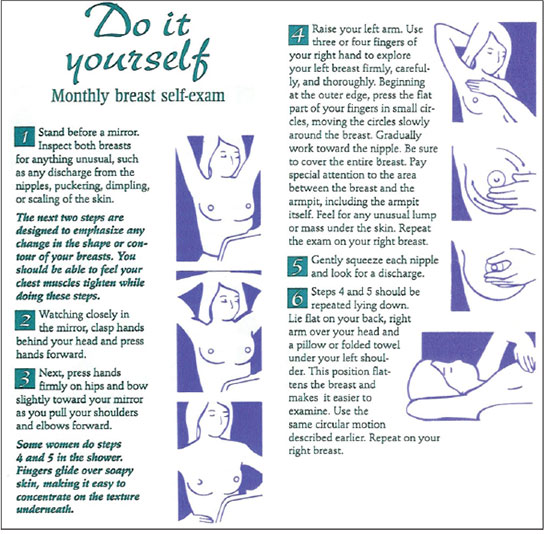
Undress the upper body and stand in front of a mirror and observe any changes of color, shape, size of breasts; inspecting by keeping arms by the side of the body, pressed at hip and raised above the head.
Palpation
This can be done standing or lying down, the left breast is examined by the right hand and vice versa. Start at the periphery of the breast and proceed in a circular manner, like a mosquito coil; at the end squeeze the nipple to see whether any discharges occur.
Once you finish with the breast feel under the armpit for any lumps.
I hope you will surf the internet to find out many educative videos on SBE to master the technique today itself.
Screening Mammogram
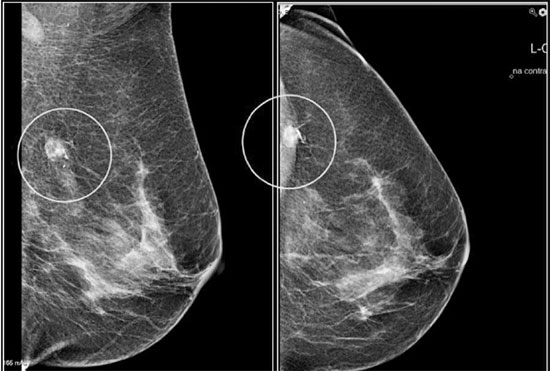
Mammogram is similar to a X-ray film but with very low radiation. It can detect cancers very early which are not felt by the hand.
‘Screening’ means it performs in healthy individuals who have a higher risk of the disease; some western countries screen their entire female population at the age of 45-years and every 3-5 yrs thereafter. In Sri Lanka there are no such guidelines but if you fall in the high risk category (Table 1) it is advisable to undergo screening mammogram periodically .Your first mammogram is considered a baseline mammogram against which all future tests will be compared to look for changes in your breast tissue.
Mammograms are not performed below the age of 35 yrs due to difficulties in interpreting when the breast tissues are dense.
Table No 1
Risk factors for Breast Cancer
Non-Modifiable risk factors
1. Advanced age
2. Family history of Breast Cancer
3. Radiation exposure
4. Family History of early Ovarian Cancer, Uterine Cancer, Colon Cancer
5. Certain inherited genes (BRCA 1, BRCA2, TP53, Atm, CDH1)
6. First pregnancy after 35yrs of Age
7. Early Menopause
8. Late Menopause
9. Nulliparity
10. Never breast fed a child
Modified Risk Factors
1. Hormone replacement therapy
2. Obesity
3. Alcohol consumption
4. Type 2 Diabetes Mellitus
5. Tobacco Use
6. Sedentary lifestyle
Even though many are not aware, risk of Breast Cancer development can be reduced on your own, see modifiable risk factors
Medical Breast Examination
This will be done by a consultant or a medical doctor to detect any abnormality or problems as well as to address any concerns arisen from the SBE.
This is more advanced than SBE as it will be performed by a trained and experienced professional who can determine features suggestive of Cancer in order to proceed with further investigations.

Diagnosis of Breast Cancer
Early detection and confirmation pave the way for early treatment. Diagnosis of Breast Cancer is achieved through three stages referred as Triple assessment.
1. Clinical Assessment
2. Radiological Assessment
3. Pathological Assessment
Clinical Assessment
This is done by a Consultant doctor. Breast examination & thorough systemic examination will be performed and findings will be graded in a scale from 1-5 (5 bears most probability of Breast Cancer)
Radiological Assessment
Mainstay of radiological assessment is by ultrasound scan (USS) and diagnostic mammogram.
Diagnostic mammogram differs by screening mammogram as it is performed in patients where breast cancer is suspected. and may take more pictures in different angles than screening mammogram.
Ultrasound scan is an outpatient procedure. Below the age of 35 yrs. when the breasts are denser, it is a safer and reliable mode. It can detect lumps, cysts (water bubbles), infections etc.
USS can reveal valuable information as an adjunct to mammogram where sensitivity of picking a lesion can be as high as 98% when both are combined.
There are other advanced tools such as CT scan and MRI which are reserved for more complex and advanced cases.
After the radiological diagnosis radiologist will scale the findings in a scale of 1-5 (5 being the most probable of cancer)
Pathological Assessment
This is the most important step of confirmation of a breast cancer, where a small piece or few cells from the lump is taken out to be examined under the microscope.
Commonly known as fine needle aspiration cytology (FNAC) is performed on an outpatient basis by inserting a small needle to the mass and taking out few cells. If the lump is not readily probable this could be done under the USS guidance.
In case a larger sample of tissues are needed for confirmation a core of tissue or part of the lump is taken out and examined under the microscope.
Again, the results of pathological assessment will be graded in a scale of 1-5 (5 being the most probable of Cancer) by the Pathologist.
Once the results of above are available another set of tests will be performed to assess the spread of the disease outside the breast. These are chest X-ray, USS Abdomen, Bone scan, CT scan, MRI Scan, PET Scan and the most appropriate of these will be selected by the clinician according to the disease & the patient.
When the results of above tests are available he/she will summon a multidisciplinary team meeting (MDTM) to decide the best treatment option for a particular patient. This will enable to tailor made the treatment for each and every individual rather to impose a set guideline for everyone. Information which needs at the MDTM are,
1. Confirmation of Cancer, its type & behavior
2. Spread to the arm pit
3. Spread to the other areas of the body
4. Proportion of cancer size compared to the breast size
5. Patient wishes and compliance
Novel modalities of treatment available in Sri Lanka
In 1894 Dr. William Stewart Halsted performed the first series of mastectomies to remove the whole diseased breast and this technique was the gold standard for the treatment of breast cancer with slight modifications until recently.
But in recent past there has been a paradigm shift of treatment modalities for the disease mainly due to the way we analyze it now.
Treatment options for Breast Cancer are subdivided as follows,
1. Treatment of Breast
2. Treatment of Armpit
3. Systemic Treatment
Treatment of the Breast
There has been a drastic change of the way we treat breast nowadays with mastectomy seldom required. Following are some approaches,
1. Wide local excision (WLE)
If the cancer is small compared to the size of the breast, it can be taken out with a clear margin of normal tissues carefully through a small incision. This will be assessed under the microscope to determine complete removal.
2. Quadrantectomy
Breast is divided arbitrarily in to four quadrants; Upper medial, Upper lateral, Lower medial & Lower lateral.
In case of a relatively large cancer which is in a quadrant can be taken out along with this entire quadrant. And the resulted defect can be filled with fat from under the armpit. (Li cap)
In some cases, it is necessary to remove more than one quadrant, in these cases resultant defect can be filled with fat & muscles taken out from the arm pit and back.
3. Skin and nipple sparing mastectomy
When the tumor is much bigger or it is in several different places, whole breast tissue is taken out leaving the skin & nipple. Obviously large defects created by this surgery can be filled with silicon prosthesis which are commercially available to restore the size & context of the breast.
4. Mastectomy and reconstruction
Still mastectomy has its ground for advanced cancer when the patients presents herself late for examination. It can now be combined with immediate, early or late breast reconstruction to restore the beauty.
Treatment of the Armpit
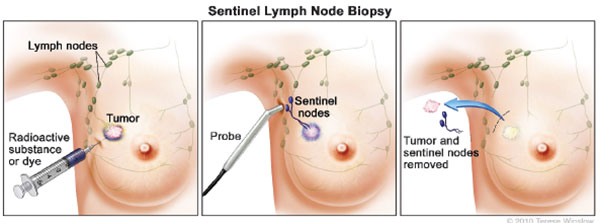
It was customy to remove all lymph nodes under the armpit along with Mastectomy as described by the Halsted, but now mainly due to the knowledge of lymph draining pathways, we perform sentinel lymph node biopsy.
When cancer cells travel from breast to armpit it goes along the lymph channel to one lymph node first, which we call as sentry or sentinel lymph node.
When we inject a dye or radioactive particle around the cancer and nipple it drains first to the sentinel lymph node which will be identified using a gamma camera and removed through a small incision to be examined under the microscope for cancer cells. If there are no Cancer cells detected rest of the lymph nodes will not be removed. Only when there is cancer present at the sentinel node rest of the lymph nodes are cleared away.
This will greatly reduce the complications and side effects associated with arm pit clearance.
Systemic Treatment
Usually, systemic treatment is advocated for patients with advanced breast cancer. There are several modalities,
1. Radiotherapy
2. Chemotherapy
3. Hormone Therapy
4. Immune Therapy
These can be given prior to the surgery, after the surgery or both to achieve maximum effect.
Take home message
Breast Cancer is completely curable without removing the breast if treated early. SBE and Screening Mammogram are crucial in picking up early cancer.



Institute of Hospitality Sri Lanka
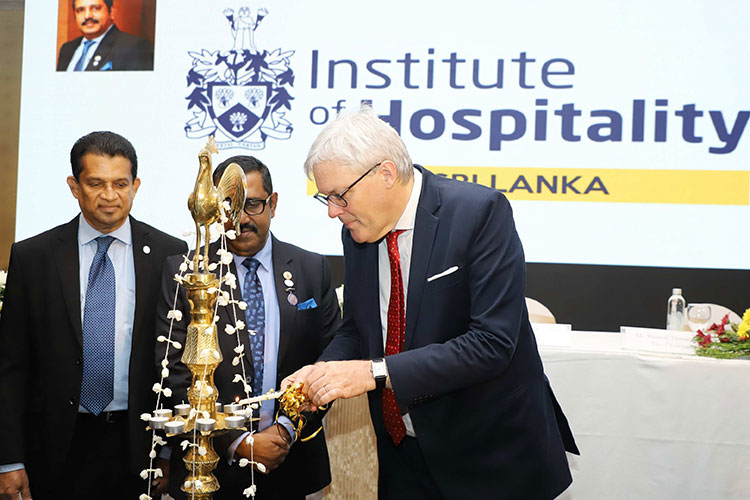
 The 32nd Annual General Meeting (AGM) of the UK-based Institute of Hospitality’s Sri Lanka Chapter was held recently at the Ramada Hotel Colombo,.The event provided an evening of camaraderie , reflection of the past and present achievements,setting new benchmarks for the future
The AGM had the presence of two distinguished guests, the Chief Guest Opposition Leader Sajith Premadasa, and the Guest of Honour British High Commissioner to Sri Lanka, Andrew Patrick. Their inspiring speeches were lauded by all hoteliers who were present at the occasion
A special thanks was extended to Robert Richardson, CEO of the Institute of Hospitality UK, along with his team, sponsors, committee members, and all attendees for making the event memorable.
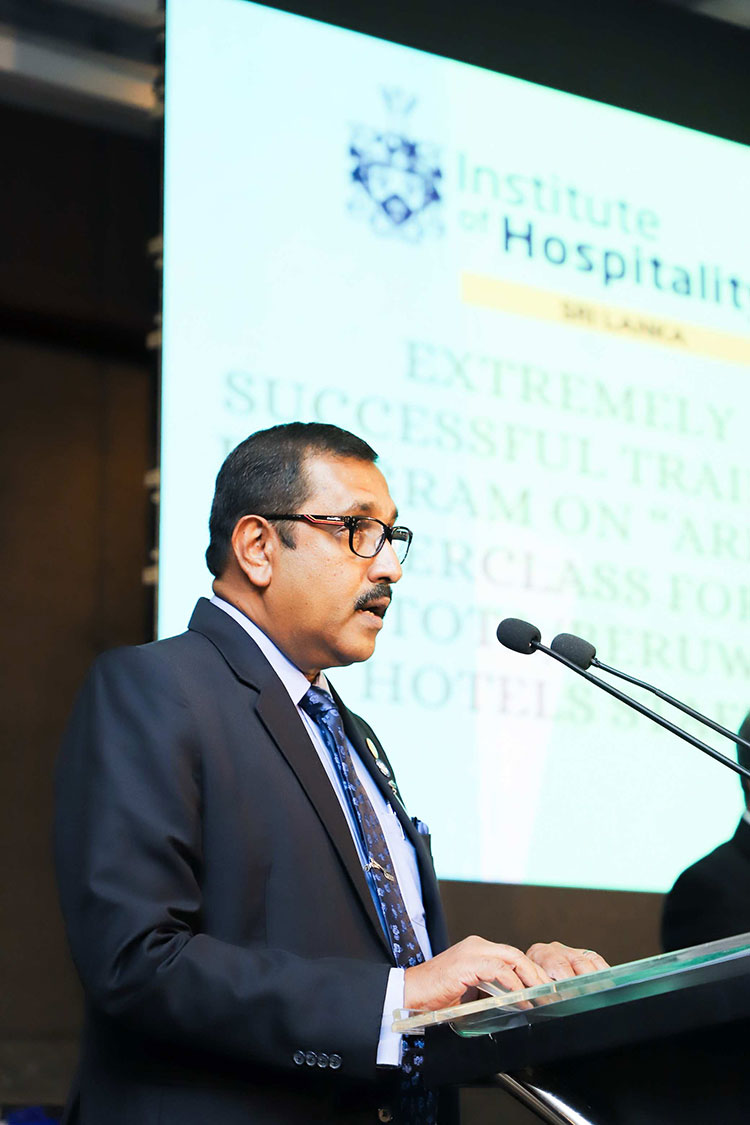
Dr. Harsha Jayasingh, Past President of the Institute of Hospitality (UK) Sri Lanka Chapter, emphasised the Institute’s longstanding history and the strength of its Sri Lankan branch. “The Institute of Hospitality (IH) UK has a history of 86 years, and we are proud to be the Sri Lanka Branch. IH Sri Lanka is much stronger now with many members from all areas of the hospitality industry,” he stated.
Dr. Jayasingh highlighted the significant role of tourism in Sri Lanka’s economy,. He said tourism it is the third-largest source of revenue for the country. “Tourism accounts for about 13.3% of total foreign exchange earnings and employs 450,000 people directly and indirectly. The hospitality industry in this island of pearl holds tremendous potential for economic growth, job creations, and cultural exchange,” he added.
He also pointed out more women should be attracted to the industry and advocated for the use of technology in hospitality sector to attract the younger generation.
The newly appointed Chairman Ramesh Dassanayake spoke about the challenges faced by the industry, including the reluctance of youth to join the sector. . Dassanayake expressed concerns over the migration of staff between hotels and the overall ‘brain drain’ in the sector. ” We must maintain high standards in the hotel We must try to attract tourists to Sri Lanka, we must have with many facilities Hence, hotel schools and other professional institutions involved in skills development mustincrease their intakes,” he pointed out.
Chief Guest Sajith Premadasa emphasised the importance of eco tourism and said “We need to have an environmental policy related to tourism in place,” . .
The 32nd AGM of the Institute of Hospitality UK, Sri Lanka Chapter, was a testament to the strength and potential of Sri Lanka’s hospitality industry. The insights and commitments shared during the event set a new benchmark for the future.(ZC)



Pix by Thushara Attapathu
Life style
He recognizes human identity beyond boundaries of gender, race, nationality and religion.

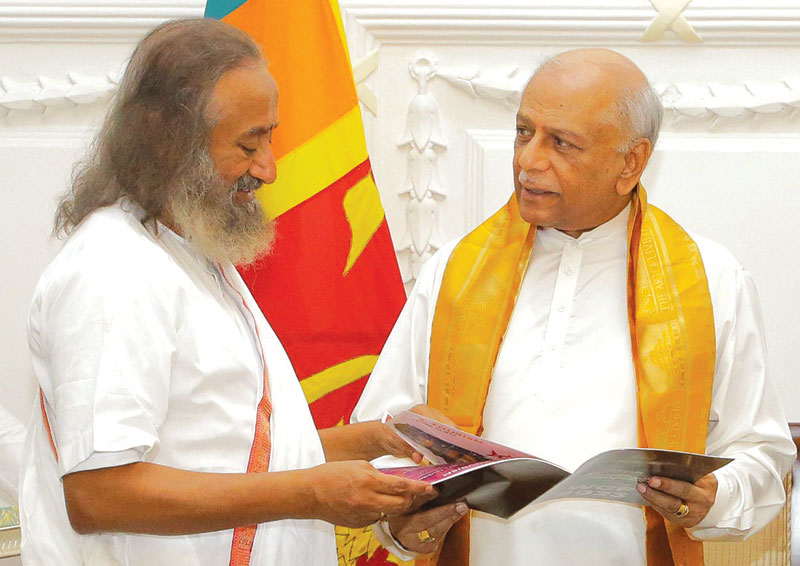
Visit of Sri Gurudev to Sri Lanka
Humanitarian, spiritual leader and Global Ambassador of Peace Gurudev Sri Sri Ravi Shankar (Sri Gurudev) was in Sri Lanka on a three day tour on the invitation of the Prime Minister of Sri Lanka Dinesh Gunewardene. Gurudev who inspired a wave of volunteerism and service to moot one of the largest volunteer-based organisations in the world – The Art of Living – visited the various projects under the aegis of the foundation and launched twelve vocational and technical centers around the island. He was accompanied by thousands of followers from Sri Lanka and around the world.
Gurudev who visited Sri Lanka for the sixth time also had a first day cover launched in honour of his visit. He is a strong proponent of spreading happiness, using the unique Sudarshan Kriya, yoga, meditation and practical wisdom to unite people, empower individuals and transform communities. His programmes provide techniques and tools to live a deeper, more joyous life, while his non-profit organisations recognize the human identity beyond the boundaries of gender, race, nationality and religion.
The Art of Living which has more than 30,000 teachers and over one million volunteers across 180 countries has touched in excess of five hundred million people around the world. CNN called it “Life Changing” and The Washington Post headlined it, “Fresh air to millions”.
In Trincomalee, Gurudev met with war victims and had a heartwarming engagement with the children from the children’s homes run by the Foundation. He also visited the Koneswara Temple in Trincomalee and graced the Kumbhabhishekam at Seetha ecogPnize the human identity beyond the boundaries of gender, race, nationality and religion. Amman temple at Nuwara Eliya. He held discussions with the trustees on the progress of the foundation’s social service projects, while also holding a special event – Ekamuthuwa – attended by a large number of dignitaries and his devotees from around the world.
His time with the Prime Minister was spent discussing the prospects of unity in diversity and uniting Sri Lanka by adding happiness into the formula of living. In addition he had discussions with the Speaker of the Parliament of Sri Lanka Mahinda Yapa Abeywardena, prominent business stewards and civil society leaders.
by Zanita Careem
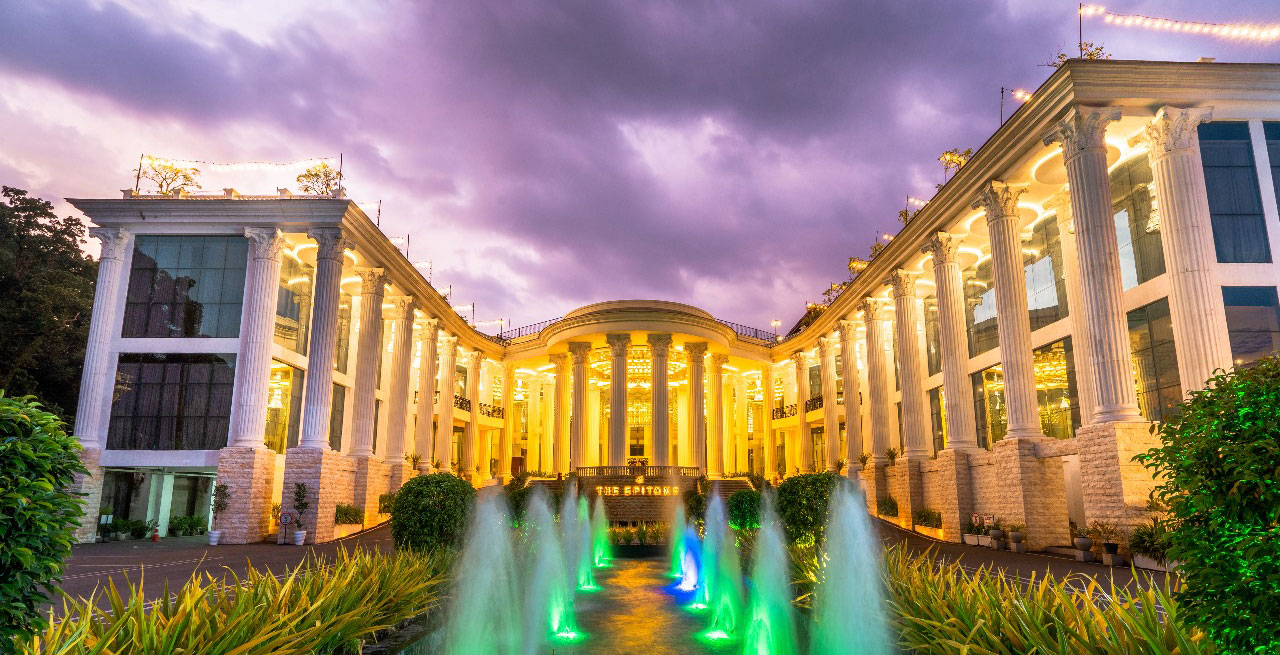
Envison your dream wedding day come to life at the Epitome Hotel, a prestigious city hotel in Kurunegala offering an unrivalled luxury rendors experience for weddings.
The venue is designed to embody opulence and luxury from all quarters for a spectacular wedding in kurunegala,Thier ballroom is the largest banquet facility in Sri Lanka It can be divided into six luxurious pillarless wedding halls on the ground floor and 25pax smaller banquet halls.
It can be easily named as a five star heaven in the heart of the city contributing to a myriad of immense experiences tailored to inspire and delight wedding experiences.
From opulent décor set up to exquisite table decor, lavish food, every detail is meticulously curated to spark your imagination and ignite creativity for a perfect wedding. The previous prestigious wedding shows season one and season two attracted large crowds
were unique events which gave the wedding vendors and potential clients had an opportunity to connect and interact with each other. Beyond being a showcase it was a chance for the wedding vendors to unite and contribute to the vibrancy of the wedding industry. The wedding show covered all area of the bridal industry providing a comprehensive variety of bridal supplies from Sri lanka and became the most popular bridal exhibitions in Kurunegala.This bridal exhibitions allowed brides and grooms to experience first hand the products and services available from suppliers in Sri Lanka
These wedding shows held at The Epitome created a benchmark and gave an opportunity for vendors to create connections to the utmost satisfaction said Harshan Lakshita Executive Director. of the magnificent Hotel
Our wedding shows featured experts and professionals in every field‘ It covered all areas of the bridal industry provided a comprehensive variety of bridal supplies from Sri lanka and became most popular bridal exhibition in this region.We are always open to everyone to join us at our wedding shows in the future. It is an opportunity to discover the incredible talent within our local wedding and bridal vendors to make meaningful relationships and plan thier special day at our breathtaking hotel The Epitome said General Manager Kavinda Caldera
The Epitome Hotel’s bridal show which will be held end of June will buzz with great ideas,advice and inspiration for all those who plan thier dream wedding
…….
The Hotel Epitome’s Wedding Season 3 will marked excellence, celebration and inspiration for those in the wedding industry. The exhibition halls will resonate with ideas on exquisite bridal wear to decor, florists , photography etc and showshowcase the rich tapestry of talent within the local wedding industry. .







US sports envoys to Lanka to champion youth development

Rahuman questions sudden cancellation of leave of CEB employees


