Features
Boys Only? No Way!

By Sumi Moonesinghe narated to Savitri Rodrigo
I was 17, one entire year younger than those allowed to get into university in Sri Lanka. But I had matured and grown up quite a lot by then and was very independent and confident. When Mrs. Wimala de Silva walked into the Thurstan College Hall triumphantly waving my university entrance letter to give me the good news, I realized that I had achieved something quite unique – broken barriers within the hallowed grounds of the Engineering Faculty.
The reason I was utterly elated with this turn of events was because I had to go through another chapter prior to this triumph, which would be daunting for any 17-year-old.
After I had applied to the Engineering Faculty at Mignonne (Lokubalasuriya’s) (maths teacher) behest, I was quite surprised to receive a letter from the office of the Dean of the Faculty of Engineering requesting me to appear for an interview. When I walked into the room, there were about 15 professors in a semi-circle in this very large room. I was quite overwhelmed. The words of Mrs. Wimala de Silva came to mind about how male-dominated the faculty was, but I steeled myself and decided that I just had to do my best.
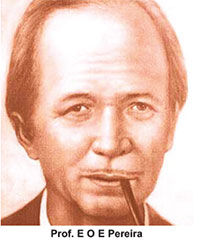

The Dean of the Faculty at the time, who founded the Faculty of Engineering at the University of Ceylon was Prof. E O E Pereira. He later became Vice Chancellor and was conferred the national honour of Vidya Jyothi for his services to education. He gained the title as the Father of Modern Engineering Education in Sri Lanka and I understand why.
Prof. Pereira observed the scene unfold before him and after a few minutes, stepped in. He announced to those at the table that a housewife’s work was far more difficult than being an engineer. The gentlemen’s faces creased with smiles and I was able to go through the interview answering more subject-oriented queries with the knowledge I had. I also recognized that Prof. Pereira’s progressive ideas were gradually filtering into the university system and was probably the door that opened for me to enter the faculty.
I began my university life in 1962 at the Faculty of Engineering of the University of Ceylon. The campus was located at Reid Avenue, Colombo 7. The University of Ceylon was established in 1942 although its roots can be traced to 1870 when the Ceylon Medical School was mooted. The University amalgamated Ceylon University College and the Medical College, with Queen Elizabeth II officially inaugurating the buildings at Peradeniya in 1954. At the latter stage of my degree, the campuses were split in two, and were known henceforth as the University of Ceylon Peradeniya and University of Ceylon Colombo.
The University of Ceylon Peradeniya was the only residential university in the country and was quite picturesque, with beautiful buildings and sprawling gardens on the banks of the Mahaweli, Sri Lanka’s longest river. It was probably modeled on the lines of Oxford and Cambridge. In 1961, the University Act amended the residential principle and subsequently, only those students who obtained higher marks could live in the halls of residence. By the time I entered the precincts of the faculty, more halls of residence had been constructed.
My batch had 104 university entrants, of whom 103 were male. I was the only female in the batch and in fact, the whole faculty had 500 boys, with just a few women students. Our lectures were from 8 am to 12 noon at the Reid Avenue campus, but practicals were held at Maradana Technical College from 1 pm to 4 pm which was a bit of trek from the campus. My uncle Tata Samaranayake, whom we fondly called Tata Bappa, would send his car each day to pick me up from Reid Avenue and drop me off in Maradana in time for lectures as we had just one hour’s break in between. I would return to my boarding house at Asoka Gardens, Colombo 5, by tram or bus. While studies were a priority during the week as evidenced by my getting a second class and a scholarship in the Part 1 exam, dancing and movies took precedence at weekends.
When the Engineering Faculty moved to its new premises in Peradeniya in 1964, I was admitted to Hilda Obeysekara Hall, the same hall my sister resided in during her university days. I remained here until my graduation in 1966. Hilda Obeysekara Hall was the only hall of residence for women with the landmark ‘Hilda Tree’ which added an aesthetic touch to the Mahaweli River flowing behind the hall.
The hall, sitting calmly at the foot of Sanghamittha Hill (so named after Buddhist nun Sanghamittha Theri, who is known for being a pioneering erudite Buddhist nun). Between Sanghamittha Theri and Lady Hilda Obeysekara, the intention of empowering women including me with education came to pass in this revered hall.
As the Engineering Faculty was quite far away from my hall of residence, I had to walk across the bridge every day for more than a mile to get to my lecture halls. While the residence hall served lunch, the distance was far too great and time consuming for me to return for lunch. So the warden arranged for my lunch to be served at Akbar Nell Hall, the residential hall for male students and one of the new halls that had been constructed, which was next to the faculty.
Once I finished my lectures, I would start the long trek back. Sometimes, I was most fortunate that a passing lecturer would offer me a lift. Most often, it would be Prof. Everard Frederick Bartholomeusz, our brilliant maths lecturer fondly nicknamed Batho, who considered me a good student, thanks to the foundation Mignonne Lokubalasuriya had provided while I was at Devi Balika.
Practical work was part of my studies and we had lots of these. I happily worked alongside my male batchmates, never deeming it necessary to ask for any concessions because I was female. On one of these practical exercises, I was conducting a survey in the hot midday sun on the Peradeniya-Gampola Road, not even wearing a hat and I vividly remember Prof. E O E Pereira passing by. He stopped his car to find out how I was doing. I said, “Fine, Professor,” and carried on with my work. He watched us work for a little while and then drove off.
Just as Prof. Pereira stepped in and gave me the opportunity to become one of the first women at the Engineering Faculty, I have been truly blessed to have the right people coming into my life and shaping my destiny, whether in my school years, university, career and even marriage. Each person has either taught me a lesson in life or guided me or shown me a path that others have not traveled, knowing that I had it in me to take the baton and run.
I went into university not only with the aim of studying hard but also to make the most of these academic years. The first year was absolute fun. I went dancing every Friday night because College House held a dance. I loved dancing and the friends I made, most of whom were from Colombo, all enjoyed dancing. My allotted partner for these dancing parties was a boy who shared Sri Lanka’s founding father’s name, D S Senanayake, who jived very well. Mano and Shanthi Rajaratnam would join me at King George’s Hall for the Medical/Engineering dances on Friday nights. We danced well into the night but since we were never given a key to our hostel, we would sheepishly knock on the door to be let in. The conservative Sri Lankan culture Always hung like the Sword of Damocles above our heads.
I nurtured some great friendships during these years. I had a good selection of friends, both girls and boys, all of whose company I enjoyed, spending a lot of time together, but always mindful that I was never to get distracted in any way. My best I friend was Philomena Perera, who was a medical student. She and I were keen on excelling in our academics and studied very hard, which also meant we got very little sleep.
But it wasn’t all study and no play. Like I mentioned, I loved the dancing parties, but I was also on the university netball and badminton teams. Pramilla Senanayake who was in the Medical Faculty was the captain of the netball team. She would eventually obtain her PhD in England and become the Assistant Director General of the International Planned Parenthood Federation networking with 150 countries. She became a renowned voice in women’s reproductive health and played a key role in eradicating smallpox in India. These were the calibre of women in the university at the time.
Led by Pramilla, our netball team would travel around the country. One of my most memorable trips was traveling to Jaffna with the team. You can imagine the height of excitement; all of us girls giggling, gossiping and generally having a great time. We stayed at Dr. Amarasingham’s quarters at the Manipay Hospital on the invitation of Arundathie Amarasingham, who was with us at university. When we told her we had to travel to Jaffna to play a match, she said, “Don’t worry, you can stay at my father’s quarters.” I’ll never forget the taste of the murunga and crab curry. It was so delicious, I can almost taste it every time I think about it.
In 1966, 1 graduated from the Engineering Faculty of the University of Ceylon Peradeniya with a Bachelor of Science Second Upper Class and as the only woman engineer in that batch!