
Business
Book industry stakeholders decry ‘further taxing of reading and learning’

By Ifham Nizam
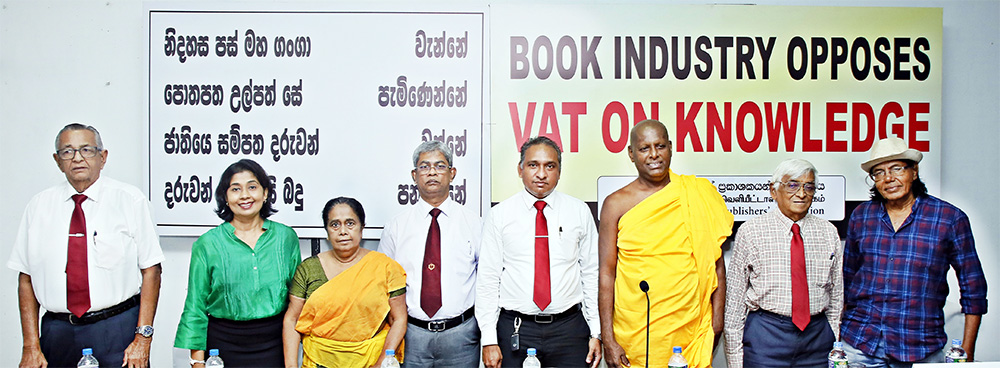
Industry associations, academics and writers expressed concern over the long-term consequences of making books more expensive for the masses. All stakeholders stressed that they would go all out to bring justice to the book lovers and the industry, at a media briefing held at the SLFI on February 2.
Accordingly, Sri Lanka’s book industry called for an immediate reversal of the decision to impose a tax of 18% on the sale of books, in terms of the recent VAT revisions.
General Secretary of the Sri Lanka Book Publishers Association (SLBPA) Dinesh Kulatunga, in response to a query by The Financial Island Review said that over the past few decades, the local book industry has diligently produced books using imported paper, plates, inks, chemicals and machinery, consistently paying all required import taxes, including VAT.
He said that the cumulative amount contributed by the industry in the form of these taxes exceeds Rs. 1 billion. This tax has been levied on book production by both the state and private sectors.
Kulatunga added: “We have never sought subsidies for these activities. However, we are now respectfully requesting the government to reconsider this decision, as the ultimate burden of this additional 18% tax will fall upon the general public, including students, as a form of a tax on reading and learning.
“We wrote to the IMF that since gaining independence in 1948, our nation has been committed to providing books at an accessible cost to students, educators, education authorities, universities, and the general public. This was made possible by the absence of taxation on books, which serve as the primary repository of knowledge across a diverse range of subjects. Books are not merely a fundamental element of human civilization; they continue to mold our comprehension of the world around us. They serve as versatile tools that enrich our lives by disseminating and safeguarding knowledge, promoting communication, nurturing creativity and serving as educational, entertainment, and cultural resources.
“In the light of these circumstances, we earnestly requested the authorities to reinstate books under the exemption from VAT. We also requested an opportunity to engage in a further discussion regarding this matter, given its profound significance to a knowledge-based economy and our society as a whole. But there was no response.
“Countries like the UK, USA, India, China, Japan, Saudi Arabia, and Brazil, do not levy VAT on books. Therefore, we do not believe that the IMF has compelled the imposition of a tax on books; it may be an inadvertent error made by our officials. We are optimistic that they will reevaluate this decision.”
Speakers representing different stakeholder groups in the book industry also charged that with the indiscriminate extension of VAT to a highly sensitive and vulnerable sector like books, Sri Lanka was also in violation of the UNESCO Florence Agreement of 1950, to which the country was an early signatory and continues to be a Contracting State.
The UNESCO Florence Agreement is a treaty that binds Contracting States not to impose customs duties and taxes on certain educational, scientific, and cultural materials that are imported.
The Sri Lanka Book Publishers Association Past President, Vijitha Yapa said: “Last year in September when the 18 per cent VAT on books was announced, we met President Ranil Wickremesinghe and discussed about exempting books from VAT. The President said that that is one of the IMF conditions.”
Yapa also said nothing had happened since then. “After lobbying and writing letters to the Finance Ministry, relevant authorities and various ministers, we were asked to write to the IMF directly and sort things out as we were given to understand that it was an IMF condition and that the authorities have no control over it.”
Yapa added: “It is an obstacle towards the expansion of knowledge in this country as people can’t afford to buy books. Any book publisher or printer with a monthly turnover of over Rs. 5 million is liable for VAT on top of all the other taxes that are imposed when importing the raw materials for printing.”
Meanwhile, Writers Organization of Lanka, Secretary Kamal Perera told The Island Financial Review that:
“If we are talking about VAT on books, I think this will strongly affect the reader and the writer. In my opinion, they should be informed about the unfairness of this tax and raise a national-level protest that the rulers could feel.
“I see it as a very futile action to submit proposals to the government. It’s a failure like playing the harp for deaf elephants. It’s now very clear that this government will never listen to the people’s voice.
“I do not see any practical solution other than building a broad public opinion demanding the immediate removal of this unjust tax.”
Sri Lanka Books Importers and Exporters Association, President, Dinushi Abeywickreme stated, “It’s not just the 18 per cent VAT that is added to the price of the book, but an overall tax of 30 per cent, inclusive of other taxes and a price hike of all raw materials following the COVID-19 pandemic and economic crisis in Sri Lanka.”


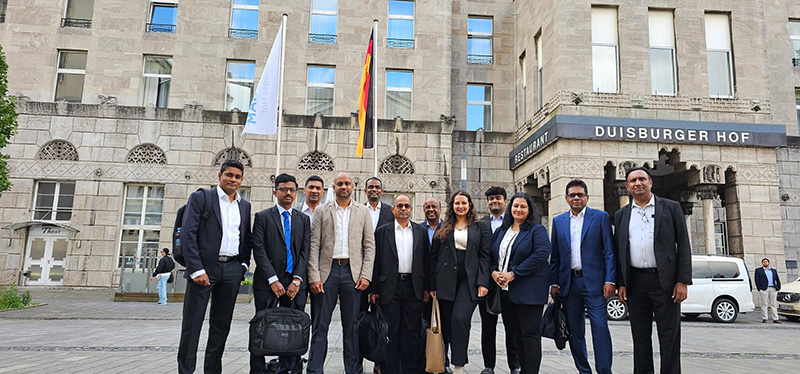
The Delegation of German Industry and Commerce in Sri Lanka (AHK Sri Lanka) proudly facilitated the first-ever Sri Lankan delegation’s participation at Drupa 2024, the world’s largest trade fair for the printing industry and technology. Held after an eight-year hiatus, Drupa 2024 was a landmark event, marking significant advancements and opportunities in the global printing industry.
AHK Sri Lanka played a pivotal role in organising and supporting the delegation, which comprised 17 members from the Sri Lanka Association for Printers (SLAP), representing eight companies from the commercial, newspaper, stationery printing, and packaging industries. This pioneering effort by AHK Sri Lanka not only showcased the diverse capabilities of Sri Lanka’s printing sector but also facilitated vital bilateral discussions with key stakeholders from the German printing industry.
Business
Unveiling Ayugiri: Browns Hotels & Resorts sets the stage for a new era in luxury Ayurveda Wellness

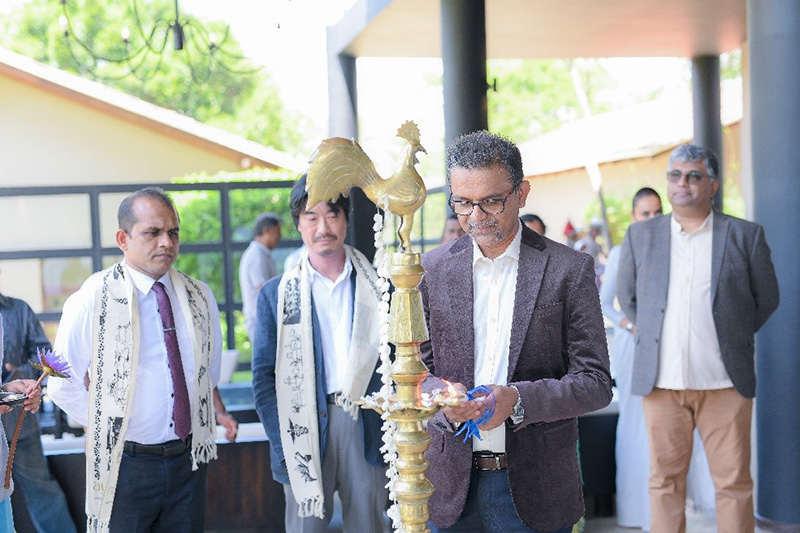
In a captivating reimagining of luxury wellness tourism, Browns Hotels & Resorts proudly unveiled the exquisite Ayugiri Ayurveda Wellness Resort Sigiriya. This momentous occasion, celebrated amidst a vibrant and serene grand opening on the 6th of June, heralds a new chapter in the Ayurveda wellness tourism landscape in Sri Lanka. Nestled amidst 54 acres of unspoiled natural splendour, Ayugiri features 22 exclusive suites and stands out as the only luxury Ayurveda wellness resort in the country offering plunge pools in every room, rendering it truly one-of-a-kind.
The grand opening of Ayugiri Ayurveda Wellness Resort was an enchanting event, where guests were captivated by the melodies of flutists and violinists resonating through Sigiriya’s lush landscapes. As traditional drummers and dancers infused the air with vibrant energy, Browns Hotels & Resorts’ CEO, Eksath Wijeratne, Kotaro Katsuki, Acting Ambassador for the Embassy of Japan and General Manager, Buwaneka Bandara, unveiled the resort’s new logo, marking a significant moment witnessed by distinguished guests from the French Embassy, Ayurveda and wellness enthusiasts along with officials from the Sigiriya area, LOLC Holdings and Browns Group.
“Our strategic expansion into wellness tourism with Ayugiri Ayurveda Wellness Resort Sigiriya symbolises a significant milestone for Browns Hotels & Resorts. Wellness tourism has consistently outperformed the overall tourism industry for over a decade, reflecting a growing global interest in travel that goes beyond leisure to offer rejuvenation and holistic well-being. By integrating the timeless wisdom of Ayurveda with modern luxury, we aim to set a new standard in luxury wellness tourism in Sri Lanka. Whether your goal is prevention, healing, or a deeper connection to inner harmony, Ayugiri offers a sanctuary for holistic well-being” stated Eksath Wijeratne.
Ayugiri encapsulates the essence of life, inspired by the lotus flower held by the graceful queens of the infamous Sigiriya frescoes. Just as the lotus emerges from the murky depths, untainted and serene,
Ayugiri invites guests on a journey of purity and rejuvenation, harmonised with a balance of mind, body and spirit, the essence of nature, echoes of culture and the wisdom of ancient Ayurvedic healing.

HNB General Insurance, one of Sri Lanka’s leading general insurance providers, has been honored as the Best General Bancassurance Provider in Sri Lanka 2024 by the prestigious Global Banking and Finance Review – UK.
The esteemed accolade underscores HNB General Insurance’s unwavering commitment to excellence and its outstanding performance in the field of bancassurance. Through dedication and hard work, the HNB General Insurance team has continuously endeavored to deliver innovative insurance solutions, cultivate strong relationships with banking partners, and provide unparalleled service to customers nationwide. This recognition is a testament to the team’s dedication and relentless pursuit of excellence in the bancassurance business.
“We are honored to receive this prestigious award, which reflects our team’s tireless efforts and dedication to delivering value-added insurance solutions and exceptional service through our bancassurance partnerships,” said Sithumina Jayasundara, CEO of HNB General Insurance. “This recognition reaffirms our position as a trusted insurance provider in Sri Lanka and motivates us to continue striving for excellence in serving our customers and communities.”



US sports envoys to Lanka to champion youth development

Rahuman questions sudden cancellation of leave of CEB employees


