Features
Black artistes hit figurative wall of racism

Ma Rainey’s Black Bottom
By Tharishi Hewavithanagamage
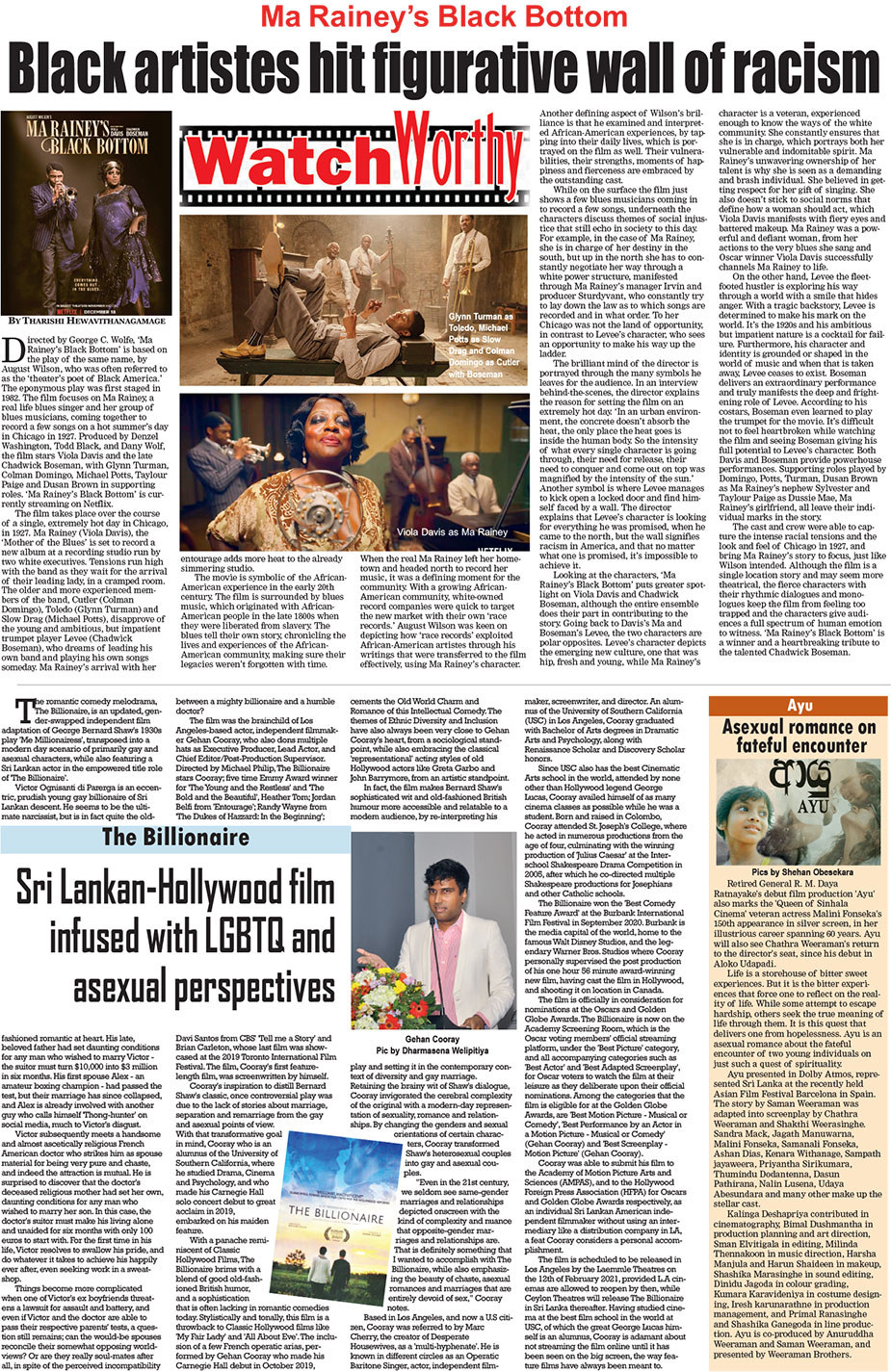
Directed by George C. Wolfe, ‘Ma Rainey’s Black Bottom’ is based on the play of the same name, by August Wilson, who was often referred to as the ‘theater’s poet of Black America.’ The eponymous play was first staged in 1982. The film focuses on Ma Rainey, a real life blues singer and her group of blues musicians, coming together to record a few songs on a hot summer’s day in Chicago in 1927. Produced by Denzel Washington, Todd Black, and Dany Wolf, the film stars Viola Davis and the late Chadwick Boseman, with Glynn Turman, Colman Domingo, Michael Potts, Taylour Paige and Dusan Brown in supporting roles. ‘Ma Rainey’s Black Bottom’ is currently streaming on Netflix.
The film takes place over the course of a single, extremely hot day in Chicago, in 1927. Ma Rainey (Viola Davis), the ‘Mother of the Blues’ is set to record a new album at a recording studio run by two white executives. Tensions run high with the band as they wait for the arrival of their leading lady, in a cramped room. The older and more experienced members of the band, Cutler (Colman Domingo), Toledo (Glynn Turman) and Slow Drag (Michael Potts), disapprove of the young and ambitious, but impatient trumpet player Levee (Chadwick Boseman), who dreams of leading his own band and playing his own songs someday. Ma Rainey’s arrival with her entourage adds more heat to the already simmering studio.
The movie is symbolic of the African-American experience in the early 20th century. The film is surrounded by blues music, which originated with African-American people in the late 1800s when they were liberated from slavery. The blues tell their own story, chronicling the lives and experiences of the African-American community, making sure their legacies weren’t forgotten with time. When the real Ma Rainey left her hometown and headed north to record her music, it was a defining moment for the community. With a growing African-American community, white-owned record companies were quick to target the new market with their own ‘race records.’ August Wilson was keen on depicting how ‘race records’ exploited African-American artistes through his writings that were transferred to the film effectively, using Ma Rainey’s character. Another defining aspect of Wilson’s brilliance is that he examined and interpreted African-American experiences, by tapping into their daily lives, which is portrayed on the film as well. Their vulnerabilities, their strengths, moments of happiness and fierceness are embraced by the outstanding cast.
While on the surface the film just shows a few blues musicians coming in to record a few songs, underneath the characters discuss themes of social injustice that still echo in society to this day. For example, in the case of Ma Rainey, she is in charge of her destiny in the south, but up in the north she has to constantly negotiate her way through a white power structure, manifested through Ma Rainey’s manager Irvin and producer Sturdyvant, who constantly try to lay down the law as to which songs are recorded and in what order. To her Chicago was not the land of opportunity, in contrast to Levee’s character, who sees an opportunity to make his way up the ladder.
The brilliant mind of the director is portrayed through the many symbols he leaves for the audience. In an interview behind-the-scenes, the director explains the reason for setting the film on an extremely hot day. ‘In an urban environment, the concrete doesn’t absorb the heat, the only place the heat goes is inside the human body. So the intensity of what every single character is going through, their need for release, their need to conquer and come out on top was magnified by the intensity of the sun.’ Another symbol is where Levee manages to kick open a locked door and find himself faced by a wall. The director explains that Levee’s character is looking for everything he was promised, when he came to the north, but the wall signifies racism in America, and that no matter what one is promised, it’s impossible to achieve it.
Looking at the characters, ‘Ma Rainey’s Black Bottom’ puts greater spotlight on Viola Davis and Chadwick Boseman, although the entire ensemble does their part in contributing to the story. Going back to Davis’s Ma and Boseman’s Levee, the two characters are polar opposites. Levee’s character depicts the emerging new culture, one that was hip, fresh and young, while Ma Rainey’s character is a veteran, experienced enough to know the ways of the white community. She constantly ensures that she is in charge, which portrays both her vulnerable and indomitable spirit. Ma Rainey’s unwavering ownership of her talent is why she is seen as a demanding and brash individual. She believed in getting respect for her gift of singing. She also doesn’t stick to social norms that define how a woman should act, which Viola Davis manifests with fiery eyes and battered makeup. Ma Rainey was a powerful and defiant woman, from her actions to the very blues she sang and Oscar winner Viola Davis successfully channels Ma Rainey to life.
On the other hand, Levee the fleet-footed hustler is exploring his way through a world with a smile that hides anger. With a tragic backstory, Levee is determined to make his mark on the world. It’s the 1920s and his ambitious but impatient nature is a cocktail for failure. Furthermore, his character and identity is grounded or shaped in the world of music and when that is taken away, Levee ceases to exist. Boseman delivers an extraordinary performance and truly manifests the deep and frightening role of Levee. According to his costars, Boseman even learned to play the trumpet for the movie. It’s difficult not to feel heartbroken while watching the film and seeing Boseman giving his full potential to Levee’s character. Both Davis and Boseman provide powerhouse performances. Supporting roles played by Domingo, Potts, Turman, Dusan Brown as Ma Rainey’s nephew Sylvester and Taylour Paige as Dussie Mae, Ma Rainey’s girlfriend, all leave their individual marks in the story.
The cast and crew were able to capture the intense racial tensions and the look and feel of Chicago in 1927, and bring Ma Rainey’s story to focus, just like Wilson intended. Although the film is a single location story and may seem more theatrical, the fierce characters with their rhythmic dialogues and monologues keep the film from feeling too trapped and the characters give audiences a full spectrum of human emotion to witness. ‘Ma Rainey’s Black Bottom’ is a winner and a heartbreaking tribute to the talented Chadwick Boseman.