
Sat Mag
Between romance and revolution: Nanda Malini and Politics of Pavana

By Uditha Devapriya
Nanda Malini has a great deal to do with my being a Sri Lankan. How could one grow up here and not hear that voice? Nearly every radio station plays it every hour or so; unless you turn the radio off, you can’t escape her. Even then her voice creeps up somewhere. Ever ubiquitous, she makes herself heard in the most unpredictable moments.
As with Victor Ratnayake, everything she has sung has become so embedded in our collective consciousness that we can’t ignore it. This has mostly been on account of how she has brought two diametrically opposed themes, love and politics, together. If it’s hard to talk about either without remembering a line from her songs, it’s because she’s made the transition from love to revolution so seamlessly that there’s really no other artiste from here who can compare. Such an achievement should not be belittled: in the history of the Sinhala song, I find it difficult to think of a singer who’s engaged with the worldly and the political as much as Malini did.
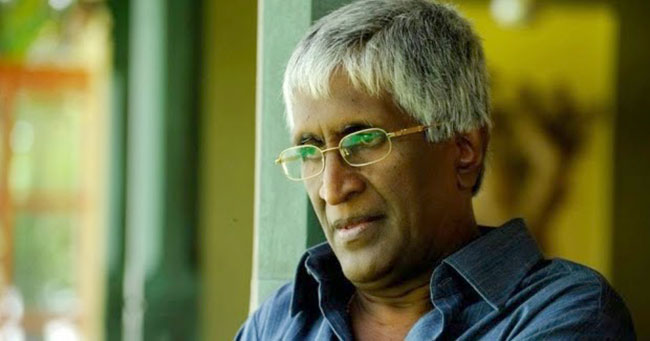
When reflecting on Nanda Malini’s political forays in the 1970s, it’s impossible not to mention Sunil Ariyaratne. Most of Malini’s politically assertive songs were penned by Ariyaratne. He was her principal lyricist in Pavana, the most politically explicit of her albums. His involvement with her career of course preceded Pavana: their first collaboration was perhaps Sakura Mal Pipila, a song which was banned by authorities for its perceived anti-establishment content. Malini’s and Ariyaratne’s political interventions hence predate Pavana, even if we primarily focus on the latter when writing on those interventions. In that sense their first political album was Sathyaye Geethaya, which is not unabashedly political in the way her later work would be. Yet in this, as in their later work, Ariyaratne served as her kivindune.
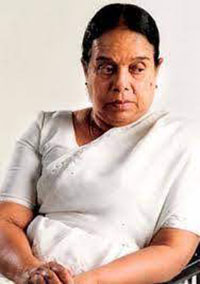
It’s hard to sum up Pavana’s impact without having lived through the times in which it first came out. For my parents’ generation, it represented a diversion and an aberration on the part of their favourite woman singer. For the more radicalised, it represented the fulfilment of their hopes: a songstress who captured their angst in ways no other vocalist – barring one, who I will get to later in this essay – had. In works like this it’s obviously futile to 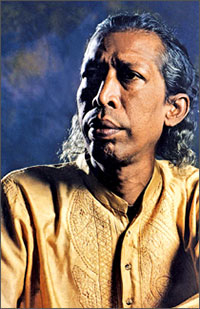 separate the singer from the poet: what part was Malini’s, what part Ariyaratne’s? But despite the spirit of collaboration that enlivened it, Pavana remained a distinctly Nanda Malini product. The lyrics did not become peripheral or take a backseat; far from it. Yet for much of the country, the face of the performer became more important than the name of her versifier.
What I am saying, essentially, is that Pavana would not have worked with another singer. In saying this, of course, I am by no means suggesting that there were no other radical artists and writers in the country then. Yet far more than her contemporaries, Malini epitomised the times she was in and of. Donning a white sari wholly at odds with the politics she espoused, she cut an incongruous figure: a woman who had sung of romance, now singing of revolution. The turnaround was sharp and definite: she would have nothing to do with the romanticism of her early years. Like Gunadasa Amarasekara critiquing the influence of the Peradeniya School on his novels in Aliya Saha Andayo, she emerged a different person. In Amarasekara’s case, the self-critique turned him to the politics of nationalism; in Malini’s case, it turned her to the spirit of politics. It naturally goes without saying then that in post-1980 Sri Lanka, these two epitomised the confluence of art and politics far more than anyone else did, or could.
That has as much to do with the artiste as it does with the album. Pavana was unprecedented and unique: nothing prepared audiences for it, and nothing followed from it. What stood out in it? Why made it so unique? Why did it peter out after a while?
Pavana became so unique on account of Nanda Malini’s voice. Sardonic and acerbic, that voice had a way of striking you. Even in her earlier phase, when she sang of love, she laced her sense of wonderment with a veneer of raw candour; hearing Sari Podiththak now, for instance, I am intrigued by how the verses veer between the natural simplicity of the theme and the layers of meaning the vocalist infuses into it. The song centres on a family trying to marry their daughter off and the travails of finding a suitable groom. Yet, from the narrator’s perspective, the whole process of visiting one suitor to another comes off as tumultuous, hilarious: worthier of parody than of the hallowed respect marriage commands in traditional Sinhala society. It is this kind of sardonic joi de vivre which animates Sakura Mal Pipila: sakura flowers blooming in the open, the sun up at night, the sky falling down, and lions transforming into winged beasts. She revels in chaos, in disarray, thereby flaunting her rebelliousness against convention.
What interest me most in Pavana are the songs with which she seems to summon this phase in her career. In these songs, she doesn’t so much turn to and embrace radicalism as she rejects, ridicules, and flouts convention. Malini’s voice is so distinct here because you are never sure whether she’s being sincere or sarcastic, whether she’s presenting things as they seem or laying bare the hypocrisy and reality lingering beneath the surface; it takes a second reading of these lyrics to discern the irony underscoring them. There are very few songs in Pavana which project this irony, but the few that do (like Upasakamma) are the ones that stand out.
These songs should be contrasted with those of that other great, radicalised artiste of her time, Gunadasa Kapuge. The two were contemporaries; both adroitly used music to articulate their respective politics. And yet, striking as the comparison may seem, there is less a similarity than a difference between their output. The point of Nanda Malini’s politics, at least in Pavana, was to direct the seeing anger of a dominated milieu against a dominating class. There is anger and sadness, but they are cloaked by a joyous defiance. Indeed, barring a song or two, she does not bother revealing the falsities of tradition. She lets out her feelings, but there is a sense of bitter candour in the lyrics that refuses to reflect on false impressions. In Pavana, then, far more than in any other political songs, the lyrics let the polemical win over the poetic.
 Even at his most assertive, Kapuge did not take this route. There is, in “Sudu Nanda”, “Ahasa Usata”, and “Uthuru Kone”, an attempt at retaining the poetry in the polemic. These are not really songs of love; “Sudu Nenda” is, but what strikes one in that song is not the lover’s lament, but the class difference between the narrator and his lover that feeds his lament. In “Ahasa Usata” the narrator is almost bemused at how those who work on big construction projects go higher than anyone else; just not in their class position. “Uthuru Kone” is different from Malini’s “Mongoliyanuwane”, in that unlike the latter it does not resort to the rhetoric of war. Malini’s (and Ariyaratne’s) aim in “Mongoliyanuwane”, “Budun Daham”, and “Mugurak Awasi Thana Mugurak”, hence, is to raise the battle cry. More often than not they give into an insularity of vision; in “Budun Daham”, for instance, the cosmopolitanism of their worldview – their vision for the country – is contradicted by an almost bigoted rage at the nation of “hota bariyo“, India. This is a contradiction Kapuge never had to work with, nor resolve.
Insofar as these constitute a critique of Pavana, the critique can help us understand why Pavana failed to sustain momentum after its peak at the height of the bheeshanaya. I don’t necessarily agree with Malinda Seneviratne’s view that it was the political explicitness of these songs which limited their appeal. To say that is to say that “La Marseillaise” is pertinent to only 1792, or that “The International” is pertinent to only the late 19th century. Talking with Malinda many years ago, Malini disagreed with such an assertion, and argued that tethered to its period as it would have been, the issues which Pavana spoke about were “still valid.” I agree: hardly anyone who has listened to “Yadamin Banda”, “Seethala Polawa”, or “Avurudu Dedahas Panseeya Wasarak” will find it difficult to transpose their themes to a contemporary context.
The more valid critique, or criticism, of Pavana is that the lyrics of these songs do not match up to the subtlety which once animated Malini’s (and Ariyaratne’s) collaborations. When I listen to “Perahera Enawa”, I discern an almost delicious joi de vivre at work, a musical sensibility tearing to pieces the falseness of surfaces: Malini first outlines the hallowed pomp and pageantry of a perahera before revealing its underside. Pavana doesn’t contain this sensibility. It may be that the directness of its subject matter made the songstress and kavidune prefer the explicit to the ironic. But we have the example of Kapuge’s work to remind us that political objets d’art do not necessarily have to compromise on subtlety to gain in power and strength. Perhaps due to this, the politics in Pavana comes off as crass, divisive, hardly life-affirming; by comparison the songs in Sathyaye Geethaya feel more subtle, more open-ended, and much less divisive.
It is no doubt both a confirmation of this critique and a tribute to the singer, her lyricist, and the album that Pavana was never followed by a comparable endeavour. In the 35 years or so that have passed since it debuted, Pavana continues to stand as the most politically explicit musical work Sri Lanka has ever produced; in its blend of popular and folk music, of baila and poetry, it gave the radicalised an antidote to their grievances. The government of the day saw it fit to not just ban Pavana cassettes, but also arrest anyone caught possessing them. It is a testament to its enduring popularity and also its limited appeal that there has never been a Pavana since it dissipated in the years following the bheeshanaya. Kapuge did come close, with Kampana. But Kapuge’s sensibility was qualitatively different. In the great pantheon of vocalists and lyricists, Nanda Malini and Sunil Ariyaratne thus continue to occupy high places.
The writer can be reached at udakdev1@gmail.com




By Eng. Thushara Dissanayake
The primitive man lived in caves to get shelter from the weather. With the progression of human civilization, people wanted more sophisticated buildings to fulfill many other needs and were able to accomplish them with the help of advanced technologies. Security, privacy, storage, and living with comfort are the common requirements people expect today from residential buildings. In addition, different types of buildings are designed and constructed as public, commercial, industrial, and even cultural or religious with many advanced features and facilities to suit different requirements.
We are facing many environmental challenges today. The most severe of those is global warming which results in many negative impacts, like floods, droughts, strong winds, heatwaves, and sea level rise due to the melting of glaciers. We are experiencing many of those in addition to some local issues like environmental pollution. According to estimates buildings account for nearly 40% of all greenhouse gas emissions. In light of these issues, we have two options; we change or wait till the change comes to us. Waiting till the change come to us means that we do not care about our environment and as a result we would have to face disastrous consequences. Then how can we change in terms of building construction?
Before the green concept and green building practices come into play majority of buildings in Sri Lanka were designed and constructed just focusing on their intended functional requirements. Hence, it was much likely that the whole process of design, construction, and operation could have gone against nature unless done following specific regulations that would minimize negative environmental effects.
We can no longer proceed with the way we design our buildings which consumes a huge amount of material and non-renewable energy. We are very concerned about the food we eat and the things we consume. But we are not worrying about what is a building made of. If buildings are to become a part of our environment we have to design, build and operate them based on the same principles that govern the natural world. Eventually, it is not about the existence of the buildings, it is about us. In other words, our buildings should be a part of our natural environment.
The living building challenge is a remarkable design philosophy developed by American architect Jason F. McLennan the founder of the International Living Future Institute (ILFI). The International Living Future Institute is an environmental NGO committed to catalyzing the transformation toward communities that are socially just, culturally rich, and ecologically restorative. Accordingly, a living building must meet seven strict requirements, rather certifications, which are called the seven “petals” of the living building. They are Place, Water, Energy, Equity, Materials, Beauty, and Health & Happiness. Presently there are about 390 projects around the world that are being implemented according to Living Building certification guidelines. Let us see what these seven petals are.
Place
This is mainly about using the location wisely. Ample space is allocated to grow food. The location is easily accessible for pedestrians and those who use bicycles. The building maintains a healthy relationship with nature. The objective is to move away from commercial developments to eco-friendly developments where people can interact with nature.
Water
It is recommended to use potable water wisely, and manage stormwater and drainage. Hence, all the water needs are captured from precipitation or within the same system, where grey and black waters are purified on-site and reused.
Energy
Living buildings are energy efficient and produce renewable energy. They operate in a pollution-free manner without carbon emissions. They rely only on solar energy or any other renewable energy and hence there will be no energy bills.
Equity
What if a building can adhere to social values like equity and inclusiveness benefiting a wider community? Yes indeed, living buildings serve that end as well. The property blocks neither fresh air nor sunlight to other adjacent properties. In addition, the building does not block any natural water path and emits nothing harmful to its neighbors. On the human scale, the equity petal recognizes that developments should foster an equitable community regardless of an individual’s background, age, class, race, gender, or sexual orientation.
Materials
Materials are used without harming their sustainability. They are non-toxic and waste is minimized during the construction process. The hazardous materials traditionally used in building components like asbestos, PVC, cadmium, lead, mercury, and many others are avoided. In general, the living buildings will not consist of materials that could negatively impact human or ecological health.
Beauty
Our physical environments are not that friendly to us and sometimes seem to be inhumane. In contrast, a living building is biophilic (inspired by nature) with aesthetical designs that beautify the surrounding neighborhood. The beauty of nature is used to motivate people to protect and care for our environment by connecting people and nature.
Health & Happiness
The building has a good indoor and outdoor connection. It promotes the occupants’ physical and psychological health while causing no harm to the health issues of its neighbors. It consists of inviting stairways and is equipped with operable windows that provide ample natural daylight and ventilation. Indoor air quality is maintained at a satisfactory level and kitchen, bathrooms, and janitorial areas are provided with exhaust systems. Further, mechanisms placed in entrances prevent any materials carried inside from shoes.
The Bullitt Center building
Bullitt Center located in the middle of Seattle in the USA, is renowned as the world’s greenest commercial building and the first office building to earn Living Building certification. It is a six-story building with an area of 50,000 square feet. The area existed as a forest before the city was built. Hence, the Bullitt Center building has been designed to mimic the functions of a forest.
The energy needs of the building are purely powered by the solar system on the rooftop. Even though Seattle is relatively a cloudy city the Bullitt Center has been able to produce more energy than it needed becoming one of the “net positive” solar energy buildings in the world. The important point is that if a building is energy efficient only the area of the roof is sufficient to generate solar power to meet its energy requirement.
It is equipped with an automated window system that is able to control the inside temperature according to external weather conditions. In addition, a geothermal heat exchange system is available as the source of heating and cooling for the building. Heat pumps convey heat stored in the ground to warm the building in the winter. Similarly, heat from the building is conveyed into the ground during the summer.
The potable water needs of the building are achieved by treating rainwater. The grey water produced from the building is treated and re-used to feed rooftop gardens on the third floor. The black water doesn’t need a sewer connection as it is treated to a desirable level and sent to a nearby wetland while human biosolid is diverted to a composting system. Further, nearly two third of the rainwater collected from the roof is fed into the groundwater and the process resembles the hydrologic function of a forest.
It is encouraging to see that most of our large-scale buildings are designed and constructed incorporating green building concepts, which are mainly based on environmental sustainability. The living building challenge can be considered an extension of the green building concept. Amanda Sturgeon, the former CEO of the ILFI, has this to say in this regard. “Before we start a project trying to cram in every sustainable solution, why not take a step outside and just ask the question; what would nature do”?

By Uditha Devapriya
On June 7, 1964, the Central Committee of the Lanka Sama Samaja Party convened a special conference at which three resolutions were presented. The first, moved by N. M. Perera, called for a coalition with the SLFP, inclusive of any ministerial portfolios. The second, led by the likes of Colvin R. de Silva, Leslie Goonewardena, and Bernard Soysa, advocated a line of critical support for the SLFP, but without entering into a coalition. The third, supported by the likes of Edmund Samarakkody and Bala Tampoe, rejected any form of compromise with the SLFP and argued that the LSSP should remain an independent party.
The conference was held a year after three parties – the LSSP, the Communist Party, and Philip Gunawardena’s Mahajana Eksath Peramuna – had founded a United Left Front. The ULF’s formation came in the wake of a spate of strikes against the Sirimavo Bandaranaike government. The previous year, the Ceylon Transport Board had waged a 17-day strike, and the harbour unions a 60-day strike. In 1963 a group of working-class organisations, calling itself the Joint Committee of Trade Unions, began mobilising itself. It soon came up with a common programme, and presented a list of 21 radical demands.
In response to these demands, Bandaranaike eventually supported a coalition arrangement with the left. In this she was opposed, not merely by the right-wing of her party, led by C. P. de Silva, but also those in left parties opposed to such an agreement, including Bala Tampoe and Edmund Samarakkody. Until then these parties had never seen the SLFP as a force to reckon with: Leslie Goonewardena, for instance, had characterised it as “a Centre Party with a programme of moderate reforms”, while Colvin R. de Silva had described it as “capitalist”, no different to the UNP and by default as bourgeois as the latter.
The LSSP’s decision to partner with the government had a great deal to do with its changing opinions about the SLFP. This, in turn, was influenced by developments abroad. In 1944, the Fourth International, which the LSSP had affiliated itself with in 1940 following its split with the Stalinist faction, appointed Michel Pablo as its International Secretary. After the end of the war, Pablo oversaw a shift in the Fourth International’s attitude to the Soviet states in Eastern Europe. More controversially, he began advocating a strategy of cooperation with mass organisations, regardless of their working-class or radical credentials.
Pablo argued that from an objective perspective, tensions between the US and the Soviet Union would lead to a “global civil war”, in which the Soviet Union would serve as a midwife for world socialist revolution. In such a situation the Fourth International would have to take sides. Here he advocated a strategy of entryism vis-à-vis Stalinist parties: since the conflict was between Stalinist and capitalist regimes, he reasoned, it made sense to see the former as allies. Such a strategy would, in his opinion, lead to “integration” into a mass movement, enabling the latter to rise to the level of a revolutionary movement.

Though controversial, Pablo’s line is best seen in the context of his times. The resurgence of capitalism after the war, and the boom in commodity prices, had a profound impact on the course of socialist politics in the Third World. The stunted nature of the bourgeoisie in these societies had forced left parties to look for alternatives. For a while, Trotsky had been their guide: in colonial and semi-colonial societies, he had noted, only the working class could be expected to see through a revolution. This entailed the establishment of workers’ states, but only those arising from a proletarian revolution: a proposition which, logically, excluded any compromise with non-radical “alternatives” to the bourgeoisie.
To be sure, the Pabloites did not waver in their support for workers’ states. However, they questioned whether such states could arise only from a proletarian revolution. For obvious reasons, their reasoning had great relevance for Trotskyite parties in the Third World. The LSSP’s response to them showed this well: while rejecting any alliance with Stalinist parties, the LSSP sympathised with the Pabloites’ advocacy of entryism, which involved a strategic orientation towards “reformist politics.” For the world’s oldest Trotskyite party, then going through a series of convulsions, ruptures, and splits, the prospect of entering the reformist path without abandoning its radical roots proved to be welcoming.
Writing in the left-wing journal Community in 1962, Hector Abhayavardhana noted some of the key concerns that the party had tried to resolve upon its formation. Abhayavardhana traced the LSSP’s origins to three developments: international communism, the freedom struggle in India, and local imperatives. The latter had dictated the LSSP’s manifesto in 1936, which included such demands as free school books and the use of Sinhala and Tamil in the law courts. Abhayavardhana suggested, correctly, that once these imperatives changed, so would the party’s focus, though within a revolutionary framework. These changes would be contingent on two important factors: the establishment of universal franchise in 1931, and the transfer of power to the local bourgeoisie in 1948.
Paradoxical as it may seem, the LSSP had entered the arena of radical politics through the ballot box. While leading the struggle outside parliament, it waged a struggle inside it also. This dual strategy collapsed when the colonial government proscribed the party and the D. S. Senanayake government disenfranchised plantation Tamils. Suffering two defeats in a row, the LSSP was forced to think of alternatives. That meant rethinking categories such as class, and grounding them in the concrete realities of the country.
This was more or less informed by the irrelevance of classical and orthodox Marxian analysis to the situation in Sri Lanka, specifically to its rural society: with a “vast amorphous mass of village inhabitants”, Abhayavardhana observed, there was no real basis in the country for a struggle “between rich owners and the rural poor.” To complicate matters further, reforms like the franchise and free education, which had aimed at the emancipation of the poor, had in fact driven them away from “revolutionary inclinations.” The result was the flowering of a powerful rural middle-class, which the LSSP, to its discomfort, found it could not mobilise as much as it had the urban workers and plantation Tamils.
Where else could the left turn to? The obvious answer was the rural peasantry. But the rural peasantry was in itself incapable of revolution, as Hector Abhayavardhana has noted only too clearly. While opposing the UNP’s Westernised veneer, it did not necessarily oppose the UNP’s overtures to Sinhalese nationalism. As historians like K. M. de Silva have observed, the leaders of the UNP did not see their Westernised ethos as an impediment to obtaining support from the rural masses. That, in part at least, was what motivated the Senanayake government to deprive Indian estate workers of their most fundamental rights, despite the existence of pro-minority legal safeguards in the Soulbury Constitution.
To say this is not to overlook the unique character of the Sri Lankan rural peasantry and petty bourgeoisie. Orthodox Marxists, not unjustifiably, characterise the latter as socially and politically conservative, tilting more often than not to the right. In Sri Lanka, this has frequently been the case: they voted for the UNP in 1948 and 1952, and voted en masse against the SLFP in 1977. Yet during these years they also tilted to the left, if not the centre-left: it was the petty bourgeoisie, after all, which rallied around the SLFP, and supported its more important reforms, such as the nationalisation of transport services.
One must, of course, be wary of pasting the radical tag on these measures and the classes that ostensibly stood for them. But if the Trotskyite critique of the bourgeoisie – that they were incapable of reform, even less revolution – holds valid, which it does, then the left in the former colonies of the Third World had no alternative but to look elsewhere and to be, as Abhayavardhana noted, “practical men” with regard to electoral politics. The limits within which they had to work in Sri Lanka meant that, in the face of changing dynamics, especially among the country’s middle-classes, they had to change their tactics too.
Meanwhile, in 1953, the Trotskyite critique of Pabloism culminated with the publication of an Open Letter by James Cannon, of the US Socialist Workers’ Party. Cannon criticised the Pabloite line, arguing that it advocated a policy of “complete submission.” The publication of the letter led to the withdrawal of the International Committee of the Fourth International from the International Secretariat. The latter, led by Pablo, continued to influence socialist parties in the Third World, advocating temporary alliances with petty bourgeois and centrist formations in the guise of opposing capitalist governments.
For the LSSP, this was a much-needed opening. Even as late as 1954, three years after S. W. R. D. Bandaranaike formed the SLFP, the LSSP continued to characterise the latter as the alternative bourgeois party in Ceylon. Yet this did not deter it from striking up no contest pacts with Bandaranaike at the 1956 election, a strategy that went back to November 1951, when the party requested the SLFP to hold a discussion about the possibility of eliminating contests in the following year’s elections. Though it extended critical support to the MEP government in 1956, the LSSP opposed the latter once it enacted emergency measures in 1957, mobilising trade union action for a period of three years.
At the 1960 election the LSSP contested separately, with the slogan “N. M. for P.M.” Though Sinhala nationalism no longer held sway as it had in 1956, the LSSP found itself reduced to a paltry 10 seats. It was against this backdrop that it began rethinking its strategy vis-à-vis the ruling party. At the throne speech in April 1960, Perera openly declared that his party would not stabilise the SLFP. But a month later, in May, he called a special conference, where he moved a resolution for a coalition with the party. As T. Perera has noted in his biography of Edmund Samarakkody, the response to the resolution unearthed two tendencies within the oppositionist camp: the “hardliners” who opposed any compromise with the SLFP, including Samarakkody, and the “waverers”, including Leslie Goonewardena.
These tendencies expressed themselves more clearly at the 1964 conference. While the first resolution by Perera called for a complete coalition, inclusive of Ministries, and the second rejected a coalition while extending critical support, the third rejected both tactics. The outcome of the conference showed which way these tendencies had blown since they first manifested four years earlier: Perera’s resolution obtained more than 500 votes, the second 75 votes, the third 25. What the anti-coalitionists saw as the “Great Betrayal” of the LSSP began here: in a volte-face from its earlier position, the LSSP now held the SLFP as a party of a radical petty bourgeoisie, capable of reform.
History has not been kind to the LSSP’s decision. From 1970 to 1977, a period of less than a decade, these strategies enabled it, as well as the Communist Party, to obtain a number of Ministries, as partners of a petty bourgeois establishment. This arrangement collapsed the moment the SLFP turned to the right and expelled the left from its ranks in 1975, in a move which culminated with the SLFP’s own dissolution two years later.
As the likes of Samarakkody and Meryl Fernando have noted, the SLFP needed the LSSP and Communist Party, rather than the other way around. In the face of mass protests and strikes in 1962, the SLFP had been on the verge of complete collapse. The anti-coalitionists in the LSSP, having established themselves as the LSSP-R, contended later on that the LSSP could have made use of this opportunity to topple the government.
Whether or not the LSSP could have done this, one can’t really tell. However, regardless of what the LSSP chose to do, it must be pointed out that these decades saw the formation of several regimes in the Third World which posed as alternatives to Stalinism and capitalism. Moreover, the LSSP’s decision enabled it to see through certain important reforms. These included Workers’ Councils. Critics of these measures can point out, as they have, that they could have been implemented by any other regime. But they weren’t. And therein lies the rub: for all its failings, and for a brief period at least, the LSSP-CP-SLFP coalition which won elections in 1970 saw through something of a revolution in the country.
The writer is an international relations analyst, researcher, and columnist based in Sri Lanka who can be reached at udakdev1@gmail.com
By Nilakshan Perera
Prime Minister Sirimavo Bandaranayake wanted to forge a cordial relationship with school children and the Police Department, after carefully studying a similar programme in Singapore and Malaysia. With the support of the then Ministry of Education and the Sri Lanka Police, the Sri Lanka Police Cadet Corps began as an attachment to the Sri Lankan Police Reserve. On 03 July 1972, six schools were selected for the pilot programme; namely Kingswood College Kandy, Mahinda College Galle, Hindu College Jaffna, Ananda College Colombo, Zahira College Gampola and Sangabodhi Vidyalaya Nittambuwa. By 1978, this number rose to 32 Boys’ schools and 19 Girls’ schools.
Each of these individual platoons consisted of 33 cadets. The masters who were in charge of these platoons were considered part of the Police Reserve. They were assigned with the rank of an Inspector (IP) or a Sub Inspector (SI).
Cadet Corps held a selection for the camps. They would participate in annual competitions for squad drills, physical training, first-aid, drama, billet inspection, general knowledge and public relations, best commander, sports and IGP’s Challenge Shield. From these selection camps, the first three winners would be called for the final camp, from which the Island winner was then selected.
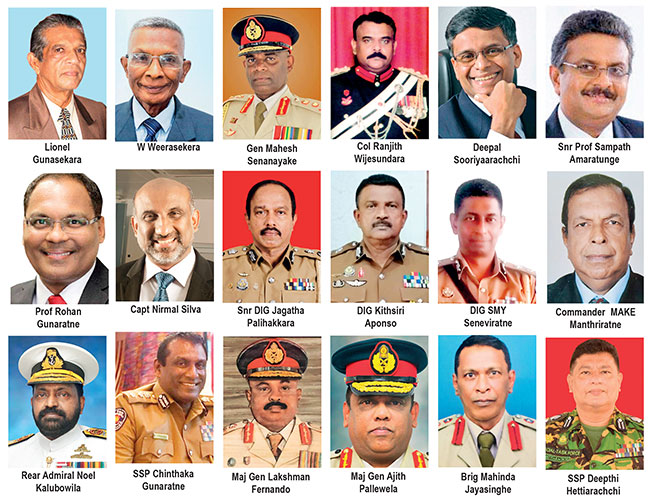
When Ananda College was selected for Police Cadetting on 03 July 1972, two of the school’s teachers were appointed as the Officers In-charge of the College Cadet Platoon. They were Mr Lionel Gunasekera and Mr Ariyapala. Later on, Mr W Weerasekera took over from Mr Ariyapala. Both Mr Gunasekera and Mr Weerasekera extended their invaluable and unwavering services for the Cadet Platoon’s success story. Both these gentlemen were there to supervise and train cadets. One could not forget Mr Weerasekera’s 9 Sri 7321 orange coloured Bajaj scooter parked next to the College main canteen. Another teacher, who trained cadets for drama competitions, voluntarily, was the late Mr Lionel Ranwala. He was the talented master who helped cadets to secure wins in the drama competition, year after year, at the annual camps.
The evening before attending the camp, a special “Mal Pooja” was organised to bless the platoon. After this, they would meet the principal, at his office, for another special blessing and a tea party, hosted by the principal himself. The then Principal of Ananda College, Colonel GW Rajapakse, gave his fullest blessings to the Police Cadets. These recognised cadets earned more responsibilities and assumed various leadership roles at the College. Prefects, Deputy Head Prefect, Head Prefect, Big Match Tent Secretaries, and Presidents of various societies were given to Cadets uncontestedly.
The Cadets stayed at the hostel, the night before leaving for camp. Our trunks were loaded into the college van and unloaded at Maradana Railway station. The most valuable trunk in the Cadet’s eyes was the PLATOON BOX. This was so since the box often contained items such as butter cakes, bottles ofcordial, sweets, such as marshmallows, chocolate rolls, and biscuits. This precious box was kept under lock and key and the watchful eyes of two Cadet Corporals.
SSP Prof Nandadasa Kodagoda, SSP P V W de Silva and a few other senior officers from Police HQ often attended as judges for different categories in the annual camp competitions, such as first aid, general knowledge, squad drill and physical training. Both these senior officers would discharge their duties to the rule and spirit.
All first-aid requirements were provided by the college St John’s Ambulance Brigade for all college special events, such as big matches and sports meets. This unit was led by 1979 Corporal Devapriya Perera (IT Professional – London) and most of the first-aiders were Police Cadets. They volunteered their services to the General Hospital Accident Ward and the Sri Pada pilgrims. It was pleasing to see Cadets controlling traffic duties in front of the college, at the Maradana – Borella main road, every morning, from 7.00 am to 7.25 am and helping with traffic duties and car park duties during the college sports meet and other functions.
Police Cadets CR Senanayake (Automobile Engineer-Brisbane), Ravi Mahendra (IT professional), and the late Dharmapriya Silva, established a swimming club that held its training at Otters Swimming Club. The School Bus Travelers Society, organized by the Police Cadets, issued bus seasons tickets for students with the help of CTB officials.
Back then when a teacher had not reported to a class, senior Police Cadets would step in and take turns to teach these classes. Deepal Sooriyaarchchi (Former MD of Aviva, Management Consultant) and Sarath Katangoda (Management Consultant – UK) were the most popular student masters in that era with their popular stories and innovative methods of teaching. This increased the popularity of police cadets among the other students. The way cadets conducted themselves had a very high impact on fellow Anandians, and the number of students attending practices rose rapidly.
On several occasions, Anula Vidyalaya Police Cadets called our Cadets to assist with their training in preparation for their Annual Camps. Having borrowed bus season tickets from students coming to College, via Nugegoda, our senior cadets were looking forward to visiting Anula to train them during school hours. This friendly culture blossoms during camps as well as outside the two schools. We still continue our friendships with Kamal Hathamuney (who joined the Army and retired with the rank of Major, residing in Sweden), Nirmala Perera, Malraji Meepegama (married to Maj Gen Sunil Wanniarachchi), Rosy Ranasekera (married to former Ananda Cadet Band leader Maj Gen Dhananjith Karunaratne) Dilani Balasuriya, (former IGP late Mahinda Balasuriya’s sister – married to Dr Priyanga de Zoysa). Interestingly our Cadet Lanka Herath continued this relationship and found his lifetime partner Ganga Thilakaratne from the Anula Vidyalaya Platoon. A famous school from Kelaniya, St Paul’s Balika Vidyalaya, too, started Police Cadeting in 1980. The writer being 1981 Ananda Sgt found his partner from St Paul’s Balika Cadet Sgt of the same year, Rasadari Jayamaha. Former Dean of the faculty of Law, University of Colombo Prof Indira Nanayakkara and Shiromi Perera (Melbourne) were the Corporals of the same platoon.
In 1972, the College platoon, led by Sgt Ranjith Wijesundara, became the Island’s best platoon. On the 23rd of July, 1983, the Sri Lankan Army’s routine patrol was assigned from Madagal to Gurunagar with the call sign of Four Four Bravo, commanded by 2/Lt A.P.N.C de Waas Gunwardane with 15 soldiers attached to Charlie company of SLLI were ambushed at Thirunelveli in Jaffna. 2/Lt Waas Gunawrdane and 12 soldiers made the supreme sacrifice. Adjutant and Intelligence Officer of SLLI Capt Ranjith Wijesundara was assigned the task of identifying the fallen heroes. Lt Wass Gunawardane was a Cadet of the 1977 platoon. Ranjith Wijesundra is now retired with the rank of Colonel.
In 1975 the College platoon, led by Sgt M A K E Manthriratne, also became the country’s best platoon and he was selected by the National Youth Council to represent the Sri Lanka Police Cadet Corps to travel to Canada under the Youth Exchange Programme between Sri Lanka and Canada. Manthriratne later joined the SL Navy and retired with the rank of Commander. Presently, as the President of Past Cadets, together with the ever-reliable 1982 Sgt V S Makolage carrying out various welfare projects under the banner of the Past Police Cadet Wing of Ananda.
Ananda held an unbroken record of winning nine out of 10 Trophies in 1978, under the great leadership of Sergeant Kithsiri Aponso who undoubtedly took Ananda Police Cadets to greater heights, was a leader with great charisma, integrity and leadership qualities. He became the Deputy Head Prefect and joined the STF. He later moved to the Police dept and is presently appointed as the DIG In Charge of the Badulla region.
The highest rank Cadet could achieve is Sgt Major. There were three Sgt Majors who brought honour and recognition to Ananda, namely Piyal Jayatilake in 1977, Jagathpriya Karunaratne in 1978 and ‘79, and Kithsiri Aponso in 1980. Chinthaka Gunaratne, a Cadet of 1981, also became the athletic Captain in 1983 (presently SSP In Charge of Highways) brought great honour and recognition as he became the Director in Charge of the Sri Lanka Police Cadet Corps.
College Athletic Captain of 1977, Ranasinghe Dharmadasa (Snr Manager BOI), 1978 JPPP Silva (Consultant-USA), 1980 Damitha Vitharana, (joined Sri Lanka Navy and retired as Lt. Commander and was the Director at Lankem Ceylon PLC before migrating to the UK), 1981 Jagath Palihakkara, (joined Sri Lanka Police as a SI in 1982 and at presently acting Senior DIG Western Region). DIG S M Y Senviratne another past Cadet joined the Police and is presently DIG in Charge of the Ampara Region. They also brought pride and joy to their alma mater during their time in their respective platoons and in their subsequent endeavours.
Two Sgts who led the Island’s best Platoons in 1983 Priyantha Ratnayake (Planter) and Pasindu Hearath of 2016 (Undergraduate of Kyoto University, Japan) became Head Prefects and Pasindu was awarded the Fritz Kunz Memorial Trophy for the Most Outstanding Student of 2017. The 4th of July 2017 was a great day for Ananda, as well as for the Police Cadets. 1980 Cadet Sgt who led the Island’s Best Platoon became Commander of the Army. It was a great honour for Cadets. Past Cadets organized a felicitation for Gen Mahesh Senanayake to recognise his prestigious appointment.
With profound gratitude, we remember past Cadets Rear Admiral Noel Kalubowila (a highly rated naval officer decorated with the highest gallantry medals especially having led the “Suicide Express” in 1990 evacuating troops from Jaffna Fort, Major General Lakshan Fernando, Major General Ajith Pallewela, Brig Mahinda Jayasinghe, Maj Aruna Vithanage, Maj Sampath Karuanthilake, Major SP Rodrigo, Lt Bandual Withanachchi, Director Prisons TI Uduwera, SSP Deepthi Hettiarchchi of STF (Zonal Commander Jaffna Mannar, Killinochchi and Mullaithivu), SSP Amal Edirimanne (In Charge of Colombo North) were Cadets who joined the forces, Police and Prison departments, respectively.
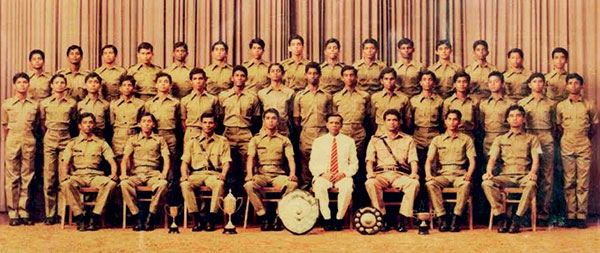
Chairman of University Grant Commission Senior Prof Sampath Amaratunge, one of the brilliant academics and a past Cadet, always believed and mentioned that “I am where I am because of my alma mater, and shall forever grateful to my journey”. Other note-worthy past Cadets are Harbor Master Capt Nirmal Silva, Prof Rohan Gunaratna (a political analyst specializing in international terrorism) present President of Ananda OBA, Bimal Wijesinghe who excelled in athletics during annual camps.
When this writer contacted one of our Masters-In-Charge, Mr W Weerasekera, he recalled those golden days. “As a pilot school where Police Cadet platoons were formed, Ananda College played its role in achieving the aims of cadetting as envisaged in the curriculum. It gives me great satisfaction to note the leadership and achievements of the Cadets, their success in later life with the highest contribution to the society at large”
Thanks for the untiring efforts of Hiranya Hewanayake (Senior Manager – Singer Sri Lanka) and Wing Commander Pradeep Kannangara Retd (Former Officer Commanding of the Special Air Borne Unit of Sri Lanka Air Force – Director – General Manager Abans Securitas), all past Cadets who reside all over the world are now well connected, via social media.We cherish the remarkable legacy of Ananda Police Cadetting.



US sports envoys to Lanka to champion youth development

Rahuman questions sudden cancellation of leave of CEB employees


