
Features
Battaramulla then and some unforgettable characters


(Excerpted from the memoirs of Rtd. Senior DIG Police Edward Gunawardena)
Ganahena is perhaps the highest area; and St. Mathew’s Anglican Church built in 1850 is located here. Sri Sudassanaramaya the oldest temple in the village is also located on a high location close to Ganahena. These were the only places of worship. There were no Mosques or Kovils. However on the site on which St. Mathew’s Church stands there had existed a Hindu place of worship called the Gane Kovil. I have myself seen large granite columns strewn about in the churchyard. These are no more to be seen. A remarkable feature was the unity in which the Christians and Buddhists lived. In fact no family was wholly Buddhist or wholly Christian. My grandfather once told me that when a Revd. Welikala was the Parish Priest of St. Mathew’s Church, his brother had been the Chief Incumbent of the Sri Sudassanarama temple!
The sub-village place names mentioned above served a very useful purpose particularly because the systematic numbering of houses had not commenced. Persons and places were identified with reference to these places. eg. ‘Ganahena Kanda Uda’, ‘Udumulla lindalanga’, ‘Deniye Simon’, ‘Minuwanvila Carolis’ or Averiwatta Romlas’.
Ownership of land was mainly in small-holdings. But certainly not small by today’s standards. It was not unusual for a family to own an acre or more. Most of these plots were planted with coconut, arecanut and ground crops such as manioc, batala, pepper and even coffee. It is indeed a matter for regret that with the demand for land in Battaramulla in the 80s and 90s and the prices rocketing many of the less affluent decided to sell their lands and move further away from Colombo to places such as Pore, Habarakada and Aturugiriya. The massive influx of the affluent, urban middle class who have built palatial homes has certainly transformed the tranquil, traditional, unspoilt village that I have lived from birth to a crude mix of Cinnamon Gardens and Maligawatta of Colombo. Indeed the face of the village which I have known so intimately from the forties of the last century has changed beyond recognition. Only the name ‘Battaramulla’ remains. The story of Battaramulla over the past five decades is the story of a ‘vanished village’.
Large extents of land were rare; and the few that existed were owned by non-villagers. The present Jayanthipura which originated as a housing project during the premiership of Sir John Kotelawela was a coconut land belonging to the de Livera family. The large extent of land that forms the residential complex of Subuthipura was a rubber plantation belonging to a lawyer by the name of Ebert from Kalutara. The area bordering Lily Avenue off the Robert Gunawardena Mawatha was a rubber land belonging to a Vanlangenberg. During the rubber boom of the late forties and early fifties my father was the lessee of this land. As children we were able to closely observe how the latex was collected and sheet rubber turned out. My parental house and the house in which I live today are on a land that once belonged to the Lady Obeysekera Trust which had been purchased by my father and his two younger brothers in 1931. A substantial part of this eight-acre land is to-date retained by the family.
The land on which the Battaramulla Maha Vidyalaya stands today belonged to the Dassanayake family of Mirigama. Until the time of its acquisition by the Education Department my father was its leaseholder. This was the land on which the four Gunawardena brothers started playing football. Soon other children as well as adults were to join, ultimately leading to the birth of the Wingers’ Football Club. More about football later.
Roads and other utilities
The two main roads that traversed the village were the Colombo – Kaduwela Road, and the Pannipitiya Road commencing from the Battaramulla bazaar. The former was better known as the Colombo – Godagama Road. The village stood between the sixth and seventh mileposts on this road. These were the only macadamized roads. The present Parliament roundabout and the road to Parliament and beyond to Pelawatta and to Koswatta did not exist. The present Parliament was built in the eighties. The by-roads of note the Averiwatta Road, the Udumulla Road. and the Korambe Road. were all Village Council (VC) roads and they were all single lane gravel paths.
My father’s residence where I lived with my grandfather, grandmother, my father and my brothers was on the large extent of land that my father had purchased abutting the Korambe Road. From the Ganahena turn off up to the village boundary, was the present Parliament Rd. The others who lived on this road were the Jansens and the Vanlangenbergs on the eastern side and the Wijewickremas, Jamis baas and Obiyas baas on the Western side. James and Obiyas were much sought after village carpenters. The Wijewickrema property which was adjoining our land was occupied later by Roy Perera and his wife who were from Badulla. They were a very amiable couple who were very fond of children. Hema de Silva a nephew of Roy was a regular visitor who became friendly with us and would even take us regularly to see Hindi films. He had just returned after graduating from the London School of Economics and joined the newly created Central Bank of Ceylon.
This road was generally deserted except for the few people from the village of Korambe who travelled to work on foot or to take bus from the Battaramulla bazaar. Most casual labourers came from Korambe. I remember Lewis Aiya, Burampi and Thomis Appu as extremely honest and hardworking. The last mentioned drove our buggy cart. In the nights these people returning home carried chulu lights (hulu athu) and sang loud to scare away serpents from the road. Snakebites were common on these unlit by-roads; and the snake bite specialist (Sarpa vedamahattaya) who lived in Korambe was a much wanted man. He was the brother of the best known Vedamahattaya of Battaramulla, Simon Vedamahattaya.
It was from the Averiwatta (Rajamalwatta) Road that we approached the paddy fields and threshing floors that belonged to my grandfather. Ambalangodella was a substantial extent of paddy land together with a well tended fodder grass land. Cartloads of harvested fodder grass were delivered daily to Elephant House that used bullock carts for the transport of aerated waters.
As children my brothers and I enjoyed working in these paddy fields during the school holidays. Harvesting time was particularly pleasant I still remember even the Kamath language eg. Batha, maduwan, ambaruwa etc. My brother Irwin showed a special liking for the paddy fields and did not shy away from the mud. Fittingly in later life he joined the Agriculture Department and eventually rose to be the Director General of Agriculture.
The Udumulla road which was quite narrow, led through footpaths to the northern fringes of the village, the scanty settlement of Hakurugoda and an extensive patch of thick shrub jungle called Bogahahena. Hakurugoda was characterized by three or four small families of the Jaggery caste. These people integrated well with the rest of the villagers. Being traditionally cooks by profession the men were much sought after at village weddings and other social functions. The women carrying baskets on their heads were a welcome sight. They went house to house with breakfast preparations of string hoppers, pittu and hoppers together with delicious vegetable curries and sambols. During the New Year time everybody looked forward to their Kevum, Kokis, Aasmi, Helapa etc.
Two landmarks that I distinctly remember on the Udumulla road were the public bathing well and an elevated garden of mangosteen trees with a fashionable house. The occupant of these premises was an elderly English gentleman by the name of Meaden. He had been a former civil servant in the colonial administration.
Another important footpath that I often used as a short cut, connected the Pannipitiya road from near the present Indrajothi Vidyalaya with the Sri Sudassanarama Temple. On this narrow by-way was located a coconut land where the Hamers lived. Opposite this land was a home for destitute dogs which was very caringly and efficiently run by an energetic English lady by the name of Mrs. Bartlam. I remember visiting this place that was well known as the ‘Balu Madama’ with a parcel of buns for the dogs. There were several others too from the village who had brought food for the dogs.
In the late forties there was no electricity in the village. Some shops and a few affluent households used Petromax lamps. Most people used kerosene lamps with chimneys. Bottle lamps were widely used. Hurricane lanterns were used for outdoor activities while cyclists used carbide lamps. We as children were not allowed by our father to study by kerosene light. He saw to it that the four brothers used candies. Even today whenever lights fail I make do with a candle.
There was no refrigerator or any other electrical appliance in our home. It was common to preserve fish or pork in salt. Delicious preparations were made of salted fish or salted pork. T
The butter, bacon and sausages that my father brought were salted and did not need refrigeration. It is no exaggeration to say that the bacon or sausages sold today are insipid compared to what we ate then. Whenever my father brought ice cream, the container was packed in dry ice. Although rare, whenever an Elephant House van had to pass the village, apart from two or three crates of aerated waters a few chunks of ice were delivered to our home. Making our own ice cream with milk, eggs and mango juice in a manually operated churner was great fun.
There was no water service or drainage. All households had wells and well kept pit latrines. Water for household use was kept in earthenware pots. Boiled drinking water was also stored in earthen decanters. It was a practice for most households by the road to have a large pot of water covered with a coconut shell for the use of thirsty wayfarers.
Schools
In the forties and the fifties there were only three schools in the village. The Christian Missionary School situated in the premises of St. Mathew’s Church which to-date remains a popular institution for juniors is perhaps the oldest. Even a century ago this school had been well known for discipline. My grandfather used to relate many stories about the headmaster of the time by the name of Hendrick Gurunanse. Children feared him so much that the mischievous ones wore gunny sacks under their sarongs. He had been a firm believer in the dictum “Spare the rod and spoil the Child”. His son H.D.L. Perera better known as Lennet Ralahamy was the Headman of Battaramulla until the Grama Sevaka system replaced the headman system.
The Indrajothi Vidyalaya on the Pannipitiya road had about four class rooms and three or four teachers. Today this is a popular school catering mainly to the expanding population on the Pannipitiya road to Pelawatta and beyond. This school and the Christian Missionary School which are government schools today, being on limited space have no land for any further expansion. At Mampewatta on the land of Henry Boteju a prominent local politician was situated a small school that was known as the YMBA School. The land adjoining my father’s property which was held by the latter on lease was acquired by the Education Department to accommodate the YMBA School. Fortunately for Battaramulla and the entire locality this school developed rapidly to become the present Sri Subhuthi Madya Maha Vidyalaya catering even to children from Colombo. The role played by the late M.D.H. Jayawardena when he represented the Kaduwela electorate and was a senior minister in the Dudley Senanayake government of 1965 in the development of this school will never be forgotten by the people of Battaramulla.
The English language was not taught in any of these schools. As a result before the Maha Vidyalaya took shape children wanting to learn English attended the Kotte Bangalawa School which subsequently became the Kotte Christian College.
My grandfather had come to know Rev. Dowbiggin, the head of the Christian Mission in Kotte. In fact the latter had succeeded in converting him to Christianity. My father and his two younger brothers had attended this school and been successful in the English School Leaving Certificate Examination (ESLC). Incidentally it was the son of Rev. Dowbiggin, Herbert Dowbiggin, who after his education at Trinity College Kandy and Cambridge became the Inspector-General of Police.
Transport & Retail Facilities
Travel to work or to school or places away from the village, particularly to Borella and Fort was by bus. Buses were few in number and belonged to the Colombo Omnibus Company. It was also called the B.J. Fernando Bus Company. The bus crews were extremely polite and even knew the regular travelers personally.
Travelling in the open bodied buses was fun. The Battaramulla terminus for the Borella buses was at the present turn off to the Battaramulla cemetery. As school children we were particularly fond of the bus that was driven by Yahonis Aiya. He was a very kind driver who was caring and helpful to the children. ‘Checker’ Patrick Aiya who usually travelled in this bus was also a friendly and amiable sort. Not long ago, in the mid eighties I often met Yahonis on my walks. He was old but strong enough to ride a bicycle. He never failed to get off the bicycle; and I made it a point to have a brief chat with him. He took great pride in the fact that the DIG Metropolitan traveled in his bus as a child. His funeral in the village of Korambe was well attended.
Fish and vegetable vendors who were mainly womenfolk also brought their goods from the Pettah market in these passenger buses. Baskets of fish and vegetables were accommodated on the hoods of buses and the loading and unloading was done by the conductor. He considered this as a part of his duty. Most passengers returning from Colombo after work also brought their vegetables, fish and meat in bags made of reeds as polythene bags were not even known at that time. Restrictions on this free and easy manner of transport of consumables commenced with the introduction of buses with fully enclosed bodies which were known as ‘Nelson body’ buses at the time.
Use of Bicycles
Cycling was a popular means of transport. Most people used bicycles to travel to their workplaces in Colombo. So did the children particularly boys in their teens to travel to schools such as Christian College Kotte, Wesley, St. Joseph’s and Ananda. The bicycles were all imported brands —Raleigh, Humber and Hercules. They were quite costly. As a result the theft of bicycles was a common occurrence. It was such a nuisance that bicycle theft was considered a ‘grave crime’ by the police. It was necessary for the OIC of the police station to visit the scene of theft and also report such theft to Police Headquarters. Every office, school and even shops had bicycles stands for parking bikes. At almost all the places reserved for the parking of bicycles there were warning boards in red, ‘Beware of Cycle Thieves’.
During the war because motor vehicles were not allowed to drive with their head lights on when the ‘black out’ regulation came into force it was difficult to spot cyclists ahead. As a result all bicycles apart from a rear reflector were compelled to paint the lower section of the rear mudguard white.
Much police time on the roads was spent on taking up offenses of cyclists. Riding without lights was considered a serious offense. Most cyclists used carbide or oil lamps until the dynamo became popular. Carrying a passenger on the bar or doubling and riding abreast were the other offenses that were detected by police. Most culprits were schoolboys. I remember having being detected ‘doubling’ on at least three occasions. However on all these occasions I was to plead with the sergeant or constable and escape being charged. One reason was because I made it a point to address the detecting officer as ‘Sir.’
I was once ‘doubling’ a friend, who in later life became a member of the Ceylon Civil Service (CCS) and was detected at Maradana. The sergeant let us go. But he deflated the tyres and asked us to push the bicycle home!
There was another friend of mine who adopted a unique ruse. Whenever he was detected he gave his name as ‘Abraham Lincoln’. In his carrier basket the three exercise books on top carried this name. He also gave a false address. Often he made it a point to be at the Maligawatta Courts on days that these cases were usually heard to enjoy the fun when the name Abraham Lincoln was called loud by the court Mudaliyar. This exceptional prankster in later life became a President’s Counsel and an Ambassador. That was at least 25 years before the National Identity Card was introduced.
Goods Transport
There were no vans, double cabs, tractors or landmasters in the village. It was rarely that a lorry was seen. Transport of all types of goods was by bullock carts which were in plenty. It was a common sight to see handcarts being pushed along with vegetables, young coconuts (Kurumba) etc.
My grandfather had two bullock carts in addition to a passenger carrying tirikkale which he enjoyed driving. The bullock carts that were kept in our premises were used mainly for the transport of paddy, coconuts and rubber. Occasionally these carts were hired to cover the expenses of the carters and the cost of fodder for the cart bulls.
Even large business establishments such as Elephant House and the Colombo Commercial Company used bullock carts. The former used bullock carts extensively for the transport of aerated waters whilst the latter transported building materials to their work sites in bullock carts.
In the late forties and early fifties Uncle Sam, my fathers younger brother had a licensed tea cider manufactory in Battaramulla. This became a popular alcoholic drink particularly in the estate areas upcountry. It was a common sight to see hundreds of bullock carts lined up to load tea cider crates to be transported to destinations in the Kandy, Ratnapura and Kalutara districts.
It was a highly profitable business, but Uncle Sam gave up this business as his wife, Auntie Florence, was not very happy with the production of an alcoholic beverage. She was the daughter of a leading Baptist minister and Principal of Carey College, Revd. W.M.P. Jayatunga. Subsequently Uncle Sam began the manufacture of mirrors which turned out to be a successful venture. His son, the late Herschel Gunawardena, became a well known astronomer.
Retail Trade
There was only one grocery store of note in the Battaramulla bazaar. This belonged to an Indian by the name of Abraham. Vegetables and fish were mainly sold by women seated on the roadside. There were so many such roadside vendors that the bazaar resembled a fair. Women carrying baskets of vegetables, dry fish etc. also visited homes regularly.
My father purchased provisions for our home monthly from a wholesale grocery in Welikada, W.D. Paulin Appuhamy & Sons. The bulk of the goods that came in a bullock cart from Welikada consisted of poonac and kollu, a seed akin to cowpea, as fodder for our cart bulls and the large herd of cattle that roamed our land. The cows in this herd yielded adequate milk for our home consumption. The breakfast of each of the four brothers, before leaving for school was a large mugfull of hot milk mixed with two eggs and sugar. Even the eggs were from the free run poultry in the garden.
The only shop that sold clothing and other personal goods like shoes, slippers etc. was Rajamoney’s also in the Battaramulla bazaar. However cloth as well as numerous other personal requirements ranging from shoes, sarongs, banians & socks to items such as mirrors, combs and soaps were brought by Chinese and Moor traders to the door step.
The ‘China man’ who pushed his bicycle along with a large bundle of cloth on the luggage carrier and the Moor man wearing a fez with several coloured umbrellas hung on the handlebars were regularly seen on our road. They were both good humoured men who happily tolerated the annoyance caused to them by mischievous children. I still remember how the China man pretended to be angry and threatening when children shouted, “Cheena booku, booku, chinare” and ran away.
The man carrying a bread basket was a welcome visitor to our home. The black barrel shaped basket with a pyramidal cover kept the bread and buns fresh and warm. Apart from bread and buns he brought popcorn sugar coated balls and fresh thala ‘gull’. During the week-ends, when we did not have to rush to school, we looked forward to the visit of the ammes’ who brought breakfast preparations of string hoppers, hoppers, pittu etc. Curries made of kebella leaves and gotukola with maldive fish were delicious indeed.
Electricians and plumbers were unheard of in the village. Of course there was no electricity or water service. Obiyas Bass and Jamis Bass were excellent carpenters. Appuhamy from the village of Korambe was a much sought after mason and Coranelis who was partially deaf was the painter that my father always employed for the colour washing of our walls. The village blacksmith was also a busy man. He was well known in the village as Mattha. Our ‘dhoby’ or laundryman who was addressed as ‘Hene Mama’ was an elderly man from Korambe who visited our home every week. I remember him contacting leprosy and ending up at the Leprosy Hospital, Hendala.



by Dr Gotabhya Ranasinghe
Senior Consultant Cardiologist
National Hospital Sri Lanka
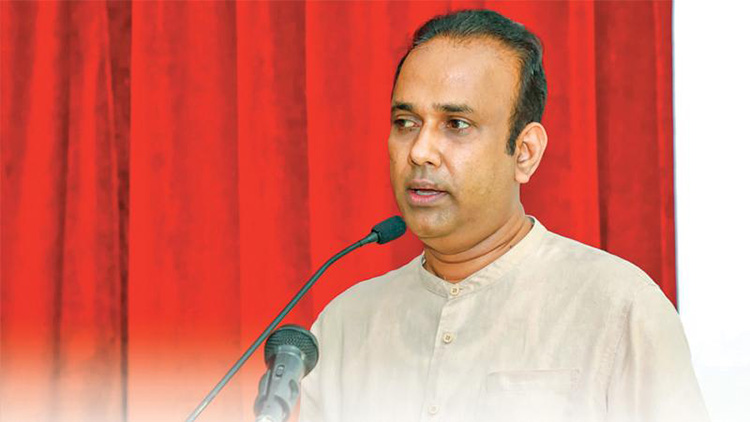
When we sought a meeting with Hon Dr. Ramesh Pathirana, Minister of Health, he graciously cleared his busy schedule to accommodate us. Renowned for his attentive listening and deep understanding, Minister Pathirana is dedicated to advancing the health sector. His openness and transparency exemplify the qualities of an exemplary politician and minister.
Dr. Palitha Mahipala, the current Health Secretary, demonstrates both commendable enthusiasm and unwavering support. This combination of attributes makes him a highly compatible colleague for the esteemed Minister of Health.
Our discussion centered on a project that has been in the works for the past 30 years, one that no other minister had managed to advance.
Minister Pathirana, however, recognized the project’s significance and its potential to revolutionize care for heart patients.
The project involves the construction of a state-of-the-art facility at the premises of the National Hospital Colombo. The project’s location within the premises of the National Hospital underscores its importance and relevance to the healthcare infrastructure of the nation.
This facility will include a cardiology building and a tertiary care center, equipped with the latest technology to handle and treat all types of heart-related conditions and surgeries.
Securing funding was a major milestone for this initiative. Minister Pathirana successfully obtained approval for a $40 billion loan from the Asian Development Bank. With the funding in place, the foundation stone is scheduled to be laid in September this year, and construction will begin in January 2025.
This project guarantees a consistent and uninterrupted supply of stents and related medications for heart patients. As a result, patients will have timely access to essential medical supplies during their treatment and recovery. By securing these critical resources, the project aims to enhance patient outcomes, minimize treatment delays, and maintain the highest standards of cardiac care.
Upon its fruition, this monumental building will serve as a beacon of hope and healing, symbolizing the unwavering dedication to improving patient outcomes and fostering a healthier society.We anticipate a future marked by significant progress and positive outcomes in Sri Lanka’s cardiovascular treatment landscape within the foreseeable timeframe.

by Fr. Emmanuel Fernando, OMI
Jesuit Fr. Aloysius Pieris (affectionately called Fr. Aloy) celebrated his 90th birthday on April 9, 2024 and I, as the editor of our Oblate Journal, THE MISSIONARY OBLATE had gone to press by that time. Immediately I decided to publish an article, appreciating the untiring selfless services he continues to offer for inter-Faith dialogue, the renewal of the Catholic Church, his concern for the poor and the suffering Sri Lankan masses and to me, the present writer.
It was in 1988, when I was appointed Director of the Oblate Scholastics at Ampitiya by the then Oblate Provincial Fr. Anselm Silva, that I came to know Fr. Aloy more closely. Knowing well his expertise in matters spiritual, theological, Indological and pastoral, and with the collaborative spirit of my companion-formators, our Oblate Scholastics were sent to Tulana, the Research and Encounter Centre, Kelaniya, of which he is the Founder-Director, for ‘exposure-programmes’ on matters spiritual, biblical, theological and pastoral. Some of these dimensions according to my view and that of my companion-formators, were not available at the National Seminary, Ampitiya.
Ever since that time, our Oblate formators/ accompaniers at the Oblate Scholasticate, Ampitiya , have continued to send our Oblate Scholastics to Tulana Centre for deepening their insights and convictions regarding matters needed to serve the people in today’s context. Fr. Aloy also had tried very enthusiastically with the Oblate team headed by Frs. Oswald Firth and Clement Waidyasekara to begin a Theologate, directed by the Religious Congregations in Sri Lanka, for the contextual formation/ accompaniment of their members. It should very well be a desired goal of the Leaders / Provincials of the Religious Congregations.
Besides being a formator/accompanier at the Oblate Scholasticate, I was entrusted also with the task of editing and publishing our Oblate journal, ‘The Missionary Oblate’. To maintain the quality of the journal I continue to depend on Fr. Aloy for his thought-provoking and stimulating articles on Biblical Spirituality, Biblical Theology and Ecclesiology. I am very grateful to him for his generous assistance. Of late, his writings on renewal of the Church, initiated by Pope St. John XX111 and continued by Pope Francis through the Synodal path, published in our Oblate journal, enable our readers to focus their attention also on the needed renewal in the Catholic Church in Sri Lanka. Fr. Aloy appreciated very much the Synodal path adopted by the Jesuit Pope Francis for the renewal of the Church, rooted very much on prayerful discernment. In my Religious and presbyteral life, Fr.Aloy continues to be my spiritual animator / guide and ongoing formator / acccompanier.
Fr. Aloysius Pieris, BA Hons (Lond), LPh (SHC, India), STL (PFT, Naples), PhD (SLU/VC), ThD (Tilburg), D.Ltt (KU), has been one of the eminent Asian theologians well recognized internationally and one who has lectured and held visiting chairs in many universities both in the West and in the East. Many members of Religious Congregations from Asian countries have benefited from his lectures and guidance in the East Asian Pastoral Institute (EAPI) in Manila, Philippines. He had been a Theologian consulted by the Federation of Asian Bishops’ Conferences for many years. During his professorship at the Gregorian University in Rome, he was called to be a member of a special group of advisers on other religions consulted by Pope Paul VI.
Fr. Aloy is the author of more than 30 books and well over 500 Research Papers. Some of his books and articles have been translated and published in several countries. Among those books, one can find the following: 1) The Genesis of an Asian Theology of Liberation (An Autobiographical Excursus on the Art of Theologising in Asia, 2) An Asian Theology of Liberation, 3) Providential Timeliness of Vatican 11 (a long-overdue halt to a scandalous millennium, 4) Give Vatican 11 a chance, 5) Leadership in the Church, 6) Relishing our faith in working for justice (Themes for study and discussion), 7) A Message meant mainly, not exclusively for Jesuits (Background information necessary for helping Francis renew the Church), 8) Lent in Lanka (Reflections and Resolutions, 9) Love meets wisdom (A Christian Experience of Buddhism, 10) Fire and Water 11) God’s Reign for God’s poor, 12) Our Unhiddden Agenda (How we Jesuits work, pray and form our men). He is also the Editor of two journals, Vagdevi, Journal of Religious Reflection and Dialogue, New Series.
Fr. Aloy has a BA in Pali and Sanskrit from the University of London and a Ph.D in Buddhist Philosophy from the University of Sri Lankan, Vidyodaya Campus. On Nov. 23, 2019, he was awarded the prestigious honorary Doctorate of Literature (D.Litt) by the Chancellor of the University of Kelaniya, the Most Venerable Welamitiyawe Dharmakirthi Sri Kusala Dhamma Thera.
Fr. Aloy continues to be a promoter of Gospel values and virtues. Justice as a constitutive dimension of love and social concern for the downtrodden masses are very much noted in his life and work. He had very much appreciated the commitment of the late Fr. Joseph (Joe) Fernando, the National Director of the Social and Economic Centre (SEDEC) for the poor.
In Sri Lanka, a few religious Congregations – the Good Shepherd Sisters, the Christian Brothers, the Marist Brothers and the Oblates – have invited him to animate their members especially during their Provincial Congresses, Chapters and International Conferences. The mainline Christian Churches also have sought his advice and followed his seminars. I, for one, regret very much, that the Sri Lankan authorities of the Catholic Church –today’s Hierarchy—- have not sought Fr.
Aloy’s expertise for the renewal of the Catholic Church in Sri Lanka and thus have not benefited from the immense store of wisdom and insight that he can offer to our local Church while the Sri Lankan bishops who governed the Catholic church in the immediate aftermath of the Second Vatican Council (Edmund Fernando OMI, Anthony de Saram, Leo Nanayakkara OSB, Frank Marcus Fernando, Paul Perera,) visited him and consulted him on many matters. Among the Tamil Bishops, Bishop Rayappu Joseph was keeping close contact with him and Bishop J. Deogupillai hosted him and his team visiting him after the horrible Black July massacre of Tamils.
Sri Lanka-Singapore Free Trade Agreement
By Gomi Senadhira
senadhiragomi@gmail.com
“You might tell fairy tales, but the progress of a country cannot be achieved through such narratives. A country cannot be developed by making false promises. The country moved backward because of the electoral promises made by political parties throughout time. We have witnessed that the ultimate result of this is the country becoming bankrupt. Unfortunately, many segments of the population have not come to realize this yet.” – President Ranil Wickremesinghe, 2024 Budget speech
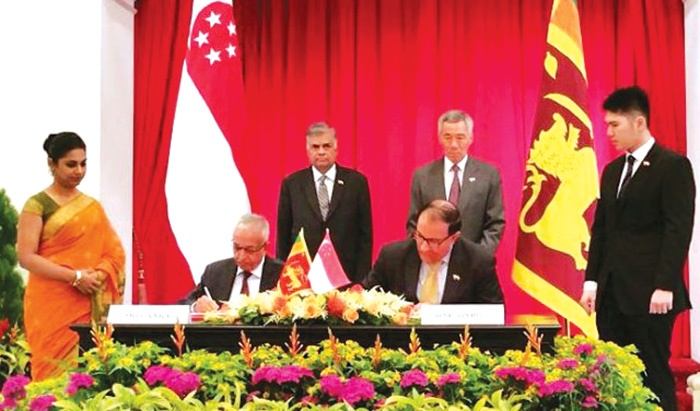
Any Sri Lankan would agree with the above words of President Wickremesinghe on the false promises our politicians and officials make and the fairy tales they narrate which bankrupted this country. So, to understand this, let’s look at one such fairy tale with lots of false promises; Ranil Wickremesinghe’s greatest achievement in the area of international trade and investment promotion during the Yahapalana period, Sri Lanka-Singapore Free Trade Agreement (SLSFTA).
It is appropriate and timely to do it now as Finance Minister Wickremesinghe has just presented to parliament a bill on the National Policy on Economic Transformation which includes the establishment of an Office for International Trade and the Sri Lanka Institute of Economics and International Trade.
Was SLSFTA a “Cleverly negotiated Free Trade Agreement” as stated by the (former) Minister of Development Strategies and International Trade Malik Samarawickrama during the Parliamentary Debate on the SLSFTA in July 2018, or a colossal blunder covered up with lies, false promises, and fairy tales? After SLSFTA was signed there were a number of fairy tales published on this agreement by the Ministry of Development Strategies and International, Institute of Policy Studies, and others.
However, for this article, I would like to limit my comments to the speech by Minister Samarawickrama during the Parliamentary Debate, and the two most important areas in the agreement which were covered up with lies, fairy tales, and false promises, namely: revenue loss for Sri Lanka and Investment from Singapore. On the other important area, “Waste products dumping” I do not want to comment here as I have written extensively on the issue.
1. The revenue loss
During the Parliamentary Debate in July 2018, Minister Samarawickrama stated “…. let me reiterate that this FTA with Singapore has been very cleverly negotiated by us…. The liberalisation programme under this FTA has been carefully designed to have the least impact on domestic industry and revenue collection. We have included all revenue sensitive items in the negative list of items which will not be subject to removal of tariff. Therefore, 97.8% revenue from Customs duty is protected. Our tariff liberalisation will take place over a period of 12-15 years! In fact, the revenue earned through tariffs on goods imported from Singapore last year was Rs. 35 billion.
The revenue loss for over the next 15 years due to the FTA is only Rs. 733 million– which when annualised, on average, is just Rs. 51 million. That is just 0.14% per year! So anyone who claims the Singapore FTA causes revenue loss to the Government cannot do basic arithmetic! Mr. Speaker, in conclusion, I call on my fellow members of this House – don’t mislead the public with baseless criticism that is not grounded in facts. Don’t look at petty politics and use these issues for your own political survival.”
I was surprised to read the minister’s speech because an article published in January 2018 in “The Straits Times“, based on information released by the Singaporean Negotiators stated, “…. With the FTA, tariff savings for Singapore exports are estimated to hit $10 million annually“.
As the annual tariff savings (that is the revenue loss for Sri Lanka) calculated by the Singaporean Negotiators, Singaporean $ 10 million (Sri Lankan rupees 1,200 million in 2018) was way above the rupees’ 733 million revenue loss for 15 years estimated by the Sri Lankan negotiators, it was clear to any observer that one of the parties to the agreement had not done the basic arithmetic!
Six years later, according to a report published by “The Morning” newspaper, speaking at the Committee on Public Finance (COPF) on 7th May 2024, Mr Samarawickrama’s chief trade negotiator K.J. Weerasinghehad had admitted “…. that forecasted revenue loss for the Government of Sri Lanka through the Singapore FTA is Rs. 450 million in 2023 and Rs. 1.3 billion in 2024.”
If these numbers are correct, as tariff liberalisation under the SLSFTA has just started, we will pass Rs 2 billion very soon. Then, the question is how Sri Lanka’s trade negotiators made such a colossal blunder. Didn’t they do their basic arithmetic? If they didn’t know how to do basic arithmetic they should have at least done their basic readings. For example, the headline of the article published in The Straits Times in January 2018 was “Singapore, Sri Lanka sign FTA, annual savings of $10m expected”.
Anyway, as Sri Lanka’s chief negotiator reiterated at the COPF meeting that “…. since 99% of the tariffs in Singapore have zero rates of duty, Sri Lanka has agreed on 80% tariff liberalisation over a period of 15 years while expecting Singapore investments to address the imbalance in trade,” let’s turn towards investment.
Investment from Singapore
In July 2018, speaking during the Parliamentary Debate on the FTA this is what Minister Malik Samarawickrama stated on investment from Singapore, “Already, thanks to this FTA, in just the past two-and-a-half months since the agreement came into effect we have received a proposal from Singapore for investment amounting to $ 14.8 billion in an oil refinery for export of petroleum products. In addition, we have proposals for a steel manufacturing plant for exports ($ 1 billion investment), flour milling plant ($ 50 million), sugar refinery ($ 200 million). This adds up to more than $ 16.05 billion in the pipeline on these projects alone.
And all of these projects will create thousands of more jobs for our people. In principle approval has already been granted by the BOI and the investors are awaiting the release of land the environmental approvals to commence the project.
I request the Opposition and those with vested interests to change their narrow-minded thinking and join us to develop our country. We must always look at what is best for the whole community, not just the few who may oppose. We owe it to our people to courageously take decisions that will change their lives for the better.”
According to the media report I quoted earlier, speaking at the Committee on Public Finance (COPF) Chief Negotiator Weerasinghe has admitted that Sri Lanka was not happy with overall Singapore investments that have come in the past few years in return for the trade liberalisation under the Singapore-Sri Lanka Free Trade Agreement. He has added that between 2021 and 2023 the total investment from Singapore had been around $162 million!
What happened to those projects worth $16 billion negotiated, thanks to the SLSFTA, in just the two-and-a-half months after the agreement came into effect and approved by the BOI? I do not know about the steel manufacturing plant for exports ($ 1 billion investment), flour milling plant ($ 50 million) and sugar refinery ($ 200 million).
However, story of the multibillion-dollar investment in the Petroleum Refinery unfolded in a manner that would qualify it as the best fairy tale with false promises presented by our politicians and the officials, prior to 2019 elections.
Though many Sri Lankans got to know, through the media which repeatedly highlighted a plethora of issues surrounding the project and the questionable credentials of the Singaporean investor, the construction work on the Mirrijiwela Oil Refinery along with the cement factory began on the24th of March 2019 with a bang and Minister Ranil Wickremesinghe and his ministers along with the foreign and local dignitaries laid the foundation stones.
That was few months before the 2019 Presidential elections. Inaugurating the construction work Prime Minister Ranil Wickremesinghe said the projects will create thousands of job opportunities in the area and surrounding districts.
The oil refinery, which was to be built over 200 acres of land, with the capacity to refine 200,000 barrels of crude oil per day, was to generate US$7 billion of exports and create 1,500 direct and 3,000 indirect jobs. The construction of the refinery was to be completed in 44 months. Four years later, in August 2023 the Cabinet of Ministers approved the proposal presented by President Ranil Wickremesinghe to cancel the agreement with the investors of the refinery as the project has not been implemented! Can they explain to the country how much money was wasted to produce that fairy tale?
It is obvious that the President, ministers, and officials had made huge blunders and had deliberately misled the public and the parliament on the revenue loss and potential investment from SLSFTA with fairy tales and false promises.
As the president himself said, a country cannot be developed by making false promises or with fairy tales and these false promises and fairy tales had bankrupted the country. “Unfortunately, many segments of the population have not come to realize this yet”.
(The writer, a specialist and an activist on trade and development issues . )



US sports envoys to Lanka to champion youth development

Rahuman questions sudden cancellation of leave of CEB employees


