Features
BARCELONA TO SOFIA IN FROZEN TRAINS

CONFESSIONS OF A GLOBAL GYPSY
By Dr. Chandana (Chandi) Jayawardena DPhil
President – Chandi J. Associates Inc. Consulting, Canada
Founder & Administrator – Global Hospitality Forum
chandij@sympatico.ca

EUROPE AT minus 41 °C
After two weeks of virtually non-stop travelling by train and ship across Wales, Ireland, France, Portugal, Morocco, and Spain in the midst of a brutal winter, we had to suddenly change our plans. My wife had taken ill and was shivering with a very high fever as we reached Barcelona. We took a break and stayed in Barcelona for four days until she was fit to travel again.
The lady who owned the guest house the middle of Barcelona that we stayed in treated us very well. Her guest house was rustic and had no heating. We had to share the bathroom with guests in two other rooms, but her hospitality was genuine. She looked after my wife, treating her like a daughter. She hardly spoke any English, but was able to convince us to remain at her house until my wife fully recovered. I temporally ceased to be an adventurous tourist and stayed with my wife. I went out occasionally only to buy some medicine and snacks.
For the first time in two weeks, I found some English newspapers to read. I was shocked to read that the current winter (1984/85) was one of the worse European winters of all time. The newspapers also reported that over 300 Europeans had died due to the extremely cold weather.
This phase was the start of a prolonged cold wave in Europe with extremely low temperatures, the lowest on record. Our planned next stop was in the South of France. On that day (on January 17, 1985) in France, the coldest ever temperature of -41 °C was recorded. Across Europe, schools and airports were shut down for several days.
When the owner of the guest house heard that we planned to reach five Eastern European countries – Yugoslavia (today, six different countries), Bulgaria, Romania, Hungary and Czechoslovakia (today, two different countries), within the next few days, she thought we were insane! She tried hard to convince us to change our mind, but failed. As soon as my wife was feeling a little better, we re-commenced our winter adventure.
After Spain our plan was to do a few stops in the South of France and then travel right across Northern Italy with minimum stops to reach Venice. As we lived in Italy for two months in 1982, when I was awarded an ILO/UN fellowship, we had covered key tourist attractions in Turin, Florence, Rome, Vatican City and Genova. During the current visit to Italy, we decided to focus only on Venice, a city we had not visited before.
During my wife’s illness in Spain which delayed us by four days, I re-did our travel plan for the next leg of the trip. We were concerned that our good friends in Austria had taken one week’s leave to host us. Therefore, after Venice, we had to reach Vienna within a week after quick visits to five capital cities in the Eastern block – Belgrade, Sofia, Bucharest, Budapest and Prague.
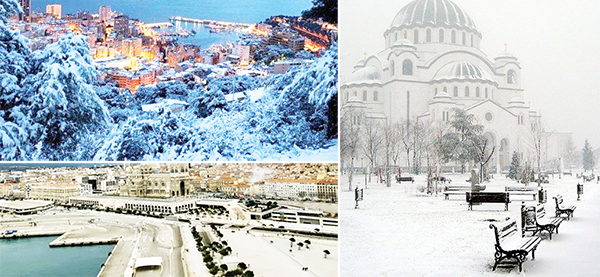

We used the same itinerary, but decided to move faster with fewer stops. Passing through with a quick stops in the railway stations in a few cities, was our new plan. The train travel provided us with a good feel of places we passed through. Eurail passes provided flexibility whenever we were compelled to change plans.
BACK TO FRANCE
Within two and half hours of leaving Barcelona, our train passed two border cities: Portbou on the Spanish side and Cerbére on the French side. Then we passed a couple of more snow-covered smaller French cities, Narbonne and Nîmes, before reaching our next quick stop – Marseilles.
Marseilles, a port city in Southern France, has been a crossroad of immigration and trade since its founding by the Greeks around 600 BC. It is the oldest city in France as well as one of Europe’s oldest continuously inhabited settlements. It is the third most populated city in France, after those of Paris and Lyon. In 1985, it had around 1.4 million residents. My previous knowledge of Marseilles was limited to some dramatic scenes filmed there for ‘The French Connection’, the Academy Award winning Best Picture of 1971.
Having been an important trading port since ancient times, Marseilles experienced a considerable commercial boom during the colonial period and especially during the 19th century, becoming a prosperous industrial and trading city. At its heart is the Vieux-Port (Old Port), where fishmongers sell their catch along the boat-lined quay. Unfortunately, in the middle of the winter, we did not see any fishmongers.
As an Executive Chef in the mid-1970s, once a week for my seafood buffets in Sri Lanka, I prepared and served bouillabaisse (well, my version of it!) the famous traditional Provençal fish stew originating in Marseilles. Although the Winter was not the best time for it, I was determined to try the authentic Bouillabaisse Marseillaise. It was lighter and different from my preparation. “Well, lost in translation!” I thought to myself enjoying a whole bowl with French bread and garlic butter in a small café. It was a perfect warm food for a cold day.
A dish similar to bouillabaisse also appears in Roman mythology: it is the soup that Venus fed to Vulcan. However, as the legend has it, bouillabaisse was created by Marseilles fishermen who wanted to make a meal in the boat during an overnight fishing expedition or when they returned to port. Rather than using the more expensive fish, they cooked the common rockfish and shellfish that they hauled in their nets and lines, usually fish too bony to serve in restaurants. These were cooked in a cauldron of water on a wood fire and seasoned with garlic and fennel. Tomatoes were added to the recipe in the 17th century, after their introduction from the Americas.


The name bouillabaisse comes from the method of the preparation—the ingredients are not added all at once. The broth is first boiled (bolh) then the different kinds of fish are added one by one, and each time the broth comes to a boil, the heat is lowered (abaissa).
When in the 19th century, as Marseilles became more prosperous, restaurants and hotels began to serve bouillabaisse to upper class patrons. The recipe of bouillabaisse became more refined, with the substitution of fish stock for boiling water and the addition of saffron. Bouillabaisse spread from Marseilles to Paris, and then gradually around the world adapted to local ingredients and tastes. When I cooked bouillabaisse in 1970s, as saffron was not available in Sri Lanka, I substituted with a pinch of turmeric but it never tasted the same.
We were happy to pass through Cannes, the well-known resort town on the French Riviera, famed for its highly respected international film festival. Its Boulevard de la Croisette, curving along the coast, is lined with sandy beaches, upmarket boutiques and palatial hotels. It snows only occasionally in Cannes, and It was our turn get that rare chance to see it. After 30 more minutes of travelling, we passed Nice. Once again, the trains were virtually frozen with no running water on tap and toilets.
Due to our changed plans, another city we had to quickly pass through was Nice on the French Riviera. Founded by the Greeks and later a retreat for 19th century European elite, the city has also long attracted artists. Former resident and famous French artist Henri Émile Benoît Matisse is honoured with a career-spanning collection of paintings at Musée Matisse. As a visual artist I was keen to visit it, but the time was not on our side. Some of the services in Nice were not available. The biggest challenge we faced was that all facilities to change money were closed. We only had four French Francs remaining and that was sufficient to get a bottle of water and pay coin-operated toilets.
The Principality of Monaco, is a small (with around 30,000 residents) sovereign city-state and microstate on the French Riviera. With an area of only 2.1 sq. kms, it is the second-smallest sovereign state in the world after the Vatican City. It did not appear to be like anything we have seen in movies and postcards. During our visit it looked like a winter wonderland. As we were rushing, we also had to forget about visiting the famous Monte Carlo Casino. It is widely recognised as one of the most expensive and wealthiest places in the world very close to the Italian border.


ITALY
We arrived at the Italian border around mid-night. We passed a small border town, Ventimiglia on the Gulf of Genoa, an area we knew. Due to our memorable two-month stay in Italy, three years prior, we felt comfortable in Italy. My wife still remembered a few words of Italian she learnt at the ILO Turin Centre when we lived there. She chatted with a Sicilian family in our night compartment. As the seats were adjustable as beds, after passport checks were over we managed to get a few hours sleep in the train. We passed a few beautiful Italian cities, Milan, Brescia and Verona, but unfortunately, we did not have much free time to do lengthy visits as our focus was to spend a full day in Venice.
Arriving in Venice was simply magical. We loved everything about this beautiful city with no new buildings, no motor vehicles, and no large streets. We arrived there before mid-day and were happy to change money and feel comfortable. After a long gondola ride, we had some of the best Italian food we tasted in three years in a small, but well-heated wayside restaurant. After that we took a taxi boat to Point di Rialto, and walked to Piazza San Marco, often known in English as St. Mark’s Square, the principal public square of Venice. Locals called it la Piazza.
As it was freezing, we covered ourselves with layers of clothing to enjoy a visit without missing any ‘must do stuff’ in Venice. We had some of our Italian favourites bringing us the happy memories of our Turin days – Succhi di Frutta, Gelato (although not the ideal weather for it) and Cappuccino. I was happy to note that the barista used exactly a third each espresso, steamed milk, and foam for the preparation.
We then proceed on a three-hour train journey to reach an interesting city which had changed hands a few times during the two World Wars – Trieste. It is a beautiful old port city, which occupies a thin strip of land between the Adriatic coast and Slovenia’s border on the limestone-dominated Karst Plateau. Italian, Austro-Hungarian and Slovenian influences are all evident in its layout, which encompasses a medieval old city and a neoclassical Austrian quarter. Eventually, in 1954 most parts of the city of Trieste joined Italy, whereas four adjoining villages became part of Yugoslavia.
YUGOSLAVIA
It was midnight when we passed a small border town, Villa Opicina, to reach the Italy- Yugoslavia border. Some passengers were angry as the taps and toilets were frozen. We felt like the poor passengers in the train scene during the winter in Siberia in the movie, ‘Doctor Zhivago’. The train was very crowded, noisy, and at times somewhat unruly until the Yugoslavian officials arrived to check visas.
We passed Ljubljana (today, Slovenia’s capital and largest city) around 1:00 am and reached Zagreb (now Croatia’s capital and largest city) around 4:00 am. Eventually we reached Belgrade (Serbia’s capital and largest city today), then the capital city of Yugoslavia, around 10:00 am. We had hardly slept, and were very tired.
As we got down from the train in the Yugoslavian capital, we felt that the English translation of the word ‘Belgrade’ as ‘White City’ or ‘White Fortress’ was totally justified. The city is named for its fortress, which was built on a white ridge that has been of great strategic importance throughout history. Originally the city walls were plastered white. The day we arrived there (January 20, 1985) a winter storm too was arriving, and the city was already covered with snow. We felt the ‘Brass Monkey weather’ right in our gut.


BARCELONA TO SOFIA IN
Belgrade is one of the oldest continuously inhabited cities in Europe and the world. It is also one of the most important prehistoric cultures of Europe. The Vinča culture evolved within the Belgrade area in the sixth millennium BC. It was conquered by the Romans under the reign of Augustus Caesar, and awarded Roman city rights in the mid-second century. In a fatally strategic position, the city has been battled over 100 wars. After many historic invasions by Turks, Austrians, Hungarians etc. over the centuries, in the period after the Serbian Revolution, Belgrade again was named the capital of Serbia in 1841. Belgrade became the capital of Yugoslavia from its creation in 1918 (to the dissolution of Yugoslavia in 2006).
In 1985, there were hardly any tourists from western countries in this city of 1.5 million out of the total national population of 22 million. Residents we met in dark and smoke-filled coffee shops all looked serious. We missed the happy laughter and friendly smiles we experienced in Venice the previous day. Uncertainty of the inclement weather may have been a reason for this.
People who worked in information counters and shops were not so friendly and did not speak any English. However, we were surprised to notice that Hollywood movies (with sub-titles) such as ‘Ghostbusters’ and TV soap operas such as ‘Dynasty’ had some following. As we arrived on a Sunday, all museums and left luggage facilities were closed. We walked around the historic part of the city with our bags. As we had couple of hours free before our next train, we decided to see a famous river.
The Danube
We did a tour around the banks of the Danube, a great river that was once a long-standing frontier of the Roman Empire and today connects 10 European countries, running through their territories, or forming a border. The river was not blue as implied in the famous 1867 waltz by the Austrian composer Johann Strauss II. “We should come back during the summer to see it blue,” I jokingly told my wife.
Originating in Germany, the Danube flows south-east for 2,850 km. We were happy to experience the Danube, the second-longest river in Europe, second in length only to the Volga in Russia. It passes through, or borders on, Austria, Czechoslovakia, Hungary, Yugoslavia, Romania, Bulgaria, and USSR (today, Ukraine) before draining into the Black Sea. Its drainage basin extends into nine more countries. During this trip we were visiting the four largest cities on the river: Vienna, Budapest, Belgrade and Bratislava. The Danube passes through many capital cities, more than any other river in the world.
BULGARIA
After meeting a friendly Bulgarian family who spoke a little English, our nine-hour train ride between Belgrade and Sofia became more pleasant. Belgrade to Sofia is

Will continue in next week’s article:
“Rejected from Romania, back to Bulgaria, Yugoslavia and Austria”