Features
Atomic Bombing of Hiroshima: 6th August Seventy-five years ago

By Kirthi Tennakone
The dwellers of the Japanese city Hiroshima resorted to their routine on 6th August 1945. That day the morning sky had been clear – people observed three air planes and descending parachutes. These are happenings to be expected at the time of a war and largely ignored.
Around 8.15 am a flash of light intensely brighter than the sun and a burning sense of heat terrified the population. The noiseless instant effect reacted more severely over a circular area of radius approximately 1 kilometer. Men, women and children exposed to the flash were incinerated to ash or fatally burnt. Cloths crumbled to pieces or spontaneously ignited – particularly if the shade is darker. A man dressed in white was burnt lightly, but his wife in black beside him died as a result of harsh burning. Most people within the range succumbed immediately- very few shielded by thick concrete survived. After fraction of a second a blast wave flattened almost every building in an area of nearly 40 square kilometers. A fireball formed created in the atmosphere expanded rapidly blowing a horrendously hot wind – setting fires everywhere up to a distance of about 4.5 kilometers from the centre. The pressure of the blast wave and heat of the rushing wind killed or wounded many more people. Expanding and a rising fireball created a white plume extending to the atmosphere up to a height of 6100 meters darkening the city as if night has befallen. Around 9 am a black toxic rain poured over a large area, sickening those who got wet. The death toll in the day of the incident exceeded 40,000 and subsequent mortality resulting from injuries was estimated to be more than 100,000.
ATOMIC BOMB
The Japanese government and most of the world at large could not immediately fathom how a ferocious calamity unheard previously was inflicted. A devastation of such magnitude would require dropping thousands of most powerful conventional bombs simultaneously – a technical impossibility. On August 7th, the American President Harry Truman announced ‘It is an atomic bomb. It is a harnessing of the basic power of the universe. The force from which the sun draws its power has been loosed against those who brought war to the Far East’. He further stated that the bomb had more power than 20000 tons TNT- more than 2000 times the blast power of British Grand Slam which is the largest bomb ever used in history of warfare.

Leo Szilard with Albert Einstein
Despite theoretical soundness of the argument of achieving an explosive nuclear chain reaction, the Manhattan project encountered many astounding practical challenges. Natural uranium occurs in two forms named as isotopes U(238) and U(235). A chain reaction is feasible only with U(235) occurring as 0.7 percent of the metal found in the uranium ores. Furthermore to initiate a chain reaction at least a critical mass of about 60 kilograms of U(235) is required. Refining the ore to obtain this amount was an arduous costly task. Another option explored has been to use plutonium instead of uranium. The advantage of the latter is the smaller critical mass 5-10 kilograms. Plutonium is not found in nature can be synthesized – again a time consuming costly affair. Expenses of the project ran to 100 million dollars a month!
The other hurdle was assembling of the critical mass.
The requisite amount of uranium or plutonium cannot be simply cast as an ingot. Moment the critical mass which depend on shape and density of the sample is reached. The chain reaction propagate emitting radiation, because even one neutron is sufficient for triggering. Some neutrons always exist in the environment and also produced by spontaneous fission uranium. A method planned was to collide two pieces of uranium in a gun-like device using dynamite so that their union creates the critical mass. Another method considered was casting uranium or plutonium into a sphere of calculated size and implode it to increase the density by firing an appendage ordinary explosives. These methods needed to be secured foolproof and tested.
TESTING THE BOMB
After three years of intensive activity, scientists and engineers at the Los Alamos Laboratory assembled an atom bomb on 13th July 1945. It was a plutonium device containing around 6 kilograms of this metal in the form of a sphere. Why was a plutonium bomb instead of uranium chosen for testing? The amount of weapons grade uranium available at that time was sufficient to make just one bomb, planned to be fired by the gun mechanism. Plutonium of much lower critical mass, adequate for several bombs was ready in the processing line. Furthermore, the implosion firing mechanism worked out for plutonium bombs demanded experimental confirmation.
Including accessories the bomb nicknamed ‘Gadget’ weighed nearly 5 metric tons. Gadget was transported to the testing site in the New Mexico desert and hoisted to a 100 m high steel tower. The bomb was scheduled to be exploded at 4 am 16th July 1945. However because of bad weather the time was pushed forward to 5.30 am. Scientists stationed 10 km away eagerly awaiting to watch the test were concerned. Some doubted whether the bomb would turnout to be a dud. Other pointed its power might exceed the expectation and pose danger to observers and community in the neighbourhood. Emphasizing this point, Edward Teller who later came to be known as the father of the hydrogen bomb distributed suntan cream.
When the trigger was switched-on at 5.30 am, the whole landscape was instantly lighted many times brighter than sunlight and a rising vividly coloured fireball appeared in the sky. The test was a success and a moment that changed the world forever. Seconds later the bang was felt, following a gush of wind. Physicist Enrico Fermi floated pieces of paper, timed their motion and quickly calculated the strength of the bomb, saying it is equivalent to 10 kilotons of TNT. More precise calculations carried out later revealed that strength was 22 kilotons.
BOMBING HIROSHIMA
The success of the atom bomb test was conveyed to President Truman but not publicly announced. general public inquisitive of the blinding flash and the bang were told an explosion occurred in an ammunition storage. President was planning to visit Germany to attend Potsdam conference – the famous big three Truman–Stalin–Churchill meeting. At the proceedings he hinted new development but did not elaborate. On 24th July Truman met Stalin casually and told him the United States has developed a weapon of unprecedented strength. Stalin did not react with excitement or interest and said ‘I hope the United States would make good use of it ‘. The reason for Stalin’s indifference became clear later. Soviet intelligence had been aware of the achievements in the Manhattan project.
Potsdam deceleration warned Japan to surrender unconditionally or suffer utter destruction – which Japan did not accept. Immediately the decision to drop atomic bombs on Japan was confirmed. The directive was said to be – hit Hiroshima, Kokura, Niigata or Nagasaki after 3rd August as weather permitted.
The bombing operation was assigned to Colonel Tibbets of the US Air Force. On August 6th early morning he took-off from Tinian Island air base in the Pacific carrying the bomb. Two other planes accompanied the B-29 bomber to monitor weather and parachute instruments to record the physical effects of the explosion. At about 8.15 am the pilot released the bomb from an altitude of 9.5 kilometers. The bomb fell down for 47 seconds and exploded at a height 600 meters above the ground – the triggering mechanism designed to explode the bomb in mid-air for the purpose of maximizing the destructive power. Tibbets who hurried away was at a safe distance of 18 kilometers when he observed the flash and the fireball.
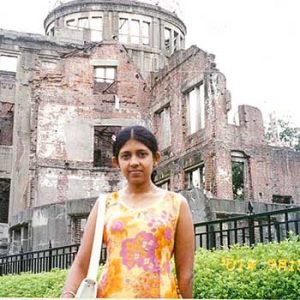
The bomb aimed to the Aioi Bridge missed the target by 250 meters and detonated overhead Shima Hospital flattening it instantly. Amazingly the structure of the Hiroshima Industrial Promotion Hall almost at the epicenter did not collapse. A temperature exceeding 4,000 degrees Celsius burnt the roof killing everybody inside, but the peculiar way in which the shockwave approached, left the structural shell largely intact. This landmark ruin named Atomic Bomb Dome serve as a memorial for lives lost and a reminder for peace.
I (the author of this article) visited Hiroshima in the year 2000. My daughter then a high school student posed in front of the dome for a photograph and smiled. When I said this not a place to smile. A group of Japanese visitors at the site understood what I meant and emotionally expressed appreciation of my remark.
WORLD AFTERMATH HIROSHIMA
Even after Hiroshima attack, Japan did not surrender but vowed to fight. Soviet Union declaring war on Japan 8th August 1945 and United States dropping of a second atomic bomb on Nagasaki next day changed the situation. On 15th August 1945 the Emperor Hirohito agreed unconditional surrender effectively ending Second World War. Some celebrated the bombings implicating it’s a lesson to warmongering and crimes committed, but those died were innocent civilians. The horror atomic bombings particularly the late effects of radiation continued to uncover as days and months passed. Nevertheless there were glorifications of nuclear weapons. Many nations strived hard acquire them, boost their destructive power and develop strategic methods of delivery. Human desire for increasing power of self-destructive weapons did not end with atom bomb. In 1952 United States tested first hydrogen bomb or the thermonuclear device based on nuclear fusion – the opposite of fission where lighter nuclei similar to hydrogen fuse together to yield heavier nuclei liberating extra-large quantity of energy – thousands of times stronger than the Hiroshima bomb. In the following year, the Soviet Union exploded a similar weapon. Between 1950 -1962 the competition of super powers in detonating nuclear bombs polluted the atmosphere- increasing the incidence of cancer.
The Limited Test Ban Treaty of 1963 forbid atmospheric tests. However, underground tests continued and the 1996 Comprehensive Nuclear Test Ban Treaty of the United Nations could not be strictly enforced as some nations avoided the agreement. On July 2017, United Nations proposed the resolution – The Treaty on the Prohibitions of Nuclear Weapons. The enforcement of the agreement require signature and ratification of 50 states. To date of the 82 countries, who have signed the treaty, only 40 have ratified it. Some countries seem to abstain from signing and ratifying the accord on the presumption that those who might not agree will pose a threat – vicious circle contradicting attitudes. Global citizens worldwide and a number organisations advocating peace, campaign to prohibit nuclear weapons. Most vociferous among them are the survived victims of Hiroshima and Nagasaki- popularly known as ‘hibakusha’. Their pledge is ‘so that the people of future generations will not have to experience hell on earth, we want to realise a world free of nuclear weapons while we are still alive’.
The first sitting US President to visit Hiroshima was Barak Obama. On May 26th , 2016, talking to a gathering there, Obama said ‘Technological progress without an equivalent progress in human institutions can doom us. The scientific revolution that led to the splitting of an atom require moral revolution as well ’.
Human greed – the limitless urge to acquire material possessions – is blind to dangers ensuing in the horizon, threatening their own existence. Nuclear weapons and excessive burning of fossil fuels are two examples.
The author Prof.Kirthi Tennakone, National Institute of Fundamental Studies can be reached via ktenna@yahoo.co.uk