Features
Anatomy of a Match: The Royal Thomian Up Close (Part I)

By Uditha Devapriya and Uthpala Wijesuriya

A cricket match that exists beyond cricket, the Royal Thomian is one of the most celebrated sports encounters in South Asia – and the world.
“Everyone turns into a different being here.”
A spectator at the Royal Thomian
A Historical Outline
The Royal Thomian is Sri Lanka’s most popular cricket encounter, more popular than the many test and ODI matches that dot the island nation’s sports calendar. It unfolds every March, customarily on a Thursday, Friday, and Saturday.
Every year, Old Boys take the first chance they get to return home, like a pilgrimage, through whatever way they can, to meet long lost friends, share a beer, sing, dance, and cheer. Yet while cricket occupies a secondary place there, the match itself occupies an important place in the history of the sport in Sri Lanka – and in South Asia.
Like tea plantations, public schools, and the civil service, cricket came to Sri Lanka through European colonisers, specifically the British. And like all things British, it was introduced by the colonisers to help insulate themselves from the locals.
In India, the first cricket clubs were formed in 1792. Four years later, the British annexed Sri Lanka, then known as Ceylon, from the Dutch.
Despite a promising start, cricket took time to get fully established in Ceylon. The island’s first cricket club was formed only in 1832. As in India, it came to be restricted to a narrow circle, including colonial officials, the military, and plantation owners.
This was a crucial period in the island’s history. In 1833, the British government appointed a Commission of Inquiry to assess the state of the country’s administration.
The Commission made several recommendations. Among these was the establishment of a public school to impart an English education and prepare the sons of elites for the civil service. In 1835, that school, the Colombo Academy, opened in the capital Colombo. Forty six years later it obtained a Royal decree, and was renamed Royal College.
Manned by Anglican missionaries and British headmasters, these schools promoted European culture and Western values. Sport, particularly cricket, became markers of social status, distancing their students from the world outside. The models adopted were invariably British, with Eton and Harrow as the preferred prototypes. Their clientele, so to speak, were the sons of planters, administrators, and chieftains.
In 1851 the Anglican Diocese of Colombo founded S. Thomas’ College. Unlike the Colombo Academy, which was non-denominational, the College sought to impart a religious education. In 1864, it held what is now regarded as the first school match in the country, where it managed to record an eight-run victory.
The Royal Thomian’s long saga commenced when the Colombo Academy appointed Ashley Walker, an Old Boy of Westminster College and a graduate of Cambridge – a Cambridge Blue, to boot – as a mathematics tutor in 1877.
Walker, celebrated today as the father of Ceylonese cricket, was soon appointed as Boarding Master at the Academy. He went out of his way to promote cricket at school and to this end formed a rather formidable student team.
Having developed the sport in the Academy, Walker then wrote to the Sub-Warden of S. Thomas’, outlining his plan for an inter-collegiate encounter.
The first recorded fixture of the “Academy versus College” match, as it was called at the time, took place in 1879, with Walker captaining the Academy. The Academy won the toss and elected to bat. At the day’s close, it emerged champions.
At the first match, the teams from both schools comprised of teachers and students. The format changed the following year when the students took the lead. The Academy prevailed at this encounter as well, with a lead of 62 runs.
From the beginning, the match took on the character of a social event, with the active if obligatory participation of the upper class. By now, the British experiment of implanting Western civilisation in the country had proved immensely successful.
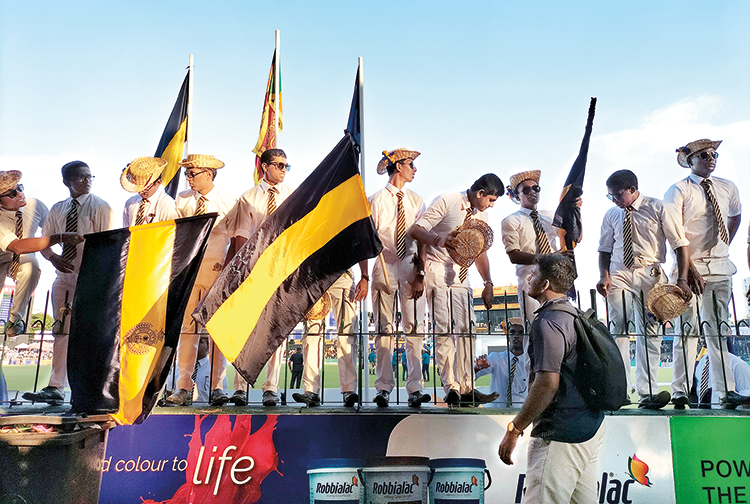

In this regard, for the upper classes, sport, in particular cricket, became more than just a game. Elite schools served a pivotal function in moulding their attitudes from an early age. At such institutions, cricket thus became a marker of social status.
As the years progressed, the schools and the match produced many of the country’s leading figures, including lawyers, doctors – and the country’s leaders.
In 1928 the match was rechristened the Senanayake Shield. Its namesake, D. S. Senanayake, who had played for S. Thomas’ more than 20 years earlier, would wind up as independent Ceylon’s first Prime Minister 20 years later.
1979 marked the centenary of the match. At the end of the Royal Thomian that year, the then Sri Lankan President, J. R. Jayewardene, who had played for Royal in 1925, granted permission to change it from a two-day to its current three-day format. Since then the match has been played without any major modifications.
This is, admittedly, an all too brief historical summary. Yet it underlies at least three essential points about the Royal Thomian. First, in the words of fervent Old Boys and diehard fans, it has “stopped for nothing.” Not even two World Wars have managed to stop it – even if, as 2021 and 2022 showed, it has had its share of delays and postponements. That has sealed it with a posterity enjoyed by very few other cricket matches elsewhere.
Second, such historical legacies tend to provoke the most passionate emotions – as they did in 2020, when the then President, facing a crisis during COVID-19, revealed at a meeting that he had asked the organisers to call the match off over health concerns. Ironically, in 2021, it was to the President’s nephew, the then Sports Minister, that a group of concerned Old Boys presented a petition, urging the government to grant permission to hold the match and help maintain “the distinction the encounter has had for generations.”
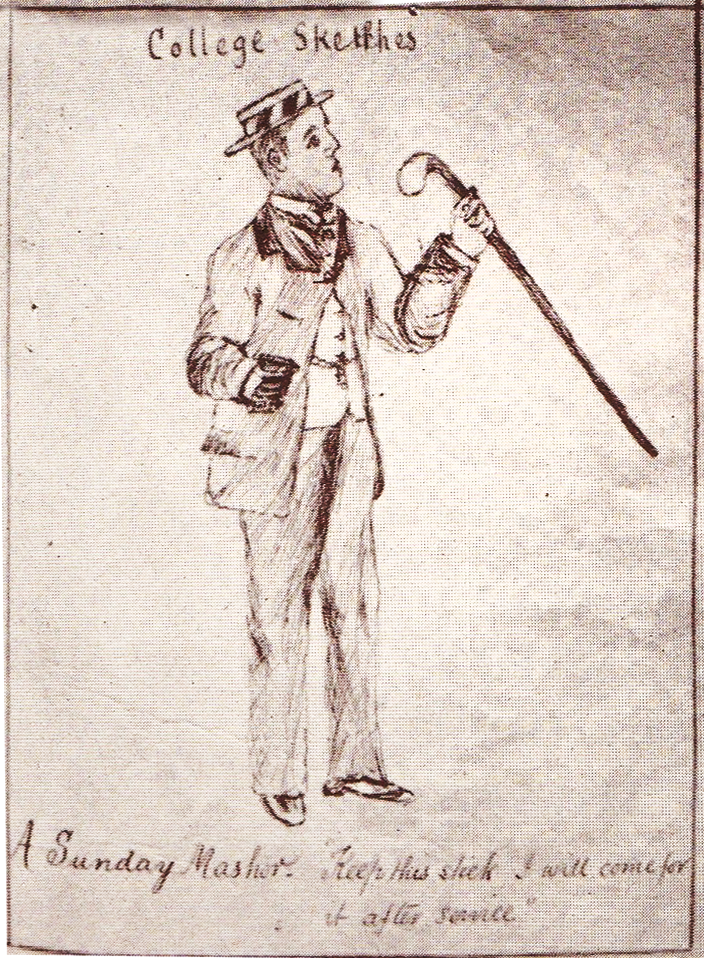
Royal-Thomian fashions in 1893
Third, and perhaps most significantly, the match serves as a backdrop or a culmination to a series of other events – each with their own histories behind them – which unfold like a ritual every March – lending themselves to the moniker “March Madness.”
Today, cricket, like every other facet of life in Sri Lanka, has become more grounded in Sri Lankan society: a far cry from what it used to be under colonial rule. This has been no less true of the Royal Thomian – though it has managed to maintain its elite veneer.
Class, Politics, and Baila
For all intents and purposes, the Royal Thomian is not just a cricket match. But to define it in terms of what it is not, is to ponder on what it is. That, however, depends on who you ask and what perspective you adopt. Perhaps the best way of defining it without essentialising it would be to examine the many contradictions that underlie it.
To outsiders, the Royal Thomian appears as a gathering of a social elite, a class which sees itself as superior to everyone else. But to insiders, there are no such demarcations: all those who make themselves part of the proceedings eventually fall in line with the mood of the event. “There’s nothing classist about the match,” one Old Boy, beer can in hand, says. His friend cheerily agrees: “It doesn’t matter where you come from.”
Certainly, the Royal Thomian – with its cacophony of baila, drinking, and endless merriment – is a far cry from what it used to be in the early 20th century. Back then – lodged between the Victorian and Edwardian eras – the event resembled an Ascot race, with sharply tailored suits and top hats all around. That era has long gone.
To be sure, students take pride in its elite character, and do everything to maintain its status. But that quality doesn’t really come out on the field or the many tents on both sides of the field. This is because the elite have their preferred spaces at the match: prominently at the Mustangs Tent, the male-only club with a history of more than a 100 years attracting the highest echelons of Sri Lankan society.
From corporate heads to heads of state to parliamentarians, everyone with a pass come to these corners and spaces to socialise, sing, dance, and cheer. Here, traditional rivalries transform into perennial friendships. It’s not unusual to spot MPs – Sri Lanka is an electoral democracy – who make a career out of bickering with each other, dancing, singing, even holding arms. Occasionally the members of these tents invite special guests: this year, it was the Indian High Commissioner and the US Ambassador.
Some of the invitees leave feeling dazed. As one former Ambassador recalls:
“Part of my work involved visiting government Ministers and Opposition lawmakers. They invariably badmouth each other. Seeing them hang out with each other so casually at the tent confused me. It almost felt like a drama.”
Old Boys, even students, would defend such contradictions on the grounds that the Royal Thomian is no place for politics: if you are part of the crowd – if you are an Old Boy – you bond with one another. And yet, these paradoxes invite their fair share of criticisms, with some accusing the match – and not altogether inaccurately – as whitewashing the excesses of the political elite, many of whom hail from either of the two schools.
It would be naive to claim that politics plays no part at the Royal Thomian. It does, often in not-so subtle or diplomatic ways. The 2015 encounter, for instance, unfolded three months after what was dubbed as a “Royalist coup”: the election of a government, most of whose Ministers had been educated at Royal College.
Indeed, as one newspaper editor pointed out at the time, “the subtext [of the match was] that these people were back in charge now.”
Responding to the charge, one MP bluntly agreed and added, “We’re bringing with us the values we learned at these schools: inclusiveness and common decency.”
Historically, the match has served as a backdrop for elite politics. For much of its post-independence period, the political leadership in Sri Lanka – Ceylon until it became a Republic in 1972 – shifted between two main parties, the United National Party (UNP) and the Sri Lanka Freedom Party (SLFP). Most of the country’s leaders hailed from leading schools, including Royal and S. Thomas’. The situation has changed today: there is more room for those from outside elite circles to enter the corridors of power.
It would be amiss to view elite schools as being immune to these developments. Such institutions have, in their own way, accommodated the social and political changes that have swept through the country since independence.
Still, the charge that events like the Royal Thomian are gathering spaces for the elite has managed to stick, the result being that social media users get hostile when match season is around the corner. Often they decry the match as a “snooty” affair.
To Be Continued Next Week
Uditha Devapriya is an international relations analyst, researcher, and freelance columnist who can be reached at udakdev1@gmail.com.
Uthpala Wijesuriya is a law and international relations student and history researcher who can be reached at wijesuriyau6@gmail.com.
Uditha and Uthpala are the two leads of U & U, an informal Sri Lankan collective that engages in art and culture research. Twitter handle: @uanduthoughts.