
Features
An untold history of Sri Lanka’s Independence


By Uditha Devapriya
In Sri Lank, as in every other colonial outpost, resistance to foreign domination predated Western intervention by well more than two centuries. Surviving numerous onslaughts of South Indian conquest, the Anuradhapura kingdom gave way to the Polonnaruwa kingdom in the 11th century AD. The latter’s demise 200 years later led to a shift from the country’s north to the north-west, and from there to the south-west. It was in the south-west that the Sinhalese first confronted European colonialism, a confrontation that pushed the Kotte and the Sitava kingdoms to the last bastion of Sinhalese rule, Kandy.
The shift to Kandy coincided with the commencement of Portuguese rule in the island. Both Portuguese and Dutch officials emphasised, and sharpened, the line between the Maritime Provinces and the kanda uda rata. The Sitavaka rulers, in particular Rajasinghe I, had fought both Portuguese suzerainty and Kotte domination. These encounters more or less breathed new life into the country’s long history of resistance to foreign rule.
The Kandyan kings inherited this legacy and imbibed this streak. But under them resistance to colonial subjugation acquired a new logic and a fresh vigour. That was to define the island’s struggle against imperialism for well more than three centuries.
Sri Lanka’s confrontations with European colonialism took place in the early part of what historians call the modern period. The social, political, and economic transformations inherent in this period had a considerable impact on the trajectory of European imperialism and anti-imperialism. For that reason, any examination of Sri Lanka’s fight against colonial rule and its eventual independence must evaluate a broad array of historical trends. While the island’s lunge into statehood in 1948 followed a long period of peasant, elite, and radical struggles against foreign domination, the analysis would be incomplete without reference to how European colonialism itself influenced the course of such struggles.
The period between the British annexation of the island and the declaration of independence (1815-1948) unfolded in four successive but interrelated stages. In the first stage between 1815 and 1848, British colonialism was compelled to reckon with the reality of an unending series of peasant uprisings, beginning in Uva-Wellassa in 1817 and culiminating in Matale three decades later. In keeping with similar insurrections in other colonial societies, these were essentially Janus-faced: on the one hand, they sought liberation for a repressed group, the Kandyan peasantry, while on the other they envisaged a return to a pre-colonial polity. Yet, whatever their motives, they wanted to free the country of foreign rule.
The British government realised too late, the folly of assuming that its political-military grip over the island would weaken, and prevail over, peasant resistance. Since the annexation of 1815, the colonial government had drawn and redrawn the country’s borders, breaking up the former Kandyan kingdom into Central and North-Western provinces and separating the Kandyan kingdom from its Sabaragamuwa and Wayamba peripheries. With these measures, officials hoped for the breakup of Kandyan unity. The aim of these processes, notes K. M. de Silva, was “to weaken the national feeling of the Kandyans”.
However, for obvious reasons, none of these reforms could quieten or dispel the spirit of resistance among the peasantry. The Kandyan peasantry never accepted the notion of Sri Lanka as a unitary and united administration overseen by the colonial government. Indeed, when the subject of constitutional reform came up in the 1920s, the Kandyan delegation demanded federal autonomy, predating Tamil nationalist claims for a separate homeland by three decades. This showed very clearly that the British policy of amalgamating the Kandyan provinces with the rest of the country had not really worked out.
To complicate matters further, while dealing with peasant rebellions colonial officials had to put up with the growth of an assertive, and often radical, middle-class. To give one example, the Matala Uprising was never limited to Matale and Kurunegala: it erupted in Colombo as well, where Sinhalese, Tamil, and Burgher middle-classes protested the government’s tax policies. K. M. de Silva observes that attempts by these middle-classes to influence Kandyan agitation “achieved little impact.” Yet that such an attempt was made at all showed that the colonial government had to reckon with two distinct dissenting groups.
The middle-classes may not have been revolutionaries, but as their interventions during the Matale Uprising showed, they could combine their dissatisfaction with the way things were with popular hatred of the government, to make their own demands. As a way of resolving this issue, between 1848 and 1870 – the second of the four periods pertinent to this essay – the colonial government began hiring and empowering a subservient elite, drawn from “the second echelon of the Kandyan nobility” as well as a low country bourgeoisie.
Newton Gunasinghe has noted the paradox underlying these reforms. While putting an end to the monopoly of the Kandyan aristocracy, the British government reactivated the very social relations that had undergirded traditional Kandyan society. By reviving rajakariya in modified form, feudal production relations in temple lands, and a network of gamsabhas, colonial authorities grafted archaic social customs and practices on what was, essentially, a capitalist mode of production. This had the effect of building up a class of subservient elites and reducing the revolutionary potential of the peasantry.
For a while, the strategy worked. However, while it kept the Kandyan peasantry in check and in control, it backfired when the same intermediate elite the government had employed to their ranks began demanding further reforms.
Here it’s important to clarify exactly what these elites wanted. In rebelling against the government, neither the newly co-opted aristocracy nor the middle-classes promoted the overthrow of the British government. They did not want a radical transformation of colonial society, largely because by then they had grown too dependent on that society to envisage, or desire, a Ceylon falling outside the British orbit. This is why, while clamouring for greater representation for themselves, they very carefully, and consistently, opposed the extension of the franchise. As Regi Siriwardena has noted, none of those celebrated as national heroes today – with the important exception of A. E. Goonesinha – wanted universal suffrage vis-à-vis the Donoughmore Commission. Such reforms had to be imposed on them.
Despite this, though, the British government’s policy of engaging with local elites worked fairly well. Colonial officials now had local emissaries through whom they could mediate potential peasant uprisings. Yet the policy necessitated the retention of archaic and quasi-feudal social relations, which in the long term stunted capitalist development. On the other hand, the new strategy paved the way for the revival of various art forms, most prominently the Dalada perahera. As scholars like Senake Bandaranayake have noted, the government defined the perimeters and the contours of cultural artefacts and objets d’art, ensuring that they were in line with the broader aim of legitimising colonial rule.
These reforms led, in the third period (1870-1915), to a Buddhist revival whose exponents alternated between championing opposing to and cooperation with colonial officials. These two lines were promoted, respectively, by the two Buddhist institutions of higher learning established in the late 19th century, Vidyalankara and Vidyodaya. While it’s rather difficult to draw a line between these two universities and their representatives, it is true, as H. L. Seneviratne suggests in The Work of Kings, that significant disagreements prevailed within the Buddhist clergy over the issue of British domination.
From their side, colonial authorities, especially governors like Henry Ward, William Gregory, and Arthur Gordon, sought closer cooperation with a conservative Buddhist bourgeoisie, legitimising British rule while implementing cultural and political reforms. Very often these reforms antagonised groups like Evangelical missionaries. Yet colonial officials ignored their concerns; endearing themselves to revivalists, orientalists, and moderate nationalist opinion to maintain the colonial administrative structure became the bigger priority.
The effect of these developments was to turn the Buddhist elite to the forefront of the reforms being supported by the British government. Towards the end of this period, the bourgeoisie, who were too entrenched economically in colonial rule to advocate radical change, yet too underrepresented politically to be content with the way things were, began to take the lead in these reforms through the Temperance Movement.
 The Temperance Movement provided an impetus for a number of other organisations. K. M. de Silva has argued that none of them – not even the ambitious Ceylon National Association – fulfilled the aims for which they had been set up. Ranging from communal outfits like the Dutch Burgher Union to commercial groups like the Plumbago Merchants Union, these organisations, for the most, preferred gradual to radical change, dispensing with the sort of agitation politics that would come to define the Indian National Congress.
Moreover, Hector Abhayavardhana has noted that the bulk of the Sinhalese elite leadership consisted of “small men with narrow vision” who wanted to bring religion into politics. Any hopes for a multicultural alliance faded away with the establishment of Mahajana Sabhas, which campaigned for Buddhist candidates. However highly one may have thought of outfits like the Jaffna Youth Congress, the lack of enthusiasm for such alliances, among the colonial bourgeoisie, paved the way for their inevitable and tragic demise.
Meanwhile, the colonial bourgeoisie faced a more formidable foe, or competitor, in the form of nationalist firebrands like Anagarika Dharmapala. In a bid to blunt the fervour of such firebrands, who they viewed with much distaste, the Sinhalese bourgeoisie toed the Vidyodaya line, promoting change within the framework of a plantation economy while seeking more representation for themselves. This was necessitated by expedience: by the early 20th century a working class movement had begun to emerge in the country, as the Carters’ Strike of 1906 showed, and though it lacked proper leadership, it nevertheless concerned the bourgeoisie. Their rather ambivalent response to these developments had the unfortunate effect of stunting the rise of a mass struggle in the country.
The comprador bourgeoisie shot to fame, so to speak, with the 1915 riots. A point often forgotten in contemporary reconstructions of the riots is that none of the elites arrested by the British government posed a direct threat to colonial rule. As Kumari Jayawardena has pointed out, it was a case of official overreaction to the faintest threat of an anti-colonial uprising. Much like the J. R. Jayewardene government proscribing the Left after the 1983 riots, there was no link between the riots and the causes attributed to it, be it the supposed agitation of Buddhist elites or the politics of the Temperance Movement.
Kumari Jayawardena and K. M. de Silva point out that the period after the 1915 riots – the fourth period relevant to our discussion – witnessed the dulling down and fading away of the Buddhist revival. This is indeed what happened. In the person of Anagarika Dharmapala, the revival had brought together both reformist and radical streams. The Sinhalese elites, obviously cooperating with British authorities, marginalised him to the extent of excluding him from political activity. Yet Dharmapala’s departure from the island gave rise to newer parties and forms of struggle, many of them inspired by his vision. Among these, the most prominent was the Labour Party, founded in 1928 by A. E. Goonesinha.
Naturally enough, working class unrest dominated much of the post-1915 period, leading to the formation of a broad, radical Left. The newly formed Left identified the limitations of Goonesinha’s politics and sought to transcend them. To this end the establishment of the Lanka Sama Samaja Party (LSSP), in 1935, marked a pivotal turning point in the country’s lunge towards independent statehood. Envisioning a complete, radical transformation of society, its representatives and ideologues broke with the dominant political outfit of the day, the Ceylon National Congress, charting their own course.
The LSSP’s original objectives, as radical in their time as in ours, included the socialisation of the means of production, the attainment of complete independence, and the abolition of all forms of inequality, including caste. Given the state of the economy at the time – it was a plantation enclave heavily dependent on a few sectors – no other programme would have sufficed for an organisation calling for a mass struggle against colonial rule. It goes without saying that it was the stalwarts of the Marxist Left – specifically Philip Gunawardena – who first advocated complete independence for Ceylon.
In the meantime, the colonial bourgeoisie managed, rather dismally, to turn the Ceylon National Congress into a pale echo of what it had once aspired to. With the departure of Ponnambalam Arunachalam in 1921, there came an end to an era where, as K. M. de Silva and Hector Abhayavardhana have observed, Sinhala and Tamil communities constituted in unison the majority of the country. In the hands of a predominantly Sinhalese bourgeoisie the Congress became a little more than a communal organisation, a point reinforced by the decision of its leaders to disenfranchise estate Tamils. In this they were occupied more than anything else with the preservation of their economic interests.
All these developments led to a situation where the Left could claim, very validly, that the ruling elite had not won independence, but had secured it on a platter from Whitehall. The elite themselves were not unaware of the inadequacy of their campaign for freedom: when the masses reacted vociferously against the cosmetic reforms they had obtained from the British government, the Congress bourgeoisie quickly went back and pressed for what was being demanded. Yet tied to three agreements which made the defence, foreign policy, and civil service blanks of the government subservient to British interests, Ceylon could become free only through a radical transformation of its political structures.
In breaking off all remaining ties with the colonial government, the 1972 Constitution sought to give effect to such a transformation. By then even the Sinhalese bourgeoisie had come to realise the folly of maintaining the status quo and the inevitability of change: whereas John Kotelawala could support Ceylon remaining a Dominion, Dudley Senanayake could a decade later support the idea of it becoming a Republic within the Commonwealth.
I believe we need a new account of our country’s emergence as an independent state. The accounts we have at present, barring very few, glorify one set of leaders over all others, marginalising and excluding everyone else. Conventional narratives depict the colonial elite as national heroes. This was not always so, though important differences did exist within the bourgeoisie. What we have learnt about our own independence is hardly adequate to the task of helping us understand our past. We badly need a new history.
The writer can be reached at udakdev1@gmail.com



by Dr Gotabhya Ranasinghe
Senior Consultant Cardiologist
National Hospital Sri Lanka
When we sought a meeting with Hon Dr. Ramesh Pathirana, Minister of Health, he graciously cleared his busy schedule to accommodate us. Renowned for his attentive listening and deep understanding, Minister Pathirana is dedicated to advancing the health sector. His openness and transparency exemplify the qualities of an exemplary politician and minister.
Dr. Palitha Mahipala, the current Health Secretary, demonstrates both commendable enthusiasm and unwavering support. This combination of attributes makes him a highly compatible colleague for the esteemed Minister of Health.
Our discussion centered on a project that has been in the works for the past 30 years, one that no other minister had managed to advance.
Minister Pathirana, however, recognized the project’s significance and its potential to revolutionize care for heart patients.
The project involves the construction of a state-of-the-art facility at the premises of the National Hospital Colombo. The project’s location within the premises of the National Hospital underscores its importance and relevance to the healthcare infrastructure of the nation.
This facility will include a cardiology building and a tertiary care center, equipped with the latest technology to handle and treat all types of heart-related conditions and surgeries.
Securing funding was a major milestone for this initiative. Minister Pathirana successfully obtained approval for a $40 billion loan from the Asian Development Bank. With the funding in place, the foundation stone is scheduled to be laid in September this year, and construction will begin in January 2025.
This project guarantees a consistent and uninterrupted supply of stents and related medications for heart patients. As a result, patients will have timely access to essential medical supplies during their treatment and recovery. By securing these critical resources, the project aims to enhance patient outcomes, minimize treatment delays, and maintain the highest standards of cardiac care.
Upon its fruition, this monumental building will serve as a beacon of hope and healing, symbolizing the unwavering dedication to improving patient outcomes and fostering a healthier society.We anticipate a future marked by significant progress and positive outcomes in Sri Lanka’s cardiovascular treatment landscape within the foreseeable timeframe.

by Fr. Emmanuel Fernando, OMI
Jesuit Fr. Aloysius Pieris (affectionately called Fr. Aloy) celebrated his 90th birthday on April 9, 2024 and I, as the editor of our Oblate Journal, THE MISSIONARY OBLATE had gone to press by that time. Immediately I decided to publish an article, appreciating the untiring selfless services he continues to offer for inter-Faith dialogue, the renewal of the Catholic Church, his concern for the poor and the suffering Sri Lankan masses and to me, the present writer.
It was in 1988, when I was appointed Director of the Oblate Scholastics at Ampitiya by the then Oblate Provincial Fr. Anselm Silva, that I came to know Fr. Aloy more closely. Knowing well his expertise in matters spiritual, theological, Indological and pastoral, and with the collaborative spirit of my companion-formators, our Oblate Scholastics were sent to Tulana, the Research and Encounter Centre, Kelaniya, of which he is the Founder-Director, for ‘exposure-programmes’ on matters spiritual, biblical, theological and pastoral. Some of these dimensions according to my view and that of my companion-formators, were not available at the National Seminary, Ampitiya.
Ever since that time, our Oblate formators/ accompaniers at the Oblate Scholasticate, Ampitiya , have continued to send our Oblate Scholastics to Tulana Centre for deepening their insights and convictions regarding matters needed to serve the people in today’s context. Fr. Aloy also had tried very enthusiastically with the Oblate team headed by Frs. Oswald Firth and Clement Waidyasekara to begin a Theologate, directed by the Religious Congregations in Sri Lanka, for the contextual formation/ accompaniment of their members. It should very well be a desired goal of the Leaders / Provincials of the Religious Congregations.
Besides being a formator/accompanier at the Oblate Scholasticate, I was entrusted also with the task of editing and publishing our Oblate journal, ‘The Missionary Oblate’. To maintain the quality of the journal I continue to depend on Fr. Aloy for his thought-provoking and stimulating articles on Biblical Spirituality, Biblical Theology and Ecclesiology. I am very grateful to him for his generous assistance. Of late, his writings on renewal of the Church, initiated by Pope St. John XX111 and continued by Pope Francis through the Synodal path, published in our Oblate journal, enable our readers to focus their attention also on the needed renewal in the Catholic Church in Sri Lanka. Fr. Aloy appreciated very much the Synodal path adopted by the Jesuit Pope Francis for the renewal of the Church, rooted very much on prayerful discernment. In my Religious and presbyteral life, Fr.Aloy continues to be my spiritual animator / guide and ongoing formator / acccompanier.
Fr. Aloysius Pieris, BA Hons (Lond), LPh (SHC, India), STL (PFT, Naples), PhD (SLU/VC), ThD (Tilburg), D.Ltt (KU), has been one of the eminent Asian theologians well recognized internationally and one who has lectured and held visiting chairs in many universities both in the West and in the East. Many members of Religious Congregations from Asian countries have benefited from his lectures and guidance in the East Asian Pastoral Institute (EAPI) in Manila, Philippines. He had been a Theologian consulted by the Federation of Asian Bishops’ Conferences for many years. During his professorship at the Gregorian University in Rome, he was called to be a member of a special group of advisers on other religions consulted by Pope Paul VI.
Fr. Aloy is the author of more than 30 books and well over 500 Research Papers. Some of his books and articles have been translated and published in several countries. Among those books, one can find the following: 1) The Genesis of an Asian Theology of Liberation (An Autobiographical Excursus on the Art of Theologising in Asia, 2) An Asian Theology of Liberation, 3) Providential Timeliness of Vatican 11 (a long-overdue halt to a scandalous millennium, 4) Give Vatican 11 a chance, 5) Leadership in the Church, 6) Relishing our faith in working for justice (Themes for study and discussion), 7) A Message meant mainly, not exclusively for Jesuits (Background information necessary for helping Francis renew the Church), 8) Lent in Lanka (Reflections and Resolutions, 9) Love meets wisdom (A Christian Experience of Buddhism, 10) Fire and Water 11) God’s Reign for God’s poor, 12) Our Unhiddden Agenda (How we Jesuits work, pray and form our men). He is also the Editor of two journals, Vagdevi, Journal of Religious Reflection and Dialogue, New Series.
Fr. Aloy has a BA in Pali and Sanskrit from the University of London and a Ph.D in Buddhist Philosophy from the University of Sri Lankan, Vidyodaya Campus. On Nov. 23, 2019, he was awarded the prestigious honorary Doctorate of Literature (D.Litt) by the Chancellor of the University of Kelaniya, the Most Venerable Welamitiyawe Dharmakirthi Sri Kusala Dhamma Thera.
Fr. Aloy continues to be a promoter of Gospel values and virtues. Justice as a constitutive dimension of love and social concern for the downtrodden masses are very much noted in his life and work. He had very much appreciated the commitment of the late Fr. Joseph (Joe) Fernando, the National Director of the Social and Economic Centre (SEDEC) for the poor.
In Sri Lanka, a few religious Congregations – the Good Shepherd Sisters, the Christian Brothers, the Marist Brothers and the Oblates – have invited him to animate their members especially during their Provincial Congresses, Chapters and International Conferences. The mainline Christian Churches also have sought his advice and followed his seminars. I, for one, regret very much, that the Sri Lankan authorities of the Catholic Church –today’s Hierarchy—- have not sought Fr.
Aloy’s expertise for the renewal of the Catholic Church in Sri Lanka and thus have not benefited from the immense store of wisdom and insight that he can offer to our local Church while the Sri Lankan bishops who governed the Catholic church in the immediate aftermath of the Second Vatican Council (Edmund Fernando OMI, Anthony de Saram, Leo Nanayakkara OSB, Frank Marcus Fernando, Paul Perera,) visited him and consulted him on many matters. Among the Tamil Bishops, Bishop Rayappu Joseph was keeping close contact with him and Bishop J. Deogupillai hosted him and his team visiting him after the horrible Black July massacre of Tamils.
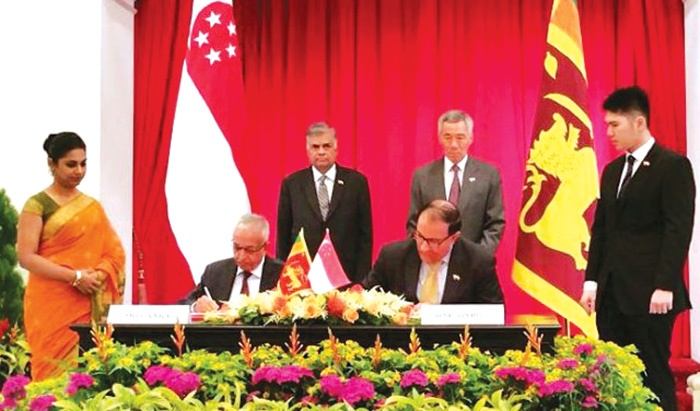
Sri Lanka-Singapore Free Trade Agreement
By Gomi Senadhira
senadhiragomi@gmail.com
“You might tell fairy tales, but the progress of a country cannot be achieved through such narratives. A country cannot be developed by making false promises. The country moved backward because of the electoral promises made by political parties throughout time. We have witnessed that the ultimate result of this is the country becoming bankrupt. Unfortunately, many segments of the population have not come to realize this yet.” – President Ranil Wickremesinghe, 2024 Budget speech
Any Sri Lankan would agree with the above words of President Wickremesinghe on the false promises our politicians and officials make and the fairy tales they narrate which bankrupted this country. So, to understand this, let’s look at one such fairy tale with lots of false promises; Ranil Wickremesinghe’s greatest achievement in the area of international trade and investment promotion during the Yahapalana period, Sri Lanka-Singapore Free Trade Agreement (SLSFTA).
It is appropriate and timely to do it now as Finance Minister Wickremesinghe has just presented to parliament a bill on the National Policy on Economic Transformation which includes the establishment of an Office for International Trade and the Sri Lanka Institute of Economics and International Trade.
Was SLSFTA a “Cleverly negotiated Free Trade Agreement” as stated by the (former) Minister of Development Strategies and International Trade Malik Samarawickrama during the Parliamentary Debate on the SLSFTA in July 2018, or a colossal blunder covered up with lies, false promises, and fairy tales? After SLSFTA was signed there were a number of fairy tales published on this agreement by the Ministry of Development Strategies and International, Institute of Policy Studies, and others.
However, for this article, I would like to limit my comments to the speech by Minister Samarawickrama during the Parliamentary Debate, and the two most important areas in the agreement which were covered up with lies, fairy tales, and false promises, namely: revenue loss for Sri Lanka and Investment from Singapore. On the other important area, “Waste products dumping” I do not want to comment here as I have written extensively on the issue.
1. The revenue loss
During the Parliamentary Debate in July 2018, Minister Samarawickrama stated “…. let me reiterate that this FTA with Singapore has been very cleverly negotiated by us…. The liberalisation programme under this FTA has been carefully designed to have the least impact on domestic industry and revenue collection. We have included all revenue sensitive items in the negative list of items which will not be subject to removal of tariff. Therefore, 97.8% revenue from Customs duty is protected. Our tariff liberalisation will take place over a period of 12-15 years! In fact, the revenue earned through tariffs on goods imported from Singapore last year was Rs. 35 billion.
The revenue loss for over the next 15 years due to the FTA is only Rs. 733 million– which when annualised, on average, is just Rs. 51 million. That is just 0.14% per year! So anyone who claims the Singapore FTA causes revenue loss to the Government cannot do basic arithmetic! Mr. Speaker, in conclusion, I call on my fellow members of this House – don’t mislead the public with baseless criticism that is not grounded in facts. Don’t look at petty politics and use these issues for your own political survival.”
I was surprised to read the minister’s speech because an article published in January 2018 in “The Straits Times“, based on information released by the Singaporean Negotiators stated, “…. With the FTA, tariff savings for Singapore exports are estimated to hit $10 million annually“.
As the annual tariff savings (that is the revenue loss for Sri Lanka) calculated by the Singaporean Negotiators, Singaporean $ 10 million (Sri Lankan rupees 1,200 million in 2018) was way above the rupees’ 733 million revenue loss for 15 years estimated by the Sri Lankan negotiators, it was clear to any observer that one of the parties to the agreement had not done the basic arithmetic!
Six years later, according to a report published by “The Morning” newspaper, speaking at the Committee on Public Finance (COPF) on 7th May 2024, Mr Samarawickrama’s chief trade negotiator K.J. Weerasinghehad had admitted “…. that forecasted revenue loss for the Government of Sri Lanka through the Singapore FTA is Rs. 450 million in 2023 and Rs. 1.3 billion in 2024.”
If these numbers are correct, as tariff liberalisation under the SLSFTA has just started, we will pass Rs 2 billion very soon. Then, the question is how Sri Lanka’s trade negotiators made such a colossal blunder. Didn’t they do their basic arithmetic? If they didn’t know how to do basic arithmetic they should have at least done their basic readings. For example, the headline of the article published in The Straits Times in January 2018 was “Singapore, Sri Lanka sign FTA, annual savings of $10m expected”.
Anyway, as Sri Lanka’s chief negotiator reiterated at the COPF meeting that “…. since 99% of the tariffs in Singapore have zero rates of duty, Sri Lanka has agreed on 80% tariff liberalisation over a period of 15 years while expecting Singapore investments to address the imbalance in trade,” let’s turn towards investment.
Investment from Singapore
In July 2018, speaking during the Parliamentary Debate on the FTA this is what Minister Malik Samarawickrama stated on investment from Singapore, “Already, thanks to this FTA, in just the past two-and-a-half months since the agreement came into effect we have received a proposal from Singapore for investment amounting to $ 14.8 billion in an oil refinery for export of petroleum products. In addition, we have proposals for a steel manufacturing plant for exports ($ 1 billion investment), flour milling plant ($ 50 million), sugar refinery ($ 200 million). This adds up to more than $ 16.05 billion in the pipeline on these projects alone.
And all of these projects will create thousands of more jobs for our people. In principle approval has already been granted by the BOI and the investors are awaiting the release of land the environmental approvals to commence the project.
I request the Opposition and those with vested interests to change their narrow-minded thinking and join us to develop our country. We must always look at what is best for the whole community, not just the few who may oppose. We owe it to our people to courageously take decisions that will change their lives for the better.”
According to the media report I quoted earlier, speaking at the Committee on Public Finance (COPF) Chief Negotiator Weerasinghe has admitted that Sri Lanka was not happy with overall Singapore investments that have come in the past few years in return for the trade liberalisation under the Singapore-Sri Lanka Free Trade Agreement. He has added that between 2021 and 2023 the total investment from Singapore had been around $162 million!
What happened to those projects worth $16 billion negotiated, thanks to the SLSFTA, in just the two-and-a-half months after the agreement came into effect and approved by the BOI? I do not know about the steel manufacturing plant for exports ($ 1 billion investment), flour milling plant ($ 50 million) and sugar refinery ($ 200 million).
However, story of the multibillion-dollar investment in the Petroleum Refinery unfolded in a manner that would qualify it as the best fairy tale with false promises presented by our politicians and the officials, prior to 2019 elections.
Though many Sri Lankans got to know, through the media which repeatedly highlighted a plethora of issues surrounding the project and the questionable credentials of the Singaporean investor, the construction work on the Mirrijiwela Oil Refinery along with the cement factory began on the24th of March 2019 with a bang and Minister Ranil Wickremesinghe and his ministers along with the foreign and local dignitaries laid the foundation stones.
That was few months before the 2019 Presidential elections. Inaugurating the construction work Prime Minister Ranil Wickremesinghe said the projects will create thousands of job opportunities in the area and surrounding districts.
The oil refinery, which was to be built over 200 acres of land, with the capacity to refine 200,000 barrels of crude oil per day, was to generate US$7 billion of exports and create 1,500 direct and 3,000 indirect jobs. The construction of the refinery was to be completed in 44 months. Four years later, in August 2023 the Cabinet of Ministers approved the proposal presented by President Ranil Wickremesinghe to cancel the agreement with the investors of the refinery as the project has not been implemented! Can they explain to the country how much money was wasted to produce that fairy tale?
It is obvious that the President, ministers, and officials had made huge blunders and had deliberately misled the public and the parliament on the revenue loss and potential investment from SLSFTA with fairy tales and false promises.
As the president himself said, a country cannot be developed by making false promises or with fairy tales and these false promises and fairy tales had bankrupted the country. “Unfortunately, many segments of the population have not come to realize this yet”.
(The writer, a specialist and an activist on trade and development issues . )



US sports envoys to Lanka to champion youth development

Rahuman questions sudden cancellation of leave of CEB employees


