Features
A visionary garden designed with such care

Green in all its brilliant shades; vast undulating open spaces; clumps of trees; water to be seen and a distant white dagoba. Peace and absolute serenity and excellent service with the helpers showing concern and sincerely desiring to please. All this and more during a weekend spent in a famous garden. There were four of us


I had previously walked around this garden which is a showpiece of pride to our country, with my son explaining each piece of it and sat in the verandah of the house which too he gave the history of, and much more. But this was my first relaxed overnight stay. I soaked in the solitude; the unbroken stretches of nature; the vistas at dawn, midday, dusk with twilight gently descending. The moon illumined the wide verandah of the house and lawns giving an entirely different perspective.
We had our meals out in the garden of the main house, in the different locations the owner would breakfast, lunch and dine in. Breakfast was on the front entry terrace of the house; lunch in a corner of the garden and dinner on the north terrace with lights glimmering in the distance. Most of the dishes served were what the owner would have had. Our lunch after arrival was rice and curry. Dinner offered a choice of fish prepared in two ways or chicken, pasta and homemade bread. Breakfast meant hot, hot hoppers with spicy accompanying curries.

The Place
The weekend was spent at Lunuganga; me with three architects: well known, C Anjalendran who had worked with Geoffrey Bawa and then served as his unpaid assistant for 20 years, spending most weekends at Lunuganga with the great man. The other – my architect son, an ardent admirer of Bawa; and a young, just graduated architecture student. Thus it was a unique two days, not only staying in a special place but with interesting conversations and introductions by Anjalendran to the history and evolution of Lunuganga. Many were informal conversations with nuggets of information and memories narrated; but one was a proper lecture with all the staff invited to it. Thus we got to know anecdotes, character traits of Geoffrey Bawa and his brother Bevis too, and how this special place came into being.
History of Lunuganga
In January1948, the year his mother died, Geoffrey Bawa (1919 -2003) bought a neglected rubber plantation a few miles interior to Bentota. Upon first sight of the land, Bawa knew for sure it could be made the garden he had created in his mind. He had returned from Cambridge with a Tripos in English, but design and architecture were what his intellect drove him to. His brother Bevis had already designed and constructed his garden residence – Brief – also in Bentota, in 1938.
Anjalendran had a long tale to tell about the purchase of the rubber estate which meant buying and building in a sort of musical chairs enactment, music being substituted with coaxing, promises and money. The estate was the dowry endowment of a lady living in Bentota. She had rented the then dilapidated house to the tax officer of the area. He said he would budge only if he got possession of a house in Bentota occupied by another government servant. This latter gent agreed to move if he got possession of the schoolmaster’s house down by the sea. Hence Bawa approached this last person. He said he would vacate his house if a new one was built for him. Thus the building of this house resulted in Geoffrey Bawa finally becoming the owner of the 15-acre rubber estate after “controlled patience and determination and occasional bouts of despair.”
He wrote to friend Jean Chamberlain, “When I had first seen Lunuganga I had known that with a first few clearings of trees and opening up of obvious vistas an inevitable basic pattern would emerge. It was enormously exciting, and the morning after the dramatic breaking of walls and the feel of possession, the adventure began and adventure that has lasted 40 years and the pleasure of which has never palled.”
The old house was completely renovated and reoriented with the back becoming the front. Various buildings were added over time as the garden was being reshaped. Today the property is under the care of the Geoffrey Bawa Trust and operated impeccably as a boutique hotel by Teardrop Hotels. Many of the staff have been at the property for a decade or more.

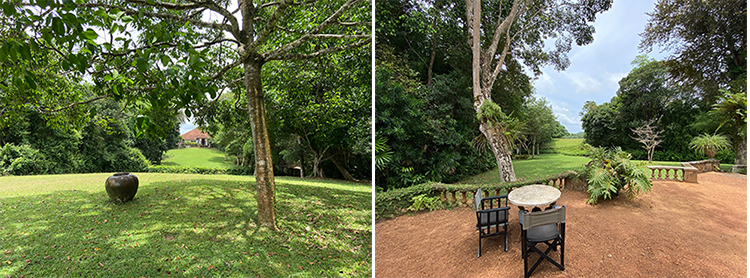
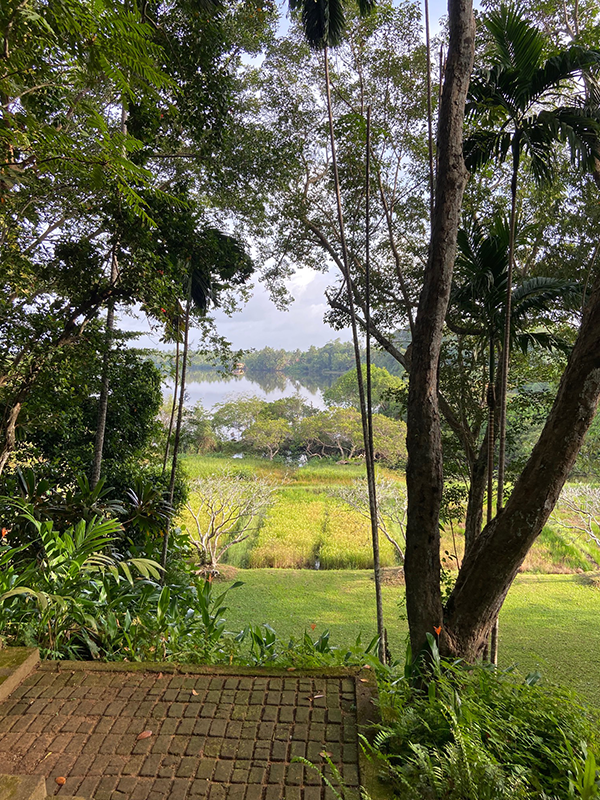
Pointing to the verdant island in the middle of Dedduwa Lake beside which Lunuganga stretches, Anjalendran said that it was a belief propagated by temple lore that the restless spirit of a long dead monk lived in a tree on the island. Maybe he turned a benign eye on the new owner of the land as he started creating his heart’s desire of a unique garden. Ulrik Plesner, Bawa’s early collaborator in the 1960s, was a constant visitor and offered suggestions. To improve views, the land was meticulously ‘structured’ with massive earthworks, transport of soil and depositing it elsewhere so that the present slightly terraced slopes were achieved. Trees were studiedly left standing or cut down. Cinnamon Hill seen from the back of the house was lowered so that a sliver of lake at the far end could be seen. Marvelously, the distant view was interrupted but enhanced by placing a large jar at a spot under a Moonama tree. As Plesner writes “By placing a big old Portuguese jar under an old tree in the middle distance, several square kilometers of lagoon and jungle and even the temple itself have been drawn into the garden. It is strange how one can civilize a whole landscape with a single pot.”
I quote from the monograph Lunuganga published by Geoffrey Bawa with Christoph Bon and Dominic Sansoni in the late 1980s. “Bawa continued to shape and change Lunuganga until the very end of his practice; even when he was taken ill and immobile. In fact, he continued to spend time in the gardens even in the final stages of his life; and the soothing qualities of the place prevail even today. It is both an ever-transient place and one where time stands still; a subtle change in the position of the sun or the direction of the wind will completely change the dance of leaves at Lunuganga and its entire atmosphere. Yet it feels as though the gardens have always been there, we feel assured that it will remain.”
Though confined to a wheel chair after his first stroke, Bawa undeterred, went daily around the garden, pointing out work that had to be done like lopping off view obstructing branches of trees.
On our return to Colombo we dropped by at Brief, built by Bevis Bawa modeled on French and British palace gardens. The contrast between the two gardens, to even a novice like me, was obvious. One is conventional, with ordered lawns, discrete outdoor rooms and terraced flower beds, the other seemingly wild yet carefully planned, stark yet lush. The only flower ‘allowed’ at Lunuganga seems to be frangipani. The very old tree right in front of the verandah which has thick branches almost grazing the ground had shed its leaves and its white flowers too were few and far between. Bawa had deliberately moulded the tree by placing weights on its lowest branches so they grew horizontally, almost touching the earth before rising higher.
Two quoted remarks made to Geoffrey Bawa sums up the varied reactions to the place from puzzlement to contentment and appreciation. A city dwelling woman had commented to Bawa on seeing Lunuganga for the first time: “This would be a lovely place to have a garden.” In contrast, a lorry driver who had arrived to unload bricks said: “Meka Nam Hari Seedevi Thenak!”