Features
A Tribute to Ena on her 100th Birthday

by Anila Dias Bandaranaike
Sunday, October 23, 2022 was the 100th birth anniversary of Ena de Silva, nee Aluwihare. During the past week, her unique contribution over 70 years, to reviving traditional crafts and to style, beauty and design in Sri Lanka and elsewhere, have been celebrated in many wonderful ways.
I was one of her younger generation, who was privileged to be a part of her amazingly rich life. She shared that life so generously with many, and among them, my brother Rajiva, her favourite travel companion; a circle of my closest friends, Shanthi, Priyani, Harin and Radhika; my immediate family, Romesh, Ravi and Anisha; her Ratwatte nephews and her daughter, Kusum. Together, we spent unforgettable holidays at “Alu” and elsewhere, experiencing Sri Lanka’s incredible bio-diversity and rich history, made all the more exciting by having Ena with us, learning from Ena’s vast knowledge, understanding, artistic perspective and forbearance.
Today, I look back with joy and gratitude on the many roles she played in my life as “Aunt”, friend, partner-in-adventure, confidante (after my mother died) and role-model.
Ena was born to many privileges and social advantages in life, as well as being gifted with incredible physical beauty, a razor-sharp intellect and artistic abilities bordering on genius. In this life, one cannot take credit for the advantages of birth, physical or intellectual attributes that one has been endowed with. To my mind, it is how one uses those advantages and gifts to make this world a better place in one’s journey through life, and the lives one has touched positively on that journey, that count in the final anaylsis.
Ena touched many lives, and that was what made “Aunt” so unique and so very special. She shared close and special bonds with each member of her immediate family. Yet, her world extended to another realm.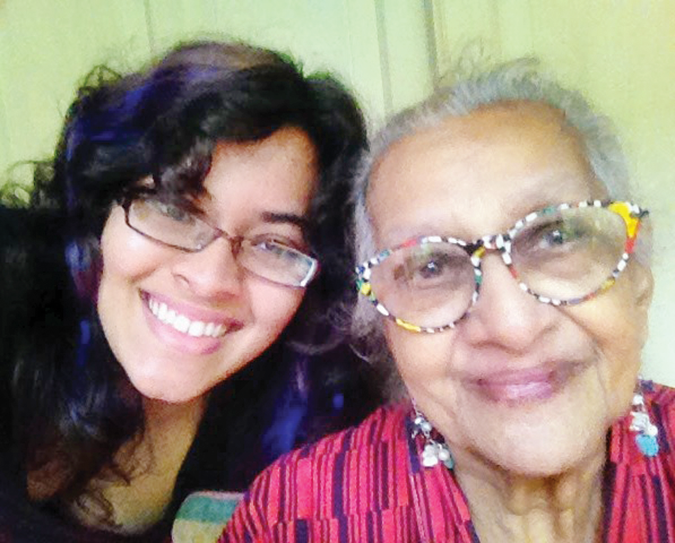

Her creativity, interests and expertise were not limited to any single sphere. She was friend and colleague to a host of architects, artists and designers of different generations, too numerous to mention here. At the same time, her interest in, and knowledge and understanding of botany, zoology, history, fiction, non-fiction, poetry, cuisine and landscaping, to name a few, were phenomenal. She collaborated closely with Geoffrey Bawa on many of his architectural projects; recognised Laki Senanayake’s varied artistic and landscaping talents, long before he came into the limelight; enjoyed discussing and debating literature and poetry with Regi Siriwardena and Rajiva; argued historical details with Ismeth Raheem and discussed research on molluscs with his daughter Dinarzarde; indulged in her culinary creativity and legendary hospitality with her loyal cook, Suja, and Man Friday, Piyadasa, for a team of culinary experts from the USA, whom she hosted to a 30-dish Sri Lankan lunch in her home; shared her bird-watching ecstasy on discovering a chestnut-backed owlet in the Alu garden with Shirley Perera and Suja, and the joys of their wild life photography with Nihal Fernando and Dr. Upen de Zylva; got stranded many times in the Menik ganga in Yala, with Anwer Deen and her long-suffering “Charioteers” Sena, and later, Carim; learnt and taught woodwork skills and brass work techniques with her “baases” at her carpentry workshop and brass foundry at Alu; designed batik, Sinhala embroidery, kabakuruttu embroidery and artificial flower extravaganzas with Chandra, Nanda, Suvineetha and her “Alu Girls”, now in their 60s and 70s; all with the same ease, grace and passion. She was NEVER afraid to experiment with technique or colour. Saying, “Daaahling, NEVER be afraid of colour”, she would create the most resplendent works of art in each of these different media. She was UNSTOPPABLE.
She created a pandal at Alu to welcome my son, Ravi, as a baby, and years later, entertained him and his young adult friends at Alu, discussing the world’s problems with them seated under the tamarind tree overlooking the knuckles range. She taught my nine-year old daughter, Anisha, to appreciate and learn Sinhala embroidery. She did so with the same interest in each person and enthusiasm on each subject, as she had shown a decade earlier to our generation of footloose and fancy-free young adults, just back from graduate studies and starting our careers. She introduced us to forays in the jungles of Yala, Wilpattu and Maduru Oya, the archaeological treasures of Maligawila, Hastha Kuchchi Vehera and Buduruvagala and the sheer wonder of the landscapes of the Sinharaja, Arugam Bay and the Matale hills.
Following on the first Aluwihare Heritage Centre Exhibition and Sale organised by Rajiva at the British Council, Romesh and I hosted their Annual Sale in our home for some years. Later, after my mother, Mukta, died, my father and Rajiva took it over in my parent’s home, Lakmahal. All friends and family were co-opted to help the “Alu crew”, who arrived with their sale items in large lorries and camped out in our several homes. We all helped in displaying, bill-writing, book-keeping and clearing up. Batik table linen and wall hangings; embroidered cushion covers and spectacle cases; wooden elephants, Hindu gods and gargantuan chess sets; brass animals and tableware; Christmas trees made from ekel brooms; Alu chicken, lamprais, polos pahi and cheeses, and breads baked in a barrel in our garden… the range of items goes on and on. What incredible fun we had – the colour, creativity and camaraderie.
Time with Ena was never dull. On one weekend visit to Alu, just she, almost 90 years, and I watched Tiger Woods playing in a golf tournament till late into the night, with a dictionary she produced for us to figure out golf terms, since neither she nor I knew anything about golf. But we learnt golf that night with the aid of the dictionary! On a later visit, we were watching her TV in silence. I asked her “Aunt, why is there no sound? ” She replied “Daahling, I can’t hear anyway, so I have turned the sound off”. The diamante Ena attached to her hearing aid was better treated than its battery.
Of course, Ena was not easy. She had no time for pomposity or hypocrisy or gossip, and did not suffer these kindly. She was a hard taskmaster and expected all who worked with her to put in the same 150% to every task, as she did. She had a temper. I would tell Kusum that, much as I loved Ena and was in awe of her creative genius, I would have found it really hard to live with such a phenomenon as my mother! Kusum had to deal with that. Ena did not have a business bone in her body. As Romesh will testify, Ena was incapable of taking the advice she asked for on this subject, so her creativity never made much money! The fact that all who worked with her felt the brunt of her temper and the weight of her work ethic, and yet, shielded her from her own inability to make the profits a more business-minded artist may have done, and remained intensely loyal and loving throughout her life, is testimony to how much they valued her.
When I look around my home, I see mementos of her creativity and thoughtfulness – my wedding saree, so uniquely stunning; a clay strawberry pot trailing plants in my porch gifted three decades ago; in my pantry, a stainless-steel tiffin career and thali platter I have used for over 25 years; guarding my entrances, a large painted wooden elephant and duck; a kabakuruttu table cloth from that first Alu sale – my valued treasures.
The memories are many and varied. One of my last memories is of a conversation we had when I visited her in Alu in 2015, towards the end of her life. While chatting at dusk, she quoted to me “Golden lads and girls all must, as chimney-sweepers, come to dust.”, and then said to me “Daahling, I think it is from Shakespeare’s Cymbeline. Could you please look it up” So I did, on google, and while doing so, the thought crossed my mind that here was a truly “Golden Girl” coming to terms with the end of her own life, with the same realism, grace and dignity with which she had lived it.
Throughout her life, which had its own share of tragedy and sadness, Ena performed her “worldly task” with zest and courage, sharing her gifts with so many. Ena has “gone home”, but she lives on vibrantly in her creations and in the hearts and minds of all of us whose lives she touched so beautifully and meaningfully.
Fear no more the heat o’ the sun,
Nor the furious winter’s rages;
Thou thy worldly task hast done,
Home art gone, and ta’en thy wages:
Golden lads and girls all must,
As chimney-sweepers, come to dust.
(from Cymbeline by William Shakespeare)