Life style
A Pond, a rock and a view

by Christina Vidanagamage
The North Central province of Sri Lanka is part of what is called the Dry Zone but a reputed lecturer and the dean of the University of Rajarata said that it should be known as the “Waevu baendi rajyaya” (the kingdom where reservoirs were built). Of course the word ‘reservoir’ doesn’t exactly capture everything associated with ‘weva’ because the latter is not just a body of water but part of a socio-economic-ecological system. What’s important is that the extensive and sophisticated irrigation systems has made it too wet to be called ‘Dry Zone.’


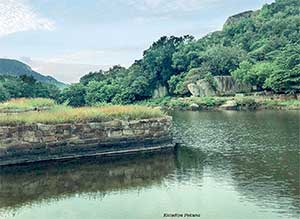
“Kalu diya pokuna” (black water pond) in Mihintale, during a recent visit, was like a historical filter keeping away everything that was familiar. As I walked through the mighty stone entrance just as dawn was breaking it was as though I was entering a different era.
The surroundings fascinated me. It was a monastic complex made for the saffron robe. The ruins gave out the vibe of a grandiose history. Around the pond there were ruins of what could have been a place of residence for meditating bikkhus, who may have been arahats. There was also a stupa with a stone inscription the characters on which, according to the description posted by the Archaeological Department, were hard to decipher. The presence of life overpowered me. It was not only a pond I saw but an entire habitat of civilization long gone. I was enliven by the architecture and the designs related to the ancient hydraulic system. I felt the strength and the sweat of a people who built the place upon the orders of the king.
I imagined the bikkhus walking slowly along the paths meditating or going about their diurnal routines with the soft music of the gathas being chanted during a Buddha poojawa. The black water pond certainly reflected the shadows of the past at that moment. It was a place of tranquility.
About an hour and a half from Kalu Diya Pokuna is a different kind of monastery belonging to a different time. Buddhungala Raja Maha Viharaya, a few kilometers off Padaviya is also a place of pure serenity, but of a different kind. It had also been home to bikkhus in centuries gone by.
The rock formations are spectacular and so too the views from the top of the hill where the ruins are. Typical of such places, slight depressions made for small seasonal rock pools, referred to as kemas. There had been rain so these kemas of varying size had frogs, dried leaves and moss. The villagers claim that various creatures big and small, elephants included, slake their thirst in these kemas.
The quaint belfry, rising against several formidable boulders, stood like a sentinel, a relatively modern construction loo0king upon things from an ancient time.
Upon the adjacent rock there was a boulder of very interesting shape. From one angle it looked like a perfect square but poised upon one of the four points. It seemed it could roll over any moment.
There was a moment of stillness and silence. A moment for the imagination to do its work.
I heard the sound of the bell. I saw bikkhus walking down the stone stairway, each cradling a paththaraya.
Such places do this to us. They take us back to a different time. We duly imagine even though what we imagine could be very different from what was actually there then.
There are monasteries hidden deep in wild places, far away from the blare of the traffic and bustling towns. The greenery surroundings, the open skies, the emptiness upon the rock formations invite us to mediate and help us focus.

These are not places for hurried visits. One has to allow the physical surroundings and historical remains to present themselves in their own pace. There are also seemingly insurmountable heights which can be reached if one is prepared to make the effort and look for the right path.
The view will mesmerize. The surroundings will engulf. One visits a place expecting certain things, for example a splendid view. And yet one comes away having been even more impressed by a simple belfry silhouetted against an evening sky or the reflection of tress and bits of cloud in conversation with the dead leaves at the bottom of a kema.
Photo credits @ Tharindu Amunugama