Features
A JOURNEY THROUGH SRI LANKA’S NIGHT

by Razeen Sally
Our life is a journey
Through winter and night
We look for our way
In a sky without light
Louis-Ferdinand Céline,Journey to the End of the Night
I had watched Sri Lanka’s latest catastrophe unfold from the safety and comfort of Singapore, not having been to the country for two years due to the pandemic. But I felt this catastrophe personally. I am half Sri Lankan. Colombo is my hometown, where I spent most of my childhood. After an almost three-decade absence, I returned to Sri Lanka in my forties and spent a decade travelling its length and breadth to write a travel memoir. From 2015 to 2018, I was an economic-policy adviser to the government.
I arrived at Katunayake airport in late April. A score of porters stood idle around luggage conveyor belts – one sign of chronic overstaffing in Sri Lanka’s public sector. Once on the Southern Expressway, there were striking differences from pre-pandemic times: roadside billboards were naked, reduced to their iron frames, denuded of advertising; shops and small tourist hotels and eateries were shuttered and boarded up.
Galle was front and centre in the post-2009 tourist boom, heaving with visitors all year round, with a transformative facelift of its crumbling buildings and soaring property prices. But now I saw hardly any foreign tourists, just a Colombo crowd down for the weekend.On May 9, the government imposed a nationwide curfew. In Colombo, there had been violence between Rajapaksa supporters and protestors demanding the resignation of Gotabaya, Mahinda and the rest of the government. Mahinda resigned that afternoon. That night mobs burnt down homes belonging to the Rajapaksa clan and other Rajapaksa-supporting politicians.
Armed with a tourist permit to avoid the continuing curfew, my driver Nihal and I, accompanied by Indian friends visiting from Singapore, drove from Galle to Tissamaharama. The coast road was predictably quiet. Most shops were shut, and the odd police or army checkpoint waved us through. Just out of Tangalle, the scenery changed suddenly from the deep dark green of the wet zone to the dry zone’s wider spaces and bigger skies, more economical vegetation, a paler shade of green and fewer people.
On my previous visits, Tangalle and Hambantota were plastered with posters and billboards of the Rajapaksa brothers and Mahinda’s son Namal. This time none were to be seen. A police and army cordon protected Carlton House, the family’s home in Tangalle. Right opposite, lying by the main road, was the toppled statue of D.A. Rajapaksa, Gota’s and Mahinda’s father and founder of the dynasty, a victim of anti-Rajapaksa retribution on May 9.
Initially we were the only guests at our hotel in Tissamaharama. Priyantha, a boat operator on Tissawewa, complained of hard times: no tourists, no diesel for his boat, his children’s school without new textbooks due to a paper shortage, skyrocketing prices for everything. Nearby Kataragama, normally jam-packed with worshippers from all over the island and lots of tourists, was eerily quiet.
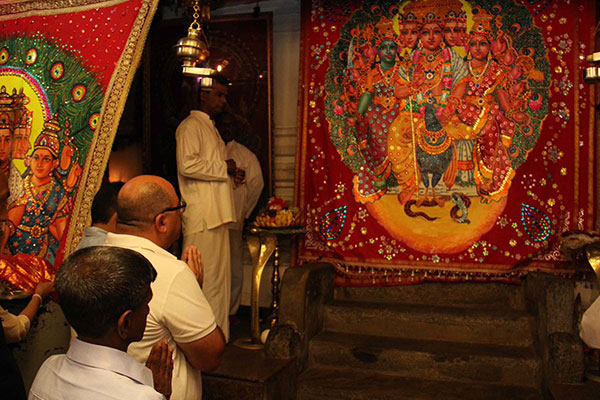

From the south coast, Nihal and I drove to Kandy. The Kandy road seemed to be a never-ending stretch of cars, lorries, motorbikes and three-wheelers queueing for petrol and diesel, often sprouting subsidiary branches snaking down side roads. Many stations had run out of fuel; vehicles were parked in queues overnight, their drivers hoping to get fuel the following morning. This day, May 16, was Vesak. But this was the most subdued Vesak I had seen: just a few lanterns here and there, no pandals, and much less food at threadbare roadside stalls.
The following day I walked around a down-at-heel Kandy. The handful of tourists I saw were young backpackers. The Suisse and Queens, Kandy’s venerable colonial hotels, looked even more faded than they did before the pandemic, in dire need of renovation. I popped into a sepulchral Suisse for tea, seemingly the only guest that afternoon. Opposite Queens, bordering the Tooth Temple, several tourist shops and a hotel had closed down.
Back at my hotel, one of the managers told me his family were now drinking tea without milk and not eating chicken to cut down on expenses – a symptom of hyperinflation immiserating the middle class. He said poorer folk in his village were down to one meal a day. Parents were giving up meals to feed their children. Many – all day labourers in the informal economy – had lost their jobs. On my last day in Kandy I spent a couple of late-afternoon hours with Ruwan, one of the founders of the Aragalaya protests in Kandy. We met close to the small group of protesters settled in by the central roundabout and clock tower.
Ruwan, in his late twenties, with unkempt black hair and a straggly brown goatee, had an earnest sincerity and practical idealism I found immediately attractive. He spoke in intelligible, though sometimes halting, English. He was a village boy who got top A-level grades and went to the University of Peradeniya. After graduation and a Colombo internship, he ran a small advertising business from his village home, where he looked after his widowed father. He remained a villager at heart, rejecting the noise, dirt and money-driven rat race that, he thought, poisoned human relations in Colombo. He took his Buddhist philosophy and meditation seriously: a simple, focused, present-in-the-moment life was his Buddhist ideal.
Ruwan told me of his entrepreneurial plans: marketing organic agricultural products from his village; a bike-sharing scheme in Kandy that had won him a nationwide competition. And of his myriad other pursuits: singing in a Sinhala folk-rock band, for which he composed songs with social and environmental commentary; a few screenplays for teledramas; and a novel he was writing on three generations of a family of Kandyan dancers, drawing on his own family and village experience. A visit to the Aragalaya protests in Colombo convinced him to start something similar with a group of friends in Kandy. He was hopeful the movement would bring about real change – “maybe 40 per cent if not 100 per cent”. And determined, unlike so many of his university contemporaries, not to emigrate but to stay in his homeland and do his bit.
Ruwan’s simple life-philosophy, his idealism and engagement, and his varied talents, reminded me how much potential there was in Sri Lanka’s heartlands. But it had long been quashed by the country’s entrenched elite and its noxious politics. And depleted by decades of emigration to faraway places with more opportunities than obstacles – emigration is accelerating fast in the present crisis.
From Kandy I went to the high tea country for a week. The winding, climbing road to Nuwara Eliya was practically deserted, free of the usual traffic of local and foreign tourists, but, alas, still scarred by the billboards that uglify landscapes along Sri Lanka’s main roads. And from Nuwara Eliya we drove to the Uva hills, where my father was born and grew up, and where I spent childhood holidays on a little tea estate.

The petrol queues were nearly as long as they were on the Colombo-Kandy road. Wherever I went I heard the same complaints about fuel, cooking-gas and milk-powder shortages, and prices of eggs, meat, fish and vegetables going through the roof. But life in these mostly rural areas did not seem quite as desperate as it was in the cities and big towns, at least for those who tilled their own land: Sinhala villagers had their paddy fields, orchards, cows and hens to fall back on; and Tamil estate workers assiduously cultivated large, neat vegetable plots next to often straggly tea bushes, rusting tea factories and the cramped, cheek-by-jowl line-rooms they lived in. Most had ready access to firewood for cooking. But even they were anxious about the fertiliser shortage that endangered the next harvest.
I arrived in Colombo after over a month outstation. How different it looked from my last visit in February 2020: so many shops and offices closed – on a Monday afternoon; half the population seemingly queueing for fuel and kerosene; multi-storey hotels, malls and condos on and just off the Galle Road, now hulking eyesores with construction suspended due to lack of finance and concrete. At one end of Galle Face Green, right next to the Aragalaya protest site, Port City lay idle, as it had done since early 2020 when its Chinese workers were whisked back to their homeland. And I saw beggars in numbers I had not seen since my childhood in the 1970s: often wizened men and women with destitution and hopelessness written in their downcast eyes.
Conversations with old friends and acquaintances were almost uniformly depressing. Corruption was endemic: grand larceny at the top and everyday petty graft at the bottom. Hyperinflation, food and fuel shortages and power cuts made daily life a wasteful, exhausting grind. Burglary was on the rise; the poor were getting desperate. Many bemoaned a galloping brain drain. Local companies were haemorrhaging professional staff who were probably leaving the country for good. But the Colombo rich were still OK, filling their favourite clubs, hotel bars and restaurants and upscale malls most evenings.
On a clear, balmy Sunday night I paid my first visit to the Aragalaya protest site, passing crowds of all ages promenading on Galle Face Green, enjoying the post-sunset Indian Ocean breeze. The Aragalaya cluster of tents, stalls and raised wooden stages started right in front of the Shangri La hotel, mall and condo complex, an in-your-face contrast between an elite in glass-encased airconditioned luxury and a suffering majority outside. A flag-bedecked “Love Stage” obscured a roadside view of the statue of S.W.R.D. Bandaranaike. Big white boards attached to a fence were filled with protest scrawls in Sinhala, English and, very occasionally, Tamil. One board displayed mugshots of all the Rajapaksa clan involved in politics. I passed a small tent with a makeshift “art gallery”, and a much larger one housing a well-frequented lending library.
One raised stage had a twenty-something man pumping his fist and shouting a slogan about Rajapaksa “robbers” repetitively, punctuated by an equally young woman singing the refrain, to the rhythmic beat of drums and cymbals. On another stage a university student, to emphasise communal unity, shouted Sinhala Ape … Damila Ape … Muslim Ape … Lanka Ape. The crowds were overwhelmingly young and Sinhala, but with Muslims and a few Tamils mixed in, even including the odd head-shaven, saffron-robed Buddhist monk and white-cassocked Catholic priest.
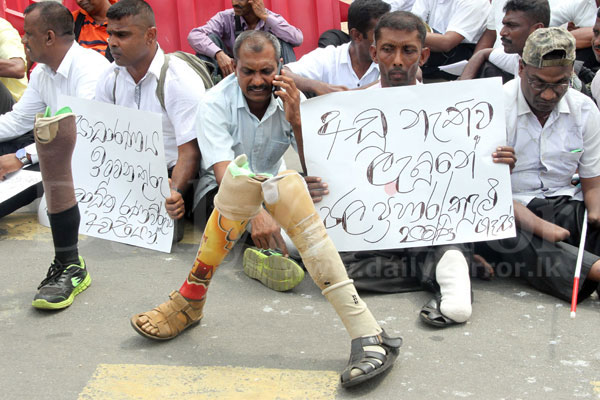
As I walked by one tent, my gaze turned towards a young man in a wheelchair, clad in a banian and sarong and with dishevelled hair. He made direct eye contact and beckoned me over, addressing me in Sinhala, his speech a little slurred. He took firm hold of my hand with his good hand – the other arm was skeletal, ending in a stump just below the elbow – placed it on the back of his scalp to one side, and ran it across and down to his forehead. It felt ridge-like and lumpy. These were bullet wounds, he said. He pointed to a bullet wound under one eyebrow. The eye below was clearly disfigured. A scar crossed his Adam’s apple – another bullet wound. Then he raised himself using a long crutch, lifted his sarong and showed me a broad gash running down the side of his lame leg – more bullet wounds. He told me he was hit by an LTTE sniper on Nandikidal lagoon, only two months after he got engaged. He spent over a year in a coma and the next five in hospitals undergoing surgeries and rehabilitation. Now he lived on a war veteran’s disability pension, unable to work. And never married.
As we chatted, other disabled veterans gathered round. Two had leg prosthetics, victims of landmines from battles in the Jaffna peninsula. They had all been here, in their disabled war veterans’ tent, since the first day of the protests. It was now Day 58. I found it difficult to keep up with their fast village Sinhala, but “system change”, oft repeated in English, was easy enough to understand.
My last trip outstation was to Jaffna. The scenery changed dramatically once we passed Vavuniya and entered the Vanni, becoming flat, arid, almost airless scrub jungle under an enormous sky and immensely distant horizons. We passed Kilinochchi. On my first visit, over a decade earlier, it was practically deserted, full of empty spaces where the LTTE’s buildings, parade ground and giant cemetery for its fallen soldiers had been razed to the ground by the victorious Sri Lankan army. Now it looked transformed. The smooth A9, heavily potholed a decade ago, expanded to four lanes through a town centre packed with gleaming white shops and showrooms.
The scenery changed again as we approached the causeway at Pooneryn. Parched brown scrub jungle gave way to a shallow expanse of glistening water and, entering the Jaffna peninsula, groves of black-brown palmyrahs, paddy fields and vegetable plots.
We entered Jaffna town, also busier and noisier than I had seen it before. There were new shops and eating houses, hotels and guest houses, reception halls, Hindu temples which looked like money had recently been lavished on them, and more cars and motorbikes replacing the ubiquitous bicycles I had seen on my first visit just over a decade earlier. Battered Austin Cambridges and Morris Oxfords from the 1950s and ‘60s, kept running during the lean war years, were then a familiar sight. Now I saw just one lonesome Austin Cambridge parked in a garage. In town and around the peninsula, ancestral homes that had been destroyed or lay derelict during the war had been rebuilt or renovated by their owners in Colombo and abroad. A new Indian Cultural Centre, built by the Indian government, was now the tallest building in town. But some sights and smells had not changed: plastic and other rubbish strewn on roadsides; the stench of open drains; roaming packs of stray dogs. And maddeningly dangerous driving: motorbikes, three wheelers and bicycles kept shooting out of side roads and sped across the main road.
On previous visits I had heard much about Jaffna’s post-war problems: grievances against the army and the government in Colombo; caste divisions; and disaffected youth freely spending money sent by relatives in the diaspora, indulging in drink and drugs, or whose only ambition was to emigrate. None of that had gone away. But Jaffna, like Kilinochchi, clearly had a post-war bounce. It was up and doing again, partially reviving its pre-war reputation for industriousness, alongside thrift and a thirst for education.
Selvi, introduced to me by a Colombo friend, embodied what I thought were the best Jaffna qualities. In her mid-twenties, short and bespectacled, she came to see me sprucely turned out in her Sunday best of long blouse and pants, her long raven hair brushed straight back. Her English was good. She had a mind of her own and exuded confidence.
There was tragedy in the family. Selvi’s father, a contractor, had an accident; his operation went wrong and he died after four months in hospital. A few months later, her adored younger brother, just nineteen, whose ambition was to become a pilot, committed suicide. She was left alone to support her traumatised mother.
Selvi wanted to make a career in aviation. She put herself through a training school in Colombo and was doing part-time jobs for aviation companies at Jaffna’s Palaly airport. She ran a vegetable export business on the side that generated a steady income. She did not want to rely on handouts from relatives in the diaspora, let alone emigrate via an arranged marriage with a diaspora Jaffna Tamil. Rather she wanted to stay, look after her mother and make the most of professional possibilities in post-war Sri Lanka. She told me there was a younger, aspirational generation in Jaffna without wartime baggage, who wanted to bridge old divides and mix productively with other Sri Lankans.
Jaffna, like the rest of the country, had its long queues in front of petrol stations, shortages of this and that, and hyperinflation. But it cast a different light on Sri Lanka’s present crisis to what I had seen elsewhere in the country. On our last evening in town, my hosts and I met a livewire doctor at the Northgate hotel bar, nursing a weird multicoloured cocktail and conversing in his fast-and-furious, semi-broken English. He was based at Jaffna hospital just around the corner.
He warned us to steer well clear of stray dogs; the country had run out of the anti-rabies vaccine, not to mention other essential medicines. Then he added: “The rest of the country is miserable because they don’t have petrol and cooking gas and suffer daily power cuts. But, during the war, we went for years without petrol, cooking gas and electricity. We had bombs dropping on us. We were terrorised by the army and the LTTE. This is nothing in comparison. So we cope as best we can and get on with life.”
The crisis got even worse after I left in June. In late July, the swelling Aragalaya protests finally prompted Gotabaya Rajapaksa to flee the country and resign as president. But the protestors’ victory was hollow. Parliament voted in Ranil Wickremesinghe as the new president. He owed his election to SLPP MPs and the backing of the Rajapaksas. He appointed a new prime minister and cabinet of Rajapaksa loyalists. The army and police cleared the Aragalaya protest site; some protesters were arrested and prosecuted.
There was no “system change”. Gotabaya Rajapaksa’s unopposed return to Colombo in early September, enjoying all the privileges due to a former head of state, was proof enough that the system really had not changed. Sri Lanka’s economic and humanitarian crisis continues, so far without substantial reforms to turn the situation round. Complex negotiations with international organisations (the IMF, World Bank and ADB), sovereign creditors (especially China, India and Japan) and mainly US-based private bondholders are proceeding slowly. For ordinary Sri Lankans, there is no end in sight to their suffering.Razeen Sally is author of Return to Sri Lanka: Travels in a Paradoxical Island. He was a professor at the London School of Economics and the National University of Singapore, chairman of the Institute of Policy Studies, and an adviser to the Sri Lankan government.