Features
A Day in July 2019:A socio-political critique

By Sajitha Prematunge
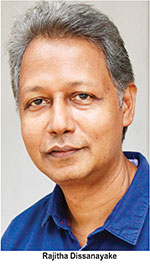
It was a year that defined a decade. And Rajitha Dissanayake’s new play A Day in July 2019 revolves around something that could have happened on any regular day in 2019, subject to the socio-political and economic conditions of the time. In fact, A Day in July 2019 is a socio-political critique as are many other popular and award-winning plays produced by him, such as Weeraya Merila, Sihina Horu Aran, Apahu Herenna Be, Bakamoona Veedi Basi and Nethuwa Beri Minihek.
“Year 2019 was a turning point in terms of politics. It’s important to revisit what happened in order to better prepare for what’s to come,” said Dissanayake. The play examines the origins of the various crises faced by the country today. Dissanayake hopes that the play would coax audiences to reflect on past and present incidents as well as future outcomes. He pointed out that the Sri Lankan society is forgetful and reluctant to think. “Individuals tend to edit memories to their advantage. But art can refresh memory and be thought provoking at the same time.”
The play is an in-depth analysis of the human tendency to constantly perceive others as threats and how suspicion and fear affects human behaviour. “It’s also about missed opportunities,” said Dissanayake, without giving too much away. “There are certain things that we can’t take back in life, certain wrongs we cannot make right, and the results can be devastating.”
Rajitha Dissanayake ranks among the top original playwrights to emerge in Sri Lanka in the last 25 years. His plays have drawn crowds, sparked debate, winning numerous awards while touring internationally. In the late 80’s, while studying at St. Mary’s College, Chilaw, Dissanayake’s father often took him to plays. After O/Ls, the habit continued in the company of like-minded friends. With the help of teachers and friends, Dissanayake wrote his debut play in 1988. It was a year of political turmoil and being a play written by a youth, it attempted to vent the anguish that resulted from government suppression. In fact, the period of social upheavals, between 1988 and 1989, were his most productive.


He spent the almost two and half year interim between secondary and university education, due to the insurgency, writing and producing plays. Although he did not study theatre at the Colombo University, he wrote and produced a play every year. Sakwadawala, which he produced in his final year at the university, is his first play staged publicly at the Lionel Wendt in 1995. A Day in July 2019 is the 12th play written and produced by him to go on the boards at the Wendt in 26 years.
Asked whether socio-political instability in the 80’s made a better dramatist out of him, he said that drama was an ideal means of venting youth frustration at the unjust system. “It was also the only respite at a time we could not take up arms, in that it was a formidable tool of resistance against suppression.” He observed that the media is a driving force behind society and the individual. Specifically how media manoeuvres society for profit and power, was discussed in plays like Weeraya Merila in early 2000.
When asked how his plays, often inspired by contemporary socio-political issues, were received by the powers that be, Dissanayake said that even when other artistic and press freedom were being curtailed, theatre remained relatively unfettered. “One of the reasons that theatre was not subject to much censorship is that plays don’t attract huge crowds.” However, there was a general concern about the political controversy of Bakamuna Weedi Basi and Apahu Harenna Be. “This was a time when journalists were being murdered and assaulted.”
Theatre of the 80’s had a particular attraction for Dissanayake. He said that, in particular Prakrama Niriella’s Uththamavi, Dharmasiri Bandaranayake’s Dhawala Bheeshana and Makarakshaya, out of the box plays such as Deepthi Kumara Gunarathne’s absurdist play Godo Unnehe Enakam, Sinhala version of Eugene Ionesco’s Rhinoceros by Kapila Kumara Kalinga, Simon Navagattegama’s Suba saha Yasa, Jayantha Chandrasiri’s Mora and Ediriweera Sarachchandra and Dayananda Gunawardena’s plays in general inspired him. Among foreign playwrights who influenced Dissanayake’s playwriting are Harold Pinter, Arthur Miller and William Gibson. “Arthur Miller in particular I read over and over.” He was also influenced by literature and film. Despite such influences, adaptation had not appealed to Dissanayake. “I prefer to share contemporary experiences with my audience.”
When asked why he is preoccupied with socio-political critique at the risk of ignoring other themes, Dissanayake said that, although critics may find fault with this tendency, he does not consider it as a flaw. “There are other dramatists who, for example, prefer to do historical adaptations. But that is not really my cup of tea. My focus is contemporary life.”

Although dialogue drama is Dissanayake’s forte, he was equally attracted to other styles. However, he opined that dialogue drama is able to best capture human nature and behaviour. “For example, what’s said inadvertently as well as what’s not said says a lot more about a person’s psyche than what is said and dialogue drama is capable of capturing these nuances.”
Most of Dissanayake’s plays are minimalist, be it background music, lighting or costume, because he is of the opinion that simplicity leads to excellence. “Besides, we operate on a limited budget and resources. We have to manage our finances, else it would not be sustainable.” He explained that dramatists are capable of producing quality plays that best reflect social realities within limited human, financial and tech resource parameters. Sihina Horu Aran is a case in point. “The minimalist nature of the play didn’t make the dramatic experience any less effective because it was actor oriented.”
Speaking of actors, at an age when overacting is the norm, how do directors cast talented actors? “Fortunately there remain few who don’t consider overacting as proper acting. There are still those who are able to project the nuances of human nature through subtle postures.” Dissanayake explained that overacting is easy, but acting in the absence of a dramatic situation is far more challenging. “Character playing takes training and discipline.” And those capable are very few and they are no doubt a dying breed.
When asked how contemporary critical theatre like his fares compared to slapstick comedy and reproductions of great plays of the past, Dissanayake said that comedy is preferred the world over. “Comedy is not essentially bad. But comedy devoid of substance is.” He pointed out that only a few good comedies have been produced locally. However, there are those who prefer realistic plays with some depth. “In fact, compared to Broadway, Germany or India, there are more of the younger age groups in local audiences.”
As a dramatist who has travelled extensively, he observes that local theatre lacks facilities compared to Broadway, for example. “But it’s a given considering their level of economic and social development. Even under various constraints Sri Lankan theatre is faring relatively well in terms of performance and creativity.” He elaborated that for audiences in developed countries theatre is part of life. “It’s a stable audience with a whole culture built around theatre.” He observed that Sri Lanka does not have theatre companies that can sustain professional actors. “We don’t have professional actors, only part time actors. However, they make huge sacrifices.”
It is obvious that taste in art has deteriorated over the decades. Consequently, he is of the opinion that for artistes to engage in theatre full time, peoples’ taste in the arts in general has to improve considerably. After all, how does one produce quality dramas when there is no audience to appreciate such refined art? “Appreciation of good art is a habit and must be made contagious. Both the school and university systems have failed to inculcate it through education, because our education system is exam oriented. Without it there is no point in developing a full time professional body of stage actors.” He pointed out that the Sri Lankan education system has failed to produce individuals who can appreciate quality art, a prerequisite of a democrat.
Rajitha Dissanayake’s latest play A Day in July 2019 premiered at the Lionel Wendt theatre on January 21 and will be staged on 22 and 23 at 7.00 pm. The cast of A Day in July 2019 includes well-known stage and screen actors Jayani Senanayake, Anuradha Mallawarachchi, Sampath Jayaweera, Gihan de Chickera, Nalin Lusena, Sulochana Weerasinghe, Prasadini Athapattu and Anuk Fernando. Music for the play is composed by Mahira Dissanayake, and the set is designed by Dharmapriya Dias and Anuradha Mallawarachchi. Make-up is by Priyantha Dissanayake, lighting design by Ranga Samarakoon and Anuradha Mallawarachchi and costume design by Nalin Lusena and Samadara Mabulage. Lenin Liyanage is the stage manager.