
Features
A Cabinet Secretary Remembers

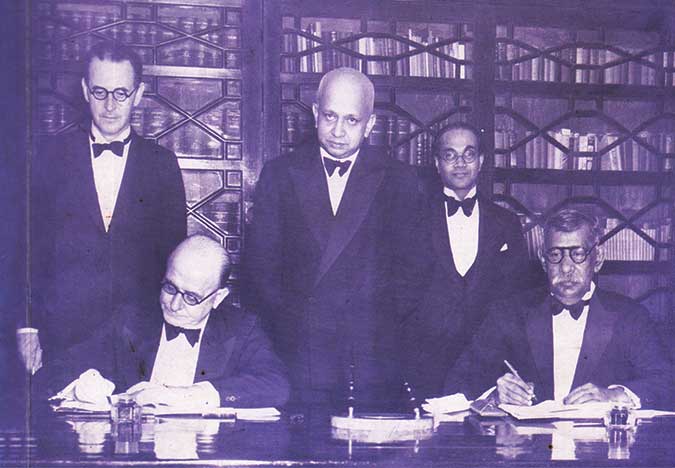
Extracted from Memoirs of BP Peiris
My father, family and early days at Panadura
According to my birth certificate, I, the eldest son of my parents, was born on March 29, 1908, at our ancestral home “Gorakapola Walauwa”, Panadura.My father was Edmund Peiris, then a clerk in the Colombo Kachcheri on the princely salary of Rs. 60 a month. He used to travel from Panadura to Colombo by train, and from his home to the railway station on a push bicycle. He very early caught the eye of the Government Agent, Mr J. G. Frazer (later Sir John) who noted him for promotion on the ground of ability. My mother was Somie, the eldest daughter of C. F. S. Jayawickrama, Mudaliyar of the District Court of Kegalle.
I have no recollection at all of my paternal grandfather, Mudaliyar Romanis Peiris, Customs Mudaliyar, who died while I was quite young, nor of my paternal grandmother. A drinking fountain gifted by my grandfather to the state still stands in the premises of the Colombo Port Commission.In commemoration of the Diamond Jubilee of Her Majesty Queen Victoria, he built a school which he called the Queen Victoria Diamond Jubilee Buddhist School, which served the needs of many of the surrounding villages. My father was manager for many years and later gifted the land and the buildings to the state.
Of my maternal grandparents I have vivid memories. My grandfather Jayawickrama, whose picture used to hang in my father’s house, was a man of honesty, integrity and strength of character. His face in the picture at home showed determination, independence and a strong will. He was not a man to bend his knee to any person, however high he might be. He had, I believe, 16 children, to all of whom he gave an excellent education.
His eldest son was Sylvester, Advocate, a very respected member of the Matara Bar, who died in 1940 at the age of 54 at a time when he was District Judge of that town. On the day of his funeral all the shops in the town were closed as a mark of respect. The second child was my mother. Another of his daughters came first in French in the Cambridge Senior in the whole of the British Empire and, after her marriage taught her brother (later Jayawickrama Q. C.) French to enable him to pass the London Inter-Arts Examination. Another son was “Sargo” of cricketing fame.
My grandfather Jayawickrama dressed, as all Mudaliyars did in those days, in trousers, cloth and coat, with a sort of a Dutch helmet on his head, used to visit periodically his married son and his daughters all the way from Panadura to Matara and Tangalle. He was a keen chess player and always carried a traveling board with him, the board having suitable holes and the pieces were pegs to fit them. The pieces were of ivory and ebony.
He was a man who worked to time; he would start a game with my mother at 7.00 p.m. and play till 8.00 p.m., having a chew of betel and a cigar during the game. At 8.00 he would close the board to dine, and continue the same game from day to day till its end. I have in vain attempted to trace that chess set. My brother and I used to watch him play with my mother and we soon, at the age of about seven, picked up the game.
On one of our return trips by train from Diyatalawa to Colombo, the old gentleman was kind enough to come to Polgahawela to meet his daughter (my mother) and his grandchildren. The next day he was dead of a heart attack. His body was brought from Kegalle to my father’s house and the cremation took place at Panadura.
He was the Jayawickrama referred to in the leading Privy Council case of Jayawickrama vs Amarasuriya (1918), which he won. He had lost the case in the District Court and the Supreme Court but had faith in justice. Before appealing to the Privy Council, he had told his children to be prepared to step on to the street and beg if he lost the final appeal.
The case was instituted by my grandmother against her brother who had benefited largely by his father’s death. There was no doubt, on the evidence, that it was his father’s wish that he should provide for his sister and her large family. The sister had threatened to institute an action against him for the assignment to her of an undivided half-share of the inheritance and he had promised to pay her Rs150,000 if she refrained from instituting the contemplated action.
The decisions of the Ceylon courts were based on the concept of “Consideration” in English law. The Privy Council applied the Roman-Dutch law concept of justa causa which was wider. They held that the brother’s promise was binding and enforceable as it was made deliberately after much negotiation, in discharge of the moral obligation found to rest upon the brother to do an act of generosity and benevolence to his sister, namely, to make provision for her and her children. The Privy Council allowed the appeal with costs in all courts.
I remember my grandmother as a most simple and kindly woman, dressed not in saree, but in skirt and jacket. She also used to visit her children regularly, and once, when I was about seven years old, my mother sent me with her by train and bus to Kegalle where my grandparents were then living. From the Polgahawela railway station, the journey was completed by bus.
For my parents I have nothing but praise for the education they gave us, which has enabled my brothers and sisters and me to hold responsible positions in life. My father was a Royalist, that is to say, an old boy of the Royal College, then situated at San Sebastian. His contemporaries were B. F. de Silva, O. L. De Kretser, T. F. Garvin, V. M. Fernando, R. L. Pereira, F. H. B. Koch, all of whom rose to the Bench.
My father, later when he was Mudaliyar of the Panadura and Kalutara Totamunes, used to tell us that he rarely used the school library while the others did, and he encouraged us and insisted that we use the library as much as possible, advice by which all his sons have profited.
He was at school in the days of Hayward and Hartley and was one who received the well-known caning for taking as their right a holiday on the Royal-Thomian match day. I remember an incident years later, after he had married and had five children and the family was having a holiday at Diyatalawa, when we crossed Hartley during our morning walk. My father raised his hat and said “Good morning, Sir”. Hartley returned the greeting and said, “Let me see -Royal? Yes, I remember. Left from the Remove.” It was a marvelous memory.
Even as a student father appeared to have been very methodical. He was a boarder at the house of (later Sir) James Pieris’ mother and kept a small notebook of his daily expenditure. I remember seeing this notebook, one item in which was “tiffin 11 cents”. He was as methodical up to the day of his death when we found a document telling us exactly what we should do – where his last will was, how he should be dressed, who his pallbearers should be, a list of his assets, a valuation of his property etc., with the result that I, as his executor, had no difficulty in answering any query from the Estate Duty Department.
The printed invitation cards sent by my mother’s parents on the occasion of her wedding, a copy of which is in my possession, show that the wedding took place at 11 a.m. on Thursday, June 28, 1906, at Amaragiri Walauwa, Unawatuna, Galle, the residence of Mr Thomas Amarasuriya. The wedding photograph shows the groom and his best man, Advocate B. F. de Silva, in morning suits. A newspaper account of the wedding states that “instead of the usual cake and wine the whole assembly sat down to a sumptuous lunch when the health of the newly wedded couple was pledged.”
In 1908 my father was appointed Muhandiram of the Colombo Kachcheri. In 1913 the post of Mudaliyar of the Panadura and Kalutara Totamunes having fallen vacant, he applied for the post. In the final selection, he told us that three applicants Mr A, Mr B and he were summoned for an interview. The interview was by the Colonial Secretary. Each candidate was asked what he thought of the other two.
Mr A and Mr B had apparently nothing very pleasant or creditable to say about the others. My father, when asked the same question, had said that he had nothing to say against the other candidates but had come to speak about himself. The Colonial Secretary’s concise minute to the Governor was, I learned, something on the following lines:
Your Excellency,
I have interviewed the three candidates. Mr A is an extremely able man, painfully conscious of his ability. Mr B is another clever man almost bordering on insanity. I recommend Mr Peiris.His Excellency minuted “Approved” and my father was appointed – the youngest man to be appointed Mudaliyar of the second most important revenue district of the island, second only to Colombo.
Congratulatory meetings on his appointment were held in different parts of the District sponsored by such gentlemen of quality as Gate Mudaliyar J. E. de Silva Suriyabandara (Magistrate of Kalutara), O. G. de Alwis, Clement Wijeratne, M. H. Jayatillake, H. Meritimus Fonseka, C. P. Samarasekera and M. E. Fonseka.
He held the office for over 25 years and was honoured with the titular rank of Mudaliyar and later of Mudaliyar of The Governor’s Gate. His district extended from the Moratuwa bridge in the north to the Bentota bridge in the south. He got to know the district and people so thoroughly that in his later years he was able to write a report from his office without inspecting the scene as he appeared to know every tree and culvert in the area.
His reports to the British Assistant Government Agent were always forwarded by them to the Government Agent with the endorsement “I forward herewith a report from the Mudaliyar, with which I agree.” Some Ceylonese Assistant Government Agents used to forward my father’s reports with his name deleted and the Assistant Government Agent’s name placed at the end in substitution.
Father had a rather peculiar habit of not getting permission to leave his station when he came from Panadura to Colombo. He always took leave when he had to go south beyond the Bentota Bridge. One day, a most amusing incident took place on the Galle Road at Ratmalana. Father had come to Colombo without leave and was returning home when he found the Assistant Government Agent’s car broken down on the way. He stopped his car and the two drivers between them got the car in order again.
The Assistant Government Agent thanked the driver and then asked my father, “Mudaliyar, aren’t you out of your station without leave?” Let me say here, in an age when the foreign British civil servant is being constantly vilified, that the officer concerned in this particular case was a Ceylonese. Father replied that in 20 odd years he had never asked for leave to come from Panadura to Colombo. His superior told him that in future he had better take leave before leaving his district in either direction, and father took that as an order.
Soon after that some affray had taken place within his district in the vicinity of the Moratuwa bridge and father was asked by the Assistant Government Agent to go personally to the spot, inquire and report. He went and held the inquiry but found that to complete proceedings he had to cross the bridge and, under the previous order, had no authority to do so without prior permission. He wired accordingly, and the order regarding prior permission to leave station was promptly withdrawn.
Father was a good host: he believed in entertaining well or not at all. Although a moderate drinker himself, he had ample liquor for his guests and a good table. If you invite people, he used to say, treat them well. If you cannot afford to treat them well, don’t invite them. He used to tell us that when we grew up, we should never get into debt and put ourselves in a position to allow the tailor to say “There goes my suit”.
He regularly took leave for the whole of April each year and took the entire family up-country. As we could not afford to rent a bungalow, he arranged through a friend of his in the railway that we occupy the bungalow of a bachelor station master who would be father’s guest during our stay. The arrangement worked extremely well. And so it was that we spent delightful holidays at Ohiya, Pattipola, Haputale, Diyatalawa and other upcountry stations.
Some of these stations were, at that time, also sub-post offices and it was, in one of these stations that, as a schoolboy, I picked up the Morse Code. I am still able to send a message in Morse but, unfortunately, I never was able to get my ear attuned to receiving one. For a holiday at Diyatalawa, the Brigadier placed a military hut at our disposal and we had a grand time with the soldiers, whom father entertained.
They were nervous about eating tomato sandwiches thinking it was red pepper.At home, Father was a strict disciplinarian. Dinner was a simple meal, within his means. It was punctually at 8 p.m. At 7. 30 p.m., whether there were visitors or not, he had his first drink. At 7. 45 p.m. his second, and then dinner. Should one of us brats come to table with hands unwashed or hair uncombed, he would be driven away from the table and not taken back until he had put himself in good condition.
At that time, a Chief Headman wielded great authority in his district, and I distinctly remember that every funeral procession and perahera stopped beating the drums whilst passing the Walauwa. I feel quite sure that the Headmen’s system was abolished by the State Council because the Councillors were jealous of the power and authority exercised by the Headmen in their districts. Today, this is replaced by a transferable Divisional Revenue Officers’ Service – able men no doubt, but men without any local prestige who do not know the district in the way my father knew his.
My father retired on the first of April 1940, after having served the Government for over 40 years. He had held the office of Mudaliyar of the Panadura and Kalutara Totamunes for 27 years and filled a large place in the official and social life of the district. On his retirement, the public accorded him a farewell dinner at the Panadura Town Hall, the largest gathering ever seen at a public dinner in the town.
Tributes to him as a man and as a public servant were paid by the speakers, and covers were laid for 183. Mr (later Sir) Susantha de Fonseka presided. Among the diners were Mr and Mrs D. S. Senanayake, Mr W. O. Stevens, Government Agent of the Western Province, and Mr P. J. Hudson, Assistant Government Agent. The Urban Council moved a vote of appreciation. His portrait in oils was unveiled at the Kalutara Kachcheri.
My father died, after a very short illness, on the first of February 1961, at the age of 81. His Excellency the Governor-General, Sir Oliver Goonetileke called at the house to pay his last respects. The following appreciation appeared in the press:
“The death yesterday of Gate Mudaliyar Edmund Peiris, at the ripe age of 81, has removed a landmark from Panadura Town. Since his retirement after 42 years of active service ending up as Mudaliyar of the Panadura and Kalutara Totamunes, which post he held for 27 years, he was always at the service of his fellow citizens and participated in many public activities in the town where he resided.
“Whatever service he performed, whether it was for the town, home for the aged, or personally looking after the urgent needs of the poor who called on him for help, or mediation, he performed his part with a great deal of method, never haphazardly.
“Method in fact was the guiding principle of his life. Even at death it was a matter for wonder to those whom he left to read his detailed and precise instructions as to the manner in which his funeral was to be conducted. He had even got prepared his own tombstone inscription leaving blank only the date of death. Few think of death while they are alive. Mudaliyar Peiris was one of the few, and it may be that because he was conscious that death comes to every man sometime or other that he was always ready to forgive and forget. That also is one of the rich legacies which he has left behind not only to the large band of sons and daughters and grandchildren but to those who enjoyed and valued his friendship.
“Till his last illness struck him down, age did not mar his zest for living and many of his friends both admired and envied the short dapper Mudaliyar out on the road ‘doing his constitutional’.
Many civic activities of the town of Panadura will be the poorer by Mudaliyar Peiris’ death, but the organization which would suffer most would be the King George V Silver Jubilee Home for the Aged which he dearly loved and cared for during the last few years of his life.
“Another act of the Mudaliyar is worthy of record. He was the owner of a school built by his father, Mudaliyar Romanis Peiris, who had named it the Queen Victoria Diamond Jubilee Buddhist School. Some years ago, Mudaliyar Peiris handed over the land and the school buildings to the State, so doing what a subsequent Government of the country was to decide to do as a matter of Government policy. Not many are now spared to live to the age of 81.
“The Mudaliyar has made the most of these many years he lived not for self alone (though he must have been a happy man to see his sons in good positions and his daughters well-married) but for others as well.”


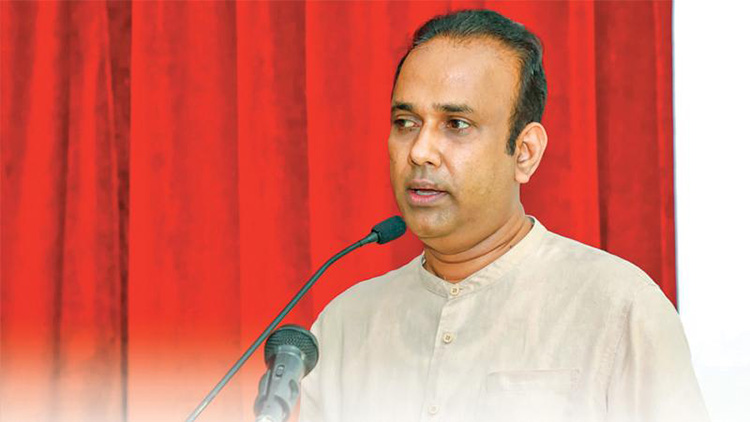
by Dr Gotabhya Ranasinghe
Senior Consultant Cardiologist
National Hospital Sri Lanka
When we sought a meeting with Hon Dr. Ramesh Pathirana, Minister of Health, he graciously cleared his busy schedule to accommodate us. Renowned for his attentive listening and deep understanding, Minister Pathirana is dedicated to advancing the health sector. His openness and transparency exemplify the qualities of an exemplary politician and minister.
Dr. Palitha Mahipala, the current Health Secretary, demonstrates both commendable enthusiasm and unwavering support. This combination of attributes makes him a highly compatible colleague for the esteemed Minister of Health.
Our discussion centered on a project that has been in the works for the past 30 years, one that no other minister had managed to advance.
Minister Pathirana, however, recognized the project’s significance and its potential to revolutionize care for heart patients.
The project involves the construction of a state-of-the-art facility at the premises of the National Hospital Colombo. The project’s location within the premises of the National Hospital underscores its importance and relevance to the healthcare infrastructure of the nation.
This facility will include a cardiology building and a tertiary care center, equipped with the latest technology to handle and treat all types of heart-related conditions and surgeries.
Securing funding was a major milestone for this initiative. Minister Pathirana successfully obtained approval for a $40 billion loan from the Asian Development Bank. With the funding in place, the foundation stone is scheduled to be laid in September this year, and construction will begin in January 2025.
This project guarantees a consistent and uninterrupted supply of stents and related medications for heart patients. As a result, patients will have timely access to essential medical supplies during their treatment and recovery. By securing these critical resources, the project aims to enhance patient outcomes, minimize treatment delays, and maintain the highest standards of cardiac care.
Upon its fruition, this monumental building will serve as a beacon of hope and healing, symbolizing the unwavering dedication to improving patient outcomes and fostering a healthier society.We anticipate a future marked by significant progress and positive outcomes in Sri Lanka’s cardiovascular treatment landscape within the foreseeable timeframe.

by Fr. Emmanuel Fernando, OMI
Jesuit Fr. Aloysius Pieris (affectionately called Fr. Aloy) celebrated his 90th birthday on April 9, 2024 and I, as the editor of our Oblate Journal, THE MISSIONARY OBLATE had gone to press by that time. Immediately I decided to publish an article, appreciating the untiring selfless services he continues to offer for inter-Faith dialogue, the renewal of the Catholic Church, his concern for the poor and the suffering Sri Lankan masses and to me, the present writer.
It was in 1988, when I was appointed Director of the Oblate Scholastics at Ampitiya by the then Oblate Provincial Fr. Anselm Silva, that I came to know Fr. Aloy more closely. Knowing well his expertise in matters spiritual, theological, Indological and pastoral, and with the collaborative spirit of my companion-formators, our Oblate Scholastics were sent to Tulana, the Research and Encounter Centre, Kelaniya, of which he is the Founder-Director, for ‘exposure-programmes’ on matters spiritual, biblical, theological and pastoral. Some of these dimensions according to my view and that of my companion-formators, were not available at the National Seminary, Ampitiya.
Ever since that time, our Oblate formators/ accompaniers at the Oblate Scholasticate, Ampitiya , have continued to send our Oblate Scholastics to Tulana Centre for deepening their insights and convictions regarding matters needed to serve the people in today’s context. Fr. Aloy also had tried very enthusiastically with the Oblate team headed by Frs. Oswald Firth and Clement Waidyasekara to begin a Theologate, directed by the Religious Congregations in Sri Lanka, for the contextual formation/ accompaniment of their members. It should very well be a desired goal of the Leaders / Provincials of the Religious Congregations.
Besides being a formator/accompanier at the Oblate Scholasticate, I was entrusted also with the task of editing and publishing our Oblate journal, ‘The Missionary Oblate’. To maintain the quality of the journal I continue to depend on Fr. Aloy for his thought-provoking and stimulating articles on Biblical Spirituality, Biblical Theology and Ecclesiology. I am very grateful to him for his generous assistance. Of late, his writings on renewal of the Church, initiated by Pope St. John XX111 and continued by Pope Francis through the Synodal path, published in our Oblate journal, enable our readers to focus their attention also on the needed renewal in the Catholic Church in Sri Lanka. Fr. Aloy appreciated very much the Synodal path adopted by the Jesuit Pope Francis for the renewal of the Church, rooted very much on prayerful discernment. In my Religious and presbyteral life, Fr.Aloy continues to be my spiritual animator / guide and ongoing formator / acccompanier.
Fr. Aloysius Pieris, BA Hons (Lond), LPh (SHC, India), STL (PFT, Naples), PhD (SLU/VC), ThD (Tilburg), D.Ltt (KU), has been one of the eminent Asian theologians well recognized internationally and one who has lectured and held visiting chairs in many universities both in the West and in the East. Many members of Religious Congregations from Asian countries have benefited from his lectures and guidance in the East Asian Pastoral Institute (EAPI) in Manila, Philippines. He had been a Theologian consulted by the Federation of Asian Bishops’ Conferences for many years. During his professorship at the Gregorian University in Rome, he was called to be a member of a special group of advisers on other religions consulted by Pope Paul VI.
Fr. Aloy is the author of more than 30 books and well over 500 Research Papers. Some of his books and articles have been translated and published in several countries. Among those books, one can find the following: 1) The Genesis of an Asian Theology of Liberation (An Autobiographical Excursus on the Art of Theologising in Asia, 2) An Asian Theology of Liberation, 3) Providential Timeliness of Vatican 11 (a long-overdue halt to a scandalous millennium, 4) Give Vatican 11 a chance, 5) Leadership in the Church, 6) Relishing our faith in working for justice (Themes for study and discussion), 7) A Message meant mainly, not exclusively for Jesuits (Background information necessary for helping Francis renew the Church), 8) Lent in Lanka (Reflections and Resolutions, 9) Love meets wisdom (A Christian Experience of Buddhism, 10) Fire and Water 11) God’s Reign for God’s poor, 12) Our Unhiddden Agenda (How we Jesuits work, pray and form our men). He is also the Editor of two journals, Vagdevi, Journal of Religious Reflection and Dialogue, New Series.
Fr. Aloy has a BA in Pali and Sanskrit from the University of London and a Ph.D in Buddhist Philosophy from the University of Sri Lankan, Vidyodaya Campus. On Nov. 23, 2019, he was awarded the prestigious honorary Doctorate of Literature (D.Litt) by the Chancellor of the University of Kelaniya, the Most Venerable Welamitiyawe Dharmakirthi Sri Kusala Dhamma Thera.
Fr. Aloy continues to be a promoter of Gospel values and virtues. Justice as a constitutive dimension of love and social concern for the downtrodden masses are very much noted in his life and work. He had very much appreciated the commitment of the late Fr. Joseph (Joe) Fernando, the National Director of the Social and Economic Centre (SEDEC) for the poor.
In Sri Lanka, a few religious Congregations – the Good Shepherd Sisters, the Christian Brothers, the Marist Brothers and the Oblates – have invited him to animate their members especially during their Provincial Congresses, Chapters and International Conferences. The mainline Christian Churches also have sought his advice and followed his seminars. I, for one, regret very much, that the Sri Lankan authorities of the Catholic Church –today’s Hierarchy—- have not sought Fr.
Aloy’s expertise for the renewal of the Catholic Church in Sri Lanka and thus have not benefited from the immense store of wisdom and insight that he can offer to our local Church while the Sri Lankan bishops who governed the Catholic church in the immediate aftermath of the Second Vatican Council (Edmund Fernando OMI, Anthony de Saram, Leo Nanayakkara OSB, Frank Marcus Fernando, Paul Perera,) visited him and consulted him on many matters. Among the Tamil Bishops, Bishop Rayappu Joseph was keeping close contact with him and Bishop J. Deogupillai hosted him and his team visiting him after the horrible Black July massacre of Tamils.
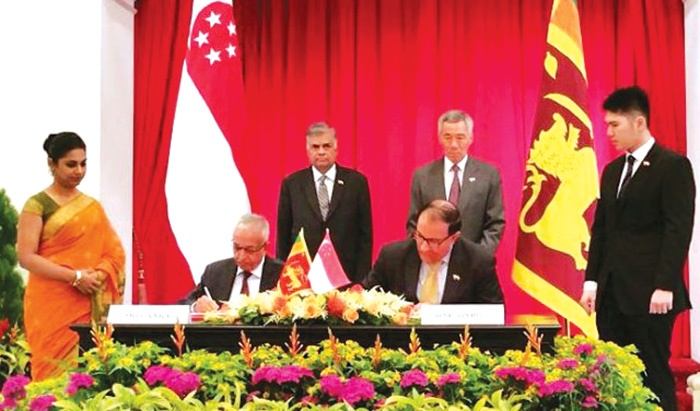
Sri Lanka-Singapore Free Trade Agreement
By Gomi Senadhira
senadhiragomi@gmail.com
“You might tell fairy tales, but the progress of a country cannot be achieved through such narratives. A country cannot be developed by making false promises. The country moved backward because of the electoral promises made by political parties throughout time. We have witnessed that the ultimate result of this is the country becoming bankrupt. Unfortunately, many segments of the population have not come to realize this yet.” – President Ranil Wickremesinghe, 2024 Budget speech
Any Sri Lankan would agree with the above words of President Wickremesinghe on the false promises our politicians and officials make and the fairy tales they narrate which bankrupted this country. So, to understand this, let’s look at one such fairy tale with lots of false promises; Ranil Wickremesinghe’s greatest achievement in the area of international trade and investment promotion during the Yahapalana period, Sri Lanka-Singapore Free Trade Agreement (SLSFTA).
It is appropriate and timely to do it now as Finance Minister Wickremesinghe has just presented to parliament a bill on the National Policy on Economic Transformation which includes the establishment of an Office for International Trade and the Sri Lanka Institute of Economics and International Trade.
Was SLSFTA a “Cleverly negotiated Free Trade Agreement” as stated by the (former) Minister of Development Strategies and International Trade Malik Samarawickrama during the Parliamentary Debate on the SLSFTA in July 2018, or a colossal blunder covered up with lies, false promises, and fairy tales? After SLSFTA was signed there were a number of fairy tales published on this agreement by the Ministry of Development Strategies and International, Institute of Policy Studies, and others.
However, for this article, I would like to limit my comments to the speech by Minister Samarawickrama during the Parliamentary Debate, and the two most important areas in the agreement which were covered up with lies, fairy tales, and false promises, namely: revenue loss for Sri Lanka and Investment from Singapore. On the other important area, “Waste products dumping” I do not want to comment here as I have written extensively on the issue.
1. The revenue loss
During the Parliamentary Debate in July 2018, Minister Samarawickrama stated “…. let me reiterate that this FTA with Singapore has been very cleverly negotiated by us…. The liberalisation programme under this FTA has been carefully designed to have the least impact on domestic industry and revenue collection. We have included all revenue sensitive items in the negative list of items which will not be subject to removal of tariff. Therefore, 97.8% revenue from Customs duty is protected. Our tariff liberalisation will take place over a period of 12-15 years! In fact, the revenue earned through tariffs on goods imported from Singapore last year was Rs. 35 billion.
The revenue loss for over the next 15 years due to the FTA is only Rs. 733 million– which when annualised, on average, is just Rs. 51 million. That is just 0.14% per year! So anyone who claims the Singapore FTA causes revenue loss to the Government cannot do basic arithmetic! Mr. Speaker, in conclusion, I call on my fellow members of this House – don’t mislead the public with baseless criticism that is not grounded in facts. Don’t look at petty politics and use these issues for your own political survival.”
I was surprised to read the minister’s speech because an article published in January 2018 in “The Straits Times“, based on information released by the Singaporean Negotiators stated, “…. With the FTA, tariff savings for Singapore exports are estimated to hit $10 million annually“.
As the annual tariff savings (that is the revenue loss for Sri Lanka) calculated by the Singaporean Negotiators, Singaporean $ 10 million (Sri Lankan rupees 1,200 million in 2018) was way above the rupees’ 733 million revenue loss for 15 years estimated by the Sri Lankan negotiators, it was clear to any observer that one of the parties to the agreement had not done the basic arithmetic!
Six years later, according to a report published by “The Morning” newspaper, speaking at the Committee on Public Finance (COPF) on 7th May 2024, Mr Samarawickrama’s chief trade negotiator K.J. Weerasinghehad had admitted “…. that forecasted revenue loss for the Government of Sri Lanka through the Singapore FTA is Rs. 450 million in 2023 and Rs. 1.3 billion in 2024.”
If these numbers are correct, as tariff liberalisation under the SLSFTA has just started, we will pass Rs 2 billion very soon. Then, the question is how Sri Lanka’s trade negotiators made such a colossal blunder. Didn’t they do their basic arithmetic? If they didn’t know how to do basic arithmetic they should have at least done their basic readings. For example, the headline of the article published in The Straits Times in January 2018 was “Singapore, Sri Lanka sign FTA, annual savings of $10m expected”.
Anyway, as Sri Lanka’s chief negotiator reiterated at the COPF meeting that “…. since 99% of the tariffs in Singapore have zero rates of duty, Sri Lanka has agreed on 80% tariff liberalisation over a period of 15 years while expecting Singapore investments to address the imbalance in trade,” let’s turn towards investment.
Investment from Singapore
In July 2018, speaking during the Parliamentary Debate on the FTA this is what Minister Malik Samarawickrama stated on investment from Singapore, “Already, thanks to this FTA, in just the past two-and-a-half months since the agreement came into effect we have received a proposal from Singapore for investment amounting to $ 14.8 billion in an oil refinery for export of petroleum products. In addition, we have proposals for a steel manufacturing plant for exports ($ 1 billion investment), flour milling plant ($ 50 million), sugar refinery ($ 200 million). This adds up to more than $ 16.05 billion in the pipeline on these projects alone.
And all of these projects will create thousands of more jobs for our people. In principle approval has already been granted by the BOI and the investors are awaiting the release of land the environmental approvals to commence the project.
I request the Opposition and those with vested interests to change their narrow-minded thinking and join us to develop our country. We must always look at what is best for the whole community, not just the few who may oppose. We owe it to our people to courageously take decisions that will change their lives for the better.”
According to the media report I quoted earlier, speaking at the Committee on Public Finance (COPF) Chief Negotiator Weerasinghe has admitted that Sri Lanka was not happy with overall Singapore investments that have come in the past few years in return for the trade liberalisation under the Singapore-Sri Lanka Free Trade Agreement. He has added that between 2021 and 2023 the total investment from Singapore had been around $162 million!
What happened to those projects worth $16 billion negotiated, thanks to the SLSFTA, in just the two-and-a-half months after the agreement came into effect and approved by the BOI? I do not know about the steel manufacturing plant for exports ($ 1 billion investment), flour milling plant ($ 50 million) and sugar refinery ($ 200 million).
However, story of the multibillion-dollar investment in the Petroleum Refinery unfolded in a manner that would qualify it as the best fairy tale with false promises presented by our politicians and the officials, prior to 2019 elections.
Though many Sri Lankans got to know, through the media which repeatedly highlighted a plethora of issues surrounding the project and the questionable credentials of the Singaporean investor, the construction work on the Mirrijiwela Oil Refinery along with the cement factory began on the24th of March 2019 with a bang and Minister Ranil Wickremesinghe and his ministers along with the foreign and local dignitaries laid the foundation stones.
That was few months before the 2019 Presidential elections. Inaugurating the construction work Prime Minister Ranil Wickremesinghe said the projects will create thousands of job opportunities in the area and surrounding districts.
The oil refinery, which was to be built over 200 acres of land, with the capacity to refine 200,000 barrels of crude oil per day, was to generate US$7 billion of exports and create 1,500 direct and 3,000 indirect jobs. The construction of the refinery was to be completed in 44 months. Four years later, in August 2023 the Cabinet of Ministers approved the proposal presented by President Ranil Wickremesinghe to cancel the agreement with the investors of the refinery as the project has not been implemented! Can they explain to the country how much money was wasted to produce that fairy tale?
It is obvious that the President, ministers, and officials had made huge blunders and had deliberately misled the public and the parliament on the revenue loss and potential investment from SLSFTA with fairy tales and false promises.
As the president himself said, a country cannot be developed by making false promises or with fairy tales and these false promises and fairy tales had bankrupted the country. “Unfortunately, many segments of the population have not come to realize this yet”.
(The writer, a specialist and an activist on trade and development issues . )



US sports envoys to Lanka to champion youth development

Rahuman questions sudden cancellation of leave of CEB employees


