
Features
Arsenophobia: The root cause of food crisis in Sri Lanka

By Emeritus Professor Upali Samarajeewa
International expert on food safety
smrjee@gmail.com
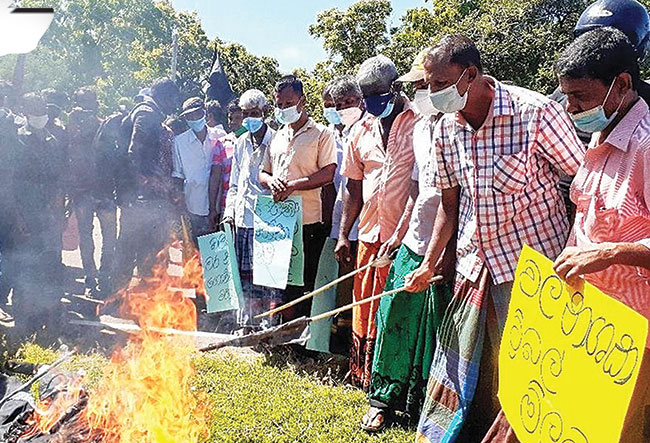
In the list of words most feared by many Sri Lankans, Arsenic stands among the top10. Historically, arsenic was a rat poison. This potential of arsenic was illegally employed later to get rid of unwanted friends and even spouses by some of the humans. However, arsenic had positive use and reputation as a health care agent. It is reported that Hippocrates used arsenic sulfide in the form of natural crystalline minerals, namely realgar and orpiment, to treat ulcers. Later, the arsenic containing minerals were used in making creams to remove unwanted hair in the human body. Since then, arsenides and arsenic salts in the form of creams for external application have been in use for centuries, in treatment of ulcers and syphilis. In the 1700s solutions of arsenic trioxide in potassium bicarbonate has been prescribed to treat asthma, chorea, psoriasis, anemia, and leukemia among several other health ailments. Some drugs containing arsenic have been prescribed to be inhaled as vapour, injected, or administered intravenously in the 19th century. Though the International Agency for Cancer Research classified arsenic in its pure form, and certain arsenic compound as a human carcinogens, Food and Drugs Administration of the USA approved the use of injectable arsenic trioxide for human treatment for relapsed acute promyelocytic leukemia. It may be considered an exceptional condition, but arsenic compounds do not deserve a total taboo without understanding their effects on the human body under each situation, beneficial or harmful. Arsenic trioxide was withdrawn from human treatment in 1950. There is evidence today on the effects of long- term exposure of humans to inorganic arsenic through food, water, or air leading to increased risk on bladder, lung, and skin cancers.
WHO records
The World Health Organization records on incidence of cancer in Sri Lanka for 2020 shows 7% lung cancer, 2.1% bladder cancer and 0.4% skin cancer, out of the total annual cancer cases. Almost all incidences of lung cancer are among males predominantly associated with smoking. The same percentage distribution of all cancers was visible in records over the previous 20 years, with fluctuations only in incidence of lung cancer. Arsenophobia was created in Sri Lanka in relation to the chronic kidney disease of unknown origin, identified as CKDU. The global literature on kidney diseases do not consider arsenic as a crucial factor in chronic kidney diseases similar to CKDU. Sri Lanka is not the only country having chronic kidney disease of this nature. There are parallels in “Chronic interstitial nephritis in agricultural communities” (CINAC) in El Salvador and Nicaragua. CINAC is also described as Mesoamerican nephropathy (MeN) in several other central and south American countries, mostly along the Pacific coastline. Scientific studies in the USA on the above chronic kidney diseases have identified relationship with a few pesticides. Some of the pesticides were banned in Sri Lanka decades back, and one still in use though to a limited extent. The studies in the USA have not been able to recognise links between arsenic or other heavy metals with the chronic kidney diseases described above.
Arsenic was used as an ingredient in weedicides and wood preservatives in the past. Registration of companies producing pesticides containing inorganic arsenic were cancelled in 1988 in the developed world. Sri Lanka does not permit the use of pesticides containing inorganic arsenic. If there is violation of this condition, there is a way to handle it rather than banning everything. The registrar of pesticides operates an accredited testing laboratory for arsenic and other heavy metals in pesticides. If law makers possess doubts on arsenic entering our food system through pesticides, what is needed simply is to provide more facilities and activate the office of the registrar of pesticides to bring in necessary controls. That is the scientific mechanism used in the developed countries to maintain food safety in the production chains. Pesticides came into existence because it had a role in agriculture. Replacing pesticides needs to identify a scientifically equivalent substitute. The World has not been successful in it. What is needed is to implement checks and controls at the appropriate levels and locations.
Cause of CKDU
If arsenic is the cause of CKDU, it should enter the humans through our main staple rice and drinking water. In Bangladesh and West Bengal, heavy and unacceptable concentrations of arsenic were reported in rice and water leading to major investigations by the United Nation bodies responsible for food and health. In the two locations the symptoms due to arsenic were quite different from the symptoms of CKDU reported in Sri Lanka. The writer, having examined 50 peer reviewed research publications and scientific reviews of acceptable quality by Sri Lankan and foreign scientists, found the arsenic concentrations in rice and water in Sri Lanka are far below the globally implemented tolerance limits of 0.2 milligrams per kilogram for rice, and 10 micrograms per litre for water. The average concentrations of arsenic in Sri Lankan rice are less than 25% of the tolerance limits for rice. The concentrations of arsenic in drinking water are less than 15% of the tolerance limit. The perused studies cover a period from 2005 to 2021. The scientific evidence has clearly proved that the arsenic concentrations in our foods pose no risk to health to Sri Lankans.
There are occasional reports on rejection of imported and locally produced canned fish due to presence of total arsenic. Total arsenic consists of inorganic arsenic and organic arsenic. Organic arsenic is present mainly in prawns and other crustaceans. Some fish carry lower concentrations of organic arsenic than crustaceans. Foods containing almost non-toxic organic arsenic carries no health risk unlike highly toxic inorganic arsenic in foods. Organic arsenic moves unabsorbed through our digestive system, getting excreted fast. Arsenic may be present in the environment and food in different inorganic forms and almost non-toxic organic forms. Main organic arsenic compound in fish is arsenobetaine. Arsenobetaine is of no toxicological concern. The issue of arsenic in fish need to be understood from a deep scientific angle before implementing controls.
Regulations
The regulations implemented by our standards and food regulatory authorities apply 0.2 milligrams per kilogram as the limit for total arsenic concentration in all foods. Regulations unfortunately takes no recognition on the toxicity difference between the organic and inorganic forms of arsenic. Arsenic appears in different forms food. Of them the inorganic forms are the culprit with high toxicity. The organic forms are of negligible toxicity. Our authorities need to distinguish between inorganic arsenic (which is 50-90% of total arsenic in rice) and organic arsenic which is approximately 95% of the total arsenic in fish. This raises an important question as to whether application of the general limit of 0.2 milligrams per kilogram of total arsenic to canned fish, which contains less than around 5% of the toxic inorganic arsenic. Interpretation of regulations needs much more scientific thinking than blind interpretations. Research scientists understand that there is no world free of arsenic and other toxic compounds. Arguing for zero arsenic or any other harmful ingredients in food and water is an indication of ignorance on basic principles of risk based regulatory approach. The tolerance limits are fixed for each and every harmful agent is to ensure food security meeting only required level of food safety.
Food safety
In arriving at decisions on food safety, the authorities consider the possible outcome of their decisions on food security of the country. First, there should be food for people to eat and live. Then comes the levels of risks associated with presence of harmful constituents. A good example is presented in the research by the USA scientists on problems linked to arsenic in rice. The mean arsenic concentrations expressed in milligrams per kilogram of rice in USA was 0.193 for white rice and 0.205 for brown rice against the regulatory limit of 0.200. The USA arsenic concentrations are at least 5 times higher than the values reported for rice in Sri Lanka. Applying the values to daily exposure of Americans consuming rice in 2-3 meals a day, it was postulated that they could reach high-risk level leading to bladder and lung cancer of the more vulnerable populations, especially the elderly and pregnant mothers. It was shown, using models, that reducing the tolerance level from current 0.200 to 0.100, would result in reduction of rice availability in the American market by a factor up to 90%, creating a food security risk. The study also postulated a reduction of regulatory limit from current 0.200 to 0.075 would bring down the food safety risk due to arsenic in rice from 11% to 79%. The regulations are maintained therefore, at 0.200 to ensure rice availability. The arsenic concentrations in Sri Lankan rice (approximately 0.04 milligrams per kilogram), is still far below the hypothetical USA limit of 0.075 limit, worked as a theoretical possibility. With all the scientific evidence, USA did not reduce the limit to 0.100. The scientific evidence clearly suggests that the ‘arsenophobia’ created in the minds of Sri Lankans is a hoax. It is continued even today by vociferous persons with scientific ignorance.
Arsenic enters food chain from soil or irrigation water. The earth crust is not free of arsenic. The crust contains 1.8 milligrams of arsenic per kilogram of soil on the average. It could take the range from 1-40. Arsenic concentrations above five milligrams per kilogram of soil make soils unsuitable for cultivation. The arsenic content in agricultural soils in Sri Lanka average around one milligram per kilogram, implying no food safety threat through local rice. The arsenic toxicity in rice occurred in West Bengal and Bangladesh due to high arsenic concentrations rising to the order of 15 milligrams per kilogram in their soils. Their irrigation water contained 10-fold higher arsenic than the permitted limit, leading to serious health problems. Sri Lankan situation is not at all comparable with the situation in West Bengal and Bangladesh. Unfortunately, we import rice from time to time from Bangladesh and other countries having arsenic contaminations.
If the food chain in a country gets contaminated with arsenic or any other toxic entities, they get detected in the exports at the foreign border check points, resulting in rejections and notifications. Information on global trade does not show instances of Sri Lanka tea or any other food getting rejected due to arsenic, or other heavy metals, or unpermitted pesticide residues.
It speaks on the Sri Lankan agricultural system was managed. Unfortunately, there are pseudo-scientists with no understanding on agriculture and food production, all out to create doubts in the minds of public.
This brings in the question as to where Sri Lanka went wrong in its science. It started with a vociferous student reading for a postgraduate degree in a university in Sri Lanka, working totally outside the specialty of his first degree in 2011. In desperation, he went to a soothsayer in a ‘Devalaya’ reputed to utter to the gullible people, under trans state of the mind. She was given some soil from Rajarata. She yelled “asan asan” perhaps asking him to listen. The student came back and started testing for arsenic using equipment of inadequate sophistication, applying unrefined test methods, ultimately “innovating” non-existent arsenic in rice. Tabloid media were fast to capture information. The ‘innovation’ was further supported by a media-oriented professor, who excelled in many fields other than his trained expertise.
The Island
carried an article around May 2011 under the title “Arsenic in Rice: Playing God”. The article highlighted the seriousness of statements arrived at without following basic principles of analytical chemistry and risk assessments, misleading the public. The materials released to the press have not gone through scientific scrutiny and was obviously questionable. The ‘arsenophobia’ next entered the august house with appearance of a reddish colour in “Kohila” curry in the meals served to members of the Parliament. The reddish colour is a common biological phenomenon on foods exposed to oxygen from air under certain preparation practices. It was October 2012 and The Island carried a note titled “Arsenic and cyanide everywhere”. The news on innovation of so-called arsenic in rice was next carried to the ears of the first citizen of the country at that time. He with his usual smile and tact said, “I eat rice three meals a day.” The message was clear to the student. Later the first citizen warned the media professor on the dangers Sri Lanka would face in our export trade, with this kind of utterances through the media. At that time there was already a shipment containing rice from Sri Lanka which was detained at a port in Turkey pending testing for arsenic. However, the stock did not get rejected as no arsenic was detected. The arsenophobia did not get marketed with the next first citizen either. Later the innovator of arsenic story reached the august house with a promise to provide “Better Health for Rajarata.” Arsenic is forgotten at least in the public eyes.
The baton was taken up by another relay team consisting of a priest, medical professional and an academic (sanga-weda-guru) expecting blessings from the highest level in the country. Unfortunately, the struggle ended up with farmers and labourers (govi-kamkaru) facing the problem. Indications are that the country would have to bear the outcome of arsenophobia for many months, if not years to come with inadequate food at exorbitant prices. No country in the world has stopped use of synthetic fertilizer in food production. European Union countries maintain extremely high levels of food safety in the world. They have decided to reach 25% organic food production by 2030 very cautiously. Canada produce food only during the warm six months of the year. They export 68% of the produce. In the Canadian Agriculture policy food production for export is a high priority. They apply scientifically controlled methods in use of agrochemicals. It is said that Canada was the major supplier of red dhal to Sri Lanka in certain years.
Leaders need to listen to scientific facts generated through careful experimenting and scholarly thinking. Mature scientists do not rush foolishly to take risks; politicians only see short term benefits. The prosperity of a country lies in well discussed decisions arrived through scientific knowledge, and not based on ad hoc findings of half-baked pseudoscientists. The l strength of India lies on the initiative to apply science in its policies immediately after independence by the Prime Minister Jawaharlal Nehru. The writer had the opportunity on two occasions to participate the Annual Indian Science Congress. On both occasions, the Prime Minister of India and four Cabinet Ministers participated at the congress and spent two days listening to the scientists. Unfortunately, interactions in Sri Lanka are nowhere near it. Sri Lanka gives the opportunity to the pseudoscientists to mislead law makers at individual levels.
Obviously, the Sri Lankan food production system affected by the absence of required fertilizer inputs is not in a position to deliver the staple and complementary food for the nation. It is already late to put things back in the track before everything gets beyond control. Let the country believe in science and its true scientists at least now and act sensibly.



by Dr Gotabhya Ranasinghe
Senior Consultant Cardiologist
National Hospital Sri Lanka
When we sought a meeting with Hon Dr. Ramesh Pathirana, Minister of Health, he graciously cleared his busy schedule to accommodate us. Renowned for his attentive listening and deep understanding, Minister Pathirana is dedicated to advancing the health sector. His openness and transparency exemplify the qualities of an exemplary politician and minister.
Dr. Palitha Mahipala, the current Health Secretary, demonstrates both commendable enthusiasm and unwavering support. This combination of attributes makes him a highly compatible colleague for the esteemed Minister of Health.
Our discussion centered on a project that has been in the works for the past 30 years, one that no other minister had managed to advance.
Minister Pathirana, however, recognized the project’s significance and its potential to revolutionize care for heart patients.
The project involves the construction of a state-of-the-art facility at the premises of the National Hospital Colombo. The project’s location within the premises of the National Hospital underscores its importance and relevance to the healthcare infrastructure of the nation.
This facility will include a cardiology building and a tertiary care center, equipped with the latest technology to handle and treat all types of heart-related conditions and surgeries.
Securing funding was a major milestone for this initiative. Minister Pathirana successfully obtained approval for a $40 billion loan from the Asian Development Bank. With the funding in place, the foundation stone is scheduled to be laid in September this year, and construction will begin in January 2025.
This project guarantees a consistent and uninterrupted supply of stents and related medications for heart patients. As a result, patients will have timely access to essential medical supplies during their treatment and recovery. By securing these critical resources, the project aims to enhance patient outcomes, minimize treatment delays, and maintain the highest standards of cardiac care.
Upon its fruition, this monumental building will serve as a beacon of hope and healing, symbolizing the unwavering dedication to improving patient outcomes and fostering a healthier society.We anticipate a future marked by significant progress and positive outcomes in Sri Lanka’s cardiovascular treatment landscape within the foreseeable timeframe.

by Fr. Emmanuel Fernando, OMI
Jesuit Fr. Aloysius Pieris (affectionately called Fr. Aloy) celebrated his 90th birthday on April 9, 2024 and I, as the editor of our Oblate Journal, THE MISSIONARY OBLATE had gone to press by that time. Immediately I decided to publish an article, appreciating the untiring selfless services he continues to offer for inter-Faith dialogue, the renewal of the Catholic Church, his concern for the poor and the suffering Sri Lankan masses and to me, the present writer.
It was in 1988, when I was appointed Director of the Oblate Scholastics at Ampitiya by the then Oblate Provincial Fr. Anselm Silva, that I came to know Fr. Aloy more closely. Knowing well his expertise in matters spiritual, theological, Indological and pastoral, and with the collaborative spirit of my companion-formators, our Oblate Scholastics were sent to Tulana, the Research and Encounter Centre, Kelaniya, of which he is the Founder-Director, for ‘exposure-programmes’ on matters spiritual, biblical, theological and pastoral. Some of these dimensions according to my view and that of my companion-formators, were not available at the National Seminary, Ampitiya.
Ever since that time, our Oblate formators/ accompaniers at the Oblate Scholasticate, Ampitiya , have continued to send our Oblate Scholastics to Tulana Centre for deepening their insights and convictions regarding matters needed to serve the people in today’s context. Fr. Aloy also had tried very enthusiastically with the Oblate team headed by Frs. Oswald Firth and Clement Waidyasekara to begin a Theologate, directed by the Religious Congregations in Sri Lanka, for the contextual formation/ accompaniment of their members. It should very well be a desired goal of the Leaders / Provincials of the Religious Congregations.
Besides being a formator/accompanier at the Oblate Scholasticate, I was entrusted also with the task of editing and publishing our Oblate journal, ‘The Missionary Oblate’. To maintain the quality of the journal I continue to depend on Fr. Aloy for his thought-provoking and stimulating articles on Biblical Spirituality, Biblical Theology and Ecclesiology. I am very grateful to him for his generous assistance. Of late, his writings on renewal of the Church, initiated by Pope St. John XX111 and continued by Pope Francis through the Synodal path, published in our Oblate journal, enable our readers to focus their attention also on the needed renewal in the Catholic Church in Sri Lanka. Fr. Aloy appreciated very much the Synodal path adopted by the Jesuit Pope Francis for the renewal of the Church, rooted very much on prayerful discernment. In my Religious and presbyteral life, Fr.Aloy continues to be my spiritual animator / guide and ongoing formator / acccompanier.
Fr. Aloysius Pieris, BA Hons (Lond), LPh (SHC, India), STL (PFT, Naples), PhD (SLU/VC), ThD (Tilburg), D.Ltt (KU), has been one of the eminent Asian theologians well recognized internationally and one who has lectured and held visiting chairs in many universities both in the West and in the East. Many members of Religious Congregations from Asian countries have benefited from his lectures and guidance in the East Asian Pastoral Institute (EAPI) in Manila, Philippines. He had been a Theologian consulted by the Federation of Asian Bishops’ Conferences for many years. During his professorship at the Gregorian University in Rome, he was called to be a member of a special group of advisers on other religions consulted by Pope Paul VI.
Fr. Aloy is the author of more than 30 books and well over 500 Research Papers. Some of his books and articles have been translated and published in several countries. Among those books, one can find the following: 1) The Genesis of an Asian Theology of Liberation (An Autobiographical Excursus on the Art of Theologising in Asia, 2) An Asian Theology of Liberation, 3) Providential Timeliness of Vatican 11 (a long-overdue halt to a scandalous millennium, 4) Give Vatican 11 a chance, 5) Leadership in the Church, 6) Relishing our faith in working for justice (Themes for study and discussion), 7) A Message meant mainly, not exclusively for Jesuits (Background information necessary for helping Francis renew the Church), 8) Lent in Lanka (Reflections and Resolutions, 9) Love meets wisdom (A Christian Experience of Buddhism, 10) Fire and Water 11) God’s Reign for God’s poor, 12) Our Unhiddden Agenda (How we Jesuits work, pray and form our men). He is also the Editor of two journals, Vagdevi, Journal of Religious Reflection and Dialogue, New Series.
Fr. Aloy has a BA in Pali and Sanskrit from the University of London and a Ph.D in Buddhist Philosophy from the University of Sri Lankan, Vidyodaya Campus. On Nov. 23, 2019, he was awarded the prestigious honorary Doctorate of Literature (D.Litt) by the Chancellor of the University of Kelaniya, the Most Venerable Welamitiyawe Dharmakirthi Sri Kusala Dhamma Thera.
Fr. Aloy continues to be a promoter of Gospel values and virtues. Justice as a constitutive dimension of love and social concern for the downtrodden masses are very much noted in his life and work. He had very much appreciated the commitment of the late Fr. Joseph (Joe) Fernando, the National Director of the Social and Economic Centre (SEDEC) for the poor.
In Sri Lanka, a few religious Congregations – the Good Shepherd Sisters, the Christian Brothers, the Marist Brothers and the Oblates – have invited him to animate their members especially during their Provincial Congresses, Chapters and International Conferences. The mainline Christian Churches also have sought his advice and followed his seminars. I, for one, regret very much, that the Sri Lankan authorities of the Catholic Church –today’s Hierarchy—- have not sought Fr.
Aloy’s expertise for the renewal of the Catholic Church in Sri Lanka and thus have not benefited from the immense store of wisdom and insight that he can offer to our local Church while the Sri Lankan bishops who governed the Catholic church in the immediate aftermath of the Second Vatican Council (Edmund Fernando OMI, Anthony de Saram, Leo Nanayakkara OSB, Frank Marcus Fernando, Paul Perera,) visited him and consulted him on many matters. Among the Tamil Bishops, Bishop Rayappu Joseph was keeping close contact with him and Bishop J. Deogupillai hosted him and his team visiting him after the horrible Black July massacre of Tamils.
Sri Lanka-Singapore Free Trade Agreement
By Gomi Senadhira
senadhiragomi@gmail.com
“You might tell fairy tales, but the progress of a country cannot be achieved through such narratives. A country cannot be developed by making false promises. The country moved backward because of the electoral promises made by political parties throughout time. We have witnessed that the ultimate result of this is the country becoming bankrupt. Unfortunately, many segments of the population have not come to realize this yet.” – President Ranil Wickremesinghe, 2024 Budget speech
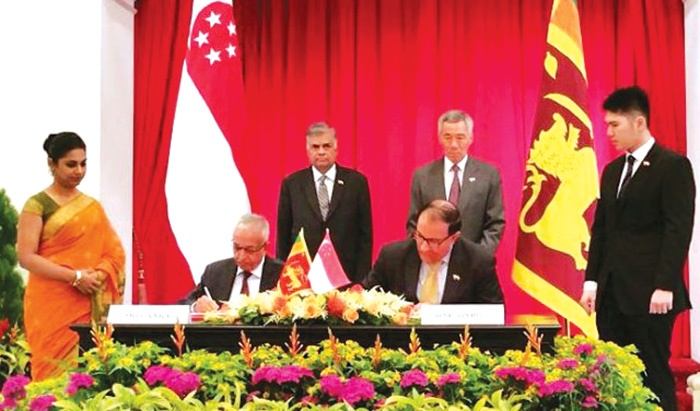
Any Sri Lankan would agree with the above words of President Wickremesinghe on the false promises our politicians and officials make and the fairy tales they narrate which bankrupted this country. So, to understand this, let’s look at one such fairy tale with lots of false promises; Ranil Wickremesinghe’s greatest achievement in the area of international trade and investment promotion during the Yahapalana period, Sri Lanka-Singapore Free Trade Agreement (SLSFTA).
It is appropriate and timely to do it now as Finance Minister Wickremesinghe has just presented to parliament a bill on the National Policy on Economic Transformation which includes the establishment of an Office for International Trade and the Sri Lanka Institute of Economics and International Trade.
Was SLSFTA a “Cleverly negotiated Free Trade Agreement” as stated by the (former) Minister of Development Strategies and International Trade Malik Samarawickrama during the Parliamentary Debate on the SLSFTA in July 2018, or a colossal blunder covered up with lies, false promises, and fairy tales? After SLSFTA was signed there were a number of fairy tales published on this agreement by the Ministry of Development Strategies and International, Institute of Policy Studies, and others.
However, for this article, I would like to limit my comments to the speech by Minister Samarawickrama during the Parliamentary Debate, and the two most important areas in the agreement which were covered up with lies, fairy tales, and false promises, namely: revenue loss for Sri Lanka and Investment from Singapore. On the other important area, “Waste products dumping” I do not want to comment here as I have written extensively on the issue.
1. The revenue loss
During the Parliamentary Debate in July 2018, Minister Samarawickrama stated “…. let me reiterate that this FTA with Singapore has been very cleverly negotiated by us…. The liberalisation programme under this FTA has been carefully designed to have the least impact on domestic industry and revenue collection. We have included all revenue sensitive items in the negative list of items which will not be subject to removal of tariff. Therefore, 97.8% revenue from Customs duty is protected. Our tariff liberalisation will take place over a period of 12-15 years! In fact, the revenue earned through tariffs on goods imported from Singapore last year was Rs. 35 billion.
The revenue loss for over the next 15 years due to the FTA is only Rs. 733 million– which when annualised, on average, is just Rs. 51 million. That is just 0.14% per year! So anyone who claims the Singapore FTA causes revenue loss to the Government cannot do basic arithmetic! Mr. Speaker, in conclusion, I call on my fellow members of this House – don’t mislead the public with baseless criticism that is not grounded in facts. Don’t look at petty politics and use these issues for your own political survival.”
I was surprised to read the minister’s speech because an article published in January 2018 in “The Straits Times“, based on information released by the Singaporean Negotiators stated, “…. With the FTA, tariff savings for Singapore exports are estimated to hit $10 million annually“.
As the annual tariff savings (that is the revenue loss for Sri Lanka) calculated by the Singaporean Negotiators, Singaporean $ 10 million (Sri Lankan rupees 1,200 million in 2018) was way above the rupees’ 733 million revenue loss for 15 years estimated by the Sri Lankan negotiators, it was clear to any observer that one of the parties to the agreement had not done the basic arithmetic!
Six years later, according to a report published by “The Morning” newspaper, speaking at the Committee on Public Finance (COPF) on 7th May 2024, Mr Samarawickrama’s chief trade negotiator K.J. Weerasinghehad had admitted “…. that forecasted revenue loss for the Government of Sri Lanka through the Singapore FTA is Rs. 450 million in 2023 and Rs. 1.3 billion in 2024.”
If these numbers are correct, as tariff liberalisation under the SLSFTA has just started, we will pass Rs 2 billion very soon. Then, the question is how Sri Lanka’s trade negotiators made such a colossal blunder. Didn’t they do their basic arithmetic? If they didn’t know how to do basic arithmetic they should have at least done their basic readings. For example, the headline of the article published in The Straits Times in January 2018 was “Singapore, Sri Lanka sign FTA, annual savings of $10m expected”.
Anyway, as Sri Lanka’s chief negotiator reiterated at the COPF meeting that “…. since 99% of the tariffs in Singapore have zero rates of duty, Sri Lanka has agreed on 80% tariff liberalisation over a period of 15 years while expecting Singapore investments to address the imbalance in trade,” let’s turn towards investment.
Investment from Singapore
In July 2018, speaking during the Parliamentary Debate on the FTA this is what Minister Malik Samarawickrama stated on investment from Singapore, “Already, thanks to this FTA, in just the past two-and-a-half months since the agreement came into effect we have received a proposal from Singapore for investment amounting to $ 14.8 billion in an oil refinery for export of petroleum products. In addition, we have proposals for a steel manufacturing plant for exports ($ 1 billion investment), flour milling plant ($ 50 million), sugar refinery ($ 200 million). This adds up to more than $ 16.05 billion in the pipeline on these projects alone.
And all of these projects will create thousands of more jobs for our people. In principle approval has already been granted by the BOI and the investors are awaiting the release of land the environmental approvals to commence the project.
I request the Opposition and those with vested interests to change their narrow-minded thinking and join us to develop our country. We must always look at what is best for the whole community, not just the few who may oppose. We owe it to our people to courageously take decisions that will change their lives for the better.”
According to the media report I quoted earlier, speaking at the Committee on Public Finance (COPF) Chief Negotiator Weerasinghe has admitted that Sri Lanka was not happy with overall Singapore investments that have come in the past few years in return for the trade liberalisation under the Singapore-Sri Lanka Free Trade Agreement. He has added that between 2021 and 2023 the total investment from Singapore had been around $162 million!
What happened to those projects worth $16 billion negotiated, thanks to the SLSFTA, in just the two-and-a-half months after the agreement came into effect and approved by the BOI? I do not know about the steel manufacturing plant for exports ($ 1 billion investment), flour milling plant ($ 50 million) and sugar refinery ($ 200 million).
However, story of the multibillion-dollar investment in the Petroleum Refinery unfolded in a manner that would qualify it as the best fairy tale with false promises presented by our politicians and the officials, prior to 2019 elections.
Though many Sri Lankans got to know, through the media which repeatedly highlighted a plethora of issues surrounding the project and the questionable credentials of the Singaporean investor, the construction work on the Mirrijiwela Oil Refinery along with the cement factory began on the24th of March 2019 with a bang and Minister Ranil Wickremesinghe and his ministers along with the foreign and local dignitaries laid the foundation stones.
That was few months before the 2019 Presidential elections. Inaugurating the construction work Prime Minister Ranil Wickremesinghe said the projects will create thousands of job opportunities in the area and surrounding districts.
The oil refinery, which was to be built over 200 acres of land, with the capacity to refine 200,000 barrels of crude oil per day, was to generate US$7 billion of exports and create 1,500 direct and 3,000 indirect jobs. The construction of the refinery was to be completed in 44 months. Four years later, in August 2023 the Cabinet of Ministers approved the proposal presented by President Ranil Wickremesinghe to cancel the agreement with the investors of the refinery as the project has not been implemented! Can they explain to the country how much money was wasted to produce that fairy tale?
It is obvious that the President, ministers, and officials had made huge blunders and had deliberately misled the public and the parliament on the revenue loss and potential investment from SLSFTA with fairy tales and false promises.
As the president himself said, a country cannot be developed by making false promises or with fairy tales and these false promises and fairy tales had bankrupted the country. “Unfortunately, many segments of the population have not come to realize this yet”.
(The writer, a specialist and an activist on trade and development issues . )



US sports envoys to Lanka to champion youth development

Rahuman questions sudden cancellation of leave of CEB employees


