
Life style
How elephant poop becomes fancy paper in Sri Lanka

BY ZINARA RATNAYAKE
An elephant can defecate 16 times in one day—and its 200 pounds of dung can double as paper pulp.Grown-up elephants can eat more than 300 pounds of food—mostly grass, twigs, foliage, and tree bark—in a single day. In the same period, they may defecate 16 to 18 times, producing over 200 pounds of dung.
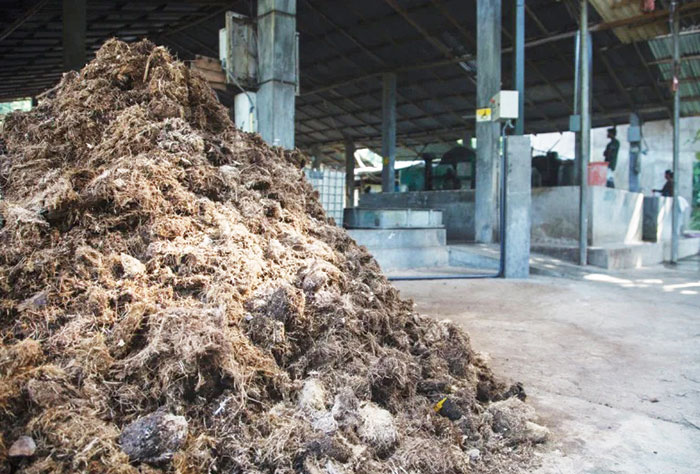
In Randeniya, a small village in the lower wetlands of Sri Lanka, elephant poop is a renewable resource. The sun-dried, deep-brown dung piles up like haystacks in a painting by Claude Monet.
Visitors could be forgiven for thinking that the poop is useless. But at Eco Maximus, a manufacturer in Randeniya, it takes on a second life.

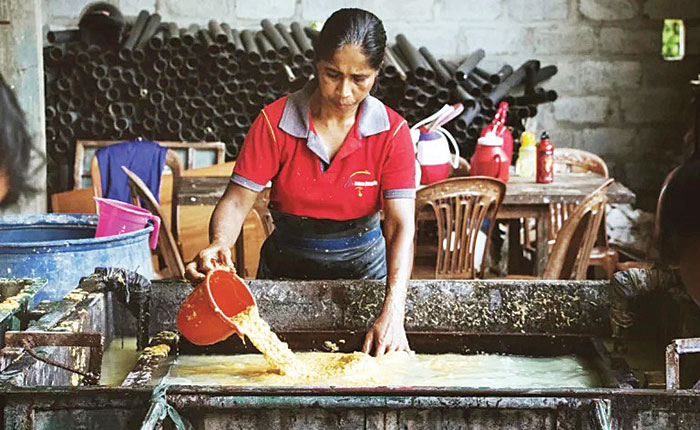
Two women create a fabric-pulp sheet
More than 20 years ago, a man named Thusita Ranasinghe saw some dung and had an idea. “He thought he could make paper from it,” says the company’s brand designer, Susantha Karunarathne, with a smile. At his office inside the company factory, Karunarathne wears a green t-shirt which says elephantdung paper and shows off some of his recent journal designs. On a table nearby, a several women carefully design covers for multi-sized notebooks. On another, the finished product is packed and ready to be shipped. Today, Maximus creates a range of stationery and souvenirs, which are sold in the local market and in 30 other countries around the globe.
Eco Maximus was an early producer of elephant dung paper, and the first in Sri Lanka, and refining the manufacturing process involved a lot of trial and error. Elephant dung is brought in by nearby rescue centers, Karunarathne says during a tour of the factory.
Fresh elephant dung, semi-solid and green in color, smells. But after it dries under the hot tropical sun, the smell disappears. Collectors gather the deep-brown, fiber-rich piles in a piping-hot steam boiler. “We boil for one hour, to ensure that the dung is germ-free,” says Vibhatha Wijeratne, the factory manager, wearing a pair of yellow gloves as he shows me a pile of boiled dung.
In one corner of the factory, bundles of paper with crumpled edges are stacked upon each other. There are different colors—earthy tones, blues, tropical greens, and deep reds. Thousands of years ago, much of the writing in Sri Lanka was inscribed on stones. Later, the islanders wrote on leaves, such as the fronds of the palmyrah palm, locally known as the tal.
-

- Paper pulp mostly consists of two things: elephant dung and off-cut, which is an industry term for scraps cut from a larger piece of paper

-
- Sun-dried elephant dung is brown in colour
“Palmyrah leaves were boiled and sun-dried for writing, which was called pus kola (old leaves),” says bright-eyed Randika Jayasinghe, who teaches biosystems technology at the University of Sri Jayewardenepura.
Conventional papermaking began after Sri Lanka was colonized by the Portuguese, the Dutch, and then the British, who referred to the island as Ceylon. Most paper uses wood pulp as the main material, which is fibrous and rich in lignin and cellulose. “It is prepared by chemically and mechanically separating fibers from wood,” Jayasinghe says. “These chemicals are then released as wastewater.”
The problem is that nearly four billion trees are cut down every year to manufacture paper. Some are farmed, but others are logged from managed and old-growth forests. “Since paper is biodegradable, we consider it to be eco-friendly compared to plastics,” Jayasinghe says. But it comes at a significant environmental cost.
After the British left Sri Lanka in 1948, the local government opened 12 factories in the 1960s to utilize waste straw from rice paddies for paper-making. But by 1993, only two of them remained. One of them was managed by Shirani Fairbanks. “I walked into the Export Development Board in Colombo, and by accident, I saw a sheet of paper made from banana fiber,” says curly-haired Fairbanks, collecting a bundle of vibrant wrapping paper from her office table. “It inspired me to start Trickledown.”
Her company eventually moved beyond conventional paper making, when they began using waste material—tea refuse, banana skins, pineapple fiber—to make paper. “There’s a huge demand for elephant dung paper products in the market,” Fairbanks tells me. They have a unique aesthetic appeal, which many young people love.”
The company now sources paper from manufacturers around the country for their stationery, crafts and other products. One of them is Eco Maximus.
Back at the Eco Maximus factory, Wijeratne, the manager, shows off a 1,000-liter cement tank known as the beater. A rubber hose pipes water into the tank from a nearby tap, and an employee uses his bare hands to toss in steam-boiled dung, which now resembles a yarn ball made out of earthy fibers. “This is the pulp we use for inner pages of notebooks,” Wijeratne says. “One-third of this pulp is elephant dung, while two-thirds of it is offcut.”
Offcut is two things: leftover paper brought from warehouses in Colombo, and remains from Eco Maximus paper that has been leveled and cut into desired sizes. Finally, bucket of deep magenta liquid is added to the mixture. (Eco Maximus also makes paper from elephant dung alone, but its fibrous texture makes it unsuitable for writing or drawing.) In one of the last steps of papermaking, a woman pours a jug of pulp onto a thin metal mesh.

A bundle of paper awaits ironing
The mesh is dipped in water, and she uses her fingers to mix the pulp for a few seconds, leveling it on the mesh while the water trickles down. “This is for 150 GSM writing paper,” Wijeratne tells me, using the industry acronym for “grams per square meter.” (Printer paper is usually less than 100 GSM, while business cards can be as high as 400 GSM.)
Two women hold the mesh up and press it onto a slightly larger cotton fabric, which is laid flat on a table by a third woman. She then folds the fabric edges in and seals it, which creates a fabric-pulp sheet. Smiling and chatting, they soon make a pile of sheets.
“We use this machine to compress the water out,” says Karunarathne, pointing to a large electric machine. A middle-aged man manually controls the machine, which squeezes a bundle of fabric-pulp sheets as water drips down. “Now you can remove the cotton fabric, and let it dry.” Karunarathne takes me to a large section of the factory where colourful papers are neatly racked. Drying takes place under the asbestos roof, as direct sunlight could bleach the blues, tropical greens, earthy tones, and deep reds.
Finally, two cheery ladies stand by a large aluminum sheet iron, which smooths out the creases and rough edges one sheet at a time. “Ironing is the final step of raw paper making,” says Wijeratne. These paper sheets will be cut, leveled and turned into stationery.
The transformation of poop into paper is complete. Outside, in a neighbour’s garden outside the factory, it is about to start all over again. An elephant marches past, holding a clump of grass beneath his trunk. He leaves a pile of poop before he moves on. “It will be turned into paper tomorrow,” Karunarathne says, and laughs.
(BBC)



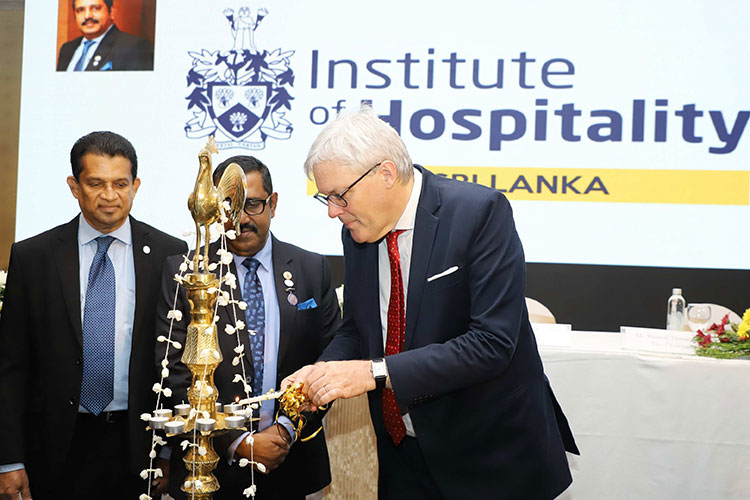
Institute of Hospitality Sri Lanka
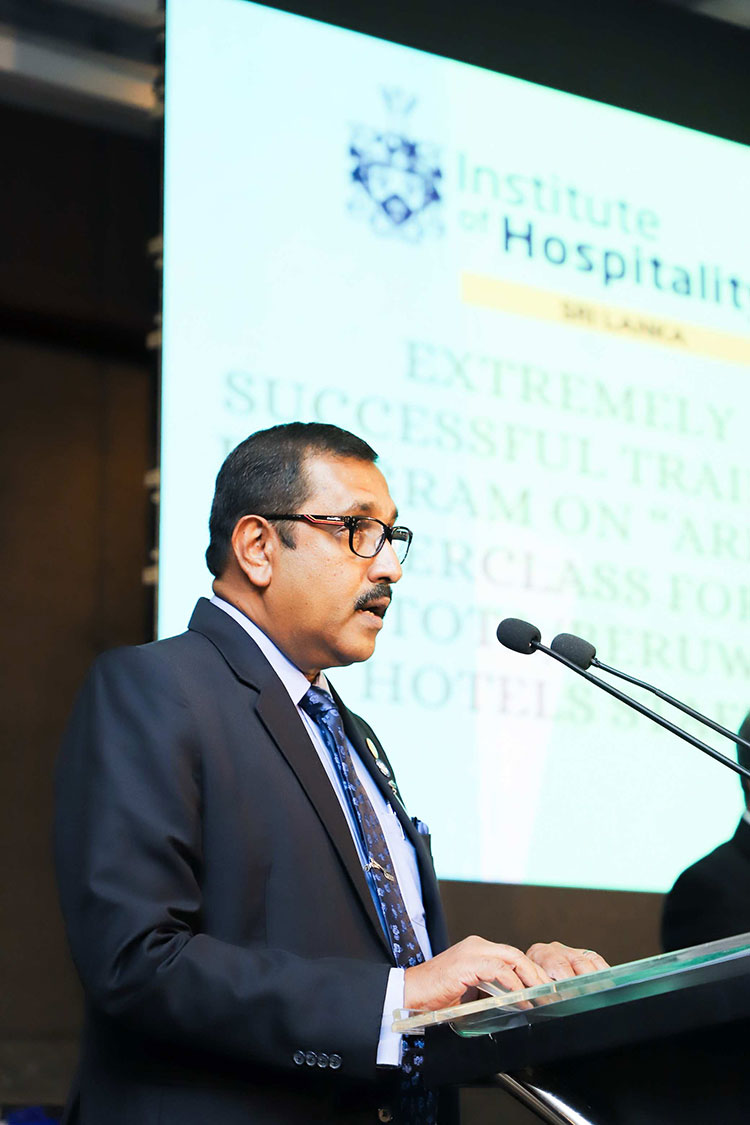
 The 32nd Annual General Meeting (AGM) of the UK-based Institute of Hospitality’s Sri Lanka Chapter was held recently at the Ramada Hotel Colombo,.The event provided an evening of camaraderie , reflection of the past and present achievements,setting new benchmarks for the future
The AGM had the presence of two distinguished guests, the Chief Guest Opposition Leader Sajith Premadasa, and the Guest of Honour British High Commissioner to Sri Lanka, Andrew Patrick. Their inspiring speeches were lauded by all hoteliers who were present at the occasion
A special thanks was extended to Robert Richardson, CEO of the Institute of Hospitality UK, along with his team, sponsors, committee members, and all attendees for making the event memorable.
Dr. Harsha Jayasingh, Past President of the Institute of Hospitality (UK) Sri Lanka Chapter, emphasised the Institute’s longstanding history and the strength of its Sri Lankan branch. “The Institute of Hospitality (IH) UK has a history of 86 years, and we are proud to be the Sri Lanka Branch. IH Sri Lanka is much stronger now with many members from all areas of the hospitality industry,” he stated.
Dr. Jayasingh highlighted the significant role of tourism in Sri Lanka’s economy,. He said tourism it is the third-largest source of revenue for the country. “Tourism accounts for about 13.3% of total foreign exchange earnings and employs 450,000 people directly and indirectly. The hospitality industry in this island of pearl holds tremendous potential for economic growth, job creations, and cultural exchange,” he added.
He also pointed out more women should be attracted to the industry and advocated for the use of technology in hospitality sector to attract the younger generation.
The newly appointed Chairman Ramesh Dassanayake spoke about the challenges faced by the industry, including the reluctance of youth to join the sector. . Dassanayake expressed concerns over the migration of staff between hotels and the overall ‘brain drain’ in the sector. ” We must maintain high standards in the hotel We must try to attract tourists to Sri Lanka, we must have with many facilities Hence, hotel schools and other professional institutions involved in skills development mustincrease their intakes,” he pointed out.
Chief Guest Sajith Premadasa emphasised the importance of eco tourism and said “We need to have an environmental policy related to tourism in place,” . .
The 32nd AGM of the Institute of Hospitality UK, Sri Lanka Chapter, was a testament to the strength and potential of Sri Lanka’s hospitality industry. The insights and commitments shared during the event set a new benchmark for the future.(ZC)



Pix by Thushara Attapathu
Life style
He recognizes human identity beyond boundaries of gender, race, nationality and religion.
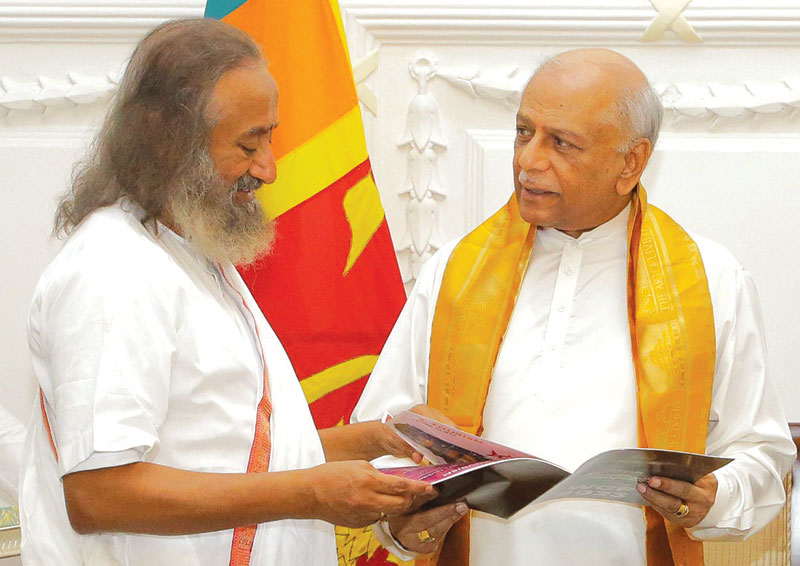
Visit of Sri Gurudev to Sri Lanka
Humanitarian, spiritual leader and Global Ambassador of Peace Gurudev Sri Sri Ravi Shankar (Sri Gurudev) was in Sri Lanka on a three day tour on the invitation of the Prime Minister of Sri Lanka Dinesh Gunewardene. Gurudev who inspired a wave of volunteerism and service to moot one of the largest volunteer-based organisations in the world – The Art of Living – visited the various projects under the aegis of the foundation and launched twelve vocational and technical centers around the island. He was accompanied by thousands of followers from Sri Lanka and around the world.
Gurudev who visited Sri Lanka for the sixth time also had a first day cover launched in honour of his visit. He is a strong proponent of spreading happiness, using the unique Sudarshan Kriya, yoga, meditation and practical wisdom to unite people, empower individuals and transform communities. His programmes provide techniques and tools to live a deeper, more joyous life, while his non-profit organisations recognize the human identity beyond the boundaries of gender, race, nationality and religion.
The Art of Living which has more than 30,000 teachers and over one million volunteers across 180 countries has touched in excess of five hundred million people around the world. CNN called it “Life Changing” and The Washington Post headlined it, “Fresh air to millions”.
In Trincomalee, Gurudev met with war victims and had a heartwarming engagement with the children from the children’s homes run by the Foundation. He also visited the Koneswara Temple in Trincomalee and graced the Kumbhabhishekam at Seetha ecogPnize the human identity beyond the boundaries of gender, race, nationality and religion. Amman temple at Nuwara Eliya. He held discussions with the trustees on the progress of the foundation’s social service projects, while also holding a special event – Ekamuthuwa – attended by a large number of dignitaries and his devotees from around the world.
His time with the Prime Minister was spent discussing the prospects of unity in diversity and uniting Sri Lanka by adding happiness into the formula of living. In addition he had discussions with the Speaker of the Parliament of Sri Lanka Mahinda Yapa Abeywardena, prominent business stewards and civil society leaders.
by Zanita Careem
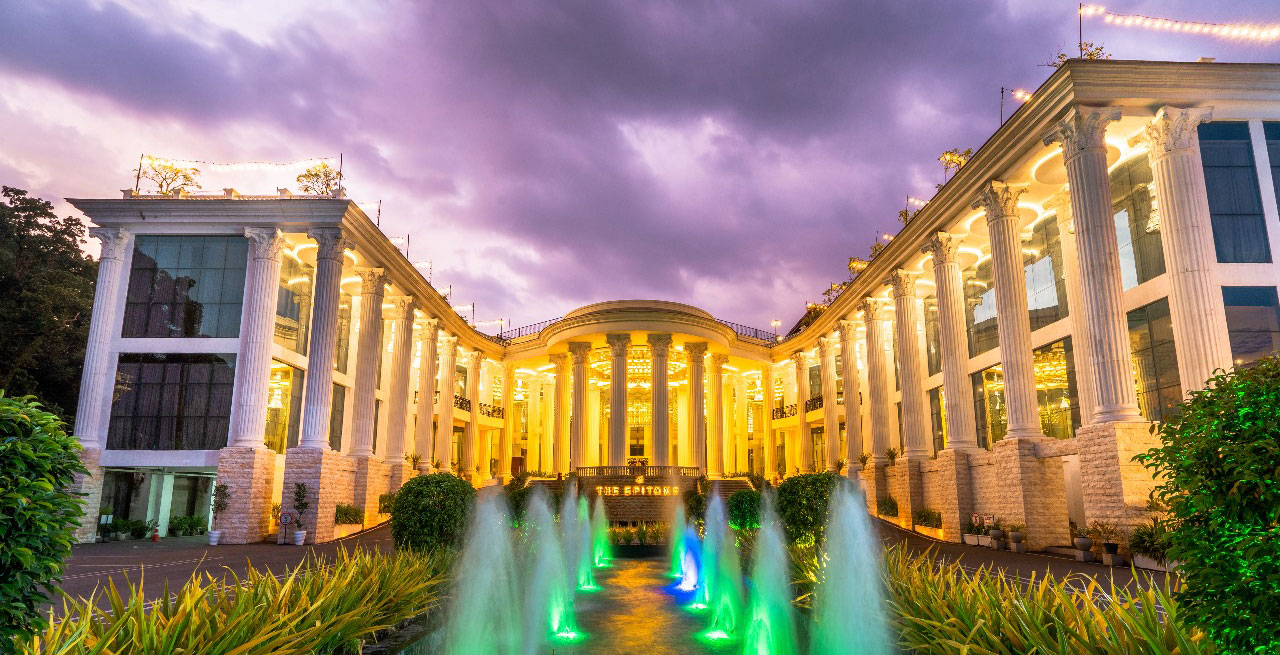
Envison your dream wedding day come to life at the Epitome Hotel, a prestigious city hotel in Kurunegala offering an unrivalled luxury rendors experience for weddings.
The venue is designed to embody opulence and luxury from all quarters for a spectacular wedding in kurunegala,Thier ballroom is the largest banquet facility in Sri Lanka It can be divided into six luxurious pillarless wedding halls on the ground floor and 25pax smaller banquet halls.
It can be easily named as a five star heaven in the heart of the city contributing to a myriad of immense experiences tailored to inspire and delight wedding experiences.
From opulent décor set up to exquisite table decor, lavish food, every detail is meticulously curated to spark your imagination and ignite creativity for a perfect wedding. The previous prestigious wedding shows season one and season two attracted large crowds
were unique events which gave the wedding vendors and potential clients had an opportunity to connect and interact with each other. Beyond being a showcase it was a chance for the wedding vendors to unite and contribute to the vibrancy of the wedding industry. The wedding show covered all area of the bridal industry providing a comprehensive variety of bridal supplies from Sri lanka and became the most popular bridal exhibitions in Kurunegala.This bridal exhibitions allowed brides and grooms to experience first hand the products and services available from suppliers in Sri Lanka
These wedding shows held at The Epitome created a benchmark and gave an opportunity for vendors to create connections to the utmost satisfaction said Harshan Lakshita Executive Director. of the magnificent Hotel
Our wedding shows featured experts and professionals in every field‘ It covered all areas of the bridal industry provided a comprehensive variety of bridal supplies from Sri lanka and became most popular bridal exhibition in this region.We are always open to everyone to join us at our wedding shows in the future. It is an opportunity to discover the incredible talent within our local wedding and bridal vendors to make meaningful relationships and plan thier special day at our breathtaking hotel The Epitome said General Manager Kavinda Caldera
The Epitome Hotel’s bridal show which will be held end of June will buzz with great ideas,advice and inspiration for all those who plan thier dream wedding
…….
The Hotel Epitome’s Wedding Season 3 will marked excellence, celebration and inspiration for those in the wedding industry. The exhibition halls will resonate with ideas on exquisite bridal wear to decor, florists , photography etc and showshowcase the rich tapestry of talent within the local wedding industry. .






US sports envoys to Lanka to champion youth development

Rahuman questions sudden cancellation of leave of CEB employees


