Features
900-year-old Buddhist monastery discovered in India’s Jharkhand state

BY S VENKAT NARAYAN
Our Special Correspondent
NEW DELHI, April 18:
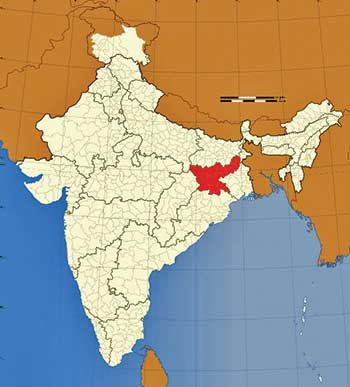
The Archaeological Survey of India (ASI) made a major discovery early this year. It found remains of a sprawling Buddhist monastery at least 900 years old, full of small and large statues of Buddhist deities in Bahoranpur village of Gurhet panchayat in Hazaribagh’s Sadar block in India’s Jharkhand state. There were also some Shaivite remains at the site.
The site, at the eastern side of Jharkhand’s Sitagraha hills, has been cordoned off by security personnel. Over the last several weeks, groups of people have been making their way to the site, about 12 kilometres outside Hazaribagh town, on foot or on bicycles.
Hazaribagh is 124km from Bodh Gaya in Bihar, where Gautama Buddha (567-487BC) had attained enlightenment at the age of 35 after 49 days of continuous meditation under the Bodhi Tree.
“Bhagwan ke darshan karne aaye hain,” (“I have come to see God”), said Prajapati, a skilled labourer trying to make his way to the site. He is hoping the excavation will continue for some time so he can perhaps find a job at the site.

Among the ASI’s discoveries are four statues of Taras, the “saviouresses” of the Thunderbolt Vehicle, displaying the Varada mudra, a hand gesture signifying the dispensing of boons. There are six statues of the Buddha in the Bhumisparsha mudra, with all five fingers of his right hand extended towards the earth, symbolising his enlightenment. Then there are remnants of a statue of the (Hindu) Shaivite goddess Maheswari, with a coiled crown and chakra, suggesting a degree of cultural assimilation at the site.
Assistant Archeologist Niraj Kumar Mishra of Excavator Branch III, Patna, said: “We had excavated this area in November 2019… Since January 31 this year, we focused on a mound near Juljul Pahar in the Sitagarhi hills, where we found remains of a Buddhist monastery-cum-shrine, with an open courtyard and rooms along the sides.”
Soon after the findings became widely known, two of the statues disappeared from the site. The thieves were arrested in Jharkhand capital Ranchi a week later, and the statues were recovered. But the incident underlined the neglect that the priceless archaeological site faced.
Mahesh Tigga, head of Gurhet panchayat, said: “Buddhist relics have been found at several places in this area. We have asked the government to build a museum here. We will not allow the statues to be taken away from our land.”
The first archaeological discoveries in this area were made three decades ago. In 1992, veteran environmentalist and tribal arts conservationist Bulu Imam, convener of the Hazaribagh chapter of the Indian National Trust for Art and Cultural Heritage (INTACH), stumbled upon pottery and remains of Buddhist relics and statues here.
Imam reported the discovery of painted grey ware (PGW) pottery, a votive stupa, a black basalt apsara torso, and an “eight-petalled astadala lotus” inscribed on stone.
“Remains of a vihara, stupa, and village with iron smelting siter alongside in a Sarna or sacred grove which yielded PGW fragments are confirmed. It seems that several tanks and wells and villages in the region were once part of comprehensive Vihara on the pilgrim route to Midnapore (Tamralipti),” Imam wrote (Damodar Valley Civilisation, 2001).
Imam estimated the antiquity of the Buddhist sites of Hazaribagh from 300 BC to the period of the Palas (8th to 12th centuries AD), and the Sena (11th-12th centuries). The monastery that has now been excavated lies on the old trade route from Varanasi to Tamralipti, via Sherghati in Gaya district in neighbouring Bihar state, and the Sitagraha hills in Jharkhand.
A lot of Hazaribagh district is forested, and is home to the Birhor tribals to whom Juljul Pahar is sacred. Every year, on Buddha Purnima day and other occasions of religious significance, local people go to the top of the hill with offerings of rice and milk. Besides the remains of the ancient vihara, the hill has a 65-foot stone face that the Birhors revere as Mahadeva (Lord Shiva, a Hindu deity).
Imam, who is now 79 and runs a museum that contains neolithic artefacts and collections of the local Khovar and Sohrai paintings, said he had been trying to get the Central Government to relocate a BSF (Border Security Force) firing range in the area from the early 1990s.
“However, till date, the firing range remains as it is… I informed ASI in 1992, but it took them close to 30 years to begin excavating this major Buddhist site… The ASI’s recent findings are the most significant archaeological discovery in Jharkhand in modern India. No other intact Buddha statue of this beauty and quality, around four feet tall and with heavy back support typical of the time of the Palas, has been found … Even in Bihar only a few statues of this quality have been found,” he said.
Imam’s discoveries were confirmed in the ASI’s report on ‘Exploration in districts Hazaribagh and Chatra, 1995’. The report, published in 2000, said: “Historical sites at Sitagarh yielded evidence of three circular brick structures besides one habitational mound, while Itkori yielded temple remains alongside a huge habitational area.
“At both these sites were noticed the sculptures of both Brahmanical and Buddhist pantheon. At Itkori a large number of sculptures, majority of which comprised votive stupas, were noticed. These sculptures belong to the Pala period, and only a few of these are inscribed.”
Imam believes the Chinese scholar Hiuen Tsang (Xuan Zang) may have visited Sitagraha during his travels in India in the seventh century. “His visitations were very complex, but at that time, he could have gone back to China through one of only two routes, from Mayurbhanj in Odisha and Tamralipti in Bengal,” he said.