Life style
A Leopard’s leap

The rare Sri Lankan black leopard which succumbed to injuries resulting from a hunter’s trap on a tea estate in Nallathanniya in Hatton a few months ago is being preserved by the Department of National Museums. The stately creature is soon to join its other ‘friends from the wilds’ sheltered at the Museum of Natural History, Colombo.
by Randima Attygalle
Igniting the outrage of animal lovers, a black leopard that was snared at a tea estate in Nallathanniya, Hatton in late May this year, succumbed to its injuries a few days later. A rare subspecies unique to the island, Sri Lankan black leopard is a melanistic colour variant of the Sri Lankan leopard zoologically termed- Panthera pardus kotiya. Although leopards are commonly associated with a yellow coloured skin and dark spots, mutation known as melanism, as in the case of the ill-fated leopard, renders it distinct all black colour. It was the third black leopard to have been reported in the past decade adding to the ill-fated list of over 40 recorded leopard deaths in the country during the period.
In a bid to enable fu
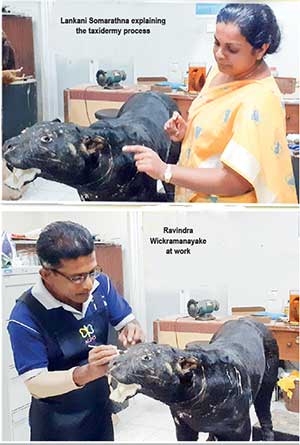

ture research on this rare giant cat, the Department of National Museums is in the process of preserving both its skin and the skeleton. This taxidermy process (preserving of an animal’s body for display purposes) which is now nearing completion is one of the most challenging exercises the Zoology Division of the Department of the National Museum has embarked recently, Assistant Director (Zoology), Department of National Museums, Lankani Somarathna told the Sunday Island.
“Since the animal had suffered severe neck injuries and had gone through a post-mortem process as well, preserving its skin required a lot of effort. Moreover unlike in the case of an elephant or any other commonly sighted animal, understanding its habitat, positioning requires extra effort,” says Somarathna who was responsible for the supervision of the project.
On a request made by the Department of National Museums, the body of the black leopard was handed over to it by the Department of Wildlife Conservation last month. “After the postmortem on the animal was performed by the Peradeniya Veterinary Faculty and following the proper legal process, we were handed the body on July 13 and since then the taxidermy process has been in place,” says Somarathna.
A well-built young male about eight ft in length and four ft tall, was killed by human cruelty robbing the majestic creature of many more years in the highlands and the country of the very few known black leopards.
“Since the death of the last Sri Lankan black leopard eight years ago whose body is preserved at the Wildlife Museum in Giritale, (managed by the Department of Wildlife Conservation), the animal was believed to be extinct in the country and no trace of it could be found until this recent tragedy in Nallathanniya,” says the Zoologist who notes that sightings of the animal have been very rare for several reasons. Its low population, its habitat in the dark

er regions enabling camouflage and its solitary nature are cited by her as reasons for rare sightings.
In the study of mammals, their skeleton and skull features are fundamental, notes t
he Zoologist, expl
aining the rationale behind the preservation of the leopard’s skin and the mounting of its skeleton. Both these will soon be displayed at the Osteology Gallery of the Natural History Museum which exhibits the skeleton of the iconic blue whale, Heiyanthuduwe Raja, Lechchami the female tusker and many more four legged creatures and reptiles.
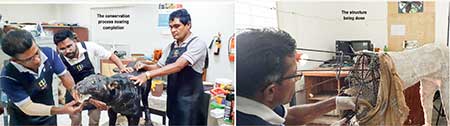
The taxidermy project was carried out by a team from the Department of National Museums comprising the Taxidermist Chamalka Kotelawala and conservationists Ravindra Wickramanayake, P. Gunasiri, Susantha Balasooriya and Ashan Sandaruwan. Counting 30 years of experience, Ravindra Wickramanayake who had played a significant role in ‘resurrecting’ many a wild creature says that the chief challenge in the latest exercise was cleaning of the leopard’s skin for conservation.


A base made out of wire mesh on which plaster and gunny material are placed holds the preserved skin of the black leopard- the biggest of the cats he had helped conserve so far he says. “Unlike in the past, now the use of plaster of Paris is minimal to avoid the hassle in moving the exhibits due to its weight and also possible damage,” says Wickramanayake. An assortment of chemicals is used to conserve animal carcasses he says. These chemicals differ from animal to animal.
Thanking the Department of Wildlife and all other relevant authorities who facilitated the move of the black leopard to the Department of National Museums and applauding its skilled team of conservationists for a job well done, the Director General of Department of National Museums, Sanuja Kasthuriarachchi says, “sadly this Sri Lankan black leopard which ideally should have been part of our ‘live heritage’ is no more. By conserving it and displaying it at our Museum of Natural History, what we envisage is to enable research on this stately creature as means of contributing towards its future conservation in its natural habitat.”