Features
10 EUROPEAN CITIES IN 10 DAYS – Part 48

CONFESSIONS OF A GLOBAL GYPSY
By Dr. Chandana (Chandi) Jayawardena DPhil
President – Chandi J. Associates Inc. Consulting, Canada
Founder & Administrator – Global Hospitality Forum – chandij@sympatico.ca
The Travel Bug
ILO headquarters in Geneva was much larger than what we expected. Around mid-February, 1982, our group of ILO Fellows were taken to Switzerland. Our coach travelled about four hours from Turin to Geneva. After sightseeing and lunch by the Lake Geneva, we proceeded for our training at the ILO headquarters. As Fellows of ILO we were well treated by the ILO staff who did our orientation. Over the next few days, we attended classes learning Modules of Employable Skills (MES). Our learning elements focused primarily on vocational training programs.
After our one-week study program at ILO headquarters, we travelled to ten different European cities over the next ten days. These included Geneva, Bern, Basel, Chamonix-Mont-Blanc, Turin, Lyon, Paris, Rouen, Amiens and Calais. The words my father jokingly said before my third overseas trip came true. Now I was certainly bitten by the travel bug.
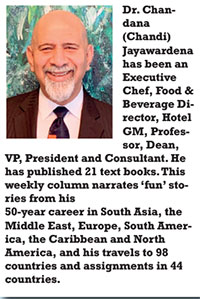

Exploring Switzerland
Geneva is an extremely beautiful water front city. I was most impressed by the cleanliness of the city and air in spite of being the second most populous city in Switzerland. Geneva is a global city, a financial centre and a worldwide centre for diplomacy. This was due to the presence of numerous international organizations, including the headquarters of many agencies of the United Nations and the Red Cross. Our Swiss guide took great pride in announcing that Geneva was the city that hosts the highest number of international organizations in the world.
Bern, as the capital city of the federal city of Switzerland, appeared to be small. The city is beautifully surrounded by a tributary of the High Rhine, the longest river that both rises and ends entirely within Switzerland. I thought that the historical section of the city, which traced its origins back to the 12th century, with well-preserved medieval architecture, was more beautiful and interesting. During a walk on the Kramgasse (Grocers Alley) we reached the 800-year-old Zytglogge Clock tower, which is one of Bern’s most recognisable symbols and the oldest monument of the city.
Switzerland’s political structure is fairly unique in the world. In total, there are 26 cantons (states of the Swiss Confederation), all of which manage their own education, healthcare, law enforcement, taxes, as well as social welfare. The average population of a Swiss canton in 1982 was only around 240,000. The primary language in 19 cantons is German, six cantons are French and one canton is Italian.
Basel is a city on the Rhine River in north-west Switzerland, close to the country’s borders with France and Germany. Its medieval, old town centres were quaint. Among other attractions, Basel is famous for its many museums, including the Kunstmuseum, the largest museum of art in Switzerland. It is also one of the largest cultural centres in relation to its size and population in Europe. We stopped at the University of Basel, founded in 1460 and Switzerland’s oldest university. We ended our day in Basel by walking across the famous Middle Bridge. One of my batch mates from Ceylon Hotel School, Anton and his Swiss wife, Claudia who lived in Basel, met us on the bridge for a brief meeting and to give us some Swiss souvenirs.
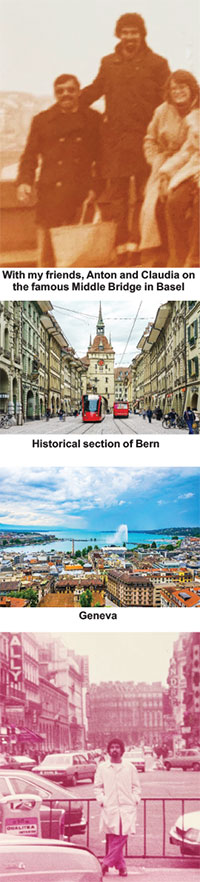

Chamonix-Mont-Blanc was our next stop where we had lunch and a tour ending our trip to Switzerland. This was one of the most beautiful places I have ever visited. This ski resort area is near the junction of France, Switzerland and Italy. Mont Blanc or Monte Bianco (White Mountain), is the highest summit in the Alps nearly 16,000 feet above sea level. It’s renowned for its skiing. Year-round, cable cars take visitors up to several nearby peaks with panoramic views.
My first trip to Switzerland created a fascination about this land-locked small country. Its mountains, lakes, natural beauty, neutrality, banks, watches, hospitality service standards, cheeses and chocolates all enhanced my interest of Switzerland. My introduction to this country in 1982 was very useful when I returned to work briefly in Switzerland as a recruiter of international students for Hotel Consult Institut Hôtelier César Ritz in Brig, a few years later. That connection led me to do two, short contracts in early 1990s, as a Visiting Professor of Hospitality Management at IMI International Management Institute in Weggis.
Exploring France
After our memorable visit to Switzerland, we returned to Turin for a few days. We enjoyed a large farewell party there before each ILO Fellow proceeded to another country to continue their learning, individually. England and Scotland were my next stops to practice or enhance what I learnt at the Turin Centre and ILO headquarters. Although the organization funding my three-month fellowship in Europe – United Nations, kindly offered me free air tickets to travel from Turin to London, I preferred to travel mainly by coach, train and ferry. This way, my wife and I were able to get a much better sense of a few cities in between Turin and London. As I had a few free days before my individual program commenced, I decided to spend a few days of leisure in France with my wife. We travelled to five French cities.
Lyon stands on the site of the ancient Roman city called Lugdunum, founded in 43 BC, which was the capital of Gaul (encompassing many large areas of Europe). We visited three main attractions in Lyon. The Museum of Archaeology displaying Gallo-Roman-era objects was very interesting. During the Renaissance, Lyon had been a major economic hub. The impressive cultural heritage of Lyon is evidenced in Musée des Beaux-Arts, widely considered the next best fine arts museum in France after the Louvre in Paris. We then walked around Quartier Saint-Jean and Quartier Saint-Georges (Old Town) and had a typical Lyonnaise meal.
Paris was our most anticipated city. When we arrived in France on our way to Italy, our visits were limited to the airports in Paris and Lyon. Therefore, travelling between these two major French cities by train was a new experience for us. In most of the cities we visited, we first did a three-hour city tour to get an orientation of the city. Then we visited three key attractions and enjoyed a typical local meal or two. In Paris, passing through Avenue des Champs-Élysées and Arc de Triomphe were memorable.
As a child, listening to my father’s stories and the memories of his frequent official visits to UNESCO head office in Paris, motivated me to follow his favourite route. We went up the Eiffel Tower and then visited Cathédrale Notre-Dame de Paris. Six years after my first visit to Paris, I returned to Paris in 1988 to be trained as an international hotelier at the prestigious management training institute (located in Paris and Tour) of the upscale Le Meridien Hotel company which was owned by Air France. During that visit, I also spent a short management observer period at their 1,000-room hotel in the heart of Paris, Le Méridien Montparnasse.
Louvre Museum experience for the first time was like a visiting a separate, great city. It was like taking a walk through the history of art. It is widely accepted as the world’s greatest art museum in comparison to other great contenders to that title from New York, London, St. Petersburg and Madrid, which I visited in years to follow. From the time it was open to the public in the year 1793, the Louvre Museum had expanded its collection and number of visitors almost every decade.
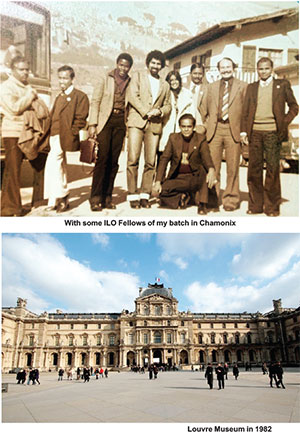

In 1982, the Louvre Museum had over 32,000 works of art and attracted over six million visitors a year (increased to over 10 million in the year 2018). We simply could not do any justice to this museum in one day. I noted that if someone wanted to see everything in one visit and spent half a minute on each, it would take more than 11 days! As an artist, the biggest highlight for me was that the Louvre had six of the 24 known free-standing works of art done by Leonardo da Vinci, including the most famous painting, Mona Lisa.
During this trip, we were fortunate to get the opportunity to visit four out of the five most visited tourist attractions in the world – the Colosseum in Rome, Vatican Museums in Vatican City, Louvre in Paris, and the Eiffel Tower in Paris (we had to wait for another 11 years to visit the fifth – the Statue of Liberty in New York). We felt ready to explore a few smaller cities of France and experience day to day French life style.
Rouen was our next stop. It is a small port city on the river Seine, with a population of just over 100,000. The reason for our stop here was to visit one of my uncles, Tilak Gunasekara and his French family. Although he was a cousin of my mother, Tilak was my age and in childhood, we grew up as friends and school mates. Tilak was always an adventurer and wanted to travel the world as a sailor which he did from his late teens. A few years earlier when his ship arrived in France, while touring in Rouen he met a teenage French girl. It was love at first sight and he never left Rouen. In 1982, Tilak was working in Rouen as an underwater welder.
Tilak came to the Rouen railway station to pick us up. He was accompanied by his young French wife and infant son. While driving us through the city, they showed us impressive Gothic churches, medieval half-timbered houses and a skyline dominated by the spires of Rouen Cathédrale Notre-Dame. I understood the reasons for the great impressionist Claude Monet to have chosen Rouen for a series of over 30 paintings. We stayed with Tilak and family for two nights.
Amiens is another historic city Tilak took us to briefly on our way to Calais. It was slightly bigger than Rouen. A central landmark of the city is Amiens Cathedral, the largest gothic cathedral in France. Famous author Jules Verne’s house and local food markets were popular tourist attractions. We had a memorable lunch in a small café in the city centre. In France, most restaurants and cafés in any city, town or village were blessed with unique characteristics and great food.

Calais, which was our port to catch a ferry to England, had a very small population of around 60,000. Calais overlooks the Strait of Dover, the narrowest point in the English Channel, which is only 21 miles wide, and is the closest French town to England. The White Cliffs of Dover can easily be seen on a clear day from Calais. Due to its position, Calais, since the Middle Ages, has been a major port and a very important centre for transport and trade with England.
The importance of Calais was much greater in the pre-channel tunnel era. We drove past the old part of the town, Calais proper (known as Calais-Nord), which was situated on an artificial island surrounded by canals and harbours. Aside from being a key transport hub, Calais was also a notable fishing port and a central fish market. After goodbyes, we boarded a small ferry for our 90-minute trip to the Port of Dover in England for the next leg of our European adventure.