Opinion
Nihal Seneviratne’s memories of 33 years in Parliament

by Prasanna Cooray
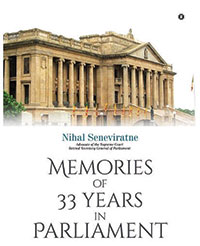

The book is a fascinating and informative read, reminiscing of the major events that unfolded during Seneviratne’s one and only vocation, as a parliamentary administrator for over 33 long years.
Seneviratne’s illustrious career began in 1961 as a second clerk assistant in the Parliament (then housed at the present day Presidential Secretariat at the Galle Face). Then as a youth of 27 years of age, soon out of the university, he was groomed by the likes of L.P. Deraniyagala, Sam Wijesinhe (both his predecessors in the highest position) and Bertie Coswatte, till he assumed office as Secretary General in 1981, the post he held till May 1994.
The role played by the parliamentary staff, risking their life and limb to safeguard democracy in the country at times, could be selfless. This is exactly what the Parliament experienced when a JVP activist hurled a hand grenade during a Parliament group meeting; an MP and a staff member died while scores of others sustained injuries in August 1987. The incident is described lucidly by the author in one of the early chapters, under the title “Hand Grenade Attack in Parliament”. That goes down the history as the most ghastly act ever experienced by the Sri Lankan Parliament.
“Learning Parliamentary Practice & Procedure”
speaks about the nitty-gritty in the making of a steadfast parliamentary administrator. It is also interesting to note that the very first task assigned to young Seneviratne, on assuming duties was to take an MP into custody. This was in relation to the parliamentarian KMP Rajarathne fasting in the Parliament. Seneviratne promptly attended to his task by studying the practice related to ‘imprisoning’ an MP, as stipulated in the British law, and came out with the plan the same day. I wonder whether the present day administrators would ever dare take such a bold step even when the floor of the Parliament is in absolute mayhem, with the throwing of chairs and chilli powder.
About the impeachment motion against President R. Premadasa (in August 1991), Seneviratne says that was the most secretive activity that ever took place in the parliament. He had not been aware of it till very late; he also could not lay his hands on a copy of the impeachment document. Interestingly, even the Parliament does not possess a copy of that document.
The book also gives an account of a similar incident when Sirimavo Bandaranaike government was toppled by just one vote following the crossover of 17 MPs from the government side to the opposition in July 1960. Then Leader of Opposition JR Jayewardene was the mastermind of this move.
Seneviratne was also the officer to oversee the relocation of the Parliament from the Galle Face to Sri Jayawardenapura Kotte, a fact that he reminisces with great pride. He recaps the memories of this transfer and the prowesses of the renowned architect Geoffrey Bawa who designed the building complex.
Among the other important events of yesteryear, involving the Parliament recalled by Seneviratne, include abolishing of civic rights of Mrs. Bandaranaike (in October 1980), takeover of the Lake House Group of Newspapers following the publicity it gave to the funeral of the late Prime Minister Dudley Senanayake (in April 1973) and the trial of two journalists (namely, Harold Peiris and Philip Cooray) for publishing a wrong picture and a caption for a news item involving then Foreign Minister ACS Hameed (in 1978). All these incidents, products of abuse of majority power have been against the true spirit of democracy the Parliament ought to protect.
Seneviratne also recollects a most unusual event ever to have happened in the chamber. A stranger, clad in spotless national dress, almost sworn in as a Member of Parliament, at an opening session of a new Parliament after a general election in the sixties. Seneviratne, diligently had observed an unfamiliar new face among the many new faces, approached him and asked which constituency he represents. He had answered “Mulkirigala”, of which George Rajapaksa was the representative whom Seneviratne knew well. That cleared his doubt and led to the arrest of the intruder. Later, it was revealed that he was an escapee from the mental hospital Angoda.
Seneviratne has not even spared some of the witty verbal jabs that were shared by the parliamentarians of his time. Dudley Senanayake, making mockery of his Opposition counterpart Maithripala Senanayake’s nationalistic sentiments while being a husband to a Tamil wife quipped “He believes Sinhala only by day and the reasonable use of Tamil at night”, recollects Seneviratne. He recapitulates few more such witty comments in the chapter “Some witty sayings of Parliamentarians”, to the much amusement of the reader.
The parliamentarians of yesteryear Seneviratne handpicked for special mention in his book include Dr. NM Perera, Dr. Colvin R. de Silva, Dr. SA Wickremasinghe, Sarath Muttetuwegama, Lalith Athulathmudali, Gamini Dissanayake and Anura Bandaranaike.
Seneviratne’s wonderful book is a must read for the readers interested in political history of this country. Had the events been ordered chronologically that would have helped the reader to traverse the past with less effort I thought while reading.
“Memories of 33 years in Parliament” is a Sarasavi publication.