Features
Mira Nair’s film of Vikram Seth’s ‘A Suitable Boy’

I wish all my readers a happy Christmas season as far as Covid 19 restrictions allow.
In the midst of so much controversy, fear and menace of the pandemic, I thought it best to divert readers’ attention with a huge success story of an excellent film produced from a superb book – Vikram Seth’s 1993, 1,349 paged ‘A Suitable Boy’ about post-Independence India in the 1950s, set in Calcutta and Lucknow, dealing with inter-religious issues and love between Muslims and Hindus. It is one of the longest English-language novels in print and worldwide reviews placed it as one of the best modern literary classics. The title is because the mother of the chief female protagonist is adamantly and determinedly in search of a suitable boy as husband for her university graduated daughter. I admit I am still to read it, but I so enjoyed Seth’s 1999 ‘An Equal Music’ which he autographed for me at a Galle Lit Festival. It was absorbingly interesting though much about western classical music and I know not a note of music!

Given the film’s epic story and production, Nair, who grew up in India, jokingly described it as “’The Crown’ in Brown.” But beyond its scale and prestige, the project clearly carries deep personal and political meaning for her. She said “The ’50s has always been a real pull for me — 1951 was the year my parents married. It was a secular time and a time of real idealism, taking from the English what we had known, but making it our own.” Though she compared ‘A Suitable Boy’ to ‘The Crown,’ both sweeping the popular stakes and aired on Netfliz, the film on the House of Windsor cost much more, being one of the most expensive shows on TV. To be within the BBC budget, ‘Suitable…’ was filmed on location in India and the production trimmed from eight episodes to six, thus somewhat curtailing the long drawn narrative of the novel.
The film
I saw three episodes of ‘A Suitable Boy’ a couple of days ago; Netflix releasing an episode every Monday. The episodes I saw were rapturously captivating. If I go to describe what I saw I will use all superlative epithets of praise. I love anything Indian and “Suitable’ is completely Indian. While the married daughter’s sister falls in love with a Muslim university student, her father-in-law, a liberal Hindu member of the governing council argues and wins a case to distribute land to the landless and is against a kovil being built by the Rajah right next to a mosque, igniting rioting. The novel “A Suitable Boy” emerged as Hindu nationalist politics began to take center stage in India.
(NOTE
: For the rest of this article I will quote or extract information from the New York Times article of Dec 7 by Bilal Qureshi: ‘A Suitable Boy’ Finally Finds Its Perfect Match: Mira Nair)
When the film debuted on BBC One in July this year it was lauded in Britain as the network’s first prime-time drama filmed on location in India with an almost entirely Indian cast. In India, the reaction was more complicated: members of the ruling Hindu nationalist party over its depictions of interfaith romance, and the police opened an investigation into Netflix, which distributes the show. (How narrow minded and illiberal can politicians become?)
“After several failed attempts to have the book adapted, Seth personally chose the Welsh screenwriter Andrew Davies for the job, fresh off a successful 2016 BBC adaptation of another historical epic, Tolstoy’s ‘War and Peace.’ As Seth continued to work on his long-gestating sequel to the novel, he entrusted his sister, Aradhana Seth, to ensure the integrity of the adaptation. (She is credited as both a producer and an executive producer). The BBC commissioned the series in 2017; Nair, who had expressed interest from the beginning, was brought on the next year.”
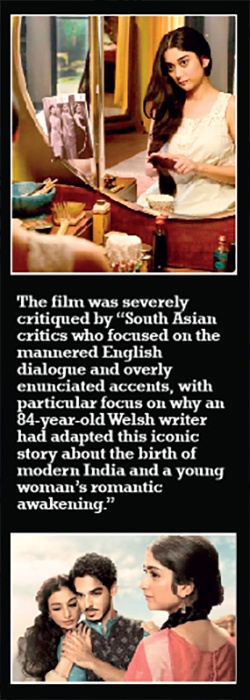
The film was severely critiqued by “South Asian critics who focused on the mannered English dialogue and overly enunciated accents, with particular focus on why an 84-year-old Welsh writer had adapted this iconic story about the birth of modern India and a young woman’s romantic awakening.” Vikram Seth broke his public silence to defend his choice of Davies in The Telegraph, saying “Race should have nothing to do with it. It’s a balance between getting someone very, very Indian to write it or someone very, very experienced at adapting long books.” Davies, who scripted the film adaptations of ‘Bleak House’ and
‘Pride and Prejudice’ explained from his home in the British Midlands: “I feel a little prickly and needing to defend my territory and not have it taken away from me as a writer. I would claim the right to put myself in the mind of people who are different from me.”
Filming was completed in India in 2019 and Nair took a break in March from editing the show in London with a visit to New York. Then international borders closed because of the corona virus. Editing and other finishing touches to the film had all to be done on line. Even the music was scored remotely, with a full orchestra in Budapest and composers, Alex Heffes and the sitarist Anoushka Shankar, in Los Angeles and London.


“The series was filmed on location amid the grandeur and the decay of real cities,” as Nair described it, “where production designers labored to hide the electrified chaos of modern life to achieve the show’s layered, mid-century Indian minimalism. An appropriated mansion in Lucknow was refashioned into the salon of the Muslim singer and courtesan – Saeeda Bai. Her home is the luminescent force at the center of the adaptation, the embodiment of an aristocratic Islamic court culture and literary sensuality that was in decline by the time the story begins.”
Snippets about the Stars
Saeeda is played by one of India’s most acclaimed actors, Tabu, who made her international debut in Nair’s 2007 adaptation of the Jhumpa Lahiri novel ‘The Namesake.’ Her character’s poetry, singing and beauty seduces the younger Maan, the dashing son of the influential Hindu politician.
Maniktala, luminous in her fresh beauty plays Lata, the female protagonist for whom a suitable boy in marriage is being sought. Her grandfather was traumatized as a Hindu refugee forced by the 1947 partition to flee to India from Pakistan. “I realize how important pain is, and the lessons to be found in that”, she noted.
Khatter, who plays Maan, the politician’s son, besotted by Saeeda, noted that in a country as diverse and sometimes divided as India, stories of interfaith love remain a powerful theme “I myself am the son of an interreligious marriage, and it’s very much who we are.”
Sadaf Jafar, who plays Saeeda’s servant, Bibbo, protested in the riots that erupted after Hindu nationalist government’s that explicitly from Indian citizenship – 2020. She was jailed and beaten. Against the advice of friends, Nair started a public campaign on Jafar’s behalf until the actor was released three weeks later.
“The optimistic multiculturalism reflected in ‘A Suitable Boy’ may seem in many ways like a fading relic of both literary and political history.” To me the very Indian film showed how different things were in India from the secular times written about to now when there is so much inter-religious conflict and the Hindu majority trampling the Muslims. Are we in Sri Lanka much different with our burgeoning Buddhist supremacy? How different from the balmy days of immediate post colonialism that we grew up in.